
In This Article
It’s January. You’ve got a plasterer arriving Monday, screed on the ground floor that needs a fortnight to cure, and a house with no central heating, no insulation in half the walls, and a kitchen that’s currently a pile of timber and hope. Sound familiar? Finding the right space heater for an unfinished house is one of those problems that doesn’t get talked about nearly enough — yet it can genuinely make or break a build schedule.
This isn’t a situation where you fire up a little plug-in fan heater from Argos and call it a job done. Unfinished spaces are an entirely different beast: no insulation, gaps everywhere, exposed masonry that drinks in the cold, and materials — plaster, screed, adhesive, paint — that simply will not behave below a certain temperature. In the UK, where winter builds are the norm rather than the exception and a “mild” February can still feel utterly miserable, getting your temporary heating right is as important as getting your trades in on time.
A space heater for an unfinished house needs raw output, portability, and the ability to shift serious volumes of warm air around draughty, uninsulated spaces. Electric models work beautifully for small rooms and plaster drying; propane and diesel units come into their own the moment you’re tackling anything larger than a generous bedroom. Understanding which tool fits which job is what this guide is for. We’ve researched the Amazon.co.uk bestseller list, consulted real builder feedback, and pulled together seven heaters that genuinely earn their place on a UK build site in 2026.
Quick Comparison: Top 7 Space Heaters for Unfinished Houses at a Glance
| Product | Type | Output | Best For | Price Range |
|---|---|---|---|---|
| Sealey LP69C | Propane (cordless option) | 9–20kW | All-round site flexibility | £££ (mid-high) |
| SIP FIREBALL 512 | Propane (230V) | 15kW | Medium rooms, consistent heat | ££ (mid) |
| Draper Jet Force 47100 | Propane (230V) | 15kW | Tradespeople who trust Draper | ££ (mid) |
| RocwooD RWGHT2 30KW | Propane (230V) | 30kW | Large open floor plans | ££ (mid-high) |
| DAHTEC 30KW Diesel | Diesel/230V | 30kW | Long site days, no gas bottle hassle | £££ (premium) |
| Garden Mile 15kW LPG | Propane (240V BS plug) | 15kW | Budget-conscious self-builders | £ (budget) |
| TOUGH MASTER 4.5kW | LPG/Calor Gas | 4.5kW | Small rooms, plaster drying | £ (budget) |
The table above tells you roughly where each heater sits, but it glosses over the most important nuance: output rating alone is nearly meaningless in an unfinished building. A 15kW heater in a room with no insulation and a missing external door will struggle to keep pace with one that’s half its size but has the windows boarded up. Always think in terms of your actual situation — not the box’s “heats up to X m²” claim, which assumes a sealed, insulated space. More on this in the buying guide below.
💬 Just one click — help others make better buying decisions too! 😊
✨ Don’t Miss These Exclusive Deals!
🔍 Take your build site comfort to the next level with these carefully selected heaters. Click on any highlighted product name to check current pricing and availability on Amazon.co.uk.
Top 7 Space Heaters for Unfinished Houses: Expert Analysis
1. Sealey LP69C Space Warmer® Propane Heater (9–20kW, Cordless Option)
If you could only have one heater across an entire build programme, the Sealey LP69C would be the most sensible argument you’d make. The cordless/corded dual option is the headline feature: run it off the mains when you’ve got site power, switch to a compatible 20V SV20 battery when you’re working in a section of the house that hasn’t been wired yet. That level of flexibility is genuinely rare in this category.
Output ranges from 9–20kW and covers up to 350m³ — enough to warm a substantial open-plan ground floor or an entire mid-terraced house’s first floor in one hit. The piezoelectric ignition fires first time in cold conditions (vital when it’s -3°C and you’re fumbling with gloves on), and the unit runs remarkably quietly for its class. UK reviews consistently praise the build quality; Sealey has been manufacturing in Britain since 1978, and that heritage shows in the finish.
What most buyers overlook is the BS EN 1596 certification and the safety solenoid that prevents gas leakage without electrical activation. On a site with multiple trades, that’s not a small thing.
✅ Cordless or corded flexibility is genuinely unique in this market
✅ Quiet running — no compressor rattling your fillings loose
✅ Backed by a reputable UK company with strong aftersales support
❌ Battery sold separately in base model — budget for this upfront
❌ Higher price point than comparable fixed-mains models
Price range: In the mid-to-upper range for 15–20kW propane heaters on Amazon.co.uk. Check current price; Prime delivery available.
2. SIP FIREBALL 512 Propane Gas Space Heater (15kW / 51,182 BTU/hr)
The SIP FIREBALL 512 is the dependable workhorse of the construction heating world — the sort of unit you’ll find in the back of a builder’s van from Carlisle to Cornwall. SIP is a well-regarded British tools and equipment brand, and the FIREBALL range has earned a solid reputation for reliability over years of site use.
At 15kW and 51,182 BTU/hr, this heater can tackle up to approximately 12,180 ft³ (344m³) — think a generous open-plan kitchen-diner in a new build, or a large bedroom floor. The 230V fan-assisted design means it pushes heat efficiently around the space rather than just warming a small bubble in front of the unit. That matters enormously in an unfinished house where heat naturally wants to escape through every gap it can find.
The FIREBALL 512 is particularly suited to the mid-build phase: when plastering is complete, screeding is done, and you simply need to hold a temperature above 5–10°C to prevent adhesives, paints, and sealants from failing. Site managers and self-builders alike report it delivers consistent output without fuss.
✅ Trusted UK brand with proven site track record
✅ Efficient fan-assisted heat distribution
✅ Available Prime-eligible on Amazon.co.uk — handy when you need it by tomorrow
❌ No cordless option; needs a socket or site generator
❌ Fuel consumption at full output can be surprisingly brisk
Price range: Solidly mid-range. Excellent value-per-kilowatt compared to similar output models.
3. Draper Jet Force Propane Space Heater (15kW, Model 47100)
Draper Tools has been a fixture of the British trade market for decades. Electricians, plumbers, and joiners know the brand; they trust it. The Draper Jet Force 47100 brings that same reliability ethos to site heating: 15kW output, 230V operation, and a no-nonsense design that suggests it was built by people who’ve actually stood in a cold building wondering why their adhesive won’t set.
What sets the Draper apart from cheaper 15kW competitors is the build quality of the housing and the quality control on gas fittings — the regulators don’t weep gas and the connections seat properly. On a construction site where multiple people are using a heater without reading the instructions (be honest), robust fittings matter. The Draper also tends to have consistently good availability on Amazon.co.uk with Prime delivery, which is a practical consideration mid-build when you’ve just discovered the temperature has dropped to 2°C overnight and your wet render has suffered for it.
UK trade buyers frequently comment that the Draper holds its heat output more consistently over a long day than some budget alternatives that gradually throttle back.
✅ Draper’s long-standing UK trade reputation for quality control
✅ Reliable gas fittings — a safety consideration, not just a convenience
✅ Strong Prime availability for next-day site delivery
❌ Slightly heavier than some rival 15kW models
❌ No thermostat on base model — requires manual management
Price range: Mid-range, in line with SIP FIREBALL 512. Worth checking current pricing for occasional deals.
4. RocwooD RWGHT2 Propane Gas Space Heater 30KW (102,360 BTU)
Here’s where things get serious. The RocwooD RWGHT2 is what you reach for when you’re heating an open-plan extension with no roof insulation, a shell of a ground floor in a new build, or a property that’s been sitting empty since October. Thirty kilowatts of propane-powered output — 102,360 BTU/hr — can theoretically cover up to 300m², and in the real world, it will warm an uninsulated large room in minutes rather than an hour.
At just 6.8kg, the RWGHT2 is impressively portable for its output class. The included gas hose and regulator mean you’re genuinely plug-and-play (or gas-and-play, rather): connect a propane bottle, fire the piezo ignition, and you’re away. The built-in overheat protection is a meaningful safety feature in a busy site environment, and the 220–240V 50Hz rating confirms full UK compatibility.
The honest caveat: fuel consumption at full chat is 2.18kg/hr. On a long winter site day, you’ll burn through a 47kg propane bottle faster than you might expect. Budget for the gas, not just the hardware. For the price bracket it sits in, the RocwooD punches well above its weight.
✅ Exceptional heat-to-price ratio for large unfinished spaces
✅ Truly portable at 6.8kg despite 30kW output
✅ Overheat protection included as standard
❌ Fuel costs at maximum output add up quickly
❌ 12-month warranty invalidated for continuous business use — worth noting for professional builders
Price range: Mid to mid-high. Significantly better value per kilowatt than premium brands at this output level.
5. DAHTEC 30KW Diesel Space Heater (Model BGO1601-30PLUS)
Sometimes you don’t want the faff of a propane bottle. Diesel is easier to source from any petrol station forecourt, stores safely in a standard jerry can, and the DAHTEC BGO1601-30PLUS leverages it brilliantly. This 30kW diesel heater covers 320–420m² and runs for approximately 14 hours on a full 38-litre tank — meaning you can heat a large unfinished building through an entire working day, refuel at the end, and repeat.
The digital temperature display and adjustable thermostat (5–55°C) give you a level of control that many gas-cannon-style heaters simply don’t offer. For new build environments where you’re trying to hold a consistent 18°C for plastering or screeding, being able to set and forget is genuinely useful. The cold-start capability down to -20°C is overkill for a British winter, but it does tell you something about how robust the engineering is.
The DAHTEC is primarily suited to larger or more commercial build sites. If you’re heating a single bedroom for a plaster skim, it’s far more heater than you need. But for shell-stage heating of an entire house or a substantial extension? This is a serious tool.
✅ Long run time — 14 hours on a full tank
✅ Digital thermostat for controlled, consistent temperature management
✅ Diesel is more accessible than propane in many rural UK areas
❌ Higher initial outlay than propane equivalents
❌ Diesel smell and exhaust require serious ventilation consideration
Price range: Premium tier. The run-cost economics make more sense on larger, longer projects.
6. Garden Mile 15kW LPG Industrial Gas Space Heater (240V/50Hz BS Plug)
For the self-builder watching the budget closely — and on a UK build, who isn’t — the Garden Mile 15kW LPG Heater is the one to know. It comes with a proper 240V/50Hz British Standard plug already fitted (a detail that cheaper imported models sometimes get wrong), and delivers a genuine 15kW / 51,000 BTU/hr output suitable for medium-sized unfinished rooms.
The Garden Mile sits at a price point that means if it gets damaged on site — dropped off a scaffold, covered in wet concrete, knocked over by an enthusiastic Labrador on inspection day — it’s not a financial catastrophe. That pragmatic resilience has real value on a working building site. UK buyers consistently report it heats up quickly, the piezo ignition works reliably, and the unit runs without complaint on standard Calor propane.
It won’t win any awards for ergonomics or refinement. But as a workhorse heater for someone self-managing a renovation on a tight budget, it does exactly what it says without drama.
✅ Proper UK BS plug fitted as standard — no adaptor drama
✅ Excellent value for the output level
✅ Good availability on Amazon.co.uk
❌ No thermostat — you’re on or off
❌ Build quality more “functional” than refined
Price range: Budget to low-mid. One of the best value options on Amazon.co.uk for the output class.
7. TOUGH MASTER 4.5kW Portable Gas Heater (LPG/Calor Gas)
Not every unfinished space is a cavernous open shell. Sometimes you’re just trying to keep a single bedroom warm enough for a plasterer to work comfortably, or to hold a stairwell above 5°C while a coat of primer dries. For these smaller, targeted applications, the TOUGH MASTER 4.5kW Portable Gas Heater is the right-sized tool.
The 4.5kW output heats 20–60m² effectively — a standard UK double bedroom or a bathroom and landing combined. It runs off standard Calor propane bottles, comes with a 150cm hose and 37mbar pressure regulator, and is genuinely compact enough to carry with one hand. The free-standing design means it stays stable on an uneven floor (a near-universal condition in a renovation site).
Where the TOUGH MASTER particularly earns its keep is in the plaster-drying phase. As construction heating specialists Rapid Energy note, a 3–9kW heater is often ideal for drying smaller rooms — powerful enough to drive evaporation without blasting the surface and risking cracks. The TOUGH MASTER slots into this sweet spot perfectly.
✅ Right-sized for small rooms and targeted heating
✅ Calor gas compatibility — widely available across the UK
✅ Very portable and easy to reposition between rooms
❌ Insufficient for large open areas — don’t expect miracles in a shell
❌ Manual operation only — no thermostat
Price range: Budget. Excellent entry-level choice for small renovation spaces.
How to Use a Space Heater for an Unfinished House Safely
Raw heat output gets all the attention. Ventilation gets almost none. That imbalance can cause real problems.
Propane and diesel heaters produce combustion gases — including carbon monoxide. In a finished, sealed room this is obviously dangerous. In an unfinished house with gaps, missing windows, and open stud walls, ventilation is usually less of a worry — but the moment you start sheeting up spaces with polythene to retain heat (a common and sensible tactic), you need to be deliberate about it. The Health and Safety Executive’s guidance on construction site heating is clear: adequate ventilation is mandatory when using combustion heaters on site, regardless of how unfinished the building is.
Practical rules for safe, effective use:
- Never run a combustion heater in a fully sealed space without a fresh air source. Leave a gap at door or window level.
- Position heaters centrally or near the floor — warm air rises naturally and will distribute more evenly.
- For plaster drying specifically, warm the room rather than blasting the wall directly. High, direct heat causes surface cracks. Aim for a steady 15–21°C room temperature with a slight window gap for moisture to escape.
- On longer site days, check gas connections and hoses at the start of each shift. A weeping regulator is both a waste and a hazard.
- If using a diesel heater indoors, seriously consider pairing it with a carbon monoxide detector — a £20 investment that costs nothing compared to the alternative.
- Electric options (such as dedicated fan heaters) are inherently safer for closed spaces and are particularly well-suited to the final drying phase, where you need clean heat with no combustion risk.
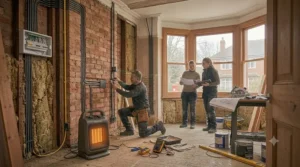
Real-World Scenarios: Matching the Heater to the Build
Scenario 1: The Self-Builder Heating a New Shell (Large, Open, January) Dave is building a four-bedroom house in Lincolnshire. The shell is watertight, the first fix is in, but there’s no insulation and glazing won’t be fitted for another three weeks. He needs to hold the building above 5°C for screeding and to protect pipework from freezing. In this case: the RocwooD RWGHT2 30KW or DAHTEC diesel 30KW are the right tools. The output matches the challenge, and the DAHTEC’s 14-hour run time means Dave isn’t refuelling every afternoon.
Scenario 2: The Plasterer Finishing a Two-Bed Terraced House (Mid-Build, February) Aisha is renovating a Victorian terrace in Sheffield. Plastering is underway room by room. She needs to keep individual rooms at around 10–15°C for the plaster to go off correctly between coats, without excessive heat that risks cracking. The TOUGH MASTER 4.5kW is ideal here — moving it room to room as plastering progresses, paired with a slightly open window for moisture release.
Scenario 3: The Experienced Contractor Needing Versatility Across Multiple Sites Tom manages a small construction company doing residential renovation across the East Midlands. He needs a heater flexible enough to work with or without site power, reliable enough to send with different crews, and robust enough to survive the back of a Transit. The Sealey LP69C is the obvious choice — its cordless option alone earns the premium price across a whole season’s use.
How to Choose a Space Heater for an Unfinished House in the UK
Choosing well means asking a few focused questions before you reach for your wallet:
1. What’s the volume of the space, realistically? Ignore the “heats up to X m²” claims in isolation. An unfinished room loses heat dramatically faster than an insulated one. A rule of thumb: assume you need roughly double the heater output you’d use in a finished room of the same size. The Energy Saving Trust’s guidance on heat loss makes clear just how dramatic the difference insulation makes — and an unfinished house is essentially insulation-free.
2. Propane, diesel, or electric? Propane heats fast and is available everywhere, but you’re managing gas bottles. Diesel offers longer run times and easier fuelling. Electric is the cleanest and safest for enclosed or partially finished spaces, but rarely has the raw output to tackle a large, cold shell. Match the fuel type to your practical situation, not the cheapest option per kilowatt.
3. Do you have reliable site power? All the propane and diesel models still need 230V/240V for their fans. If your site power is unreliable or non-existent, either a generator or the Sealey LP69C’s cordless battery option becomes a genuine consideration.
4. What are you trying to achieve? Frost protection (staying above 3–5°C) requires far less output than comfortable working temperature (15–18°C). Plaster and screed drying needs controlled, moderate heat with good airflow — not the maximum the heater can produce.
5. How long will you need it? A weekend’s drying might favour renting over buying. If you’re heating through an entire winter build, ownership makes clear economic sense. Hire costs across eight weeks often exceed the purchase price of a mid-range unit.
Common Mistakes When Buying a Construction Heater
Buying on output alone. A 30kW heater in an uninsulated shell with the door open will lose the battle. Match the heater to the actual thermal conditions, not the m² figure on the box.
Forgetting the running costs. Propane at full chat is an ongoing expense. A 30kW heater burning 2.18kg/hr gets through a lot of gas over a British winter build. Factor this into your project budget.
Ignoring the ventilation requirement. As the HSE’s construction safety guidance makes clear, combustion heaters demand adequate fresh air. Sheeting a space for warmth and running a propane heater without ventilation is a safety risk, full stop.
Using too much heat too soon on plaster. Experts consistently warn against directing high heat at fresh plaster. The result is cracking and hazing — and a plasterer who won’t be pleased to come back. Warm the air, not the surface.
Buying a US-voltage model. It sounds obvious, but it happens. Always confirm 220–240V / 50Hz compatibility and look for a proper UK BS 1363 plug or at minimum a 13-amp adaptor rated for the load. The UK specification models listed here are all confirmed 230–240V/50Hz compatible.
Space Heater vs. Dehumidifier: What Your Unfinished House Actually Needs
Here’s a question the Amazon listing for any heater won’t answer: should you be using a heater, a dehumidifier, or both? The answer matters enormously for a new build or major renovation.
A heater raises air temperature, which increases the air’s capacity to hold moisture — and drives evaporation from wet materials like plaster and screed. A dehumidifier extracts that moisture-laden air and dumps the water in a reservoir. In cold conditions (below about 10°C), a standard refrigerant dehumidifier becomes much less effective. In winter, a small heater paired with a desiccant dehumidifier is often the most efficient combination: the heater keeps conditions warm enough for the dehumidifier to work properly, and the dehumidifier pulls the moisture out rather than just redistributing it. For a more detailed look at the science of moisture in buildings, the NHBC Foundation’s technical guidance is worth a read if you’re managing a new build.
For a self-builder on a budget, getting the heater right first is the priority — the damp will usually take care of itself once the building has warmth and a touch of ventilation. The dehumidifier becomes essential if you’re trying to speed up the programme and the weather is resolutely cold and damp, which in the UK between November and March is more or less guaranteed.
✨ Don’t Miss These Exclusive Deals!
🔍 Compare all seven picks and find your perfect build site heater. Click any highlighted product to check current pricing and availability directly on Amazon.co.uk. Prime members enjoy next-day delivery — very handy when your screed is going in tomorrow morning.
UK Safety Standards & Regulations: What You Need to Know
Construction site heating in the UK sits under a fairly clear regulatory framework, and it’s worth knowing the basics before you fire anything up.
The Health and Safety at Work Act 1974 and the Construction (Design and Management) Regulations 2015 (CDM 2015) both apply to heating on construction sites. In practical terms, this means temporary heating should be part of your site’s health and safety plan — not an afterthought. The HSE provides specific risk assessment guidance for construction activities that includes temporary utilities and heating.
Gas heaters used on UK sites should comply with BS EN 1596 (portable propane heaters for professional use). The products listed in this guide that have been designed for the UK market are built to this standard. Post-Brexit, the UKCA marking has replaced CE on UK market-specific products, though many reputable manufacturers maintain dual UKCA/CE certification.
Carbon monoxide (CO) safety is the non-negotiable. A battery-operated CO alarm costs very little and could prevent a tragedy. Treat it as standard equipment, not an optional extra. For further guidance, GOV.UK’s carbon monoxide safety resources provide clear, authoritative advice.
FAQ: Space Heaters for Unfinished Houses
❓ Can I use a propane heater inside an unfinished house?
❓ What temperature do I need to maintain for plastering in winter in the UK?
❓ How much does it cost to run a 15kW propane heater in the UK?
❓ Do construction heaters on Amazon.co.uk come with UK plugs?
❓ Do I need special insurance to use a gas heater on a self-build site in the UK?
Conclusion: The Right Heat for a British Build
There’s no perfect universal answer to the space heater for unfinished house question — because build sites are endlessly various. What there is, though, is a pretty clear framework. Large open shells in the depths of winter need 30kW and diesel or propane with long run times. Individual rooms in the plastering and drying phase need moderate, controlled heat with good airflow and the patience not to blast fresh render at full power. Versatile tradespeople who move between multiple sites need something flexible, like the Sealey LP69C’s cordless option.
Whatever you choose: prioritise ventilation alongside heat output, keep CO safety in mind, and don’t expect any heater to overcome a completely unprotected shell without some effort to retain warmth. Board up openings, use heavy-duty polythene across gaps, and let the heater do what it does best — which is a great deal, as long as you give it a fighting chance.
✨ Don’t Miss These Exclusive Deals!
🔍 Ready to heat your build site properly? Check current pricing and availability on all seven picks via Amazon.co.uk. Prime members can often get next-day delivery — which, mid-build in February, feels like a minor miracle.
Recommended for You
- Best Space Heater for Construction Site UK 2026: 7 Expert Picks
- Best Industrial Electric Heater 3kW UK 2026: 7 Top Picks Reviewed
- Best Industrial Heater for Construction Site UK 2026: 7 Top Picks
Disclaimer: This article contains affiliate links. As an Amazon Associate, I earn from qualifying purchases. If you purchase products through these links, we may earn a small commission at no additional cost to you.
✨ Found this helpful? Share it with your mates! 💬🤗
