
In This Article
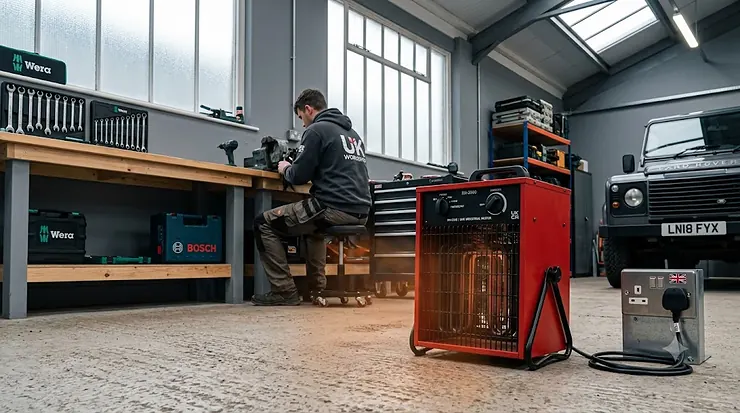
It’s 7am. The site hut is 4°C. Your lads are standing around in hi-vis jackets drinking cold tea and glancing at you expectantly. You need heat, and you need it now — not in forty minutes after a diesel heater decides to cooperate. This is precisely the scenario an industrial electric heater 3kw was born for.
A 3kW electric heater is genuinely the sweet spot for British working environments. It’s powerful enough to warm a site hut, compact workshop, or lock-up garage in under fifteen minutes, runs off a standard 230V supply (no three-phase drama), and produces clean, dry heat with zero fumes — no mean feat when you’re working in an enclosed space with wood dust, paint, or resins floating about. What’s more, as UK electricity is currently priced at around 26p per kWh under Ofgem’s July 2026 price cap, a 3kW unit costs roughly 78p an hour to run at full tilt — cheaper than you might think for the sheer volume of warmth it delivers.
The catch? Not all industrial electric heaters 3kw are created equal. Some are dressed up in yellow plastic and sold as “industrial” when they’d struggle to warm a decent-sized bathroom. Others are genuinely robust, site-hardened machines that’ll survive a builder’s merchant’s worth of abuse. In this guide, we’ve done the groundwork — sifting through Amazon.co.uk listings, checking real UK buyer reviews, and pressure-testing the specs so you don’t waste your money on something that belongs in a conservatory, not a construction site.
Quick Comparison: Best Industrial Electric Heaters 3kW — At a Glance
| Model | Output | Plug Type | IP Rating | Best For | Price Range |
|---|---|---|---|---|---|
| Sealey EH3001 | 3kW / 1.5kW | 16A industrial | — | Workshop pros | £55–£70 |
| Benross 42450 | 3kW / 1.5kW | 13A standard | IPX4 | Site huts, damp areas | £35–£50 |
| Igenix IG9301 | 3kW / 1.5kW | 13A standard | — | Garages, large spaces | £45–£65 |
| Clarke Devil 7003 | 3kW / 1.5kW | 13A standard | — | Heavy-duty workshops | £60–£80 |
| Clarke Devil 6003 | 3kW / 1.5kW | 13A standard | — | Small-medium premises | £50–£70 |
| Sealey DEH3001 | 3kW / 1.5kW | 16A industrial | — | Ducted heat distribution | £70–£90 |
| Dimplex DXFF30TSN | 3kW / 1.5kW | 13A standard | — | Light industrial, offices | £40–£60 |
The table tells part of the story, but context tells the rest. The Sealey EH3001 and DEH3001 stand apart from the rest in that they require a 16A industrial plug — brilliant for permanence and safety on a proper workshop circuit, but inconvenient if you want to plug-in-and-go on a building site where only 13A sockets are available. The Benross 42450’s IPX4 waterproof rating, meanwhile, is a detail that matters enormously in Britain’s permanently damp building sites and is the detail most buyers overlook when browsing price alone.
💬 Just one click — help others make better buying decisions too! 😊
✨ Don’t Miss These Exclusive Deals!
🔍 Take your workshop heating to the next level with these carefully selected picks. Click on any highlighted item to check current pricing and availability on Amazon.co.uk. These picks will help you find exactly what you need!
Top 7 Industrial Electric Heaters 3kW: Expert Analysis
1. Sealey EH3001 3kW Industrial Fan Heater
The Sealey EH3001 is the heater you’ll find in more serious workshops than perhaps any other 3kW unit on the market — and there’s a reason for that. Sealey has spent decades understanding what tradespeople actually need from their equipment, and it shows.
The EH3001 runs on a 230V 16A supply and delivers a full 10,000 BTU/hr, which Sealey rates as sufficient to heat a 60m³ space — roughly a two-car garage, or a well-sized workshop. It operates at two heat settings (full 3kW or half at 1.5kW), with a thermostat dial and a fan-only mode for ventilation in warmer months. The tip-over switch is a proper safety feature, not an afterthought, and the carry frame makes dragging it between workstations reasonably painless.
Now, the important bit the spec sheet won’t shout about: this heater comes with a power cable only. It does not include a plug. You’ll need to fit a 16A industrial plug yourself or have an electrician do it. For a permanent workshop installation, that’s not a problem at all — in fact, it’s better, because a 16A circuit is safer for continuous 3kW draw than a 13A socket running close to its rated limit. For a building site where you need to plug into existing sockets? Look elsewhere.
UK buyers consistently rate it highly for build quality and reliability, with many reporting seasons of continuous use without issue. At around £55–£70, it’s not the cheapest option, but the quality justifies the extra spend.
✅ Rugged construction built for years of professional use
✅ Fan-only mode doubles as summer ventilation
✅ Thermostatic control reduces running costs
❌ No plug included — requires 16A industrial socket
❌ Not suitable for damp environments without additional protection
Best for: Established workshop owners with a dedicated 16A circuit who want a heater that simply won’t let them down.
2. Benross 42450 3000W Industrial Fan Heater
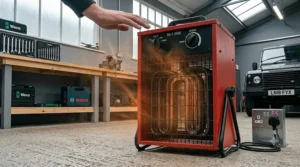
The Benross 42450 is the heater that consistently surprises people who buy it expecting something mediocre at the price. Yellow, tilting, and distinctly purposeful-looking, it manages a trick that most of its rivals don’t: a genuine IPX4 waterproof rating.
IPX4 means it can handle water splashing from any direction. On a British building site in November — where the rain comes at you horizontally and the site hut floor is perpetually damp — that matters more than any marketing copy about “industrial grade” steel casing. The tilting head allows you to direct heat precisely where it’s needed, rather than blasting the ceiling while your legs remain at -3°C. Two heat settings (1.5kW and 3kW), a fully adjustable thermostat, and a cool-air fan setting round things out nicely.
It comes with a 13A standard plug and a 1.5m cable, which means you can use it anywhere a standard socket exists. The stainless steel heating element is rated for sustained use, and dual overheat protection adds a layer of reassurance when you’ve left it running while you nip out to the van.
The one honest caveat: at 3kW running through a 13A plug, the plug can run warm during extended use — a point raised in UK reviews. It’s within safe operating parameters, but do avoid daisy-chaining extension leads and check the plug periodically. Genuinely good value in the £35–£50 range, and Prime-eligible for next-day delivery.
✅ IPX4 waterproof — genuinely site-suitable
✅ Tilting head for directional heat
✅ Standard 13A plug, works anywhere
❌ Plug can run warm during long sessions
❌ Lighter build than the Sealey or Clarke options
Best for: Site managers and contractors who need a plug-and-go heater that won’t mind a British drizzle.
3. Igenix IG9301 Industrial/Commercial Drum Fan Heater 3000W
The Igenix IG9301 looks the business. The drum fan heater form factor — a cylindrical barrel design rather than the conventional flat-fronted box — isn’t just aesthetics; it pushes warm air in a more focused column, which makes it particularly effective in longer, narrower spaces like garages, site corridors, or storage containers.
3000W output with two heat settings and a cooling fan option make it a genuine year-round tool. The integrated carry handle is thoughtfully placed, and the red powder-coat finish is, frankly, a step above the visual category. UK buyers running it in single garages and small commercial units report getting spaces to a comfortable working temperature within ten to fifteen minutes in typical British winter conditions.
Where the IG9301 earns special respect is in reliability reports. Igenix is a British brand with a distribution network focused on the UK market, which means parts, warranty queries, and customer support are handled domestically — something that becomes rather significant if you’ve got a problem in January. At £45–£65, it undercuts the Sealey slightly without giving up too much in build quality.
One note: like most drum heaters, it’s designed to blow air in a single direction. For large, open-plan spaces, you may need to reposition it as work areas change.
✅ Drum design provides focused, directional heat
✅ British brand with UK-based support
✅ Effective in long, narrow spaces
❌ Less effective in wide-open areas
❌ Fixed heat direction requires manual repositioning
Best for: Single garages, small warehouses, and anyone who values a straightforward warranty experience.
4. Clarke Devil 7003 3kW Industrial Electric Fan Heater
Clarke is one of the most recognised names in the British workshop trade, and the Devil 7003 carries that heritage into the 3kW electric heater category. Heavy-duty steel construction, adjustable thermostatic control, high/low heat settings, fan-only mode, and built-in overheat protection all combine into a heater that feels like it means business.
The 230V standard 13A plug makes it immediately usable anywhere on site. The steel casing takes knocks without denting dramatically, and the stable stand keeps it upright even on uneven floors. UK buyers in commercial workshops particularly appreciate the build quality, with many reporting that it outlasts cheaper rivals by several seasons.
However — and this is worth knowing before you buy — reviews are candid that this heater performs best in insulated spaces. In an open, uninsulated garage or a draughty site, the heat output of 3kW can feel inadequate. That’s not unique to the Devil 7003; it’s physics. No 3kW electric heater will conquer an uninsulated space with gaps large enough to park a van through. Set your expectations accordingly. At £60–£80, it sits in the upper-mid range, but Clarke’s build standards and brand reputation justify the price for buyers who need longevity.
✅ Heavy-duty steel construction takes real site punishment
✅ Reliable Clarke brand with UK trade support
✅ Standard 13A plug, immediate setup
❌ Struggles in poorly insulated or draughty spaces
❌ Slightly heavier than competitors at this output
Best for: Workshop owners and tradespeople in medium-sized, insulated spaces who want Clarke’s well-earned build quality.
5. Clarke Devil 6003 3kW Industrial Electric Fan Heater
Where the Devil 7003 is the big sibling, the Clarke Devil 6003 is the leaner, lighter option — housed in a robust steel cabinet but weighing just 5.5kg, making it genuinely easy to carry between jobs. Adjustable heat output from 1.5kW to 3kW, a safety thermostat, and insulated handles (which allow safe handling even when the unit is hot) are all standard.
The Devil 6003 comes with a 13A plug and is suitable for both commercial workshops and home garages — a dual-life that makes it particularly appealing for the tradesperson who also wants to heat their home workshop on evenings and weekends without buying two separate heaters. Stainless steel heating element, robust steel cabinet, and Clarke’s quality control all contribute to a unit that should last several years of regular use.
At £50–£70, it’s a hair cheaper than the Devil 7003 and meaningfully lighter, which tips the balance for buyers who move their heater around regularly. The one trade-off is that the slightly smaller format means heat coverage is best suited to small-to-medium sized premises — the spec sheet says up to about 30m², which is a single-car garage or a modest site hut comfortably.
✅ Lightweight at 5.5kg — easy to move between jobs
✅ Works for both professional and home workshop use
✅ Insulated handles — safe when hot
❌ Best suited to smaller spaces than some rivals
❌ Fan noise is noticeable at full power
Best for: Mobile tradespeople who move between jobs and want a heater light enough to throw in the van without a second thought.
6. Sealey DEH3001 3kW Industrial Fan Heater with Ducting
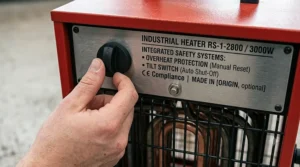
The DEH3001 is where things get interesting. It’s a 3kW industrial fan heater — same output class as everything else on this list — but with one party trick that none of the others possess: ducting capability. It can distribute heat through attached flexible ducting to where it’s actually needed, rather than simply blasting air into the room and hoping for the best.
On a building site with complex layouts — where the room being worked in is three metres from the nearest available socket — ducting makes a real practical difference. You can position the heater in a practical location and route warmth into the space. Ideal, in other words, for plasterers drying out a newly finished room, painters maintaining minimum working temperatures, or anyone dealing with awkward site geometry.
It runs on 230V 16A (same as the EH3001, so the same caveat applies — no standard 13A plug). The two heat settings and thermostat are standard Sealey quality. At £70–£90, it’s the most expensive unit on this list, but if the ducting functionality solves a genuine problem you face on site, the premium is more than justified. If you don’t need ducting, save yourself £20–£30 and buy the EH3001 instead.
✅ Unique ducting capability for complex site layouts
✅ Sealey’s professional build quality
✅ Effective for drying plaster, paint, and damp walls
❌ Requires 16A industrial socket — not plug-and-go
❌ Premium price not justified if ducting isn’t needed
Best for: Site managers dealing with complex building layouts or contractors who need to direct heat into specific spaces.
7. Dimplex DXFF30TSN 3kW Electric Fan Heater
Dimplex is a name that British households and light commercial premises have trusted for over 70 years, and the DXFF30TSN is the most domestically-inclined heater on this list — though don’t dismiss it as mere household kit. At 3kW with two heat settings (1.5kW and 3kW), a manual thermostat, frost protection mode, cool-blow function, and BEAB approval to Europe’s highest product safety standard, it’s perfectly respectable.
The honest positioning: this is ideal for site offices, welfare units, and any workspace that errs more towards the office end of the spectrum than the workshop end. The compact size, 1.5m cable, and built-in carry handle make it genuinely portable. The cool-blow function is appreciated in summer — unusual in this category. UK buyers consistently praise how rapidly it warms a small-to-medium enclosed space and highlight the frost protection mode as particularly useful for maintaining minimum temperatures overnight without leaving a more powerful heater running unsupervised.
What it isn’t is a heavy-duty site machine. The casing is lighter than the Sealey and Clarke options, and it’s not rated for damp or dusty environments. Keep it in the site office or welfare hut, not on the building floor. At £40–£60, it’s excellent value for the right application.
✅ BEAB safety approved — high safety credentials
✅ Frost protection mode for overnight temperature maintenance
✅ Compact, lightweight, and portable
❌ Not suitable for dusty or damp environments
❌ Lighter build limits heavy-duty site use
Best for: Site office managers, welfare unit managers, and light-industrial users who want Dimplex’s reliability in a compact format.
How to Use Your Industrial Electric Heater 3kW Safely on a British Building Site
Getting the most from a 3kw heater for site hut use is as much about setup as spec sheet. A few things the product listings won’t bother telling you.
The insulation problem is real. A 3kW electric heater will raise the temperature of a well-insulated 30–60m² space by a comfortable margin. In an uninsulated space — a draughty garage, an exposed site building, or a steel container with no lining — 3kW fights a losing battle against the British January. Add temporary insulation (even draught-excluding tape around doorframes and a thermal curtain over the entrance) and you’ll feel the difference immediately.
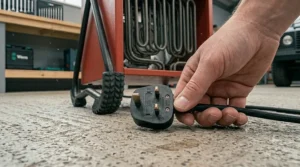
Socket safety matters more than most buyers realise. Running a 3kW heater continuously through a 13A socket draws around 13 amps — right at the limit. The socket, plug, and extension lead (if you’re using one) all need to be rated for the load. Use a properly rated heavy-duty extension lead rather than a domestic 2m cable designed for a desk lamp, and check the plug periodically for signs of heat. Better yet, run the heater directly from the socket without an extension where possible. As the Health and Safety Executive guidance makes clear, employers have a duty to provide adequate workplace heating — and electrical safety is part of that duty.
The 13°C rule. Under HSE’s Approved Code of Practice, workplaces involving physical effort should be maintained at a minimum of 13°C; sedentary workplaces (like site offices) should reach at least 16°C. The Construction (Design and Management) Regulations require reasonable workplace temperatures for indoor areas of construction sites, and site rest facilities must also be maintained at an appropriate temperature. A 3kW site heater is a practical, cost-effective way to meet that obligation.
Position matters. Floor level is sensible for fan heaters — they push warm air upward and forward, helping it mix with the cold air at working height. Don’t tuck the heater in a corner behind equipment where the airflow is immediately blocked.
Real-World Scenarios: Which 3kW Industrial Heater Suits You?
Different buyers, different needs. Here’s how we’d actually match product to person.
The building site contractor in Glasgow, November. You’ve got a site hut serving six tradespeople, standard 13A sockets only, and it rains sideways approximately 80% of the time. The Benross 42450 is your answer. Its IPX4 rating means a splash of water — from a wet jacket, a muddy boot, or the British atmosphere in general — won’t cause a problem, and the standard 13A plug means zero fiddling with adaptors. Budget: £35–£50.
The workshop owner in Sheffield with a permanent setup. You’ve got a two-car garage workshop, a dedicated circuit, and you’re there most evenings and weekends. The Sealey EH3001 is built for exactly this. Fit a 16A socket properly (any competent electrician, an hour’s work), and you’ve got a heater that will serve you faithfully for years. Budget: £55–£70.
The site manager needing to heat a welfare unit and a work room. Two spaces to heat, one heater. The Sealey DEH3001’s ducting capability lets you channel heat into the work room from the welfare unit’s socket. Slightly unconventional, thoroughly effective. Budget: £70–£90.
The small business owner in a light industrial unit in Bristol. You want to heat a tidy 20m² workshop space without spending a fortune. The Igenix IG9301’s drum design and focused heat column suit smaller premises well, and Igenix’s UK-based support means warranty queries don’t disappear into an overseas call centre. Budget: £45–£65.
How to Choose an Industrial Electric Heater 3kW in the UK: 6 Things That Actually Matter
There’s a lot of noise in this category. Here’s what to focus on.
1. Plug type: 13A vs 16A. Standard 13A plugs work everywhere but run close to their rated limit at 3kW. Industrial 16A plugs require a dedicated socket but are safer for continuous use. If you have a permanent workshop with an electrician on hand, go 16A. If you need plug-and-go portability, stick to 13A — just be sensible about the circuit.
2. IP rating. If the heater is going anywhere near moisture — a damp site hut, an outdoor covered space, a workshop where wet tools are the norm — you need an IP rating. IPX4 minimum. The Benross 42450 is the only mainstream 3kw heater for building site applications that hits this standard at a competitive price.
3. Thermostat quality. A good thermostat is worth real money in running costs. A heater that cycles on and off to maintain temperature rather than blasting continuously at full 3kW will materially reduce your electricity bill. All the heaters on this list have thermostats, but their sensitivity varies. Sealey’s are generally regarded as among the most accurate in the trade category.
4. Space size and insulation. As a rough guide, Tooled-Up’s Sealey technical documentation suggests allowing approximately 100 watts per square metre for a well-insulated workshop, or 150–200 watts per square metre for poorly insulated spaces. A 3kW heater, therefore, is well-suited to around 15–30m² of reasonably insulated space. Don’t buy a 3kW unit expecting it to warm a 60m² draughty warehouse in February.
5. Running costs. At the current UK electricity price cap rate of approximately 26p per kWh, a 3kW industrial electric heater 3kw costs around 78p per hour at full output. Thermostat cycling typically reduces real-world consumption significantly — expect 40–60% of maximum consumption over a full working day in a reasonably insulated space.
6. Safety certifications. Look for CE or UKCA markings (post-Brexit, UKCA is the UK-specific certification), BEAB approval for domestic/light commercial use, and tip-over protection as standard. The HSE’s guidance on workplace heating is available at hse.gov.uk and provides the legal context for employers providing adequate site heating.
Common Mistakes When Buying a 3kW Industrial Heater for UK Use
Buying on price alone. The difference between a £35 heater and a £65 heater in this category isn’t marketing — it’s build quality, element longevity, and thermostat accuracy. A heater that fails after one winter and needs replacing costs more than the one that runs for five years. Do the maths.
Ignoring the plug situation. Ordering a heater with a 16A industrial plug for a site that only has 13A sockets is a frustratingly common error. Check your available sockets before purchasing.
Underestimating British damp. A non-IP-rated heater in a damp environment will eventually develop problems. Even a site hut that looks dry accumulates moisture from boots, wet coats, and British air. If in doubt, get an IP-rated model.
Overlooking energy efficiency features. The difference between a heater with a sensitive thermostat and one with a crude on/off switch translates directly to your electricity bill. According to Which? and various energy comparison organisations, electric heaters with thermostats use considerably less energy per working day than those running continuously. The Energy Saving Trust has useful guidance on managing heating costs in working environments.
Running 3kW through an overloaded extension lead. This one’s a genuine fire risk. A 3kW heater on a cheap domestic extension lead is a scenario that makes electricians wince. Use dedicated, properly rated leads — or connect directly.
Benefits vs Traditional Alternatives
| Heating Type | Upfront Cost | Running Cost | Portability | Fumes/Ventilation | Best For |
|---|---|---|---|---|---|
| Electric 3kW | £35–£90 | ~78p/hr | ✅ High | None required | Enclosed spaces |
| LPG/Propane | £80–£200 | Lower per hr | ✅ High | ⚠️ Ventilation needed | Open spaces |
| Diesel space heater | £150–£400 | Lower per hr | Medium | ⚠️ Significant | Large open areas |
| Fixed gas central heating | £1,500+ | Lowest | ❌ Fixed | Minimal | Permanent buildings |
The comparison makes the electric 3kw heater’s niche abundantly clear. It produces no fumes, requires no ventilation, and can be used safely in a closed site hut without any risk of carbon monoxide — a genuine safety advantage over LPG and diesel alternatives. The running cost premium is real, but for intermittent use in enclosed spaces with no piped gas supply, it’s often the only sensible option. LPG and diesel alternatives require fuel storage, ventilation planning, and a great deal more faff. Electric simply works.
✨ Don’t Miss These Exclusive Deals!
🔍 These products are available now on Amazon.co.uk with Prime-eligible next-day delivery. Click any highlighted product to check current pricing before stock changes!
Long-Term Cost & Maintenance for UK Workshop Owners
Let’s talk money honestly, because this is where a lot of buying guides hand-wave their way past the uncomfortable parts.
A 3kW electric heater running for eight hours a day, five days a week, for a four-month British winter works out to roughly 480 hours of operation. At 78p per hour at full output, that’s around £375 in electricity per season — assuming continuous full-power operation, which thermostatic control substantially reduces. In practice, expect actual costs closer to £150–£250 per season for typical workshop use in a well-insulated space, once the thermostat is cycling sensibly.
Compare that to a propane heater where you’re buying LPG cylinders regularly, or a diesel unit requiring fuel storage and annual servicing, and the electric option starts to look considerably more reasonable for moderate use. The zero maintenance angle is also real: electric heaters have no fuel system to service, no filters to clean, no annual safety checks mandated by regulation. Inspect the cable annually, keep the vents clear of dust, and that’s genuinely about it.
Replacement elements are available for most Sealey and Clarke models from UK trade suppliers, which means a major component failure doesn’t necessarily mean replacing the whole unit. Worth factoring in when comparing a £55 Sealey against a £35 no-name import with no UK parts support.
FAQ: Industrial Electric Heater 3kW
❓ Is a 3kW electric heater enough to heat a site hut?
❓ Can I run a 3kW heater from a standard 13A plug socket?
❓ What IP rating should an industrial electric heater have for use on a UK building site?
❓ What are the legal temperature requirements for workers on UK construction sites?
❓ How much does a 3kW industrial electric heater cost to run per day in the UK?
Conclusion
The right industrial electric heater 3kw for UK use isn’t necessarily the most powerful-sounding one or the most impressively-packaged. It’s the one that matches your specific situation — your socket type, your space size, your insulation reality, your budget, and your tolerance for damp British weather doing its worst to your equipment.
For most site hut and building site applications, the Benross 42450 offers the best combination of plug-and-go convenience, IPX4 weather resistance, and competitive pricing. For established workshops with a proper circuit, the Sealey EH3001 is the professional’s choice — built to last, sensibly specified, and backed by one of Britain’s most trusted workshop brands. And if your heating challenge involves getting warmth into an awkward space, the Sealey DEH3001’s ducting capability is a rather elegant solution to a problem most heaters simply ignore.
Whatever you choose, remember that insulation is half the battle. A well-sealed space with a modest 3kW heater will always outperform an open, draughty one with twice the wattage. Spend half an hour on draught-proofing before switching the heater on and you’ll likely halve your running costs.
✨ Ready to Heat Up Your Workspace?
🔍 Click any highlighted product name to check current pricing and availability on Amazon.co.uk. All products in this guide are available for UK delivery, with many eligible for Prime next-day service.
Recommended for You
- Best Industrial Heater for Construction Site UK 2026: 7 Top Picks
- Best Propane Greenhouse Heater UK 2026: 7 Expert Picks That Actually Work
- Best Paraffin Heater for Greenhouse UK 2026: 7 Top Picks
Disclaimer: This article contains affiliate links. As an Amazon Associate, I earn from qualifying purchases. If you purchase products through these links, we may earn a small commission at no additional cost to you.
✨ Found this helpful? Share it with your mates! 💬🤗
