
In This Article
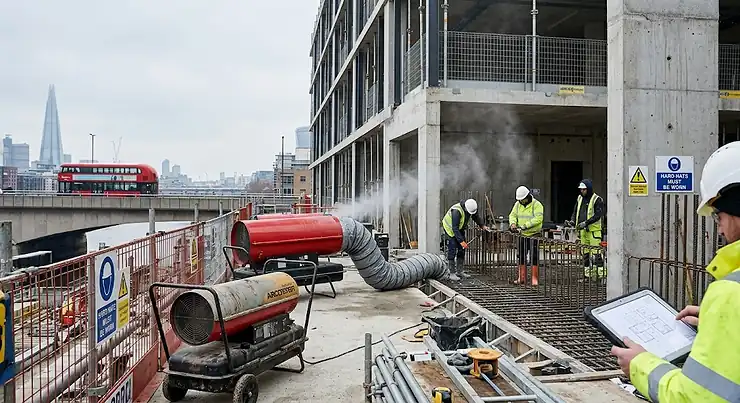
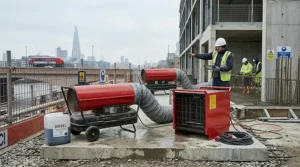
There is a particular kind of misery unique to British construction sites in January. The wind cuts sideways across an open shell of a building, condensation drips from exposed joists, and somewhere in the corner, a two-bar electric fire from 2009 glows bravely and entirely uselessly at a space the size of a tennis court. Anyone who has worked through a UK winter on site will recognise this scenario immediately — and will also understand why choosing the right industrial heater for construction site use is not a minor purchasing decision. It is a productivity decision, a safety decision, and, frankly, a morale decision.
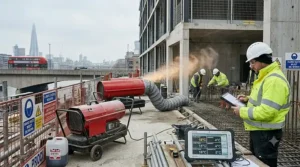
A proper industrial heater for construction site environments does more than warm cold hands. It accelerates the drying of plaster and paint (critical when British autumn rain has soaked a new render), keeps adhesives and sealants workable in sub-zero conditions, protects freshly poured concrete from frost damage, and ensures your site complies with the Health and Safety Executive’s guidance on reasonable workplace temperatures — which, under the Workplace (Health, Safety and Welfare) Regulations 1992, requires employers to maintain temperatures of at least 16°C for most indoor work, dropping to 13°C where strenuous physical exertion is involved.
This guide cuts through the noise of a crowded market to deliver seven rigorously researched options available right now on Amazon.co.uk — covering propane, diesel, and electric models across a range of output levels and price points. Whether you’re heating a tight domestic renovation or a sprawling commercial shell, there’s a pick here for you.
Quick Comparison: Top 7 Industrial Heaters for Construction Sites (UK 2026)
| Product | Fuel Type | Output | Coverage | Best For | Price Range (GBP) |
|---|---|---|---|---|---|
| SIP FIREBALL 515 | Propane (LPG) | 15kW | ~345m³ | Mid-size site, no mains power | £200–£280 |
| SIP FIREBALL 1030 | Propane (LPG) | 30kW | ~690m³ | Large open shells, warehouses | £320–£430 |
| RocwooD 30KW Propane | Propane (LPG) | 30kW | ~700m³ | Budget-conscious large site | £180–£250 |
| SIAL 15kW Electric | Electric (400V) | 15kW | ~450m² | Sites with 3-phase supply | £350–£500 |
| Garden Mile 15kW LPG | Propane (LPG) | 15kW | ~340m³ | Smaller sites, BS plug ready | £130–£190 |
| Sealey LP69C Space Warmer | Propane (LPG) | 9–20kW | Variable | Versatile multi-zone use | £250–£370 |
| SIP Fireball 125XD | Diesel/Kerosene | 36kW | ~900m³ | Large ventilated workshops | £500–£750 |
Reading the table: Output wattage is your starting point, but fuel availability on site matters just as much. Propane is the most practical choice for sites without a reliable 3-phase electrical supply. The RocwooD offers exceptional value-per-kilowatt for tight budgets, while the Sealey LP69C gives you the flexibility to dial output up or down — useful when you need to transition from warming a cavernous shell one day to spot-heating a stairwell the next. The SIAL electric stands apart entirely: if your site has 400V 3-phase supply, it is cleaner, quieter, and arguably safer in enclosed spaces than any combustion heater.
💬 Just one click — help others make better buying decisions too! 😊
✨ Don’t Miss These Exclusive Deals!
🔍 Take your site heating to the next level with these carefully selected products. Click on any highlighted item to check current pricing and availability on Amazon.co.uk. These picks will help you find exactly what you need!
Top 7 Industrial Heaters for Construction Sites: Expert Analysis
1. SIP FIREBALL 515 Propane Gas Heater
The FIREBALL 515 is one of the most capable cordless propane heaters you’ll find on Amazon.co.uk, and its battery-powered fan is the feature most buyers overlook until they actually need it. At 15kW / 51,182 BTU/hr, it can heat a space of roughly 345m³ — that is a respectable mid-size room or a tightly enclosed ground floor — without requiring any mains power at all. The cordless design means it is genuinely independent: run it off a standard 13kg propane cylinder and it will simply get on with the job while the rest of the site is still waiting for the temporary supply to be sorted.
What most UK buyers overlook is how practical this is in early groundworks or structural phases, when power is absent entirely. The 230V electric option exists too, giving you flexibility as the build progresses. For renovation contractors working in occupied terraced properties in cities like Leeds or Bristol, the low-profile cordless mode also reduces the trip hazard of trailing cables.
UK reviewers are consistently positive about the build quality — powder-coated finish, solid construction — though a few note the hose and regulator supplied are workmanlike rather than premium. Worth budgeting for a spare regulator if you run this hard.
✅ Cordless operation — no mains dependency
✅ Robust powder-coated housing
✅ Dual-mode (battery/electric) for growing sites
❌ Hose regulator could be higher quality
❌ Propane cylinder not included — factor in ongoing fuel costs
Around £200–£280 on Amazon.co.uk. An outstanding choice for electrically independent sites — good value for what it delivers.
2. SIP FIREBALL 1030 Propane Gas Space Heater
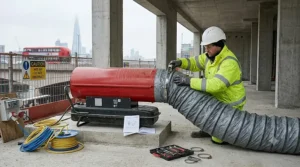
Step up to the FIREBALL 1030 and you’re in a different league of warmth entirely. At 30kW / 102,364 BTU/hr with an enormous coverage of up to approximately 690m³, this is the machine you reach for when you are heating a large open shell, a frame-stage new build, or a warehouse undergoing fit-out during the colder months. The 230V electric fan runs on a standard BS plug — that is important because it means the fan works fine from a site transformer or a temporary supply, even while the gas does the actual heating work.
The FIREBALL range from SIP is ERP (Energy Related Products) compliant, which is a detail worth caring about: it signals more efficient combustion, lower running costs, and reduced emissions — welcome on any site where COSHH considerations matter or your client has sustainability targets to hit.
In practice, UK site managers using this model report it reaches comfortable working temperatures in a 500m³ space in around 25–30 minutes on a cold morning, which is impressive. The trade-off is gas consumption at this output level, so keep a second cylinder on standby for a full working day.
✅ Exceptional heat output for large spaces
✅ ERP compliant — more efficient, fewer emissions
✅ Standard 230V fan operation, BS plug ready
❌ Significant gas consumption at full output
❌ Requires adequate ventilation — not suitable for sealed spaces
£320–£430 range on Amazon.co.uk. The go-to choice for large-scale construction heating when site power is limited.
3. RocwooD 30KW Propane Gas Heater
The RocwooD is the honest workhorse of this list — no heritage brand cachet, no premium price tag, but rather a remarkable amount of heat for the money. At 30kW / 102,360 BTU, it competes directly with units costing significantly more, and the fan-assisted design ensures warm air is pushed into the space rather than simply radiating from the front. Overheat protection is built in, which matters on a busy site where the heater might end up partially obstructed by materials stacked nearby.
What the spec sheet does not tell you is that the RocwooD runs noticeably louder than the SIP equivalents — not unusable, but worth knowing if you are heating a space where communication between tradespeople matters (a first-fix wiring phase, say, or detailed joinery work requiring concentration). On a noisy groundworks site, you will not notice.
UK customers appreciate the competitive price point, and given that an industrial heater for construction site use often gets knocked about, stored in a damp lock-up, and run hard for a single winter project before sitting unused for six months, paying substantially less for comparable output is a perfectly rational decision.
✅ Exceptional value for 30kW output
✅ Fan-assisted heat distribution
✅ Overheat protection as standard
❌ Louder operating noise than premium brands
❌ Build quality reflects the price — treat it carefully
£180–£250 on Amazon.co.uk. Best value pick for high-output site heating on a constrained budget.
4. SIAL Industrial Space Heater 15000W (400V Electric)
Here is where the article takes a turn for the electrically inclined. The SIAL 15kW electric heater operates on a 400V 3-phase supply — the round, blue or red industrial plug you find on site generators and in workshops — and it is a fundamentally different proposition from combustion heaters. No fumes. No ventilation headaches. No COSHH concerns. No gas cylinder deliveries every few days. Just clean, controllable, fume-free warmth, adjustable airflow angle up to 30°, and a sturdy IP24-rated housing designed to handle the damp, dusty reality of construction environments.
The IP24 rating is particularly relevant in a British context: this heater can handle rain splashes and water ingress from multiple directions, which on a partially exposed UK site in October is not an edge case — it is Tuesday. The stainless steel heating elements are built for continuous operation, and the anti-collision metal mesh protects the unit from the inevitable knocks of shared site spaces.
The limitation is obvious: you need 3-phase supply. But if your site has it — and most commercial construction projects do — the SIAL makes an extremely compelling case for going electric. UK reviewers in workshop and factory settings are particularly enthusiastic about the low maintenance requirements compared to combustion alternatives.
✅ Fume-free — ideal for enclosed or partially enclosed spaces
✅ IP24 waterproofing — handles British conditions well
✅ Adjustable airflow angle and thermostat control
❌ Requires 400V 3-phase supply — not universally available
❌ Higher upfront cost than propane equivalents
£350–£500 range on Amazon.co.uk. The smart choice for sites with 3-phase supply and zero appetite for gas cylinder logistics.
5. Garden Mile 15kW LPG Industrial Gas Space Heater
The Garden Mile heater is a fine introduction to proper site heating for smaller contractors and self-builders who have previously been making do with domestic fan heaters. At 15kW / 51,000 BTU/hr with a 240V/50Hz BS plug fan, it runs off any standard 13A socket — meaning you can power the fan from a domestic extension lead via a site transformer, while the propane cylinder does the heavy lifting. Coverage extends to approximately 340m³, which comfortably handles a mid-size room or a compact garage conversion.
What sets this apart from anonymous budget alternatives is the build quality for the price: the blower unit feels solid, the thermostat is reasonably responsive, and the powder-coated finish holds up to typical site abuse better than you might expect for the price bracket. It is not a Sealey or an SIP, but it is a considerable step up from the generic yellow boxes flooding the market.
For self-builders in rural locations — a barn conversion in the Cotswolds, a new-build plot in mid-Wales where materials drying time is a genuine project-critical concern — this model hits a sensible sweet spot between capability and cost.
✅ Standard BS 240V plug — no special power requirements
✅ Solid build quality for the price
✅ Good coverage for smaller sites and renovations
❌ Not suitable for very large open spaces at 15kW
❌ Fan can be noisy at maximum output
£130–£190 on Amazon.co.uk. Excellent entry-level choice for self-builders, renovation contractors, and smaller commercial projects.
6. Sealey LP69C Space Warmer® Propane Heater
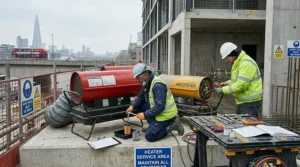
Sealey is one of Britain’s most trusted names in workshop and site equipment, and the LP69C is a fine illustration of why. The variable output range — 30,000 to 68,000 BTU/hr (approximately 9–20kW) — is the headline feature, and it is genuinely useful. Most heaters are essentially binary: full throttle or off. The LP69C lets you dial down on milder days, which in the UK means you will actually use the lower settings for six weeks on either side of the core winter months rather than running full power and losing heat through every gap in the building envelope.
The cordless option (the ‘C’ designation) means the fan operates without mains power, an increasingly common choice among UK site managers who want flexibility without trailing cables. Build quality is typically Sealey: robust, well-finished, and designed to survive real working environments rather than only look impressive in a brochure.
UK reviewers who have owned multiple site heaters consistently rate Sealey above budget alternatives for longevity — an important consideration when you factor in total cost of ownership rather than just purchase price. A heater that lasts five winters at £350 costs less per season than a budget unit replaced every year.
✅ Variable output — huge practical advantage on site
✅ Cordless fan option for maximum flexibility
✅ Sealey reliability — proven UK brand with real after-sales support
❌ Higher price than budget propane alternatives
❌ Fuel consumption at 20kW is considerable — plan cylinder logistics
£250–£370 range on Amazon.co.uk. Best all-round choice for experienced site managers who value flexibility and long-term reliability.
7. SIP 09566 Fireball 125XD Diesel Heater
The Fireball 125XD is a different beast from everything else on this list. It burns diesel or kerosene, pumps out 36kW of heat, and covers up to approximately 900m³ — a space the size of a small warehouse or a very large open commercial shell. The built-in digital thermostat and temperature display are not gimmicks; on a big site where you need to maintain specific temperatures for concrete curing or specialist coatings, having proper thermostat control rather than a dial-based guess is genuinely valuable.
The key caveat — and this applies to all direct diesel heaters — is ventilation. These units are not suitable for sealed or poorly ventilated spaces. They produce combustion gases. On a large, partially open site this is rarely a concern, but in a tightly sealed basement or windowless interior room, an indirect heater or the electric SIAL above would be the safer choice. Worth pairing with a carbon monoxide detector regardless — a small investment for significant peace of mind. The HSE has clear guidance on the safe use of fuel-burning heaters in enclosed work environments.
UK buyers in agricultural, large workshop, and heavy commercial construction settings rate this heater highly for sheer volume of heat delivered reliably. The premium price is justified by the output and thermostat precision.
✅ Massive 36kW output — the most powerful on this list
✅ Digital thermostat for temperature precision
✅ Multi-fuel (diesel or kerosene) for fuel flexibility
❌ Requires good ventilation — not for sealed spaces
❌ Highest price point; fuel and running costs are significant
£500–£750 range on Amazon.co.uk. The professional’s choice for large-scale, high-output heating on ventilated commercial sites.
How to Choose the Right Industrial Heater for Your Construction Site
Selecting an industrial heater for construction site use is more nuanced than matching the biggest BTU number to your budget. Here are the five criteria that actually matter.
1. Assess your electrical supply first. This is the question most buyers ask last but should ask first. Do you have a 3-phase 400V supply? A 240V single-phase? A generator? No power at all? Your answer eliminates half the market before you have read a single review.
2. Calculate your space correctly. Volume (not floor area) is what matters for heater sizing. Multiply length × width × height. For a poorly insulated shell building — typical of most UK new-build sites at structural stage — apply a multiplication factor of 1.5 to your volume calculation to account for heat loss.
3. Consider drying requirements. This is where propane heaters have a subtle but important disadvantage: they produce moisture as a combustion by-product. If your primary need is drying plaster, render, or new screed, a diesel indirect heater or electric unit will be more effective — and potentially faster — than a propane equivalent of the same wattage.
4. Plan your fuel logistics. A 30kW propane heater running eight hours a day will consume approximately one 47kg cylinder every two to three days. On a remote rural site, this logistics challenge is worth pricing in before purchase.
5. Match the heater to the phase of work. Early structural work: maximum output, ventilated spaces, propane or diesel makes sense. First fix and internal works: electric or indirect heating becomes safer and more practical. Finishing trades: lower-output, thermostatically controlled units protect sensitive materials and maintain consistent conditions.
Real-World Scenarios: Matching the Right Heater to UK Site Conditions
🏗️ The London basement conversion contractor. Working in a sealed, single-storey basement in Hackney, no natural ventilation, electrics live but single-phase only. The answer here is clearly the SIAL 15kW Electric — fume-free, IP24 rated, runs on 3-phase. If 3-phase is unavailable, an indirect diesel heater ducted from outside the basement is the safer combustion alternative. Propane or direct diesel in a sealed London basement is an invitation to a very unpleasant HSE visit.
🏗️ The Scottish rural new-build project manager. A timber-frame new build in Perthshire, open structural stage, nearest petrol station twelve miles away, site generator providing 240V only. The Garden Mile 15kW LPG or the SIP FIREBALL 515 (cordless mode) are sensible choices — propane is available in bulk delivery from suppliers like Calor, the BS plug fan works from the generator, and the output is sufficient for the structural cavity being warmed. Buy two cylinders and keep them rotating.
🏗️ The M25-belt commercial fit-out team. A 1,200m² warehouse-to-office conversion in Hertfordshire, 3-phase supply on site from day one, client’s net-zero aspirations making combustion heaters politically uncomfortable. Two units of the SIAL 15kW Electric running in tandem give clean, controllable, fume-free heat across the majority of the space — and the site manager can point the client to a zero-combustion heating solution without breaking a sweat.
UK Safety Regulations & Legal Requirements for Site Heating
This is the section that does not appear in Amazon product listings but absolutely should appear in any honest buyer’s guide. Under the Construction (Design and Management) Regulations 2015 (CDM 2015), principal contractors have a legal duty to ensure reasonable workplace temperatures in indoor construction areas. The HSE’s suggested minimum is 16°C for most work, or 13°C where strenuous physical activity is involved.
That sounds simple enough. In practice, achieving and maintaining those temperatures in a partially constructed shell building — with no insulation, gaps in the building envelope, and doors opening and closing constantly — requires adequate heater output, not merely adequate heater purchase. Undersizing is not just a comfort problem; it is a potential legal exposure.
Ventilation and combustion safety. Every direct combustion heater — propane, diesel, kerosene — produces carbon monoxide as a by-product of burning. The HSE recommends that carbon monoxide detectors are used alongside any fuel-burning heater in enclosed or semi-enclosed spaces. These cost around £20–£30 and should be considered mandatory accessories, not optional extras.
UKCA marking. Since Brexit, products placed on the UK market must carry UKCA marking (replacing the old CE mark) where applicable. For electrical heaters in particular, verify UKCA compliance before purchasing — products shipped from EU suppliers and relabelled for the UK market are not always compliant.
Carbon monoxide risk. Do not underestimate this. The HSE publishes specific guidance on CO risks from heaters on construction sites — worth reading before any combustion heater is commissioned in an enclosed space.
✨ Don’t Miss These Exclusive Deals!
🔍 Ready to upgrade your site heating game? Click on any highlighted product to check current pricing and availability on Amazon.co.uk. Prime members enjoy next-day delivery — useful when a cold snap arrives without warning and work cannot stop.
Common Mistakes When Buying an Industrial Heater for Construction Sites
These are the errors that cost UK site managers time, money, and occasionally a fairly miserable few weeks in November.
Buying for floor area rather than volume. A heater rated for “200m²” is meaningless without knowing the ceiling height. A 200m² space with 6m ceilings contains 1,200m³ of air — roughly three times as much as the same footprint at 2m height. Always calculate volume and size up accordingly.
Ignoring fuel type compatibility. Propane and butane are not interchangeable. Standard UK propane regulators (37mbar) are not compatible with butane cylinders. Some budget heaters ship with regulators that are technically compatible with both but perform poorly on one. Buy heaters that specify propane operation and pair them with propane cylinders.
Overlooking the moisture problem with propane. As mentioned above — propane combustion produces approximately 1.6 litres of water vapour per kilogram of gas burned. In damp British conditions (which is to say, most conditions), this can actually increase humidity in a sealed or poorly ventilated space rather than helping materials dry. Where drying is the primary goal, indirect diesel or electric heating wins.
Skipping the CO detector. The NHS guidance on carbon monoxide poisoning is unambiguous: CO is colourless, odourless, and kills. On a site with multiple combustion heaters, CO accumulation is a genuine risk. A detector is a £25 investment against a potentially fatal outcome.
Buying the cheapest possible unit and running it 24/7. Budget heaters are built to lighter duty cycles. Running a sub-£150 propane unit continuously for eight-week winter stretches is how you end up with a failed thermostat, a cracked heat exchanger, or worse. Match duty cycle to product quality.
Long-Term Cost & Maintenance: What Site Heating Really Costs in the UK
Running costs are where the true cost of site heating becomes clear — and where the choice between fuel types matters most. Let’s look at the approximate figures for 2026 UK conditions.
| Fuel | Approximate Cost | Running Cost at 15kW |
|---|---|---|
| Propane (47kg cylinder) | ~£80–£110 per cylinder | ~£1.20–£1.50/hr |
| Diesel/red diesel | ~£1.10–£1.30/litre | ~£1.00–£1.40/hr |
| Electricity (3-phase) | ~34p/kWh (commercial) | ~£5.10/hr at 15kW |
The electric heater shock. Yes, electricity at 15kW is substantially more expensive per hour than combustion fuel. But the calculation is not that simple: electric heaters have near-zero maintenance costs, require no fuel delivery logistics, and produce zero combustion by-products. On a short-term project of four to six weeks, the premium may be worthwhile. For a six-month structural and fit-out programme, fuel-based heating is likely the more economical choice.
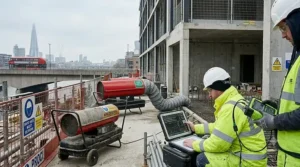
Maintenance essentials. All combustion heaters should be serviced annually if used heavily. Key checks: burner head condition, ignition electrode gap, fuel filter cleanliness, and hose integrity. Propane hoses degrade in UV light and cold — inspect before each winter season and replace if cracked. Store heaters in dry conditions with the fuel supply disconnected.
Frequently Asked Questions
❓ What is the best type of industrial heater for construction site use in the UK?
❓ Do I need ventilation when using a propane heater on a construction site?
❓ Are industrial site heaters available on Amazon.co.uk with Prime next-day delivery?
❓ What does the law say about heating on UK construction sites?
❓ Is propane or diesel better for heating a large construction site?
Conclusion: The Right Heat for the Right Site
Choosing an industrial heater for construction site work in the UK is ultimately about matching output, fuel type, and safety profile to the specific phase of your project. There is no single best answer — but there is almost certainly a worst answer, and it usually involves a 2kW domestic fan heater working heroically and pointlessly in a 500m³ shell building while your plasterer complains that the render will not go off.
For most mid-size projects and renovation contractors, the SIP FIREBALL 515 or SIP FIREBALL 1030 offer the best combination of reliability, output, and practical independence from mains power. Budget-conscious buyers should look seriously at the RocwooD 30kW — it delivers serious heat at a genuinely competitive price. For sites with 3-phase supply and zero tolerance for combustion risks, the SIAL 15kW Electric is in a category of its own.
Whatever you choose, factor in fuel logistics, pair any combustion heater with a CO detector, and comply with your CDM 2015 obligations on site temperature and welfare. The HSE’s guidance on workplace temperatures is available at hse.gov.uk and is worth bookmarking.
✨ Don’t Miss These Exclusive Deals!
🔍 Found your ideal site heater? Click on any highlighted product name to check current pricing, availability, and delivery options on Amazon.co.uk. These picks represent the best the UK market has to offer in 2026 — your site will thank you for the upgrade.
Recommended for You
- Best Propane Greenhouse Heater UK 2026: 7 Expert Picks That Actually Work
- Best Paraffin Heater for Greenhouse UK 2026: 7 Top Picks
- Best Electric Greenhouse Heater UK 2026: 7 Expert Picks Reviewed
Disclaimer: This article contains affiliate links. As an Amazon Associate, I earn from qualifying purchases. If you purchase products through these links, we may earn a small commission at no additional cost to you.
✨ Found this helpful? Share it with your mates! 💬🤗
