
In This Article
There’s a stubborn British myth that site workers are somehow impervious to cold — that a flask of tea and a hi-vis vest is all anyone needs when it’s 3°C at 7am on a wind-lashed development in Yorkshire. The reality, of course, is rather different. Cold workers are slow workers. Slow workers make mistakes. Mistakes on a construction site cost money, cause injuries, and occasionally invite a visit from someone with an HSE clipboard.
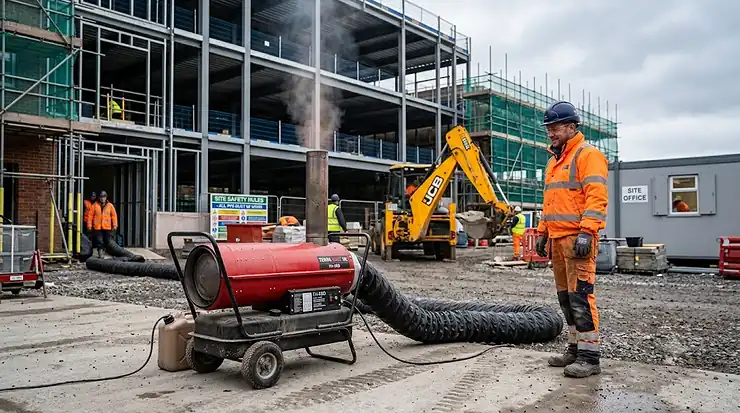
A diesel heater for construction site use isn’t a luxury. It is, increasingly, a legal necessity. Under the Workplace (Health, Safety and Welfare) Regulations 1992 and the Construction (Design and Management) Regulations 2015 (CDM 2015), site managers have a duty to maintain reasonable temperatures, provide heated rest areas, and ensure welfare facilities are fit for purpose. Get it wrong, and you’re not just looking at unhappy workers — you’re looking at improvement notices, prohibition notices, and fines from the HSE.
So the question isn’t really whether you need a diesel fired heater for site. The question is which one, and whether you’ve thought through the difference between direct and indirect firing — a distinction that matters enormously when you’re working in anything other than a wide-open, fully ventilated shell. A diesel space heater that blows warm air alongside combustion fumes is perfect for an open frame structure; put it inside a sealed welfare cabin and you’ve got a carbon monoxide problem before lunchtime.
This guide cuts through the noise: seven real products, all available on Amazon.co.uk, all verified for UK use at 230V, all assessed for different site types and crew sizes. We cover what the specs mean in practice, where the real-world compromises lie, and how to match a portable diesel heater construction scenario to the right output class. Let’s get into it.
Quick Comparison: Top Diesel Heaters for Construction Sites
| Product | Output | Coverage | Fuel | Best For | Price Range |
|---|---|---|---|---|---|
| SIP FIREBALL XD50F | 15kW / 50,000BTU | 350m³ | Diesel/Paraffin | Small site cabins | Under £300 |
| Hyundai HY70DKH | 20kW / 70,000BTU | 496m³ | Diesel/Kerosene | Mid-size shells | £250–£350 |
| JCB-SH70D | 20kW / 70,000BTU | 496m³ | Diesel/Kerosene | General site use | £250–£350 |
| SIP FIREBALL XD100 | 30kW / 100,000BTU | 700m³ | Diesel/Paraffin | Workshops & large frames | £350–£500 |
| Hyundai HY125DKH | 37kW / 125,000BTU | 900m³ | Diesel/Kerosene | Warehouse-scale sites | £350–£500 |
| JCB-SH140D | 37kW / 126,250BTU | 800m³ | Diesel/Kerosene | Commercial fit-outs | £400–£550 |
| SIP FIREBALL XD175 | 51kW / 175,000BTU | 1,230m³ | Diesel/Paraffin | Large industrial sites | £500–£700 |
All models run on 230V/13A UK plug, are available on Amazon.co.uk with Prime-eligible delivery, and operate on standard white or red diesel. Prices include 20% VAT; check current pricing on Amazon.co.uk as costs change frequently.
From the table above, the 20kW band is where most site managers will live — enough grunt for a typical shell or welfare compound without burning through fuel at an eye-watering rate. The jump to 37kW+ makes sense once you’re dealing with large open steel frames or multiple work zones. Budget buyers should note that the SIP XD50F’s 15kW output is only appropriate for genuinely compact spaces; trying to heat a 500m³ shell with it is a bit like warming a cathedral with a candle.
💬 Just one click — help others make better buying decisions too! 😊
✨ Don’t Miss These Exclusive Deals!
🔍 Tap any highlighted product name in this guide to check the latest pricing and availability on Amazon.co.uk. Free delivery is available on orders over £25, and Prime members get next-day dispatch on most of these models — handy when you’ve got a crew arriving Monday morning and it’s currently Sunday.
Top 7 Diesel Heaters for Construction Sites: Expert Analysis
1. SIP FIREBALL XD50F — Best Budget Diesel Heater for Small Sites
For smaller projects — a single-storey extension in a Conservation Area, a phased internal refurb with limited open space — the SIP FIREBALL XD50F is where most tradespeople on a tighter budget should start. At 15kW (50,000BTU), it handles spaces up to 350m³ comfortably, which is roughly equivalent to a generous double garage or a compact welfare compound.
The specs that actually matter: a stainless steel combustion chamber (resistant to the kind of damp-and-knock treatment site kit inevitably gets), a Danfoss-spec air pump, and an integrated thermostat. That thermostat isn’t just a comfort feature — it actively cuts fuel consumption by cycling the unit off once target temperature is hit. On a 12-hour winter shift, that difference is measurable. The 18L tank delivers roughly 12–13 hours of runtime at typical output, meaning one fill per shift without midnight top-ups.
For UK site use, the 230V/13A standard plug is genuinely plug-and-play. No generator modifications, no specialist electrician. It runs on diesel, paraffin, or kerosene — so if white diesel isn’t to hand and someone has leftover kerosene, you won’t be stuck. UK buyers report straightforward ignition even on cold January mornings, which is precisely the point.
✅ Pros:
- Compact and genuinely portable at 16.6kg — one person can move it
- Stainless steel internals resist corrosion in damp British conditions
- Integrated thermostat reduces fuel waste
❌ Cons:
- 350m³ ceiling means it simply won’t cut it on larger shells
- Direct-fired only — not safe for poorly ventilated enclosures
A solid entry point in the under-£300 bracket. For a sole trader doing loft conversions, this is probably your answer.
2. Hyundai HY70DKH — Best All-Round Site Heater Under £350
The name Hyundai conjures images of cars, but the power equipment arm has quietly become one of the more trusted names in UK industrial heating — and the Hyundai HY70DKH is a case in point. At 20kW (70,000BTU), it covers 496m³ and runs on either diesel or kerosene, with a 19L tank delivering roughly 10 hours of continuous use.
What the spec sheet won’t tell you: this heater is genuinely forgiving to operate. The thermostat is simple and responsive, cycling the unit efficiently rather than running flat-out all day. Fuel consumption averages 1.9 litres per hour at full output — less when the thermostat is managing the cycle. On a ten-hour winter day, you’re burning roughly 15–17 litres. At current diesel prices, that’s a manageable running cost, especially compared to electric alternatives trying to heat the same space.
UK buyers — particularly those in coastal areas or exposed northern sites — specifically highlight how well this unit deals with damp conditions, noting it dries out spaces as effectively as it warms them. That’s not incidental: damp is the enemy of concrete curing, freshly plastered walls, and worker morale in equal measure. The 3-year warranty is also notable at this price point; it signals a manufacturer confident enough in build quality to stand behind it.
✅ Pros:
- Dual-fuel flexibility (diesel or kerosene)
- Thermostat included — saves fuel over long shifts
- Strong UK customer reputation and 3-year warranty
❌ Cons:
- Direct-fired: requires adequate ventilation at all times
- At 12.9kg, manageable but not light for a solo operator on scaffolding
In the £250–£350 range, this represents excellent value. A firm recommendation for most general site scenarios.
3. JCB-SH70D — Best for Sites Where Brand Confidence Matters
Electricians, plasterers, and groundworkers all know the JCB name from the big yellow machines dominating UK construction sites. That brand trust extends to the JCB-SH70D — and while the heater itself shares a spec profile with the Hyundai HY70DKH (20kW, 496m³, 19L tank, 1.9L/hr consumption), there’s a difference in how it’s received when site managers are writing up RAMS documents. JCB’s brand pedigree carries weight in procurement conversations.
The JCB-SH70D introduces a flame cone design that directs heat output more deliberately than a standard open-barrel unit. In practice, this means more consistent temperatures across the heated zone rather than a scorching hot spot near the outlet and cold patches at the periphery. It’s a small but meaningful engineering detail. The temperature display showing both room and target temperature is another practical touch that removes guesswork.
The 3-year warranty (1-year commercial) is the same package as Hyundai’s — and JCB’s UK service network is substantial. If something goes wrong, getting replacement parts or warranty service isn’t the challenge it might be with lesser-known brands. UK site feedback notes that assembly is occasionally frustrating (pre-drilled holes can be slightly misaligned), but that the burner itself performs well once it’s up and running. Something to factor into your first Monday-morning setup plan.
✅ Pros:
- JCB brand recognition — valued in commercial procurement
- Flame cone delivers more even heat distribution
- Comprehensive UK parts and service network
❌ Cons:
- Minor assembly complaints from some UK buyers
- Direct-fired only — ventilation is non-negotiable
In the £250–£350 bracket on Amazon.co.uk. A sensible choice when the client or principal contractor cares about brand names on site.
4. SIP FIREBALL XD100 — Best Mid-Range Option for Larger Shells
The SIP FIREBALL XD100 steps things up meaningfully. At 30kW (100,000BTU), it covers 700m³ — that’s a substantial steelwork shell, a large warehouse bay, or a multi-room internal fit-out with doors open. SIP Industrial has been making tools and equipment in the UK for over 56 years, and the Fireball range carries that institutional knowledge in its build.
What justifies the step up in price over the 20kW units? Two things: the pneumatic tyres and the separate fuel pressure gauge. The pneumatic tyres handle uneven site terrain — rubble, mud, timber offcuts — without snagging. On an active construction site, you move heaters constantly; heavy-duty tyres are not a luxury. The separate air pump pressure and fuel level gauges give operators a real-time view of combustion efficiency, useful for catching blockages or fuel delivery issues before they become problems. The stainless steel combustion chamber and cast-aluminium fuel nozzle holder are over-spec’d for this price point in the best possible way.
The ErP (Energy-related Products) compliance marking is worth noting for anyone purchasing through a main contractor where procurement teams check these things. It’s a formal energy efficiency standard, and having it on the paperwork simplifies compliance conversations.
✅ Pros:
- Pneumatic tyres — built for active site movement
- Separate gauges for pressure and fuel level
- ErP compliant — useful for formal procurement
❌ Cons:
- 26L tank means earlier refuelling cycles than the 65L XD175
- Heavier than the 20kW units — two-person move on rough terrain
In the £350–£500 range on Amazon.co.uk. The sweet spot for medium-to-large shells and experienced site managers who want a unit that moves as easily as it heats.
5. Hyundai HY125DKH — Best for Warehouse-Scale Construction Heating
When the brief involves a 900m³ space — think a large industrial steel frame, a distribution facility mid-fit-out, or a multi-bay workshop — the Hyundai HY125DKH is the answer that makes the most sense without crossing into genuinely heavy industrial territory. At 37kW (125,000BTU), it delivers real heat into large, difficult-to-warm spaces quickly, which matters enormously on a British winter morning when you need a crew productive within the first hour.
The dual-fuel capability (diesel or kerosene) gives site managers purchasing flexibility when one fuel type is more readily available or cost-competitive. The adjustable thermostat — and Hyundai’s consistently well-regarded thermostat implementation — means this isn’t a heater that simply runs flat-out until someone switches it off. It manages temperature. That single distinction can reduce fuel consumption by 20–30% over a shift, which at 37kW output represents a meaningful saving.
The 3-year warranty matches Hyundai’s smaller models, which is reassuring at this price point. UK construction buyers note that delivery via Amazon Prime is typically next-day in most mainland postcodes — useful when a hire heater has failed and you need replacement heating before tomorrow’s early start. The 230V/13A UK plug setup means no specialist electrical supply is required; a standard site socket will do.
✅ Pros:
- 900m³ coverage — genuine large-space performance
- Thermostat actively manages fuel consumption
- 3-year warranty; Prime-eligible Amazon.co.uk delivery
❌ Cons:
- Direct-fired: unsuitable for enclosed, poorly ventilated indoor spaces
- Larger and heavier than mid-range units — site movement needs planning
In the £350–£500 bracket. The most practical large-space choice for site managers who don’t want to cross into specialist industrial hire territory.
6. JCB-SH140D — Best for Commercial Fit-Outs and Long-Duration Projects
The JCB-SH140D occupies the same 37kW output class as the Hyundai HY125DKH but distinguishes itself with a larger 38L tank (vs 19L on comparable models), a flame cone heat direction system, and the commercial brand presence that matters on larger contracts. Covering up to 800m³ with a fuel consumption rate of 3.8L/hr, the larger tank translates to approximately 10 hours of operation per fill — which, on a well-managed site, aligns neatly with a standard working day.
The flame cone is the engineering detail worth understanding. Rather than projecting heat in a wide, dissipating blast, the cone shapes output into a directional stream. In practical terms, this means you can position the heater to warm a specific work zone — a tiling crew, a plastering bay, a carpentry area — rather than losing heat through open doorways or up into an uninsulated roof void. For fit-out projects where walls are going up but the building envelope isn’t yet complete, this directed approach makes a real difference to fuel efficiency.
The JCB-SH140D is clearly positioned at commercial buyers — contractors rather than sole traders — and that’s appropriate. The documentation quality, the warranty terms, and the UK parts availability all reflect that positioning. For a principal contractor putting together a RAMS pack, having JCB on the site inventory is a straightforward decision.
✅ Pros:
- 38L tank for all-day operation without mid-shift refuelling
- Flame cone gives directional heat control
- JCB commercial support network across the UK
❌ Cons:
- Slightly heavier build — not a unit for solo one-person sites
- More expensive than equivalent-output Hyundai models
In the £400–£550 range on Amazon.co.uk. Worth every penny if you’re running a multi-trade fit-out project through a British winter.
7. SIP FIREBALL XD175 — Best Heavy-Duty Option for Large Industrial Sites
There are sites where 37kW simply isn’t going to cut it. A multi-bay steel structure. A large commercial shell with a 1,200m³ working volume. A highway construction compound that spans the length of a residential street. For these scenarios, the SIP FIREBALL XD175 is the Amazon.co.uk diesel fired heater for site that belongs in the conversation.
At 51kW (175,000BTU), covering 1,230m³, the XD175 is serious kit. The 65L fuel tank — one of the largest in the consumer-accessible category — runs for approximately 8–9 hours at full output, dropping significantly with thermostat cycling in operation. The integrated thermostat with a remote temperature sensor is the feature that makes this unit genuinely manageable rather than overkill; once the space hits target temperature, the XD175 cycles back rather than continuing to blast. In large spaces, this thermostat behaviour is what separates sensible fuel bills from ruinous ones.
The robust steel frame, heavy-duty pneumatic tyres, and stainless steel combustion chamber are built for sites that use and abuse equipment over extended periods. SIP’s UK manufacturing heritage means parts are accessible and servicing is straightforward. For any construction project where an equipment hire manager is making the purchasing call rather than a sole trader, this is the unit that makes the business case to buy rather than rent.
✅ Pros:
- 65L tank for extended runtime
- Remote temperature sensor gives accurate zone management
- ErP compliant with heavy-duty site construction throughout
❌ Cons:
- Not a unit for casual or small-scale use — the output is excessive for spaces under 600m³
- Investment price point; best amortised over a long project
In the £500–£700 bracket on Amazon.co.uk. The diesel space heater for large building projects where output genuinely matters.
Direct vs Indirect Diesel Heater: The Decision That Changes Everything
Most of the units in this guide are direct-fired — meaning combustion gases mix with the warm air that enters the space. That’s absolutely fine, and highly efficient, provided adequate ventilation exists. Open steelwork frames, compounds with large access doors, marquees, open warehouse bays: all ideal for direct diesel fired space heaters.
The problem arises when the space becomes enclosed. A finished welfare cabin. An office module. An internal floor of a multi-storey where windows aren’t yet fitted but the stairwells are enclosed. In these scenarios, a direct-fired unit produces carbon monoxide. This is not a minor inconvenience. It is a life-threatening hazard, and one that the HSE takes extremely seriously.
For enclosed or partially enclosed spaces, you need an indirect diesel heater — a unit where the combustion chamber is sealed, exhaust gases are vented externally via a flue, and only clean, warm air is delivered into the space. The Arcotherm EC55 (also available on Amazon.co.uk in the mid-range bracket) is the most respected name in this category for UK site use, offering indirect firing, 3-year parts warranty, and ducting compatibility for heat distribution across multiple zones.
The rule of thumb worth remembering: if you can fully close the doors while the heater is running, you need an indirect unit. If the space is always open to the outside — with cross-ventilation you can feel — a direct unit is fine. When in doubt, buy the indirect option. Carbon monoxide doesn’t give second chances.
| Direct Diesel Heater | Indirect Diesel Heater | |
|---|---|---|
| Air quality | Combustion gases present | 100% clean warm air |
| Suitable for | Open/ventilated spaces | Enclosed/indoor spaces |
| Efficiency | Slightly higher | Slightly lower (exhaust loss) |
| Setup | Simple | Requires flue installation |
| Price range | Lower | Higher (£500–£1,200+) |
| Example | SIP FIREBALL XD100 | Arcotherm EC55 |
The direct option is cheaper and simpler; the indirect option is the only safe choice for enclosed spaces. This distinction is non-negotiable on any compliant UK site.
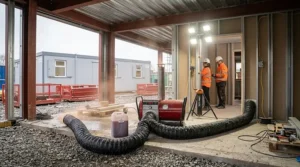
How to Set Up and Run a Portable Diesel Heater Construction Site Safely
Getting maximum life and performance from a fuel-powered site heater comes down to habits formed in the first week. Here’s what experienced site managers do that the manual doesn’t always make explicit:
Positioning. Place the unit at least 2.4 metres (8 feet) from the outlet and 1.2 metres (4 feet) on all sides. Not a guideline — a minimum clearance required by most manufacturers and implied by CDM welfare requirements. Point the outlet towards the workspace, not at combustible materials or other plant.
Ventilation check. Before ignition, verify that adequate air movement exists. On a direct-fired unit, this means doors open or panels removed. You should be able to feel cross-ventilation. Install a carbon monoxide detector — a simple, inexpensive device that gives everyone on site the early warning they need. UK buyers on Amazon frequently pair their heater purchase with a CO alarm; do the same.
First ignition. Allow 5–10 minutes of operation before the space is occupied after a cold start. This burns off any residual moisture from fuel lines and lets the combustion cycle stabilise.
Fuel discipline. Use clean, uncontaminated diesel or kerosene. Water in the fuel tank — common when diesel has been stored in conditions that permit condensation — is the leading cause of ignition failure and burner blockage. Use an appropriate storage container and keep lids secured. Store fuel away from the heater during downtime.
Winter maintenance. At the end of each season, run the tank as low as practically possible and drain the remaining fuel. Clean the air filter. Check fuel lines for cracking. UK winters involve significant temperature swings, and rubber fuel lines that are slightly degraded in October will fail in February. British damp accelerates this process; don’t assume last season’s good performance means this season’s kit doesn’t need attention.
Real-World Scenarios: Matching the Heater to the Site
Different construction projects have different heating needs. Here’s how three typical UK site scenarios map to the products in this guide:
Scenario 1: The Solo Tradesperson — South-West Extension Project. A self-employed builder working alone on a single-storey extension in Cornwall. The shell is 200m³, largely open while the roof is going on. Budget is tight. The SIP FIREBALL XD50F at under £300 is entirely appropriate — 15kW is plenty, it’s portable enough for one person to manage, and the thermostat keeps fuel costs reasonable. Priority: portability and price.
Scenario 2: The Regional Contractor — Multi-Trade Fit-Out in Birmingham. A 10-person crew finishing a commercial ground floor. Spaces are partially enclosed; welfare cabin on site. The welfare cabin needs an indirect heater (Arcotherm EC55 range). The main working area, still open at one end, takes the Hyundai HY125DKH for its 900m³ coverage and thermostat efficiency. Total investment is higher, but welfare compliance under CDM 2015 isn’t optional. Priority: compliance and coverage.
Scenario 3: The Principal Contractor — Large Industrial Shell in Yorkshire. A 20+ person crew working on a 1,000m³ steel-frame commercial unit through December and January. Yorkshire winter temperatures regularly hit -5°C overnight. The SIP FIREBALL XD175 handles the main frame heating; a smaller 20kW unit covers the site compound separately. The investment is offset against productivity gains — warm workers work faster, and the project schedule holds. Priority: output and long-term value.
UK Regulations, Safety Standards & Legal Requirements
Under the Construction (Design and Management) Regulations 2015, principal contractors must provide heated rest areas as part of their welfare obligations — not as a nicety, but as a legal duty. This means any heater used to warm a rest cabin must deliver clean air, which rules out direct-fired units in that application. The HSE can, and does, issue improvement notices on sites where welfare facilities are inadequate.
The Workplace (Health, Safety and Welfare) Regulations 1992 set the baseline: indoor working temperatures should reach at least 16°C for sedentary work (13°C for physically demanding work). While there is no statutory maximum, the duty to assess and manage temperature-related risk is absolute. If workers are working in spaces below these thresholds, the employer is in breach.
For the heaters themselves: look for ErP compliance (Energy-related Products Directive, carried over into UK law post-Brexit), which confirms the unit meets minimum energy efficiency standards. UKCA marking is increasingly required for equipment placed on the UK market; check product listings on Amazon.co.uk for current compliance status, as requirements evolved following the end of the post-Brexit transition period.
A practical note: red diesel (gas oil) is commonly used in construction equipment, but following regulatory changes in April 2022, its use in heating equipment is now restricted. For heating purposes on UK construction sites, white diesel or kerosene should be used unless specific agricultural or industrial exemptions apply. Check HMRC guidance on red diesel eligibility before assuming you can fill a site heater from the plant diesel supply.
Common Mistakes When Buying a Diesel Space Heater for Construction Sites
Experienced site managers make these errors less often than newcomers. Here’s what to watch out for:
Undersizing for the actual space. The coverage figures quoted (700m³, 900m³, etc.) assume a reasonably insulated space. An open steel frame in January with wind penetration through every gap is not a 700m³ space in heating terms — it behaves like a much larger one. If in doubt, size up one output bracket. The thermostat will prevent over-heating and control fuel cost; the floor you gain in cold-snap reserve is invaluable.
Buying a direct-fired unit for an enclosed welfare cabin. This deserves repeating because it is genuinely dangerous and surprisingly common. A direct-fired heater in an enclosed space will produce carbon monoxide. CDM 2015 requires heated rest areas; a direct heater in a sealed cabin satisfies neither CDM nor basic safety requirements. Buy the indirect unit for the cabin. Full stop.
Ignoring the tank size in relation to shift length. A 19L tank at 3.8L/hr consumption gives you 5 hours. If your site runs 10-hour days and there’s no one available to refuel at lunchtime, you need a 65L unit or a separate jerry can workflow. Map fuel capacity to your operating pattern before ordering.
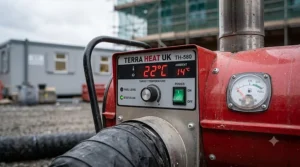
Assuming UK construction pricing will match US equivalents. Many diesel heaters sold on Amazon.com are not available on Amazon.co.uk, or arrive at significantly higher prices once import duties (post-Brexit) and VAT are factored in. The products in this guide are all verified Amazon.co.uk listings at 230V/UK plug standard. Don’t be lured by American spec sheets showing cheaper prices in USD — by the time VAT, import duty, and adapter complications are sorted, the apparent saving evaporates.
FAQ
❓ What is a diesel heater for construction site?
❓ Can I use a diesel space heater inside a welfare cabin on site?
❓ What size diesel heater do I need for a construction site?
❓ Is red diesel still legal for construction site heaters in the UK?
❓ Are these Amazon.co.uk diesel heaters covered by UK warranty?
Conclusion
The right diesel heater for construction site use isn’t the one with the biggest BTU number on the box — it’s the one matched to your space, your ventilation conditions, your shift length, and your legal obligations. Get those four variables right and the choice narrows quickly. Get them wrong and you’re either under-heating a crew into unproductive misery or, in the worst case, putting people at risk from a direct-fired unit in an enclosed space.
Our top pick for most general site scenarios is the Hyundai HY125DKH — the 37kW output covers typical large shells, the thermostat management is among the best in class, and the 3-year warranty provides genuine peace of mind. For smaller sites or tighter budgets, the SIP FIREBALL XD50F delivers solid value without unnecessary complication. And for anything with enclosed rest areas, the indirect Arcotherm EC55 range on Amazon.co.uk is the only responsible answer.
Whatever you choose: install a carbon monoxide detector alongside it. It costs very little and ensures that everyone who arrives on site in the morning also goes home in the evening.
✨ Don’t Miss These Exclusive Deals!
🔍 Check current pricing and availability on all seven diesel heaters by clicking through to Amazon.co.uk. Prime members get next-day delivery on most models — order before midnight for tomorrow morning dispatch on eligible items.
Recommended for You
- Space Heater for Unfinished House: 7 Best UK Picks for 2026
- Best Space Heater for Construction Site UK 2026: 7 Expert Picks
- Best Industrial Electric Heater 3kW UK 2026: 7 Top Picks Reviewed
Disclaimer: This article contains affiliate links. As an Amazon Associate, I earn from qualifying purchases. If you purchase products through these links, we may earn a small commission at no additional cost to you.
✨ Found this helpful? Share it with your mates! 💬🤗
