
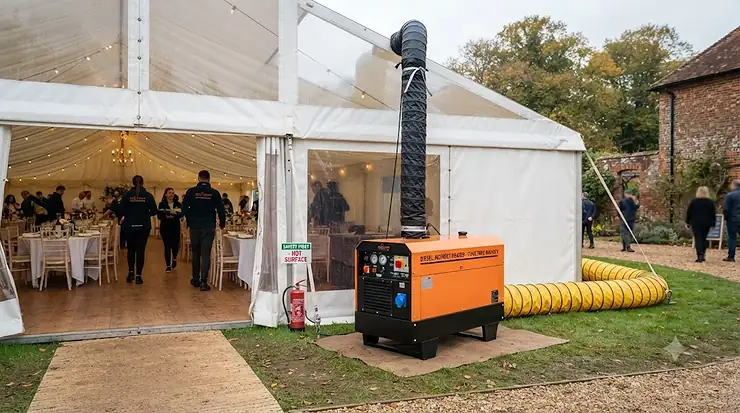
In This Article
Anyone who’s stood in a half-finished building in February, watching their breath fog up faster than the brew in their flask cools down, knows the problem with heating a construction site. Direct-fired heaters are cheap and powerful, but they pump combustion fumes straight into the air you’re breathing, which is a non-starter the moment people, drying materials, or finished surfaces are in the same space. That’s where a diesel indirect heater earns its keep.
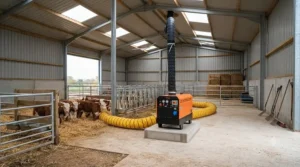
So, what is a diesel indirect heater? It’s a portable heating unit that burns diesel in a sealed combustion chamber, then passes clean ambient air over a heat exchanger before delivering it into the work area via ducting — meaning the warm air you feel never touches the flame or its exhaust, which is vented separately through a flue. The result is genuinely fume-free heating, even in enclosed or poorly ventilated spaces.
This guide breaks down seven real, currently available indirect diesel heaters for the UK trade market — from compact 20kW units suited to a single site cabin through to 50kW-plus heaters built for warehouses and large new-build projects. We’ve grounded every entry in genuine specifications and aggregated trade feedback rather than marketing fluff, and we’ll cover indirect oil heater for construction use, diesel warm air heater building site setups, and the fume-free site heater requirements that matter most when people are working alongside the equipment. As the HSE’s own guidance on carbon monoxide on construction sites makes clear, badly vented combustion equipment is a genuine, ongoing cause of poisoning incidents, which is precisely the risk an indirect, flued heater is designed to remove.
Quick Comparison Table: Diesel Indirect Heaters at a Glance
| Model | Heat Output | Best For | Price Range |
|---|---|---|---|
| Sealey ABI600 | 20kW / 68,000 BTU | Single cabin or small workshop | Around £550-£650 |
| Sealey ABI1000 | 30kW / 102,000 BTU | Mid-size site or marquee | £900-£1,100 range |
| Sealey ABI1000COMBO | 30kW / 102,000 BTU + ducting | Sites needing instant ducting | £1,000-£1,200 range |
| Master BV77E | 20kW / 71,700 BTU | Dual voltage flexibility | £1,100-£1,300 range |
| Arcotherm EC32 | 29kW / 99,000 BTU | Marquee and event hire favourite | £1,300-£1,500 range |
| Sealey ABI1700 | 50kW / 170,000 BTU | Large enclosed builds | £1,600-£1,800 range |
| Thermobile IMA 61 | 65kW heat capacity | Heavy-duty industrial sites | Specialist quote required |
Reading across the table, the clearest split is between compact, self-contained units with their own fuel tank (the Sealey range, Master BV77E) and the larger, externally-fed heaters like the Thermobile IMA 61 that need a separate bulk fuel tank but deliver substantially more heating capacity. For most single-trade site cabins and small marquees, 20-30kW covers the job comfortably; it’s only once you’re heating a genuinely large enclosed shell, or trying to dry out a flooded structure quickly, that the 50kW-plus tier earns its considerably higher price.
💬 Just one click — help others make better buying decisions too! 😊
Top 7 Diesel Indirect Heaters: Expert Analysis
1. Sealey ABI600
The standout feature here is accessibility: at 20kW (68,000 BTU/hr), the ABI600 is the most affordable genuinely indirect heater in this round-up, and it’s built around a stainless steel combustion chamber with fan cooling rather than the thinner mild steel used in some budget rivals. Combustion by-products vent out through the top of the unit via a flue, while the heater itself blows out 100% clean, fume-free warm air — the defining feature that separates it from a basic direct-fired space heater costing roughly the same.
Based on the spec comparison, this is the sensible entry point for a single site cabin, a small workshop, or a marquee that doesn’t need industrial-scale heat. Reviewers consistently note that the built-in thermostat, which switches the heater on and off to maintain a set ambient temperature, makes a genuine difference to fuel economy compared with running a basic heater at full output continuously. Large wheels and a handle mean one person can reposition it around a site without help, which matters more than it sounds once you’re moving kit between phases of a build.
Aggregated trade feedback on the wider Sealey Space Warmer range highlights reliability and straightforward servicing as consistent themes, with the electronic flame control and flame-out cut-off device cited as genuine safety reassurance — the fuel supply cuts automatically if the flame is inadvertently extinguished or fuel runs out. Sections of ducting and a flue system are available separately rather than included as standard, which is worth budgeting for if you need to direct heat into an adjoining enclosed space.
Pros: lowest entry cost for genuine indirect technology, thermostat control, stainless steel combustion chamber. Cons: ducting sold separately; 20kW limits suitability for larger enclosed areas.
Typically priced in the £550-£650 range from UK trade retailers, the ABI600 represents some of the best value in this round-up for anyone heating a single confined space rather than an entire site.
2. Sealey ABI1000
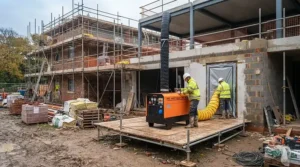
What most buyers overlook about stepping up to 30kW (102,000 BTU/hr) is just how much more headroom it gives you for marginal site conditions — a partially open shell, a leaking roof, or a particularly cold spell, all of which eat into a smaller heater’s effective output. The ABI1000 carries the same stainless steel combustion chamber and Danfoss pump as the smaller ABI600, but with a 50-litre fuel tank delivering meaningfully longer unattended run time between refills.
Here’s what the spec sheet won’t tell you outright: the thermostat doesn’t just save fuel, it also reduces wear on the burner by avoiding constant full-output cycling, which genuinely extends service intervals on equipment that’s often left running unattended overnight on site. The unit ships on wheels for repositioning, and like its smaller sibling, exhausts combustion fumes via a top-mounted flue while delivering only clean warm air into the working space.
Trade reviewers and Sealey’s own product documentation flag the robust build as suited to “challenging areas,” and the electronic flame sensor with flame-out fuel cut-off is standard across this tier, addressing a genuine safety concern around unattended overnight operation. The honest trade-off against the bundled COMBO version below is that ducting and flue sections need to be purchased separately here, which adds to the real total cost if you don’t already hold stock from a previous job.
Pros: meaningful step up in capacity and fuel autonomy, robust stainless steel build, thermostat-controlled operation. Cons: ducting and flue not included; heavier than the ABI600 at a similar footprint.
Generally available in the £900-£1,100 range, the ABI1000 sits as the natural mid-tier choice for contractors regularly heating mid-size enclosed spaces across multiple jobs.
3. Sealey ABI1000COMBO
The genuine differentiator here against the standard ABI1000 is bundling: this version ships with 5 metres of 250mm flexible ducting included as standard, removing the need for a separate purchase and getting a site operational on day one rather than waiting on an additional delivery. The ducting itself is made from glass fibre and rated flame and heat retardant to 300°C, which matters given it’s routed close to a working combustion appliance.
Based on the spec comparison against the standalone ABI1000, the heat output and combustion technology are identical — 30kW, stainless steel chamber, Danfoss pump, electronic flame control — so the entire value proposition rests on convenience rather than performance. For site managers juggling multiple deliveries and tight programme windows, having ducting bundled in removes one more variable from the critical path, which is worth more in practice than the modest price premium over the standalone unit suggests on paper.
Aggregated feedback across the Sealey indirect range consistently praises the robust design ethos running through this tier, with the same flame-out safety cut-off and thermostat control carried over from the standard ABI1000. The honest caveat is that 5 metres of ducting won’t suit every layout — larger or more complex sites may still need to purchase additional ducting sections separately to reach further or around obstructions.
Pros: ducting included out of the box, identical 30kW performance to the standalone ABI1000, fire-retardant ducting rated to 300°C. Cons: 5m ducting may be insufficient for larger or more complex layouts; modest premium over the standalone unit.
Typically priced in the £1,000-£1,200 range, the ABI1000COMBO earns its place for anyone who wants to be heating within minutes of unboxing rather than waiting on a separate ducting order.
4. Master BV77E
Here’s the standout: dual voltage flexibility. While the standard BV77E runs on 230V, Master also offers a BV77EDV dual voltage variant switching between 110V and 240V, which matters enormously on sites where 110V transformers are mandatory under site safety policy. At 20kW (71,700 BTU/hr) with a 36-litre fuel tank, it sits squarely against the Sealey ABI600 on raw output but differentiates itself through build details and a longer-established trade reputation in the indirect heating space.
What most buyers overlook about this model is the three-stage oil filtration system, which genuinely reduces burner fouling and the associated maintenance calls compared with simpler single-stage filtration on some budget rivals — a detail that matters far more over a heater’s working life than it does on a spec sheet at point of sale. The unit is mounted on a trolley with large wheels for repositioning, and Master backs the BV77 range with a three-year warranty as standard, longer than several competitors in this exact output bracket.
Reviewers and trade suppliers consistently describe the BV77 as a “well-built heater,” and aggregated feedback highlights the thermally protected motor as a genuine point of reassurance for continuous operation across long shifts. The trade-off against the cheaper Sealey ABI600 is price — the Master commands a noticeable premium for broadly comparable headline output, justified mainly by filtration quality, warranty length, and dual voltage availability.
Pros: dual voltage option available, three-stage fuel filtration, three-year warranty as standard. Cons: premium price versus comparable-output Sealey models; standard voltage version less flexible for 110V sites.
Sitting in the £1,100-£1,300 range depending on voltage configuration, the BV77E suits contractors who specifically need 110V compatibility or simply prioritise Master’s build reputation over the lowest possible entry price.
5. Arcotherm EC32
The standout feature on the EC32 is genuine industry pedigree: it’s consistently described as the most popular model in Arcotherm’s “Light” series, and it’s a particular favourite within the UK marquee and event hire trade precisely because it can support up to 7.6 metres of ducting — considerably more reach than the Sealey ABI600 or ABI1000 manage out of the box. At 29kW (99,000 BTU/hr) on dual voltage (110V/230V), it slots neatly between the 20kW and 50kW tiers in this round-up.
Based on the spec comparison, what genuinely sets this apart is the automatic burner control with electronic flame sensing via a photo-resistance sensor, paired with a timed post-ventilation cycle that cools the combustion chamber down safely after shutdown rather than leaving residual heat to dissipate passively. The hydrocarbon-resistant polyethylene fuel tank is a sensible material choice for a unit that may sit on site for weeks at a time, and the AISI 430 stainless steel combustion chamber matches the build quality seen on the Sealey ABI1700 further up the output scale.
Trade reviewers consistently flag the EC32’s reach and reliability as the reasons it’s become a firm favourite well beyond its original events-industry niche, with construction firms increasingly specifying it for similar reasons — long ducting runs and dependable automatic operation across unattended overnight cycles. Arcotherm backs the unit with a three-year parts warranty covering the control box, motor, pump, transformer, and fuel solenoid, which is a genuinely comprehensive scope for this price tier.
Pros: longest ducting reach in this round-up, comprehensive three-year parts warranty, dual voltage as standard. Cons: premium pricing reflects the extended ducting capability even if you don’t need the full 7.6m reach.
Generally available in the £1,300-£1,500 range, often bundled with a standard accessory package including ducting and a flue kit, the EC32 makes most sense for sites or events needing to heat a space some distance from where the heater itself can safely sit.
6. Sealey ABI1700
If the ABI600 and ABI1000 cover single cabins and mid-size enclosed spaces, the ABI1700 is built for genuinely large jobs: 50kW (170,000 BTU/hr) is enough to take the edge off a sizeable warehouse shell or a multi-room new-build during the drying-out phase. It carries the same DNA as the rest of the Sealey indirect range — stainless steel combustion chamber, Danfoss pump, electronic flame control — scaled up to deliver substantially more heat per hour.
The real-world meaning of that extra capacity is fewer units needed per site rather than running multiple smaller heaters in parallel, which simplifies fuel logistics and reduces the number of flues and ducting runs that need managing simultaneously. What most buyers overlook here is that stepping up to this output tier doesn’t meaningfully complicate operation — the thermostat control and flame-out safety cut-off work identically to the smaller models, just scaled to a larger fuel tank and burner assembly.
Aggregated trade feedback on the larger Sealey models echoes the smaller units’ reputation for robust, no-nonsense construction, with the same “ROBUST DESIGN — built to perform in challenging areas” positioning carried through the entire range. As with the ABI1000, ducting and flue sections are sold separately, which is a meaningful additional cost to factor in given the larger diameter ducting typically specified for this output level.
Pros: substantial heat output for large or multi-area builds, consistent build quality with the rest of the Sealey range, reduces the number of units needed on bigger sites. Cons: significantly higher upfront cost; ducting and flue purchased separately; overkill for single-room or cabin heating.
Typically priced in the £1,600-£1,800 range, the ABI1700 earns its place for contractors regularly tackling large enclosed spaces where running several smaller heaters would be less practical than one substantial unit.
7. Thermobile IMA 61
The lesser-known but highly respected alternative on this list. Thermobile has specialised in industrial space heating for over fifty years, and the IMA 61 reflects that heritage with a 65kW heat capacity and a heat exchanger rated at 92% efficiency — noticeably higher than several competitors at comparable output. Unlike the Sealey and Master units above, the IMA 61 has no internal fuel tank and must be connected to an external bulk tank, which is a deliberate design choice for heavy, continuous industrial use rather than a limitation.
Based on the spec comparison against the Sealey ABI1700, the genuine differentiator is the choice of fan configuration: the IMA 61 AX uses an axial fan suited to single ducting runs with few bends, while the IMA 61 RAD offers a radial fan delivering up to 300 Pa of pressure, enabling multiple ducting lengths to send warm air to separate locations from a single heater. A built-in tigerloop fuel filter with condensate separator is included as standard, addressing a genuine reliability concern around air ingress in long external fuel lines that simpler heaters don’t need to account for.
If you cannot verify long-term durability data for every site condition this heater might face, the honest takeaway is that Thermobile’s reputation for “extremely robust and tough” construction is well-established across the industrial hire and construction trade, even if it’s typically sourced through specialist heating equipment suppliers rather than general marketplaces. The combustion chamber is heat resistant to 850°C, and lifting eyes alongside large wheels and protective bars are standard, reflecting its design for repeated relocation between demanding sites.
Pros: industry-leading heat exchanger efficiency, choice of axial or radial fan for different ducting needs, built for sustained heavy industrial use. Cons: requires external fuel tank; typically sourced via specialist suppliers rather than general retail; heaviest unit in this round-up at 210-245kg.
Pricing is generally quote-based given the external tank requirement and fan configuration choice, but contractors regularly heating the largest enclosed spaces will find the IMA 61’s efficiency and reach genuinely justify the specialist procurement route.
Top 7 Products: Specs & Value Comparison
| Model | Fuel Tank | Key Feature | Best For |
|---|---|---|---|
| Sealey ABI600 | 20-30L (internal) | Lowest entry cost | Single cabin or small workshop |
| Sealey ABI1000 | 50L (internal) | Extended fuel autonomy | Mid-size enclosed sites |
| Sealey ABI1000COMBO | 50L (internal) | 5m ducting included | Fast site set-up |
| Master BV77E | 36L (internal) | Three-stage fuel filtration | 110V site compatibility |
| Arcotherm EC32 | 42L (internal) | Up to 7.6m ducting reach | Marquees and distant heating zones |
| Sealey ABI1700 | Large internal tank | 50kW high-capacity heating | Large enclosed builds |
| Thermobile IMA 61 | External tank required | 92% heat exchanger efficiency | Heavy industrial, continuous use |
The pattern across this table is fairly clear: internal fuel tanks suit standalone site cabins and short-to-medium jobs where simplicity matters most, while external-tank units like the Thermobile IMA 61 suit longer, continuous industrial deployments where bulk fuel delivery is already part of site logistics. If ducting reach is your priority, the Arcotherm EC32 stands out distinctly from the rest of the table at up to 7.6 metres, while the Sealey ABI1000COMBO wins on pure convenience for getting operational without a separate ducting order.
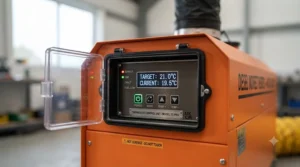
Benefits vs Direct-Fired Diesel Heaters
| Factor | Indirect Diesel Heater | Direct-Fired Diesel Heater |
|---|---|---|
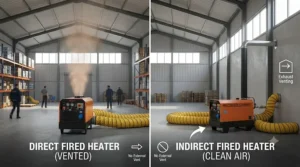
| Air quality | 100% clean, fume-free output | Combustion fumes mix with heated air |
| Suitable for occupied spaces | Yes, including enclosed areas | Generally restricted to well-ventilated spaces only |
| Set-up complexity | Requires flue and often ducting | Simple, no flue required |
| Upfront cost | Higher for equivalent output | Generally lower |
| Best for | Construction drying, occupied site cabins, food-adjacent work | Open workshops, well-ventilated warehouses |
The trade-off is genuinely stark once you see it laid out plainly: direct-fired heaters cost less and set up faster, but they’re simply not appropriate wherever people are working in an enclosed or poorly ventilated space alongside the heater. An indirect diesel heater for construction use exists precisely to solve that problem, and the additional cost of a flue and ducting is the price of being able to heat occupied spaces safely rather than a luxury upgrade. For genuinely open, well-ventilated workshops with no occupancy concerns, a direct-fired unit remains a perfectly reasonable, cheaper choice.
Practical Usage Guide: Getting the Most from Your Diesel Indirect Heater
Positioning matters more than most first-time buyers expect: the heater itself sits outside the space being heated, with ducting carrying warm air in and a flue carrying combustion fumes safely away and upward, well clear of doors, windows, and air intakes. Always run the flue and ducting in as straight a line as practical — every bend in ducting reduces airflow efficiency and adds back-pressure that the fan has to overcome, which on longer runs can noticeably reduce delivered heat at the far end.
Service the burner and filters according to the manufacturer’s schedule rather than waiting for a problem to surface; the three-stage filtration on the Master BV77E and the tigerloop fitted to the Thermobile IMA 61 both exist precisely to reduce the frequency of these issues, but no filter eliminates the need for periodic checks entirely. A common first-month mistake is undersizing the heater for the actual enclosed volume being heated, which leaves the burner running at full output continuously rather than cycling efficiently via the thermostat — a clear sign it’s time to step up an output tier rather than running two undersized units in parallel.
Keep a carbon monoxide detector in any occupied space being heated regardless of how confident you are in the flue installation, since the same engineering controls that make indirect heating safe still depend on correct installation and ongoing maintenance to function as intended.
Real-World Scenarios: Matching the Right Heater to Your Site
Picture a single-trade contractor running a small site cabin through a winter refurbishment job, with no need to heat more than one enclosed room at a time. The Sealey ABI600 fits that brief precisely — lowest entry cost, simple operation, and more than sufficient output for a confined space without unnecessary capacity sitting idle.
Now picture a marquee hire company or events contractor needing to heat a structure some distance from where the heater unit itself can safely sit, perhaps due to access or noise considerations. The Arcotherm EC32’s extended ducting reach of up to 7.6 metres solves that positioning problem directly, which is precisely why it’s become the standard choice across that trade.
Finally, picture a main contractor managing a large new-build shell through the drying-out phase before internal finishes begin, where multiple smaller heaters would mean managing several flues, ducting runs, and fuel refills simultaneously. The Sealey ABI1700 or Thermobile IMA 61 consolidate that into fewer, higher-capacity units, simplifying both fuel logistics and the number of installation points requiring inspection.
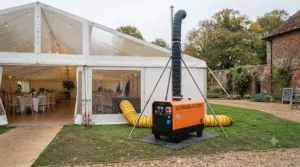
Problem → Solution: Common Diesel Indirect Heater Pain Points
Inadequate heat reaching the far end of long ducting runs is a frequent complaint, and the fix usually lies in choosing a model with a higher-pressure fan rather than simply adding more ducting length — the Arcotherm EC32 and Thermobile IMA 61 RAD both address this through fan design specifically suited to longer or multi-branch ducting runs.
Unexpected fuel costs catch out buyers who haven’t accounted for the switch away from red diesel for most commercial construction use. Under current HMRC rules detailed in GOV.UK’s guidance on rebated fuels in vehicles and machines, most commercial construction work lost entitlement to use rebated red diesel from April 2022, meaning standard white diesel (DERV) is now the legally required fuel for the majority of site-based heating equipment — budget accordingly rather than assuming historical fuel cost figures still apply.
Condensation and fuel contamination in colder weather is a less obvious but genuinely common issue, particularly with externally-fed units; a tigerloop or equivalent condensate separator, as fitted standard to the Thermobile IMA 61, largely resolves this by removing air and moisture from the fuel line before it reaches the burner.
Finally, undersized ducting diameter relative to the heater’s output reduces airflow efficiency significantly. Always match ducting diameter to the manufacturer’s specification rather than using whatever’s available on site, since narrower ducting increases back-pressure and can trip safety cut-offs unnecessarily.
How to Choose the Right Diesel Indirect Heater
- Calculate the actual enclosed volume you need to heat, including ceiling height, rather than estimating by floor area alone, since underestimating volume is the most common cause of disappointing real-world performance.
- Decide whether ducting reach matters for your layout — if the heater can’t sit close to the space being heated, prioritise a model like the Arcotherm EC32 with proven long-run capability.
- Confirm your site’s voltage requirements, particularly if 110V transformers are mandated by site safety policy, and select a dual voltage model like the Master BV77E or Arcotherm EC32 accordingly.
- Check whether an internal fuel tank suits your logistics, or whether an external-tank unit like the Thermobile IMA 61 better matches existing bulk fuel delivery arrangements on larger sites.
- Factor in ducting and flue costs separately unless choosing a bundled package like the Sealey ABI1000COMBO, since these are rarely included as standard on the base unit price.
- Confirm your fuel entitlement under current HMRC rebated fuel rules before assuming red diesel pricing applies to your specific use case.
- Weigh warranty length and filtration quality against pure upfront cost — a three-year warranty and multi-stage filtration, as offered on the Master BV77E and Arcotherm EC32, can reduce total cost of ownership even at a higher initial price.
Diesel Indirect Heater vs Direct-Fired and Electric Alternatives
The honest answer depends heavily on where people will actually be working relative to the heater. A diesel indirect heater for construction wins decisively wherever occupied or enclosed spaces are involved, since the combustion process is entirely separated from the air people breathe. Direct-fired diesel heaters remain cheaper and simpler for genuinely open, well-ventilated workshops with no occupancy concerns, but they’re simply unsuitable wherever air quality matters.
Electric fan heaters avoid combustion fumes entirely and suit smaller spaces with adequate power supply, but they typically can’t match the raw heat output of a 20kW-plus diesel indirect unit without drawing impractical amounts of site power, particularly on smaller generators. For most genuinely large or occupied construction spaces, indirect diesel heating remains the most practical balance of output, fuel logistics, and air quality currently available to UK trade buyers.
Common Mistakes When Buying a Diesel Indirect Heater
Confusing direct-fired and indirect models is a surprisingly frequent error — both are commonly marketed simply as “diesel heaters,” but only genuinely indirect, flued units deliver fume-free air safe for occupied or enclosed spaces, so always confirm flue and ducting provision explicitly before purchase rather than assuming from the word “diesel” alone.
Underestimating ducting and flue costs is another common oversight; buyers regularly budget for the headline heater price without accounting for the genuinely substantial additional cost of ducting, flue sections, and a rain cowl unless these are explicitly bundled, as with the Sealey ABI1000COMBO.
Ignoring voltage compatibility with site safety policy causes real delays — many UK sites mandate 110V equipment, and discovering a heater is 230V-only after delivery means a returns process and lost site time that dual voltage models avoid entirely.
Finally, overlooking ongoing fuel entitlement rules leads to unexpected compliance issues; always confirm current red diesel eligibility for your specific use case rather than assuming historical practice still applies, given the significant 2022 changes to commercial construction entitlement.
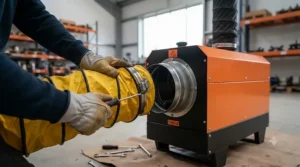
What to Expect: Real-World Performance
In day-to-day site use, the gap between budget and premium indirect heaters shows up most clearly in fuel efficiency and unattended reliability rather than peak heat output — most models in this round-up can hit their rated kW figure, but cheaper units without multi-stage filtration tend to need more frequent burner servicing over a full winter season of near-continuous operation. Trade feedback across multiple models confirms that thermostat-controlled cycling, rather than running heaters at full output continuously, is the single biggest factor in realistic fuel consumption figures matching manufacturer estimates.
Expect genuine flexibility in positioning once ducting is correctly specified — heaters can typically sit several metres from the actual occupied space, addressing both noise and the practical reality that the unit itself needs external air access alongside its flue. Realistic servicing intervals across this category run to roughly once per heating season for moderate use, extending for lighter use and shortening considerably for near-continuous operation through a full winter build programme.
Long-Term Cost & Maintenance
Running cost on a diesel indirect heater is dictated almost entirely by current diesel pricing and the heater’s fuel consumption rate at the output level you’re actually using, rather than its maximum rated capacity — a thermostat-controlled unit running well below maximum output for much of its operating time costs meaningfully less than the headline consumption figure suggests. It’s worth checking current eligibility under the GOV.UK rebated fuels guidance before assuming red diesel pricing applies, since most commercial construction use now requires standard white diesel following the April 2022 rule changes.
Maintenance largely comes down to filter and burner servicing at manufacturer-recommended intervals, alongside periodic inspection of ducting and flue sections for damage or wear, particularly on units moved frequently between sites. Expect a well-maintained mid-range model from the Sealey or Master ranges to deliver eight to ten years of reliable trade use with proper servicing, while premium industrial units like the Thermobile IMA 61 are commonly specified for considerably longer working lives given their construction and the continuous-duty applications they’re designed around.
Safety, Regulations & Compliance Guide
Every diesel indirect heater used in or near an occupied space should be installed with its flue correctly routed well clear of doors, windows, and any air intakes, since the entire safety case for indirect heating depends on combustion fumes genuinely being vented away rather than recirculating back into the working area. The Confined Spaces Regulations 1997, as summarised by the HSE, place specific duties on employers where serious injury risk exists from enclosed working conditions, and heating equipment installation is squarely within scope of the risk assessment these regulations require.
A carbon monoxide detector should be considered standard practice in any space being heated, regardless of confidence in the flue installation, since detection provides an essential backstop against installation errors, flue blockages, or unexpected changes in site conditions. Position the heater itself on stable, level ground with adequate clearance from combustible materials, and never disable or bypass the flame-out safety cut-off fitted as standard across this entire product category. Workers operating outdoors around site heating equipment should also be considered under the HSE’s guidance on outdoor working temperatures, which sets out an employer’s broader duty to manage cold-weather risk beyond the heater itself.
Indirect Oil Heater for Construction: Sizing for Building Sites and New Builds
An indirect oil heater for construction typically needs to account for variable site conditions that a settled warehouse environment doesn’t — partially completed walls, open doorways awaiting fitting, and fluctuating occupancy as trades move through different phases of a build. This means sizing slightly above a theoretical minimum is generally sound practice on active construction sites, since heat loss through incomplete building fabric routinely exceeds what the same floor area would lose once fully weathertight.
The drying-out phase after plastering or screeding is one of the most common applications for an indirect diesel heater building site setup, since maintaining consistent warm airflow without introducing combustion moisture or fumes directly into curing materials genuinely speeds up programme timelines compared with passive drying alone. For this specific use case, models offering reliable thermostat control, such as the Sealey ABI1000 or Master BV77E, allow a consistent target temperature to be maintained automatically overnight without requiring a site visit purely to adjust the heater.
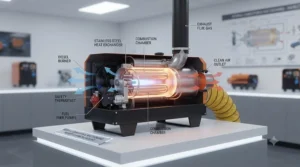
Frequently Asked Questions
❓ What's the difference between a direct and indirect diesel heater?
❓ Can a diesel indirect heater be used indoors safely?
❓ How much ducting reach do indirect diesel heaters typically offer?
❓ Do I need red diesel or white diesel for a site heater?
❓ How often does a diesel indirect heater need servicing?
Conclusion: Finding Your Perfect Diesel Indirect Heater
There’s no single “best” diesel indirect heater, only the right output and configuration for your specific site conditions, fuel logistics, and budget. If you’re heating a single cabin or small enclosed space, the Sealey ABI600 delivers genuine indirect technology at the lowest entry cost in this round-up. If ducting reach into a distant or awkward space matters most, the Arcotherm EC32 remains the trade-favourite solution. And if you’re managing a genuinely large enclosed build, the Sealey ABI1700 or Thermobile IMA 61 consolidate heating capacity into fewer, more manageable units.
What unites every model here is the core promise of indirect technology: fume-free site heater performance that makes warming an occupied or enclosed space genuinely safe, rather than a calculated risk. Whichever model you choose, prioritise correct flue installation, a working carbon monoxide detector in any occupied space, and confirmed compliance with current fuel entitlement rules — the rest comes down to matching output and ducting reach to the job in front of you.
✨ Don’t Miss These Exclusive Deals!
🔍 Take your site heating set-up to the next level with these carefully selected models. Click through to check current pricing and availability before the next cold spell hits your programme. These picks will help you keep your site warm, dry and genuinely fume-free this winter! 🔥⚡
Recommended for You
- Best Diesel Heater for Construction Site in 2026 UK: 7 Expert Picks
- Space Heater for Unfinished House: 7 Best UK Picks for 2026
- Best Space Heater for Construction Site UK 2026: 7 Expert Picks
Disclaimer: This article contains affiliate links. As an Amazon Associate, I earn from qualifying purchases. If you purchase products through these links, we may earn a small commission at no additional cost to you.
✨ Found this helpful? Share it with your team! 💬🤗
