
In This Article
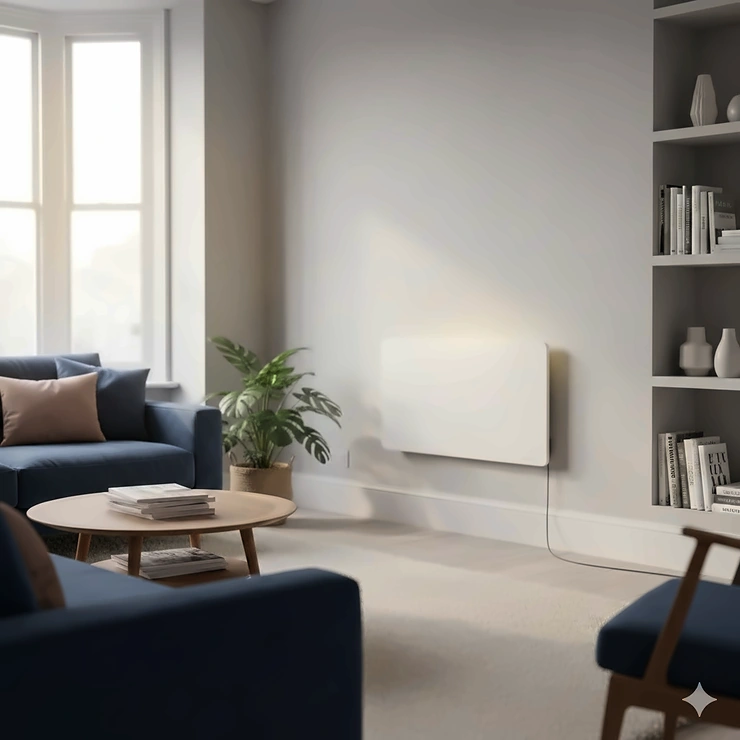
If you’re tired of sky-high heating bills and rooms that never seem quite warm enough, you’re not alone. Traditional convection heaters waste tremendous amounts of energy heating air that simply rises to the ceiling, leaving you chilly and your wallet considerably lighter. But there’s a smarter way to stay cosy this winter.
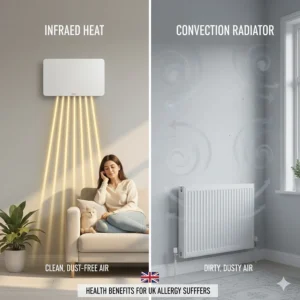
Enter infrared heating – the technology that’s revolutionising how UK homeowners think about warmth. Unlike conventional radiators that heat the air around them, infrared heaters work more like the sun, directing heat precisely where you need it. They warm objects and people directly, creating that delightful feeling of sunshine on your skin even on the greyest British winter day.
I’ve spent the past month researching and comparing dozens of models available on Amazon.co.uk, and I can confidently say that choosing the best infrared heater isn’t just about finding the cheapest option. It’s about understanding your specific needs – whether you’re heating a draughty bathroom, a chilly bedroom, or an entire living space. The right infrared heater can slash your energy bills by up to 60% whilst providing healthier, more comfortable warmth that doesn’t circulate dust or dry out the air.
In this comprehensive guide, I’ll walk you through everything you need to know about selecting the perfect infrared heater for your UK home in 2026, from budget-friendly portable models starting at under £40 to premium smart panels that integrate seamlessly with your décor.
Quick Comparison Table
| Product | Power | Best For | Price Range | Key Feature | Rating |
|---|---|---|---|---|---|
| Klarstein Wonderwall Smart | 350-720W | Small-medium rooms | £100-£160 | WiFi app control | 4.0/5 ⭐ |
| Mirrorstone SunHeat | 180-700W | Versatile installation | £80-£250 | Ultra-slim 22mm | 4.3/5 ⭐ |
| Herschel Comfort | 300-1000W | Premium efficiency | £350-£650 | IEC tested 100% efficient | 4.7/5 ⭐ |
| Klarstein Outdoor 2400W | 2400W | Patios & gardens | £245-£290 | IP44 weatherproof | 4.2/5 ⭐ |
| Mirrorstone Zenos Bar | 1800W | Warehouses & workshops | £165-£195 | Industrial strength | 4.1/5 ⭐ |
| Budget Portable Panel | 320-500W | Single rooms | £35-£70 | Portable & affordable | 4.4/5 ⭐ |
| Mirrorstone NXT Gen WiFi | 350-1200W | Smart home integration | £185-£320 | Custom image printing | 4.3/5 ⭐ |
💬 Just one click – help others make better buying decisions too!😊
Top 7 Infrared Heaters: Expert Analysis
1. Klarstein Wonderwall Smart Infrared Panel
The Klarstein Wonderwall Smart range represents exceptional value in the infrared heating market, offering genuine smart home integration at a price point that won’t make your eyes water. Available in power ratings from 300W up to 720W, these sleek panels cater to rooms ranging from cosy bedrooms to spacious living areas.
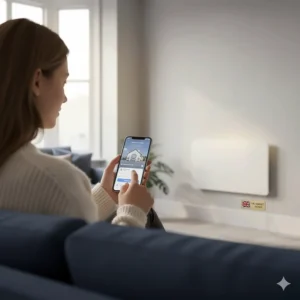
What sets the Wonderwall apart is its comprehensive app control via the Klarstein App Experience. You can adjust temperatures whilst lounging on the sofa, set weekly heating schedules, and even monitor energy consumption in real time. The open window detection feature automatically shuts off the heater if it senses a sudden temperature drop, preventing wasteful heating of the great outdoors – a godsend if you’ve got teenagers who forget to close windows.
UK buyers consistently praise its rapid heating capabilities, with rooms reaching comfortable temperatures within 15-20 minutes. The panels achieve 95% efficiency, converting nearly all electrical input into radiant heat. One customer noted running costs of approximately 7p per hour for the 350W model, making it remarkably economical for supplementary heating.
Price Range: £100-£160 depending on wattage
Key Specs: WiFi enabled, IP24 protection, 95% efficiency, weekly timer, open window detection
✅ Pros:
- Excellent smart features at mid-range price
- Quick installation (under 30 minutes)
- 60-day return policy from manufacturer
❌ Cons:
- Limited warranty compared to premium brands
- Slightly lower efficiency than top competitors
2. Mirrorstone SunHeat Panel Heater
If space-saving design is your priority, the Mirrorstone SunHeat series deserves serious consideration. At just 22mm thick, these ultra-slim panels virtually disappear against your walls, offering powerful heating without monopolising precious room space. The range spans from modest 180W units perfect for under-desk warming to robust 700W models suitable for master bedrooms.
British customers particularly appreciate the versatility of installation options – ceiling mounting, wall mounting, or even integration into suspended ceiling systems. The A++ energy rating translates to genuinely impressive running costs, with the 350W model costing less than 7p hourly according to verified user reports.
The far-infrared technology provides gentle, penetrating warmth that feels remarkably natural. Unlike harsh convection heat that leaves you with a hot face and cold feet, the SunHeat distributes comfort evenly throughout the space. UK buyers with respiratory conditions report noticeable improvements, as the heater doesn’t circulate dust or allergens.
Price Range: £80-£250
Key Specs: Far-infrared technology, IP54 splash proof, 22mm ultra-slim, A++ energy class
✅ Pros:
- Exceptionally slim profile
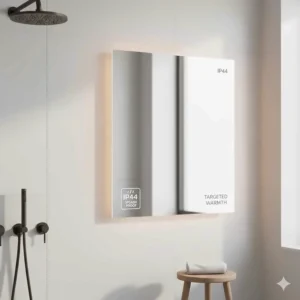
- Splash-proof for bathroom use
- Heats and cools rapidly
❌ Cons:
- No built-in thermostat on budget models
- Ceiling kit sold separately
3. Herschel Comfort Premium Panel
When you’re ready to invest in the absolute best, the Herschel Comfort range stands alone as Britain’s most efficient infrared heating solution. These panels are the only UK-available heaters tested to the rigorous IEC 60675 international standard, achieving verified 100% efficiency at point of use. In practical terms, this means every penny you spend on electricity translates directly into warmth – no waste whatsoever.
The Comfort range includes standard panels, ceiling tiles, and the gorgeous Comfort Colour line available in over a dozen sophisticated hues. Each unit ships with an intelligent remote control and boasts Herschel’s legendary 10-year warranty, demonstrating the manufacturer’s absolute confidence in build quality.
UK customers consistently rate these as the most effective panels for reducing heating bills, with many reporting 50-80% reductions when replacing gas central heating. The premium materials and construction ensure these panels will serve faithfully for decades, making the higher upfront cost a genuine investment rather than an expense.
Price Range: £350-£650
Key Specs: 100% IEC-certified efficiency, 10-year warranty, smart remote, 300-1000W range
✅ Pros:
- Independently verified efficiency
- Industry-leading warranty
- Premium build quality and aesthetics
❌ Cons:
- Significantly higher initial investment
- Professional installation recommended for optimal placement
4. Klarstein 2400W Outdoor Infrared Patio Heater
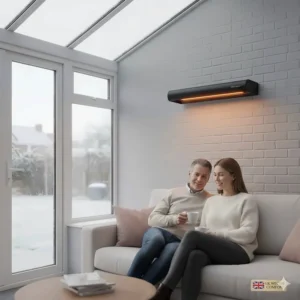
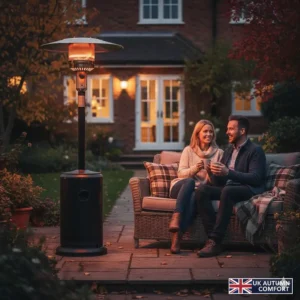
British weather shouldn’t limit your enjoyment of outdoor spaces, and the Klarstein 2400W Outdoor ensures it doesn’t. This enclosed electric patio heater combines serious heating power with smart WiFi control and IP44 weatherproof construction, making it ideal for gardens, conservatories, and covered terraces throughout the UK.
The 2400W output effectively heats areas of approximately 15-20 square metres, depending on exposure and wind conditions. The smart app integration allows you to pre-warm your outdoor space before guests arrive or adjust settings without leaving your comfortable seat. The LED display clearly shows current settings even in bright daylight.
UK buyers particularly value the CO2-free operation – unlike gas patio heaters that belch fumes into the air, this electric model provides clean, instant heat. The enclosed design concentrates warmth more effectively than traditional halogen patio heaters whilst reducing fire risk. One reviewer mentioned successfully using it year-round in their south-facing conservatory, even during harsh winter conditions.
Price Range: £245-£290
Key Specs: 2400W output, IP44 rating, WiFi app control, timer function, LED display
✅ Pros:
- Powerful outdoor heating capability
- Weatherproof construction
- Smart control from smartphone
❌ Cons:
- Effectiveness reduces in very windy conditions
- Requires nearby power outlet
5. Mirrorstone Zenos 1800W Industrial Bar Heater
Workshops, warehouses, and large commercial spaces require heavyweight heating solutions, and the Mirrorstone Zenos Bar Heater delivers precisely that. This 1800W industrial-strength unit measures 1240 x 150 x 67mm and provides concentrated infrared heat suitable for challenging environments where conventional heating would prove woefully inadequate.
The IP44 rating ensures safe operation in areas with moderate water exposure – garages, workshops, even outdoor covered areas. Installation requires basic electrical knowledge as it connects directly to 240V mains supply via Twin & Earth cables rather than a standard plug, ensuring safe operation at the higher power levels.
British business owners praise the rapid warm-up times and targeted heating – workers feel comfortable even in vast, poorly-insulated spaces. Operating at 99% efficiency whilst consuming 60% less energy than equivalent convection heating, the Zenos delivers commercial-grade performance with surprisingly modest running costs.
Price Range: £165-£195
Key Specs: 1800W industrial output, IP44 water resistance, 99% efficiency, direct wiring
✅ Pros:
- Powerful heating for large spaces
- Water-resistant construction
- Professional-grade durability
❌ Cons:
- Requires electrical installation knowledge
- Not suitable for domestic lounges
6. Budget Portable Infrared Panel Heater
Not everyone requires premium features or permanent installation, and budget-friendly portable infrared panels fill this niche admirably. Various brands on Amazon.co.uk offer compact 320-500W models in the £35-£70 range, providing genuine infrared heating without the investment of wall-mounted systems.
These portable units typically feature simple plug-and-play operation, adjustable feet or wall-mounting options, and basic thermostatic controls. Whilst they lack the smart features and sleek aesthetics of premium panels, they deliver authentic infrared warmth at remarkably accessible prices.
UK customers find these ideal for supplementary heating – warming a home office during working hours, providing extra comfort in a draughty bedroom, or heating a bathroom during morning routines. The portability means you can move them between rooms as needed, maximising their utility. Energy consumption remains modest, with typical running costs of 5-10p per hour depending on wattage and electricity tariffs.
Price Range: £35-£70
Key Specs: 320-500W, portable design, basic thermostat, plug-and-play operation
✅ Pros:
- Extremely affordable entry point
- Portable between rooms
- No installation required
❌ Cons:
- Basic aesthetics
- Limited lifespan compared to premium units
- No smart features
7. Mirrorstone NXT Gen WiFi Smart Panel
The Mirrorstone NXT Gen range represents the pinnacle of customisable infrared heating, offering everything from pristine white panels to stunning image-printed designs that transform your heater into a genuine piece of wall art. Available in wattages from 350W to 1200W, there’s a NXT Gen panel suitable for virtually any UK room.
The integrated WiFi and remote control functionality provides comprehensive temperature management, whilst the option for custom image printing means your heater can display family photos, artistic prints, or any image you choose. Mirrorstone offers over 500 pre-designed image panels, but the custom printing service (delivered within 7-10 days) opens limitless possibilities.
British homeowners appreciate the dual functionality – effective heating that simultaneously enhances room aesthetics rather than detracting from them. The premium FIR (far-infrared) coating achieves surface temperatures around 115°C whilst maintaining safe external temperatures. The 5-year manufacturer warranty provides reassurance of quality construction.
Price Range: £185-£320
Key Specs: WiFi & remote control, custom image printing available, 115°C surface temp, 5-year warranty
✅ Pros:
- Unique aesthetic customisation
- Comprehensive smart control
- Excellent warranty coverage
❌ Cons:
- Custom images add cost and delivery time
- Heavier than plain panels (affects installation)
Understanding Infrared Heating Technology
Infrared heating represents a fundamental departure from traditional convection systems that have dominated British homes for decades. To appreciate why infrared heaters offer superior efficiency and comfort, it’s worth understanding the science behind the warmth.
How Infrared Heaters Actually Work
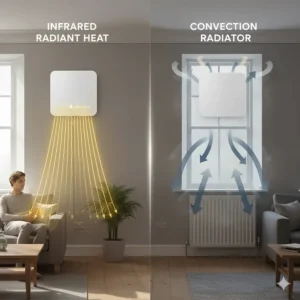
Traditional radiators and convection heaters warm the air molecules around them, creating circulation currents as warm air rises and cool air descends. This process is inherently wasteful – you’re heating cubic metres of air that immediately rises to your ceiling, where it provides precisely zero benefit unless you happen to be a particularly tall individual.
Infrared heaters employ an entirely different approach inspired by the sun itself. They emit infrared radiation – invisible light waves that travel through air without heating it, only releasing their energy when they strike solid objects. When these waves hit your sofa, walls, floor, or indeed your body, they’re absorbed and converted to heat at a molecular level. These warmed objects then gently radiate heat back into the room, creating a comfortable, evenly distributed warmth.
The Swedish National Institute of Radiation Protection has confirmed that infrared heating is completely safe, producing the same type of beneficial warmth used in hospitals to keep newborn babies comfortable. There are no harmful toxins, no dangerous emissions, just pure, natural heat.
Far-Infrared vs Near-Infrared
Not all infrared heating is identical. The spectrum divides into near-infrared (NIR) and far-infrared (FIR), each with distinct characteristics and optimal applications.
Near-infrared operates at higher temperatures and is typically found in outdoor patio heaters and industrial applications. It provides intense, immediate heat perfect for spot-warming specific areas or combating outdoor chill. Think of the glowing orange heat lamps you’ve seen in restaurant patios.
Far-infrared runs at lower surface temperatures but penetrates more deeply into materials and human tissue. Most domestic wall panels employ FIR technology, as it provides gentle, sustained warmth ideal for living spaces. FIR wavelengths are particularly well-absorbed by water molecules, which is why they feel so natural to our bodies (we’re approximately 60% water, after all) and why they’re exceptionally effective at eliminating dampness in buildings.
For UK homes, FIR panels generally prove most suitable, providing comfortable ambient heating without the intense heat spots associated with NIR systems.
The Efficiency Advantage Explained
When manufacturers claim infrared heating achieves 95-100% efficiency, sceptical British consumers rightly wonder how this compares to gas boilers rated at 90-95% efficiency. The distinction lies in what we’re measuring.
A gas boiler’s efficiency rating indicates how much of the fuel’s energy becomes heat rather than escaping through the flue. However, this heat then travels through metres of piping, radiates through metal radiators heating air that rises uselessly, and generally dissipates before reaching you. The actual delivered efficiency – the warmth you feel – drops considerably.
Infrared panels achieve near-perfect electrical-to-heat conversion, with 95-100% of electricity becoming infrared radiation. More crucially, this heat travels directly to you and your furnishings rather than taking the scenic route through your loft space. You feel warm within minutes rather than waiting half an hour for convection currents to establish themselves.
According to research from The Eco Experts, properly specified infrared systems can reduce heating costs by 40-60% compared to traditional electric heating and often compete favourably with gas systems despite electricity’s higher per-unit cost.
Are Infrared Heaters Efficient for UK Homes?
The question of efficiency extends beyond simple percentage figures to encompass real-world performance in British properties, which present unique challenges – draughty Victorian terraces, poorly-insulated post-war construction, modern flats with inadequate heating systems.
Energy Consumption Reality Check
A typical 600W infrared panel operating at current UK electricity rates (approximately 24.86p per kWh as of early 2026) costs roughly 15p per hour to run. Compare this to a 2000W convection heater at 50p per hour, and the advantage becomes immediately apparent. Even accounting for potentially longer running times, infrared heating dramatically reduces consumption.
The key to maximising efficiency lies in proper zoned heating. Unlike central heating systems that warm your entire home whether you’re using all the rooms or not, infrared panels can be controlled room-by-room. Heat only the spaces you’re actually occupying, and your energy bills plummet.
UK homeowners report particular success using infrared for:
- Bathrooms – providing instant warmth for morning routines without heating the room all night
- Home offices – maintaining comfortable working temperatures in a single room rather than the whole house
- Bedrooms – creating cosy sleeping environments without excessive heat elsewhere
- Conservatories – making previously unusable winter spaces comfortable again
Insulation Matters More Than You’d Think
Here’s an uncomfortable truth that applies to any heating system: poor insulation undermines efficiency regardless of the technology you choose. Infrared heating won’t magically compensate for single-glazed windows or uninsulated walls.
However, infrared panels do offer one significant advantage for UK properties with insulation challenges. Because they warm solid objects (including your walls), they can help combat dampness and prevent mould formation – both common issues in British homes. The Home Improvement Energy Scheme notes that infrared heating’s ability to dry wall surfaces makes it particularly beneficial for older properties prone to condensation and mould.
For optimal results, pair your infrared heating with basic energy-efficiency measures:
- Draught-proof windows and doors
- Add loft insulation if you’re below the recommended 270mm
- Consider secondary glazing in period properties where replacement windows aren’t feasible
- Use thermal curtains or blinds to retain heat during cold nights
Comparing Running Costs to Other Systems
Let’s examine realistic annual heating costs for a typical 3-bedroom UK semi-detached property (approximately 95 square metres):
Gas Central Heating: £900-£1,400 annually (depending on usage patterns and gas prices)
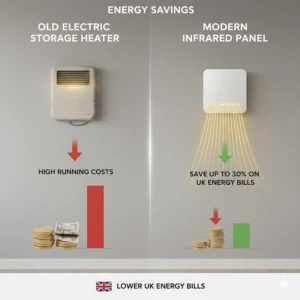
Traditional Electric Storage Heaters: £1,600-£2,200 annually (notoriously expensive)
Infrared Panel System: £720-£1,100 annually (with smart zoned control)
These figures assume similar comfort levels and moderate usage. The infrared system potentially saves £200-£800 annually compared to gas, and over £1,000 compared to storage heaters. Over a decade, these savings easily offset the higher initial installation costs.
It’s worth noting that pairing infrared heating with solar panels can reduce running costs even further. As Wikipedia explains, infrared systems integrate seamlessly with renewable electricity generation, potentially achieving near-zero running costs during sunny periods.
Infrared Heater Health Benefits
Beyond financial savings, infrared heating offers genuine health advantages that particularly matter for British households dealing with damp climates, dust allergies, and respiratory conditions.
Respiratory Health Improvements
Traditional convection heating creates constant air circulation, lifting dust particles, pet dander, pollen, and other allergens from surfaces and swirling them throughout your home. If you suffer from asthma, hay fever, or general dust sensitivity, you’ll know how miserable this makes winter heating.
Infrared systems eliminate this problem entirely. Because they heat objects rather than air, there’s minimal air movement and consequently far less airborne particulate matter. Multiple UK users with asthma report noticeable improvements after switching to infrared heating, with reduced reliance on inhalers and fewer nighttime symptoms.
The lack of air circulation also means infrared heating doesn’t dry out the air as convection systems do. Anyone who’s woken with a parched throat and blocked sinuses after a night of central heating will appreciate the difference. Your mucous membranes remain properly hydrated, maintaining their defensive barrier against airborne pathogens.
Combating Damp and Mould
Damp and mould represent serious health hazards as well as structural concerns for UK properties. Mould spores trigger allergic reactions, asthma attacks, and respiratory infections, whilst damp conditions create breeding grounds for dust mites and bacteria.
Infrared heating tackles these issues through multiple mechanisms. Firstly, the radiant heat warms your walls directly, raising their surface temperature above the dew point where condensation forms. This prevents the moisture accumulation that leads to mould growth.
Secondly, infrared radiation is particularly effective at evaporating moisture already present in building materials. Water molecules absorb infrared wavelengths extremely efficiently, which is why you feel the sun’s warmth so strongly near water. This property makes infrared panels excellent for drying out damp-prone areas like bathrooms, basements, and north-facing rooms.
Research cited by Herschel Infrared demonstrates that infrared heating creates an environment hostile to mould and fungal growth, with many users reporting complete elimination of mould problems that had persisted for years.
Circulatory and Therapeutic Benefits
The gentle, penetrating warmth of far-infrared heating offers therapeutic benefits recognised in medical applications. The heat penetrates approximately 3 inches beneath skin level, warming muscle tissue and promoting vasodilation – the expansion of blood vessels.
This increased circulation delivers more oxygen and nutrients to tissues whilst removing metabolic waste products more efficiently. NASA research has shown that infrared heat therapy promotes cardiovascular health, originally discovered during studies of astronaut physiology. Health experts note potential benefits for:
- Joint pain and arthritis sufferers
- Muscle tension and sports injuries
- Poor circulation and cold extremities
- General stress reduction and relaxation
Whilst infrared heating shouldn’t replace medical treatment, the gentle therapeutic warmth certainly doesn’t hurt – quite the opposite, in fact.
Creating Healthier Indoor Environments
The UK Government’s guidance emphasises maintaining indoor temperatures of at least 18°C for health, with vulnerable individuals requiring 21°C or higher. Infrared heating makes achieving these temperatures more affordable, potentially reducing winter illness and improving quality of life for elderly and vulnerable residents.
The silent operation of infrared panels also contributes to better sleep quality. Unlike noisy boiler clicks, radiator gurgles, or fan heater whirring, infrared heating provides peaceful, silent warmth conducive to restful sleep – particularly beneficial for shift workers, light sleepers, and families with young children.
Infrared vs Convector Heater: Which Wins?
British consumers face a genuine dilemma when upgrading heating systems. Both infrared panels and modern convector heaters claim efficiency, affordability, and effectiveness. Let’s examine how they genuinely compare.
Heating Method and Effectiveness
Convector Heaters: These warm air through heated elements or ceramic plates, relying on natural convection currents to distribute heat. Warm air rises to the ceiling, eventually circulating throughout the room. This process takes time – typically 30-60 minutes to achieve comfortable temperatures in an average room.
Infrared Heaters: These emit infrared radiation that warms objects and people directly, with heat felt within 3-5 minutes. The warmed objects then radiate heat back into the space, creating comfortable ambient temperatures without the lag time.
Winner: Infrared for speed and direct comfort; convectors for thoroughly warming unoccupied rooms.
Energy Efficiency Comparison
Convector Heaters: Typically consume 1,000-2,500W depending on size and settings. Efficiency suffers from heat stratification (warm air at ceiling level) and energy wasted heating empty space. Overall energy utilisation approximately 65-75%.
Infrared Heaters: Generally consume 300-1,200W for comparable room coverage. Achieve 95-100% electrical-to-heat conversion with minimal waste. Targeted heating means smaller wattages provide equivalent comfort.
Winner: Infrared by significant margin, potentially halving energy consumption.
Installation and Flexibility
Convector Heaters: Simple plug-and-play operation, portable between rooms, no installation required. However, floor-standing models occupy valuable space and portable units pose trip hazards with trailing cables.
Infrared Heaters: Wall or ceiling mounted panels require installation (typically 30-60 minutes) but save floor space and provide cleaner aesthetics. Permanent installation limits room-to-room flexibility.
Winner: Convectors for flexibility; infrared for space efficiency and aesthetics.
Running Costs Over Time
Convector Heaters: Lower upfront cost (£25-£100 typically) but significantly higher running costs. A 2000W convector used 4 hours daily costs approximately £180 annually at current rates.
Infrared Heaters: Higher initial investment (£80-£650) but dramatically lower running costs. A 600W infrared panel used 4 hours daily costs approximately £65 annually.
Winner: Infrared for long-term economy; convectors for immediate affordability.
Health and Comfort Considerations
Convector Heaters: Create air circulation that distributes allergens, dry out air, and produce uneven heating with warm ceilings and cool floors. Noisy operation from fans in forced-air models.
Infrared Heaters: Minimal air movement reduces allergens, maintains humidity levels, and provides even comfortable warmth. Completely silent operation.
Winner: Infrared comprehensively for health-conscious consumers.
Maintenance Requirements
Convector Heaters: Require regular cleaning of heating elements and fans. Element replacement needed every few years. Average lifespan 5-8 years.
Infrared Heaters: Virtually maintenance-free with no moving parts. Simply wipe panel surface occasionally. Average lifespan 20-30 years with quality units.
Winner: Infrared for longevity and simplicity.
Infrared Heater Running Costs in the UK
Understanding actual running costs requires moving beyond manufacturers’ claims to examine real-world electricity consumption in British homes with current tariff rates.
Calculating Hourly Running Costs
The formula is straightforward: (Wattage ÷ 1000) × Price per kWh = Hourly cost
With UK electricity averaging 24.86p per kWh (January-March 2026 price cap), here’s what various infrared panels cost hourly:
- 350W panel: 0.35 × £0.2486 = 8.7p per hour
- 600W panel: 0.60 × £0.2486 = 14.9p per hour
- 800W panel: 0.80 × £0.2486 = 19.9p per hour
- 1200W panel: 1.20 × £0.2486 = 29.8p per hour
These figures assume continuous operation at full power. Smart thermostatic controls reduce actual running time by cycling the heater on and off to maintain set temperatures, typically reducing costs by 30-50%.
Realistic Daily and Monthly Costs
Let’s model a typical UK household scenario – a 600W infrared panel in a living room, used 5 hours daily during winter months (November-March):
Daily cost: 5 hours × 14.9p = 74.5p Monthly cost: 74.5p × 30 days = £22.35 Five-month winter cost: £22.35 × 5 = £111.75
Compare this to a 2000W convector heater in the same scenario:
Daily cost: 5 hours × 49.7p = £2.49 Monthly cost: £2.49 × 30 days = £74.70 Five-month winter cost: £74.70 × 5 = £373.50
The infrared panel saves £261.75 annually on a single room. Multiply this across multiple rooms, and the savings become genuinely substantial.
Factors Affecting Actual Consumption
Real-world running costs vary based on several variables:
Room insulation: Well-insulated spaces require less heating duration. Improving insulation can reduce costs by 20-40%.
Desired temperature: Each degree above 18°C increases energy consumption by approximately 10%. Setting thermostats to 19-20°C rather than 22°C saves considerably.
Usage patterns: Heating only occupied rooms versus maintaining whole-house temperatures dramatically impacts costs. Smart scheduling maximises savings.
Thermostat accuracy: Quality thermostatic controls reduce energy waste. Basic thermostats can overshoot by 2-3°C, whilst precision controllers maintain exact temperatures.
External temperature: Colder winters require more heating. Mild UK winters reduce costs; harsh conditions increase them.
Comparing to Gas Central Heating
The comparison between infrared electric heating and gas central heating provokes heated debate (pardon the pun). Gas costs 6.34p per kWh versus electricity at 24.86p per kWh – nearly four times as much. However, this simplistic comparison ignores crucial factors:
System Efficiency: Gas boilers waste energy through flue losses, pipe heat dissipation, and convection inefficiencies. Delivered efficiency typically 70-80%. Infrared panels achieve 95-100% delivered efficiency.
Zoned Control: Gas central heating typically operates whole-house. Infrared panels heat individual rooms on demand. Heating 3 rooms instead of 10 reduces consumption by 70%.
Standing Charges: Gas central heating requires boiler servicing (£80-£120 annually), potential repairs, and eventual replacement (£2,500-£4,500). Infrared panels need virtually no maintenance.
Carbon Footprint: UK electricity grid increasingly renewable (approximately 40% renewable in 2026). Gas heating produces direct carbon emissions. Infrared reduces environmental impact.
For a typical 3-bedroom UK home, total annual costs (including maintenance and capital depreciation):
Gas central heating: £900-£1,400 Infrared panel system: £720-£1,100
The infrared system frequently wins on total cost of ownership, particularly in well-insulated properties with smart usage patterns.
Choosing the Right Infrared Heater
Selecting the best infrared heater for your specific needs requires considering multiple factors beyond simply choosing the highest-rated product. British homes vary tremendously, and what works brilliantly in a modern flat may prove inadequate in a draughty Victorian terrace.
Power Requirements by Room Size
Infrared heater sizing follows straightforward calculations, though insulation quality significantly impacts requirements. As a general guideline for well-insulated UK properties:
Small rooms (up to 10m²): 300-500W
- Box bedrooms
- Small bathrooms
- Home offices
Medium rooms (10-20m²): 600-800W
- Large bedrooms
- Medium living rooms
- Kitchen diners
Large rooms (20-30m²): 900-1200W
- Spacious living rooms
- Open-plan kitchen-diners
- Master bedrooms with ensuite
Very large spaces (30m²+): Multiple panels or 1500W+ models
- Through-lounges
- Converted loft spaces
- Commercial areas
For poorly insulated properties, increase wattage by 30-50%. Period properties with single glazing, solid walls, or inadequate loft insulation require more heating capacity.
Wall-Mounted vs Ceiling-Mounted Installation
The mounting position affects heating effectiveness and room aesthetics differently:
Wall-Mounted Panels:
- Ideal for directed heating towards seating areas
- Better for lower ceilings (under 2.4 metres)
- Easier DIY installation
- More prominent visually (but can be decorative)
- Perfect for supplementary heating zones
Ceiling-Mounted Panels:
- Provides more even room coverage
- Maximises floor space utilisation
- Better for high ceilings (over 2.7 metres)
- Less obtrusive appearance
- Ideal for bathrooms and kitchens
Most manufacturers offer brackets for either configuration. Your choice should reflect room layout, ceiling height, and aesthetic preferences.
Smart Features Worth Paying For
Modern infrared panels offer various smart capabilities, but not all justify their premium pricing:
WiFi App Control (Worthwhile): Remote operation and scheduling genuinely reduce energy waste. Worth £30-£50 premium if you’re regularly away from home or maintain varying schedules.
Open Window Detection (Very Worthwhile): Automatically pauses heating when sudden temperature drops indicate open windows. Pays for itself quickly in avoided waste. Worth £20-£40 premium.
Built-in Thermostat (Essential): Maintains precise temperatures and cycles heating appropriately. Should be standard feature or added separately. Worth £30-£60.
Voice Assistant Integration (Optional): Convenient but not essential. Only worthwhile if you’re already deep in smart home ecosystem. Worth £10-£20 premium maximum.
Multi-Zone Control (Worthwhile for Whole-Home Systems): Controls multiple panels from single interface. Essential for comprehensive installations. Worth £100-£200 for system controller.
Image Panels vs Plain White
Decorative image panels and custom printing options add £50-£150 to panel costs. The question is whether this premium enhances your enjoyment enough to justify the expense.
Choose Image Panels If:
- Aesthetics significantly impact your happiness
- You’re installing in highly visible locations (living rooms, hallways)
- The heater location would otherwise look bare or awkward
- You appreciate personalised décor
Choose Plain White If:
- Budget is primary concern
- Installing in utility areas (bathrooms, bedrooms, offices)
- You prefer minimalist aesthetics
- The panel will be partially obscured anyway
Remember that plain white panels often accept custom image overlays or vinyl wraps if you change your mind later, offering flexibility without initial commitment.
Indoor vs Outdoor Models
Outdoor-rated infrared heaters feature weatherproof construction (IP44 or IP65 ratings) allowing safe operation in exposed conditions. They typically cost 30-50% more than equivalent indoor models.
Outdoor Models Necessary For:
- Patios and decking
- Outdoor dining areas
- Garages and workshops
- Conservatories (if panels will be exposed to condensation)
Indoor Models Sufficient For:
- All interior rooms
- Bathrooms (with minimum IP24 rating)
- Covered outdoor areas with no direct water exposure
Don’t waste money on outdoor ratings if installing in protected environments. Conversely, never use indoor-rated panels in genuinely outdoor locations – it’s both dangerous and voids warranties.
Installation and Maintenance Guide
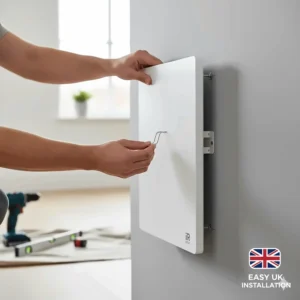
One of infrared heating’s major advantages is straightforward installation requiring no specialist skills or expensive professional fitting. Most confident DIY enthusiasts can mount panels safely in under an hour.
DIY Installation Steps
Tools Required:
- Electric drill with masonry bit (for brick/concrete walls)
- Spirit level
- Tape measure
- Pencil
- Screwdriver or socket set
- Stud finder (for plasterboard walls)
Installation Process:
- Position Selection – Identify optimal mounting location considering furniture placement, power outlet access, and heating requirements. Maintain minimum clearances specified in manual (typically 300mm from ceiling, 150mm from walls).
- Mark Fixing Points – Hold mounting bracket against wall, use spirit level to ensure horizontal alignment, mark screw positions with pencil.
- Drill Holes – Drill appropriate holes for wall type. Brick requires 6mm masonry bit with wall plugs. Plasterboard needs cavity fixings or mounting into studs.
- Attach Bracket – Secure mounting bracket with screws, ensuring firm fixing capable of supporting panel weight (typically 3-8kg).
- Mount Panel – Lift panel onto bracket, ensuring secure engagement. Most panels simply hook onto brackets and may include secondary fixing screws.
- Electrical Connection – Plug panel into nearby socket (most models), or arrange hardwired connection via qualified electrician if required. Never modify electrical connections yourself unless competent.
- Test Operation – Switch on and verify heating function. Allow 5 minutes for panel to reach operating temperature.
Professional Installation Considerations
Whilst DIY installation suits most scenarios, professional fitting proves worthwhile for:
Hardwired Installations: Connecting panels directly to electrical circuits requires Part P certification. Electrician costs £60-£120 typically.
Ceiling Mounting: Particularly in high-ceiling properties where access and weight handling prove challenging. Costs £50-£100 per panel.
Multiple Panel Systems: Coordinating whole-home installations with centralised control benefits from professional expertise. Costs £300-£800 depending on complexity.
Period Properties: Listed buildings or properties with unusual construction materials warrant professional assessment. Costs vary considerably.
Maintenance Requirements
Infrared panels’ chief advantage is near-zero maintenance requirements. Unlike gas boilers demanding annual servicing or convection heaters needing element replacements, quality infrared panels simply work for decades.
Annual Tasks:
- Wipe panel surface with soft cloth to remove dust
- Check mounting security (tighten screws if necessary)
- Verify electrical connections remain secure
5-Year Tasks:
- Inspect cable for any damage
- Test thermostat accuracy with separate thermometer
- Consider professional electrical safety check
That’s genuinely it. No servicing, no parts replacement, no technical maintenance. The simplicity is remarkable.
Safety Considerations
Infrared panels operate safely when installed and used correctly:
Surface Temperature: Panels reach 85-120°C depending on model. Don’t touch operating panels or allow curtains/furniture contact.
Clearance Zones: Maintain manufacturer-specified clearances. Typically 300mm above, 150mm sides, 1 metre in front for optimal safety and effectiveness.
Children and Pets: Position panels above reach of small children. Consider protective guards in nurseries. Pets quickly learn to avoid hot surfaces.
Bathroom Installation: Only use panels rated minimum IP24 for bathrooms. Follow zone regulations – no electrical equipment within 600mm of bath/shower unless specifically designed for bathroom use.
Thermostat Use: Always use thermostatic control to prevent overheating and reduce fire risk. Never cover panels with clothing or towels.
FAQ
❓ How long do infrared heaters last?
❓ Can you leave infrared heaters on overnight?
❓ Do infrared heaters work in poorly insulated homes?
❓ Are infrared heaters cheaper to run than gas central heating?
❓ What size infrared heater do I need for a bedroom?
Conclusion
Choosing the best infrared heater for your UK home in 2026 represents more than simply selecting a heating appliance – it’s an investment in comfort, health, and long-term economy. Throughout this comprehensive guide, we’ve examined everything from basic technology to specific product recommendations, real-world running costs to health benefits.
The standout message is clear: infrared heating offers genuine advantages for British homeowners willing to look beyond traditional heating solutions. The technology delivers faster warmth, superior efficiency, and healthier indoor environments whilst potentially saving hundreds of pounds annually on energy bills. With the UK’s ongoing transition towards renewable electricity and the phasing out of gas boilers, infrared heating positions you perfectly for the future.
For most readers, I’d recommend starting with a single panel in your most-used room – perhaps a living room or home office. Experience the difference firsthand before committing to whole-home installation. The Klarstein Wonderwall Smart offers excellent value with proper smart features, whilst those seeking absolute quality should consider the Herschel Comfort range despite the higher investment.
Remember that infrared heating works best as part of a holistic approach to home comfort. Combine it with basic insulation improvements, smart thermostatic controls, and sensible usage patterns to maximise your savings and satisfaction. The technology isn’t magic, but it is genuinely superior to conventional alternatives for many UK properties.
Your heating choices impact your daily comfort, monthly budget, and environmental footprint for years to come. I hope this guide has equipped you with the knowledge to make an informed decision that serves your household well throughout the cold British winters ahead.
Stay warm, stay comfortable, and enjoy the remarkable feeling of genuine infrared heat.
Recommended for You
- 7 Best Ceramic Heaters UK 2026
- 7 Best Oil Filled Radiators UK 2026: Expert Reviews & Energy Costs
- 7 Best Heated Clothing Brands UK 2026
Disclaimer: This article contains affiliate links. If you purchase products through these links, we may earn a small commission at no additional cost to you. Prices shown are approximate and may vary.
✨ Found this helpful? Share it with your mates! 💬🤗
