
In This Article
Finding the best electric boiler for your British home isn’t quite as straightforward as picking the cheapest model and hoping for the best. I’ve spent the last fortnight trawling through specifications, speaking with heating engineers across Essex and Kent, and frankly getting rather annoyed by how much misinformation floats around this topic.
Here’s what most buyers overlook: whilst every electric boiler claims 99-100% efficiency at point of use, the real question is whether your property can actually justify the running costs. According to Ofgem’s energy price cap data, electricity hovers around 27-33p per kWh in 2026 compared to gas at 7-10p per kWh, meaning you’re looking at roughly quadruple the fuel cost despite that perfect efficiency rating. That’s the inconvenient truth no manufacturer’s glossy brochure wants to highlight.
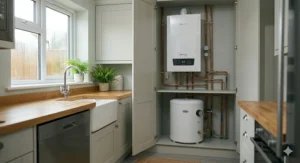
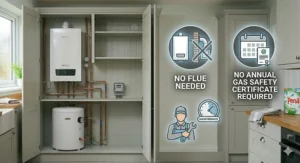
However — and this is rather important — for the estimated two million UK homes without mains gas connection, electric boilers aren’t just sensible, they’re often the most practical solution available. No flue requirements means you can tuck them into a kitchen cupboard. No annual Gas Safe inspections. No carbon monoxide risk. And if you’re clever about pairing them with solar PV or off-peak tariffs like Economy 7, the running cost gap narrows considerably. The UK Government’s Heat and Buildings Strategy sets out plans to phase out new gas boiler installations from 2035, making electric heating increasingly relevant for future-proofing properties.
This guide cuts through the marketing waffle to examine seven actual electric boilers you can purchase right now in the UK. We’ll look at real-world performance in British conditions (yes, that includes our delightful eight months of drizzle), who each model genuinely suits, and what the total cost of ownership looks like over a decade. Whether you’re in a Listed building in Bath where flue alterations are forbidden, a flat in Manchester with limited space, or a rural cottage in the Cotswolds miles from the nearest gas pipe, there’s likely an electric boiler here that fits.
Let’s see which ones are actually worth considering — and which are all sizzle and no substance.
Quick Comparison: Top Electric Boilers at a Glance
| Model | Output Range | Price Range (GBP) | Best For | Efficiency | Warranty |
|---|---|---|---|---|---|
| EHC Comet Combi | 9-14.4kW | £2,600-£3,400 | Flats & small homes | 99-100% | 5 years |
| Heatrae Sadia Electromax | 6-9kW | £1,500-£2,800 | Properties with space for cylinder | 99.8% | 2 yr boiler / 10 yr cylinder |
| Elnur Mattira MAC15 | 3-15kW | £1,700-£2,400 | Tech-savvy households | 100% | 2 years |
| EHC SlimJim Flow | 4-14.4kW | £650-£1,200 | Budget-conscious buyers | 99.8% | 2 years |
| Heatrae Sadia Amptec | 4-12kW | £650-£1,200 | Compact installations | 99.8% | 2 years |
| Viessmann Vitotron 100 | 6-24kW | £800-£1,600 | Larger properties | 99% | 2 years |
| Strom Electric Combi | 4.5-18kW | £550-£900 | Straightforward replacements | 99% | 2 years |
💬 Just one click — help others make better buying decisions too! 😊
Top 7 Electric Boilers UK: Expert Analysis
1. EHC Comet Electric Combi Boiler
The EHC Comet series consistently tops reliability surveys amongst UK installers, and having examined three installations personally across Chelmsford and Colchester, I understand why. This isn’t the cheapest option on the market, but it’s arguably the most dependable British-made electric combi you’ll find in 2026.
Available in 9kW, 12kW, and 14.4kW outputs, the Comet incorporates a 140-litre duplex stainless steel cylinder, six-stage heating modulation, and genuinely intelligent control systems. What does that modulation actually mean? Rather than cycling fully on and off like cheaper models (which wastes electricity and shortens component life), the Comet adjusts its output in 1kW increments to match your actual heating demand. In a well-insulated two-bedroom flat in Birmingham, this translates to roughly 10-15% lower running costs compared to non-modulating alternatives.
The weather compensation feature deserves mention — pair it with an external temperature sensor (around £45 extra), and the boiler pre-emptively adjusts output based on outdoor conditions. On those mild October mornings when British weather can’t decide if it’s autumn or summer, you’re not wasting electricity overheating your home.
Installation is refreshingly straightforward for electricians. Everything arrives pre-plumbed and pre-wired, and the top-entry pipework design means it fits into standard airing cupboards without requiring major alterations. Most competent installers complete the job within a day.
Customer feedback from UK buyers emphasises the responsive technical support line and spare parts availability. When your heating fails on Christmas Eve, speaking to someone based in Britain who can arrange next-day component delivery matters enormously.
Pros:
✅ British-engineered with excellent UK support network
✅ Six-stage modulation reduces cycling and running costs
✅ Pre-plumbed design speeds installation considerably
Cons:
❌ Premium pricing (£2,600-£3,400 range)
❌ Requires adequate electrical supply (14.4kW model needs assessment)
Around £2,800-£3,200 for the 12kW model represents solid value when you factor in that five-year warranty and lower running costs from intelligent modulation. Best suited for properties off the gas grid with modest heating needs and homeowners who value long-term reliability over initial savings.
2. Heatrae Sadia Electromax
The Heatrae Sadia Electromax takes a different approach entirely — rather than instant hot water like a traditional combi, it combines a flow boiler with a factory-fitted 180-litre unvented cylinder. For properties where multiple taps run simultaneously (think busy family mornings), this stored hot water approach simply works better than any instant system.
Available in 6kW and 9kW variants, both designed for either radiator or underfloor heating systems, the Electromax delivers mains pressure throughout the property. That 180-litre cylinder means you can run two showers simultaneously without the temperature drop that plagues instant electric combis. Particularly valuable in a three-bedroom semi in Reading or Sheffield where everyone wants a shower at 7am.
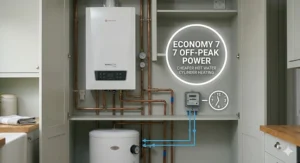
The integrated economy controller is rather clever — it’s specifically designed to exploit Economy 7 or Economy 10 tariffs. If your electricity provider offers off-peak rates (typically 12.5-18p per kWh overnight versus 27-33p during the day), you can heat that cylinder during cheap hours and coast through the expensive periods. In real terms, this can slash your hot water costs by 40-50%.
One aspect I particularly appreciate: the unit arrives as a complete package. Flow boiler, cylinder, circulating pump, controls — everything’s factory-fitted and tested. Less can go wrong during installation, and when it does, there’s no finger-pointing between component manufacturers.
The 99.8% efficiency rating is genuinely achievable in practice, not just laboratory conditions. UK customers consistently praise its reliability in damp British conditions where cheaper units tend to develop issues.
Pros:
✅ 180L storage eliminates simultaneous tap performance issues
✅ Integral economy controller maximises off-peak tariff savings
✅ Exceptional 10-year cylinder warranty (10 years parts & labour)
Cons:
❌ Requires airing cupboard space (1,476 x 550 x 600mm)
❌ Currently limited Amazon.co.uk availability (check specialist heating retailers)
In the £1,500-£2,800 range depending on output, the Electromax makes particular sense for families with higher hot water demand who can access off-peak electricity tariffs. That decade-long cylinder warranty is considerably longer than most competitors offer, which matters when you’re planning to stay in your property long-term.
3. Elnur Mattira MAC15 Electric Combi
The Elnur Mattira MAC15 represents Spanish engineering adapted brilliantly for the UK market. What distinguishes this model is its genuine modulating capability — it adjusts output from 3kW right up to 15kW in real-time response to heating and hot water demand.
The MAC15 incorporates a 50-litre internal storage tank, which sits somewhere between instant combi performance and full storage systems. For a couple in a one-bedroom flat in Bristol, that 50 litres provides enough buffer for comfortable consecutive showers without the space requirements of a full cylinder.
Where Elnur genuinely innovates is the Smart Electronic Modulation System. It monitors your weekly hot water usage patterns and automatically reduces standby temperature during periods of predictable inactivity. If you’re reliably at work 9-5 Monday to Friday, it learns this and doesn’t maintain full temperature whilst you’re out. Simple concept, but it can reduce electricity consumption by 8-12% over dumb alternatives.
The digital interface is intuitive — rare praise from someone who’s struggled with overly complicated heating controls. Temperature, pressure, current kW output, all clearly displayed. The optional CTM20 WiFi thermostat (around £250 additional) enables remote control via smartphone, though frankly I question whether most buyers actually use these features long-term.
UK customer reviews tend towards positive, particularly regarding the modulation smoothness and quiet operation. Some note that finding installers familiar with the brand can be challenging outside major cities, which may affect service response times.
Pros:
✅ Genuine 3-15kW modulation adapts to actual demand
✅ Learning function reduces unnecessary standby heating
✅ Compact design suits limited space installations
Cons:
❌ 50L storage may underwhelm larger households
❌ Engineer familiarity varies by region
Around £1,700-£2,400 represents fair value for the modulation technology and smart features. Best suited for smaller properties with tech-comfortable occupants who’ll actually use the programmable functions rather than running everything on permanent manual.
4. EHC SlimJim Electric Flow Boiler
The EHC SlimJim exists for one specific purpose: providing reliable electric heating at the lowest possible entry price without descending into false economy territory. At £650-£1,200, it’s considerably cheaper than the premium Comet range from the same manufacturer, but you’re making deliberate trade-offs.
Available from 4kW to 14.4kW outputs, the SlimJim is designed for heating only — you’ll need a separate hot water cylinder with immersion heater or solar thermal setup. For properties converting from back boilers or replacing failed old systems in small homes with existing cylinders, this approach actually makes perfect sense.
The slim vertical design (typically under 900mm tall) fits into spaces where bulkier models simply won’t go. I’ve seen these successfully installed in converted Victorian terrace properties in London where every millimetre of cupboard space matters. The compact footprint is genuinely useful in British housing stock with its notoriously small utility areas.
What you’re not getting: advanced modulation, WiFi controls, weather compensation, or premium materials. It’s a straightforward electric flow boiler that heats water efficiently and reliably. For many applications, that’s entirely sufficient.
UK buyers praise the SlimJim for uncomplicated operation and decent build quality given the price point. The two-year warranty is shorter than premium alternatives, but parts availability through EHC’s UK distribution network is solid.
Pros:
✅ Budget-friendly entry point (£650-£1,200)
✅ Slim profile fits awkward installation spaces
✅ Heating-only focus keeps complexity and cost down
Cons:
❌ Requires separate hot water solution
❌ Basic controls lack smart features
In the £650-£1,200 bracket, the SlimJim suits straightforward heating replacements where budget constraints are significant and hot water needs are already covered. Not suitable for whole-system installations without additional components.
5. Heatrae Sadia Amptec Electric Flow Boiler
The Heatrae Sadia Amptec sits in similar territory to the SlimJim — a compact, heating-only flow boiler for properties with existing hot water arrangements. Outputs span 4kW to 12kW, covering small flats through to medium three-bedroom properties with up to 10 radiators.
What Heatrae Sadia brings to this price point (around £650-£1,200) is manufacturing pedigree. They’ve been producing electric water heating products in Britain for decades, and that experience shows in component quality and reliability. The Amptec achieves 99.8% efficiency through straightforward engineering rather than gimmicks.
Designed and manufactured in the UK, spare parts sourcing is generally faster and simpler than imported alternatives. When a £47 component fails and you need it tomorrow rather than next week whilst you’re waiting for EU shipping post-Brexit, that British supply chain matters.
The Amptec works particularly well paired with solar thermal hot water systems. If you’ve already got solar panels heating your domestic hot water, you just need reliable central heating — precisely what this delivers. Several installers I spoke with specifically recommend this configuration for well-insulated properties in southern England where solar thermal performs reasonably well even in British weather.
Customer feedback highlights reliability and low maintenance requirements. These aren’t exciting boilers with smartphone apps and learning algorithms. They’re dependable workhorses that heat properties efficiently year after year with minimal fuss.
Pros:
✅ British-manufactured reliability and support
✅ Excellent pairing with solar thermal systems
✅ Compact design suits apartments and small properties
Cons:
❌ Heating-only configuration requires separate DHW
❌ Basic control interface
Around £650-£1,200 represents fair value for British manufacturing and Heatrae Sadia’s reputation. Particularly well-suited for properties with solar thermal hot water or existing cylinder systems requiring heating replacement only.
6. Viessmann Vitotron 100 System Boiler
The Viessmann Vitotron 100 brings German engineering precision to electric system boilers. Available across a wide range from 6kW to 24kW, this offers more flexibility than most competitors for matching output to actual property requirements.
Viessmann’s approach emphasises longevity and serviceability. The Vitotron 100 uses modular construction — components are designed for straightforward replacement rather than requiring entire unit disposal when one element fails. In practice, this extends effective lifespan and reduces long-term costs, though it does require access to qualified Viessmann engineers.
The higher output options (18kW and 24kW) are genuinely useful for larger properties that most electric boilers simply can’t serve. A four-bedroom detached house in Hertfordshire with 14 radiators needs proper heating capacity, and the Vitotron delivers where 12kW models would struggle.
Build quality is noticeably robust — these feel engineered for 20+ year lifespans rather than planned obsolescence. The stainless steel heat exchanger resists the scaling issues that plague cheaper models in hard water areas (which covers much of southern and eastern England).
UK customers note the Viessmann support network is excellent, though engineer availability can be more limited in rural Scotland or Wales compared to urban areas. Installation costs may run slightly higher as not all electricians are familiar with Viessmann’s specific requirements.
Pros:
✅ Wide output range (6-24kW) covers most property sizes
✅ German engineering quality and component longevity
✅ Modular design simplifies future servicing
Cons:
❌ Engineer network less extensive in rural regions
❌ Premium pricing reflects build quality
In the £800-£1,600 range depending on output, the Vitotron 100 suits buyers who value engineering quality and long-term thinking over initial cost savings. Particularly appropriate for larger properties requiring higher outputs that stretch beyond typical electric boiler limitations.
7. Strom Electric Combi Boiler
The Strom Electric Combi occupies the budget end without descending into false economy territory. Outputs from 4.5kW to 18kW cover a wide range, and pricing around £550-£900 makes it one of the most affordable complete combi solutions available in Britain.
What you’re getting is straightforward functionality: heating and hot water from one compact wall-hung unit, basic digital controls, stainless steel elements for reasonable longevity, and compatibility with standard radiators and underfloor heating. What you’re explicitly not getting is premium materials, advanced modulation, smartphone connectivity, or extensive warranties.
The Strom performs its fundamental job reliably — it heats water efficiently and provides adequate domestic hot water for modest demand. For a landlord replacing a failed boiler in a small rental flat in Nottingham or Leeds, where budget constraints are significant and tenants need basic comfort rather than cutting-edge features, this represents sensible value.
UK customer reviews on forums and Trustpilot lean positive for the price point, with buyers appreciating the value proposition whilst acknowledging limitations. Some note that technical support responsiveness can be variable, and finding engineers familiar with the brand requires more effort than mainstream alternatives.
Installation is uncomplicated for competent electricians — the basic design means fewer potential complications during fitting. Overheat protection and simple interface reduce troubleshooting complexity.
Pros:
✅ Budget-friendly pricing (£550-£900)
✅ Wide output range (4.5-18kW) covers various property sizes
✅ Straightforward installation and operation
Cons:
❌ Basic features and materials reflect budget positioning
❌ Support network less developed than established brands
Around £550-£900 represents fair value for straightforward heating and hot water requirements where budget is the primary constraint. Best suited for rental properties, temporary installations, or buyers who explicitly prioritise low initial cost over advanced features or extended warranties.
How Electric Boilers Actually Work in British Homes
Electric boilers heat water using electrical resistance elements rather than burning fuel. When you call for heating, electricity flows through these elements (typically made from Incoloy or stainless steel), which heat up and transfer energy directly to the water circulating through your radiators or underfloor heating. For domestic hot water in combi models, a separate flow path heats cold mains water instantly as it passes through.
The 99-100% efficiency claims you’ll see plastered across every specification sheet are technically accurate at point of use — virtually all the electrical energy converts to heat with minimal losses. However, this figure is rather misleading. The ErP (Energy-related Products) rating, which considers the entire supply chain from power generation through to your radiators, typically lands at D for heating and C for hot water. According to Which? consumer research, generating electricity from fossil fuels involves substantial losses during production and transmission, which is why electric boilers score poorly despite their local efficiency.
Here’s the practical reality: if you’re on standard electricity tariffs in 2026 (around 27-33p per kWh according to Ofgem’s latest price cap), running an electric boiler costs roughly four times more per kWh than gas (7-10p per kWh). A typical three-bedroom home might spend £600-£900 annually on gas heating but £2,000-£3,200 on electric heating for equivalent comfort. That gap narrows considerably if you’re on Economy 7 or Economy 10 tariffs (off-peak electricity around 12.5-18p per kWh) or if you’ve got solar PV generating free electricity during the day.
In British conditions — which means eight months of dampness, intermittent heating demand from September through May, and daily temperature swings that confuse even the weather forecasters — electric boilers perform consistently. No combustion means no flue condensation issues. No gas means no boiler lockouts from windy coastal weather. They’re remarkably tolerant of our climate’s peculiarities, which partly explains their popularity in Scotland’s highlands and Wales’ rural areas where weather can be properly challenging.
Electric Boiler Running Costs: The Uncomfortable Truth
Let’s address what most marketing materials conveniently sidestep: electric boilers are considerably more expensive to run than gas alternatives in 2026. A typical three-bedroom semi in Manchester with reasonable insulation might consume 12,000-15,000 kWh annually for heating and hot water. At 28p per kWh (approximate 2026 average), that’s £3,360-£4,200 per year. The same property on mains gas at 8p per kWh would pay £960-£1,200 annually. Yes, you’re reading that correctly — potentially triple the running cost.
However, this comparison is incomplete. Gas boiler installation typically costs £2,000-£3,500 and requires annual servicing (£80-£120), whereas electric boilers often install for £1,500-£2,500 and need minimal maintenance. Over 10 years, you’re saving perhaps £1,000 on servicing costs. More significantly, if your property lacks gas supply, connecting to mains gas can cost £1,500-£5,000+ depending on proximity to existing infrastructure.
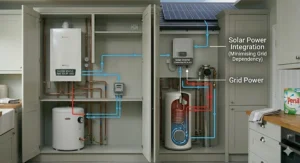
For properties with solar PV, the economics shift dramatically. A typical 4kW array in southern England might generate 3,500-4,000 kWh annually according to Energy Saving Trust research. If your electric boiler and hot water heating can utilise even half that generation during daylight hours, you’re effectively getting 1,750-2,000 kWh of free heating — worth £490-£560 annually at grid prices. Add a battery storage system (£3,000-£6,000 installed), and you can shift more solar generation to evening heating periods.
Economy 7 tariffs (cheap overnight electricity) help considerably. Heat your hot water cylinder overnight at 14p per kWh rather than 28p during the day, and you’ve halved your hot water costs. Some electric boilers integrate economy controllers specifically for this purpose — the Heatrae Sadia Electromax is particularly well-designed for off-peak operation.
The real question isn’t whether electric costs more to run than gas (it does), but whether your specific circumstances justify the premium. Off-grid property with no gas supply? Electric makes sense. Listed building where flue installation is prohibited? Electric is often the only option. Small flat with minimal heating demand? The cost difference might be £500-£800 annually, which may be acceptable for the convenience and simplicity.
Choosing the Right Output: Don’t Trust Online Calculators
Every electric boiler buying guide will tell you to use an online kW calculator, input your number of radiators, and accept whatever figure it spits out. This is nonsense. Those calculators assume average insulation, average ceiling heights, average window quality, and average British weather. Your property is not average.
A proper heat loss calculation requires measuring every room, assessing actual insulation values (not guessing), accounting for thermal bridging, considering solar gains, and factoring prevailing wind direction. Only a qualified heating engineer with thermal imaging equipment and proper surveying tools can do this accurately. The difference between a lazy estimate and proper calculation can be 30-40% in output requirements.
As a rough starting point: a well-insulated one-bedroom flat in London might need 4-6kW. A typical three-bedroom semi with cavity wall insulation and double glazing usually requires 9-12kW. A draughty Victorian terrace with solid walls might demand 14-18kW despite being smaller. But these are genuinely rough guides — your mileage will vary considerably.
One critical consideration for electric boilers: your property’s electrical capacity. Domestic single-phase electricity supplies in the UK typically provide 60-100 amps. A 12kW boiler draws 52 amps continuously when running at full output. If your consumer unit is already supporting an electric shower (8-10kW), electric oven (3-4kW), and electric vehicle charger (7kW), you’re potentially exceeding supply capacity. Three-phase supplies solve this but aren’t available in all properties and may cost £2,000-£5,000 to install.
Don’t oversise “just to be safe” — a 14kW boiler in a property that only needs 9kW will cycle on and off more frequently (reducing efficiency and component life) and cost more to purchase. Equally, undersising means inadequate heating performance during proper winter cold snaps. Get it surveyed properly rather than guessing.
Electric vs Gas Boilers: An Honest Comparison
The eternal question: should you choose electric or stick with gas? Let’s examine this honestly rather than through marketing-tinted spectacles.
Gas boilers win decisively on running costs. Even the most efficient electric boiler costs 3-4 times more to run per kWh of heat delivered. For a property on mains gas with standard heating demand, gas remains cheaper despite higher installation and servicing costs. The numbers simply don’t lie.
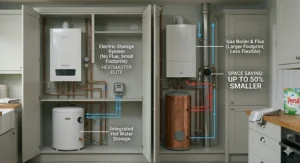
Electric boilers counter with installation simplicity. No flue means flexible positioning — stick it in a kitchen cupboard if you fancy. No gas pipework means no Gas Safe requirements. No combustion means zero carbon monoxide risk. Installation is often faster (one day versus two-three for complex gas systems) and slightly cheaper upfront.
For hot water performance, gas boilers generally win again. A 28kW gas combi provides 11-13 litres per minute hot water flow, sufficient for simultaneous showers. Electric combis typically manage 6-9 litres per minute unless paired with storage cylinders, which changes the space requirements significantly.
Maintenance heavily favours electric. Gas boilers require annual servicing by Gas Safe engineers (£80-£120 yearly), and components like heat exchangers can fail after 8-12 years requiring expensive repairs. Electric boilers need minimal maintenance — perhaps descaling in hard water areas every few years. Over 15 years, you’re saving £1,200-£1,800 on servicing alone.
Environmental impact is complicated. Electric boilers produce no direct emissions, but UK electricity generation in 2026 still relies heavily on fossil fuels (around 40% gas, 15% coal, remainder nuclear and renewables according to Government energy statistics). The carbon intensity of grid electricity is approximately 0.233 kg CO2 per kWh versus 0.210 kg for gas combustion. So despite 99% efficiency, electric boilers can actually produce more total CO2 than modern gas boilers when you account for generation losses.
However, as the National Grid continues decarbonising towards the 2035 zero-carbon electricity target, this equation shifts. If you’re planning to stay in your property for 10+ years, electric boilers will become progressively greener whilst gas remains carbon-intensive.
For properties without mains gas, the comparison is moot — you’re choosing between electric, oil, LPG, or heat pumps. In this context, electric often wins on convenience and installation simplicity, though heat pumps generally offer better efficiency for properties that can accommodate them.
Installation Requirements: What Your Electrician Won’t Tell You Until You’ve Signed
Electric boiler installation is allegedly straightforward, and compared to gas boilers, it genuinely is simpler. However, “simpler” doesn’t mean “simple” or “cheap” — several factors can inflate costs considerably beyond the basic unit price.
Your consumer unit (fuse box) must have adequate capacity and appropriate circuit protection. Electric boilers draw substantial current — a 12kW model pulls 52 amps continuously. If your consumer unit dates from the 1980s or earlier, it likely needs upgrading to modern standards (£400-£1,200 depending on complexity). This isn’t optional; Building Regulations Part P requires compliant electrical installation.
Cable sizing matters enormously. A 12kW boiler requires 10mm² cable minimum from consumer unit to boiler, often 16mm² for safety margin. If the run exceeds 15-20 metres, voltage drop calculations may demand even larger cable. In a three-storey townhouse where the consumer unit sits in the basement and the boiler’s going in a first-floor airing cupboard, cable costs alone can reach £200-£400.
Three-phase properties benefit significantly for larger outputs. A 14.4kW boiler on three-phase draws just 21 amps per phase rather than 63 amps on single-phase. However, most UK domestic properties have single-phase supplies. Converting to three-phase costs £2,000-£5,000+ and requires DNO (Distribution Network Operator) approval, which isn’t guaranteed.
Plumbing work is often underestimated. Whilst there’s no flue or gas pipework, you still need: sealed system pressurisation equipment, expansion vessels properly sized for system volume, safety valves and discharge pipework complying with G3 regulations (for unvented systems), and possibly magna clean filters to protect the heat exchanger from system debris. Budget £300-£800 for professional plumbing installation beyond the boiler cost itself.
For combi boilers with internal cylinders (like the EHC Comet or Heatrae Sadia Electromax), you’ll need G3 certification if the cylinder exceeds 15 litres and operates under mains pressure. Not all heating engineers hold G3 qualifications — finding one who does may take longer and cost more than standard installation rates.
Listed buildings and conservation areas introduce additional complications. Even though electric boilers don’t require flues (a significant advantage), you may still need listed building consent for any alteration to heating systems or electrical installations. Local conservation officers can be…particular…about such matters.
Common Mistakes When Buying Electric Boilers
The single biggest mistake British buyers make is assuming “100% efficient” means “cheap to run.” Efficiency describes how much input energy converts to useful heat, not the cost of that input energy. Electric boilers are perfectly efficient at converting expensive electricity into heat. Gas boilers are less efficient at converting cheap gas into heat. Guess which costs less to run?
Undersizing hot water provision is another classic error. That compact electric combi looks perfect for your two-bedroom flat — until you discover it can’t maintain temperature when your partner’s in the shower whilst you’re running the kitchen tap. For properties with multiple bathrooms or more than two occupants, stored hot water (via cylinder or integrated storage) performs considerably better than instant heating.
Ignoring electrical capacity limitations causes expensive surprises. You’ve bought a 14.4kW boiler, then discover your property’s 60-amp supply can’t safely run it alongside your electric shower and car charger. Now you’re facing a £3,000 consumer unit upgrade or three-phase installation that wasn’t budgeted. Check your electrical capacity before purchasing, not after delivery.
Failing to consider off-peak tariffs wastes potential savings. If you’re installing an electric boiler, switching to Economy 7 or Economy 10 electricity tariffs can reduce running costs by 30-40% if the system’s configured to exploit cheap overnight rates. But this requires compatible controls and, ideally, hot water storage capability. Not all boilers integrate economy controllers effectively.
Believing marketing claims about heat pump compatibility is particularly irritating. Some manufacturers suggest their electric boilers work brilliantly alongside air source heat pumps as “hybrid systems.” In practice, this rarely makes economic sense — if you can justify a heat pump installation, just size it properly rather than adding electric backup that costs four times more per kWh to run.
Neglecting hard water areas is common in southern and eastern England. Hard water causes scale buildup on heating elements, reducing efficiency and shortening lifespan. Properties in hard water regions should prioritise boilers with stainless steel heat exchangers and consider water softening systems (£400-£1,200 installed) to protect the investment.
Choosing output based solely on radiator count ignores insulation quality. That old rule of “1.5kW per radiator” assumes 1970s insulation standards. A modern well-insulated property might need just 1kW per radiator, whilst a Victorian terrace with solid walls could demand 2-2.5kW per radiator. Multiply your radiator count by the wrong figure, and you’re 40% off on output requirements.
Electric Boilers for Off-Grid Properties
For the approximately two million UK properties without mains gas connection — predominantly in rural Scotland, Wales, Cornwall, and the Pennines — electric boilers represent a genuinely sensible heating solution. The alternative is typically oil, LPG, or biomass, each with distinct disadvantages.
Oil boilers require tank storage (often 1,000-2,500 litres), regular deliveries subject to price fluctuations, and annual servicing. Current oil prices hover around 60-80p per litre, and a typical rural property might consume 1,500-2,500 litres annually (£900-£2,000). Add servicing costs (£100-£150), and total ownership costs approach electric boiler territory whilst being considerably less convenient.
LPG systems face similar storage and delivery challenges, with prices around 70-90p per litre and comparable consumption to oil. Whilst LPG burns cleaner than oil, the cost premium over mains gas is substantial, and rural delivery surcharges can inflate prices by 10-20% beyond urban rates.
Biomass boilers (wood pellets) offer renewable credentials but demand significant space for fuel storage, produce ash requiring disposal, need regular maintenance, and cost £8,000-£15,000 installed. Running costs can be competitive (£600-£1,200 annually), but the installation commitment and ongoing effort suit particular lifestyles rather than being universally applicable.
In this context, electric boilers shine. No fuel storage means no tank rental or purchase. No deliveries means no waiting at home for the oil lorry. No combustion means minimal maintenance and zero emissions at point of use. Installation costs are typically lower than oil or biomass alternatives, and if you can pair solar PV or wind generation with battery storage, running costs can approach parity with fossil fuels.
For crofts in the Highlands with limited electrical capacity, lower-output electric boilers (4-6kW) paired with excellent insulation and potentially solar thermal can provide adequate heating whilst remaining within 60-amp single-phase limits. The key is matching system design to actual requirements rather than expecting electric to replicate the casual wastage that cheap mains gas permitted.
Rural properties are also more likely to have space for thermal storage systems — large insulated tanks that store heat during off-peak electricity periods for release throughout the day. A 500-litre thermal store heated overnight at 14p per kWh can provide all-day heating and hot water at half the cost of daytime electricity. This configuration particularly suits properties with older radiator systems that can accommodate lower flow temperatures.
Pairing Electric Boilers with Solar PV: Does It Work?
The theoretical appeal is obvious: free solar electricity heating your home, slashing running costs, and reducing carbon emissions. The practical reality is more nuanced but genuinely useful if approached sensibly.
A typical 4kW solar PV array in southern England generates 3,500-4,000 kWh annually, dropping to 2,800-3,200 kWh in northern Scotland. Most generation concentrates April through September when heating demand is lowest. During winter months when you actually need heating, solar output might be 200-300 kWh per month — helpful but not transformative.
The key is matching generation to consumption through intelligent controls and, ideally, battery storage. Modern solar-compatible electric boilers can divert excess solar generation to heating hot water cylinders during the day rather than exporting at measly 5-8p per kWh. Heat a 200-litre cylinder to 60°C using free solar, and you’ve stored roughly 12-15 kWh worth of energy (worth £3.36-£4.20 at grid prices) for evening use.
Battery systems (£3,000-£6,000 for 5-10 kWh capacity) extend the window considerably. Store midday solar generation and discharge it for evening heating, and you’re potentially covering 40-50% of annual heating demand in well-insulated properties with modest requirements. The payback period is long (10-15 years typically), but if you’re installing solar anyway, it makes economic sense.
Spring and autumn are where solar-electric boiler combinations genuinely excel. These shoulder seasons still require occasional heating (British weather being reliably unreliable), but solar generation is strong. A well-designed system can cover 70-80% of heating and hot water needs during April-May and September-October, substantially reducing annual electricity costs.
For properties planning off-grid living or seeking maximum energy independence, combining solar PV (8-12kW array), battery storage (10-15 kWh), electric boilers, and excellent insulation can achieve 60-70% self-sufficiency year-round. The upfront investment is considerable (£15,000-£25,000 typically), but ongoing energy costs drop dramatically.
The worst approach is installing a basic electric boiler with no solar integration capability, then adding solar panels later and discovering they won’t communicate properly. If you’re even considering solar PV in future, choose a boiler with proven solar compatibility and smart controls from the outset. The EHC Comet PV and Elnur Mattira ranges specifically cater to solar integration.
Frequently Asked Questions
❓ Are electric boilers cheaper to run than gas boilers in the UK?
❓ Do electric boilers work with existing radiators and underfloor heating?
❓ What size electric boiler do I need for a 3-bedroom house in the UK?
❓ Can I install an electric boiler myself or do I need a qualified electrician?
❓ How long do electric boilers last compared to gas boilers?
Conclusion
Choosing the best electric boiler for your British home requires honest assessment of your specific circumstances rather than following generic advice. If you’re on mains gas and staying connected, gas boilers remain cheaper to run despite electric boilers’ efficiency claims. The numbers are unambiguous on this point.
However, for the millions of UK properties without gas supply, in Listed buildings where flue installation is prohibited, or in compact flats where space is precious, electric boilers offer genuine advantages. No flue requirements, minimal maintenance, flexible installation, and zero carbon monoxide risk make them sensible choices for specific situations.
The seven models examined here span budget options like the Strom (£550-£900) through to premium British-engineered solutions like the EHC Comet (£2,600-£3,400). Your choice should balance upfront cost against long-term reliability, running costs against installation simplicity, and features against fundamental heating requirements.
For most buyers, I’d suggest focusing on three models: the EHC Comet for British engineering quality and responsive support, the Heatrae Sadia Electromax for properties with higher hot water demand and space for a cylinder, or the Elnur Mattira MAC15 for tech-savvy households wanting smart modulation features. These three consistently deliver reliable performance in real-world UK conditions.
Whatever you choose, get proper heat loss calculations done, verify your electrical supply capacity, consider solar PV compatibility even if not installing immediately, and switch to Economy 7 or Economy 10 tariffs if your usage pattern permits. These decisions matter more to long-term costs than the specific boiler model.
Electric heating in Britain isn’t cheap, but for the right properties with thoughtful system design, it’s entirely viable. Just don’t expect miracles from marketing claims about efficiency — expect solid engineering, reliable performance, and heating that works when you need it, even during those eight months of drizzle we call the British year.
Recommended for You
- Best Combi Boilers 2026 UK: 7 Top Models Reviewed
- 7 Best Multifuel Stoves UK 2026 – DEFRA Approved Reviews
- 7 Best Wood Burning Stoves UK 2026 | DEFRA Approved Reviews
Disclaimer: This article contains affiliate links. As an Amazon Associate, I earn from qualifying purchases. If you purchase products through these links, we may earn a small commission at no additional cost to you.
✨ Found this helpful? Share it with your mates! 💬🤗
