
In This Article
Choosing between a combi boiler vs system boiler isn’t the sort of decision that keeps most people awake at night, yet it’s one that’ll affect your daily life for the next 10-15 years. I’ve spent over a decade working with British homeowners navigating this exact choice, and I can tell you the stakes are higher than you might think. Pick the wrong type, and you’ll spend years dealing with lukewarm showers during peak morning hours, or watch your energy bills climb because you’ve installed a system that’s fundamentally mismatched to how you actually live.
The British housing market presents unique challenges that make this decision particularly consequential. Our homes tend to be smaller than their American counterparts, our water pressure varies wildly depending on location, and our weather—well, let’s just say the damp British climate doesn’t do any favours for heating systems that aren’t up to the task. A combi boiler might be brilliant for a young couple in a Birmingham flat, but install that same unit in a four-bedroom family home in the suburbs, and you’ll quickly discover why system boilers exist.
What most buyers overlook is that this isn’t purely a technical decision about kilowatts and flow rates. It’s about understanding your household’s rhythms. Do three people try to shower within the same 30-minute window every morning? Do you run multiple taps simultaneously whilst doing laundry? These real-world usage patterns matter far more than any specification sheet. In this guide, I’ll walk you through the genuine differences between combi boilers and system boilers, drawing on real installations across UK homes, current 2026 pricing in pounds, and the practical realities that the marketing brochures tend to gloss over.
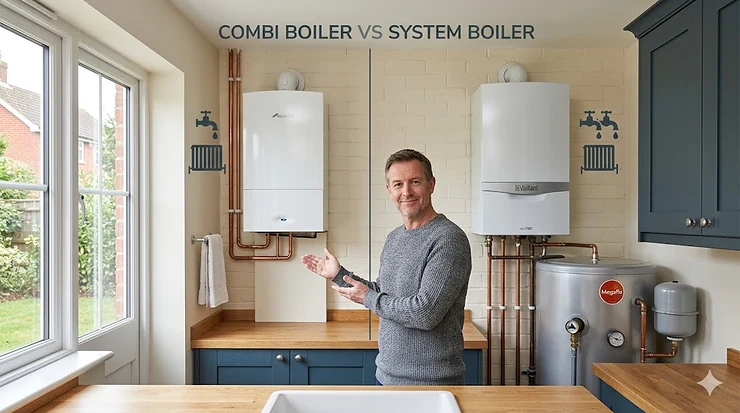
Quick Comparison Table: Combi vs System Boiler at a Glance
| Feature | Combi Boiler | System Boiler |
|---|---|---|
| Hot Water Supply | Instant, on-demand heating from mains | Stored in separate cylinder (150-300L) |
| Space Requirements | Compact, single wall-mounted unit | Requires cylinder space (airing cupboard) |
| Best For | 1-2 bedroom homes, 1 bathroom | 3+ bedroom homes, 2+ bathrooms |
| Simultaneous Usage | Limited – pressure drops with multiple taps | Excellent – maintains pressure across outlets |
| Installation Cost | £2,200-£4,000 | £2,800-£5,000 |
| Running Efficiency | 92-94% (minimal heat loss) | 92-94% (slight cylinder heat loss) |
| Water Pressure Dependency | Relies on mains pressure | Independent of mains pressure |
💬 Just one click — help others make better buying decisions too! 😊
Top 7 Boiler Models Available on Amazon.co.uk: Expert Analysis
1. Worcester Bosch Greenstar 4000 Combi (24kW-35kW Range)
The Worcester Bosch Greenstar 4000 represents what happens when a manufacturer actually listens to British Gas Safe engineers rather than just chasing headline specifications. Available in outputs from 24kW up to 35kW, this combi boiler has become the de facto standard across UK installations, and there are solid reasons why.
At 94% efficiency with an ErP A rating for both heating and hot water, it converts nearly every penny of gas into usable heat. The 35kW variant delivers around 14.4 litres per minute hot water flow rate, which translates to a decent shower for one person—or two if they’re willing to compromise slightly on temperature. What most spec sheets won’t tell you is that the 4000’s real strength lies in its modulation range. It can dial its output down to as low as 20%, meaning it’s not constantly cycling on and off like cheaper models. In a typical British autumn where you need heating but not full blast, this matters enormously for both efficiency and component longevity.
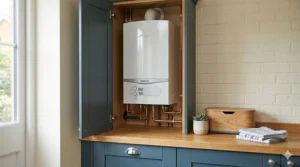
The compact dimensions (700mm x 400mm x 360mm) make it genuinely suitable for kitchen cupboards in British terraced houses where every centimetre counts. Worcester’s UK-based customer service network means replacement parts arrive quickly, and nearly every Gas Safe engineer in the country has fitted dozens of these, so you’re not dealing with obscure diagnostic codes when something does eventually go wrong.
UK customers consistently praise the quiet operation—around 36dB, roughly equivalent to a hushed library conversation. This matters more than you’d think when the boiler’s mounted in a kitchen or utility room adjacent to living spaces. The five-year warranty extends to ten years if installed by an accredited Worcester installer, and the company’s track record for honouring warranty claims is genuinely strong.
Price range: Around £1,100-£1,400 for the unit (installed costs £2,400-£3,200)
✅ Excellent modulation range reduces gas cycling
✅ Compact enough for British kitchen cupboards
✅ Nationwide parts availability and engineer familiarity
❌ Hot water flow drops noticeably with simultaneous usage
❌ Premium pricing compared to budget alternatives
Best for: Small to medium UK homes (2-3 bedrooms, 1 bathroom) where space is limited and running costs matter more than simultaneous hot water delivery.
2. Viessmann Vitodens 100-W System Boiler (19-35kW)
The Viessmann Vitodens 100-W System brings German engineering precision to the British market, and it shows in the details that matter for long-term reliability. Available in outputs from 19kW to 35kW, this system boiler pairs with an unvented hot water cylinder to deliver the consistent, high-pressure hot water that larger UK households actually need.
The standout feature here is the stainless steel Inox-Radial heat exchanger, which handles British hard water far better than the aluminium alternatives you’ll find in budget models. If you live anywhere in the South East, the Midlands, or other hard water regions, this translates to fewer scale-related failures and less frequent descaling maintenance. The seasonal efficiency rating hits 98% when properly matched with an appropriate cylinder and controls—genuinely impressive for a system boiler.
What the marketing materials won’t emphasise is how well this boiler modulates down to meet actual demand. The 35kW model can dial back to just 6kW, meaning it’s not wasting gas cycling on and off during milder weather or when you’re just maintaining hot water temperature. Paired with a 250-litre unvented cylinder, you’re looking at enough stored hot water for three proper showers back-to-back without anyone experiencing the dreaded temperature drop.
The built-in weather compensation and integration with Viessmann’s ViCare app mean you can adjust heating schedules remotely—handy when British weather does its thing and shifts from mild to freezing within 24 hours. The unit itself is compact for a system boiler (725mm x 410mm x 360mm), though obviously you still need space for the cylinder.
Price range: Around £1,300-£1,700 for the boiler unit (installed with cylinder £3,500-£4,800)
✅ Stainless steel heat exchanger handles hard water brilliantly
✅ Exceptional modulation range (98% seasonal efficiency achievable)
✅ Weather compensation adjusts to British climate fluctuations
❌ Requires dedicated space for hot water cylinder
❌ Higher upfront cost than combi alternatives
Best for: Larger UK homes (4+ bedrooms, 2-3 bathrooms) in hard water areas where multiple people need reliable hot water simultaneously and you’ve got space for a cylinder.
3. Vaillant ecoTEC Plus 635 System (19-35kW)
The Vaillant ecoTEC Plus 635 System has earned its reputation through sheer reliability rather than flashy marketing. The 35kW model delivers powerful heating output whilst maintaining 94% ErP A-rated efficiency, and the low NOx emissions (Class 6) make it one of the cleaner-burning options available in the UK market.
What sets this apart from competitors is the remarkably quiet operation—claimed at 33dB but genuinely unobtrusive in real-world installations. When the boiler’s mounted in an airing cupboard adjacent to bedrooms, this matters considerably more than spec sheets suggest. The integrated pump and expansion vessel streamline installation, reducing the number of potential failure points and keeping the overall system complexity manageable.
Vaillant’s approach to controls deserves mention. The boiler integrates seamlessly with Hive, Nest, Salus, and other third-party smart thermostats, meaning you’re not locked into proprietary controls. For UK homeowners who already have a preferred smart home ecosystem, this flexibility is valuable. The seven-year warranty (extendable to ten years with annual servicing) provides reasonable long-term protection, though parts availability isn’t quite as universal as Worcester’s network.
Paired with a 210-litre unvented cylinder, this setup handles morning shower routines in a typical four-bedroom UK household without drama. The rapid heat-up function means the cylinder recharges quickly after heavy usage, minimising the recovery time between demands.
Price range: Around £1,200-£1,600 for the unit (installed with cylinder £3,200-£4,500)
✅ Exceptionally quiet operation (33dB in practice)
✅ Third-party control compatibility (not proprietary lock-in)
✅ Low NOx emissions meet future environmental standards
❌ Parts network not as extensive as Worcester
❌ Warranty requires annual servicing commitment
Best for: Medium to large UK homes where quiet operation matters (bedrooms near boiler location) and you want flexibility with smart controls.
4. Ideal Logic Max System (18-30kW)
The Ideal Logic Max System delivers surprising value for landlords and budget-conscious homeowners who need a system boiler without the premium pricing. Available in 18kW, 24kW, and 30kW variants, this British-manufactured unit focuses on fundamentals rather than bells and whistles.
At 94% efficiency, it matches the premium brands on paper, and the pre-installed filling link with integrated pressure gauge simplifies both installation and future maintenance. The stainless steel heat exchanger provides decent corrosion resistance, though it’s not quite the same quality as Viessmann’s Inox-Radial technology. For soft to medium water hardness areas, this makes little practical difference over the boiler’s lifespan.
What makes the Logic Max particularly suited to the UK rental market is the ten-year warranty (when registered within 30 days of installation). This provides landlords with extended protection against major component failures, reducing the risk of unexpected capital expenditure between tenancies. The boiler’s compact footprint (730mm x 440mm x 360mm) means it fits into most standard airing cupboards without requiring structural modifications.
The integrated high-efficiency pump and automatic air vent reduce the external components needed, keeping the installation straightforward and the total system cost reasonable. Paired with a 180-litre cylinder, the 24kW model handles a typical three-bedroom UK rental property’s hot water demands without issue.
Price range: Around £850-£1,150 for the unit (installed with cylinder £2,800-£3,800)
✅ Ten-year warranty provides extended landlord protection
✅ Competitive pricing for system boiler segment
✅ British-manufactured with straightforward servicing
❌ Heat exchanger quality a step below premium brands
❌ Limited smart control integration options
Best for: Budget-focused homeowners and landlords with rental properties in soft water areas who need reliable system boiler performance without premium costs.
5. Baxi 800 Combi (24-32kW)
The Baxi 800 Combi represents British manufacturing at a price point that makes financial sense for cost-conscious households. Available in 24kW, 28kW, and 32kW outputs, this combi boiler delivers reliable heating and hot water without the premium associated with German engineering.
The 28kW model—the sweet spot for most British homes—provides around 11.4 litres per minute hot water flow rate. This translates to one proper shower at a time, or acceptable performance with a shower and a tap running simultaneously if you’re not too demanding about temperature consistency. The built-in Adey Micro2 magnetic filter is a genuinely useful inclusion that protects the heat exchanger from sludge and debris in older UK central heating systems.
The ten-year parts and labour warranty (when registered and serviced annually) represents strong coverage for the price bracket. Baxi’s UK service network is extensive, and parts availability is generally good, though not quite matching Worcester’s ubiquity. The unit’s compact dimensions (700mm x 395mm x 290mm) make it one of the slimmer combis available, helpful in British homes where kitchen cupboard space is perpetually tight.
What the spec sheet won’t tell you is that the 800 Series handles British weather cycling reasonably well. The frost protection activates reliably during those unexpected late April cold snaps, and the condensate drain design copes with British damp without frequent freezing issues—a surprisingly common problem with poorly designed drain traps.
Price range: Around £750-£1,100 for the unit (installed costs £2,200-£2,900)
✅ Included magnetic filter protects against system sludge
✅ Ten-year warranty at budget-friendly price point
✅ Compact design suits tight UK kitchen installations
❌ Hot water flow rate adequate rather than exceptional
❌ Build quality noticeably below premium competitors
Best for: Budget buyers in smaller UK homes (2-3 bedrooms, 1 bathroom) who need reliable combi performance and long warranty coverage without premium pricing.
6. Alpha E-Tec NX Combi (24-32kW)
The Alpha E-Tec NX Combi occupies an interesting middle ground between budget and mid-range, offering some premium features whilst keeping costs manageable. The 28kW model delivers 12.5 litres per minute hot water flow—genuinely competitive with more expensive alternatives.
The standout feature is the high-efficiency Grundfos pump and hydroblock assembly, which provides excellent modulation and quiet operation. The boiler can dial down to 25% of maximum output, reducing cycling and improving efficiency during the milder months that dominate much of the British year. The backlit LCD display is clearer than budget competitors, making fault diagnosis and settings adjustments straightforward for homeowners.
Alpha’s approach to compatibility deserves mention. The boiler integrates with Hive, Nest, Tado, and other major third-party controls without requiring proprietary adapters or expensive add-ons. For UK homeowners who’ve already invested in a smart thermostat ecosystem, this saves both money and complexity.
The seven-year warranty (with registration and servicing) is reasonable but not exceptional. Parts availability through Alpha’s UK network is generally good, though regional coverage isn’t quite as comprehensive as Worcester or Baxi. The frost protection system is well-designed for British winters, with multiple sensors ensuring the boiler doesn’t get caught out by unexpected temperature drops.
Price range: Around £850-£1,250 for the unit (installed costs £2,300-£3,100)
✅ High-efficiency Grundfos pump delivers excellent modulation
✅ Third-party control compatibility without premium adapters
✅ Competitive hot water flow rate for the price
❌ Regional parts availability less comprehensive
❌ Seven-year warranty shorter than budget competitors
Best for: Mid-budget UK homeowners in 2-3 bedroom properties who want some premium features (particularly smart control compatibility) without paying top-tier prices.
7. ATAG iS35 System Boiler (25-35kW)
The ATAG iS35 System represents the premium end of the UK market, offering exceptional build quality and one of the longest warranties available—up to 15 years with annual servicing. The Dutch manufacturer’s approach prioritises longevity over low upfront cost, and the engineering reflects this philosophy.
The 35kW output delivers powerful heating whilst maintaining 95% efficiency, and the boiler modulates down to an impressively low 15% of maximum output. This exceptional turndown ratio means it adapts brilliantly to British weather variability, running efficiently whether it’s maintaining 18°C in autumn or battling through a February cold snap.
The stainless steel heat exchanger is overbuilt compared to competitors, with substantially thicker materials that handle thermal cycling and hard water scaling far better than aluminium alternatives. For UK homeowners in hard water regions planning to stay in their property long-term, this translates to meaningfully lower lifetime costs despite the higher upfront investment.
What sets ATAG apart is the installation quality control. The warranty requires installation by ATAG-accredited installers who’ve completed specific training, ensuring the system is commissioned properly. This reduces the risk of installation-related failures that void warranties—a surprisingly common issue with complex system boiler setups.
Paired with a 250-litre unvented cylinder, this combination handles even demanding UK households with multiple bathrooms and high simultaneous usage without compromising performance. The recovery time after depleting the cylinder is impressively quick, minimising the wait between heavy usage periods.
Price range: Around £1,500-£2,000 for the unit (installed with cylinder £3,800-£5,200)
✅ Industry-leading 15-year warranty with servicing
✅ Exceptional build quality and thermal cycling resistance
✅ Outstanding modulation range (down to 15% output)
❌ Premium pricing limits market to long-term homeowners
❌ Requires ATAG-accredited installer (limits installer choice)
Best for: Long-term UK homeowners in larger properties (4+ bedrooms) in hard water areas who prioritise longevity and warranty coverage over upfront cost savings.
Understanding Combi Boilers: How They Actually Work in British Homes
Combi boilers—short for combination boilers—represent the evolution of British home heating towards compact efficiency. Unlike traditional systems requiring separate hot water cylinders and cold water tanks, a combi unit handles both central heating and instantaneous hot water production from a single wall-mounted box. When you turn on a hot tap, cold water flows directly from the mains through a powerful heat exchanger inside the boiler, emerging heated to your desired temperature within seconds.
This on-demand approach eliminates the standby heat losses associated with storing hot water, contributing to the 92-94% efficiency ratings modern combis achieve. According to the Energy Saving Trust, combi boilers heat water directly from the mains as needed, avoiding the energy required to keep hot water stored and eliminating potential heat loss over time. For British homes built in the last two decades, combis have become the default choice, installed in roughly 60% of UK properties. Under UK Building Regulations Part L, all new gas boilers must be condensing models with a minimum 92% ErP A rating, ensuring high efficiency standards. The appeal is straightforward: no cylinder stealing space from airing cupboards, no cold water tank occupying loft space, and immediate hot water without waiting for a tank to heat up.
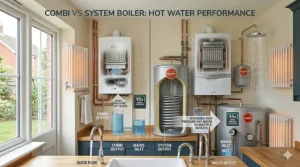
However, the physics impose genuine limitations that matter in real-world usage. A typical 28kW combi delivers around 11-12 litres per minute when heating water from cold British mains temperature (usually 10-15°C) to a comfortable 40-42°C shower temperature. Run a second tap simultaneously, and that flow rate halves between the two outlets. In a household where one person’s showering whilst another fills the kitchen sink, you’ll notice the compromise immediately.
The other consideration UK buyers often overlook is mains water pressure dependency. Combis rely entirely on your incoming mains pressure to deliver hot water. In areas with poor mains pressure—not uncommon in rural locations or at the end of long supply runs—even a powerful combi can’t create pressure that doesn’t exist in the first place. This is why Gas Safe engineers should always check your mains pressure before recommending a combi installation.
Combi Boiler Advantages in British Context
The space-saving benefits of combi boilers matter enormously in British housing stock. Victorian terraces, 1930s semis, and modern new-builds all tend towards compact dimensions compared to international standards. Reclaiming the airing cupboard space previously occupied by a hot water cylinder provides valuable storage in homes where every square metre counts.
Installation costs typically run £2,200-£4,000 for a straightforward replacement, making combis the most budget-friendly option for most UK households. The simpler installation requirements—no cylinder, no additional pipework, fewer components overall—translate to lower labour costs and shorter installation times. Most combi replacements complete within a single day, minimising disruption.
The efficiency advantages are genuine rather than marketing hyperbole. By heating water only when needed, combis eliminate the standing losses that plague cylinder-based systems. Even a well-insulated hot water cylinder loses heat gradually, requiring the boiler to periodically reheat the stored water whether you’re using it or not. This matters particularly for households with irregular usage patterns—single occupants working long hours, couples who travel frequently, or anyone whose hot water demand varies significantly day-to-day.
Modern smart controls pair brilliantly with combi boilers. Apps like Hive, Nest, and Tado allow you to adjust heating schedules remotely, perfect for British weather’s tendency to shift dramatically with little warning. The ability to dial back heating when you’re out, then boost it before returning home, capitalises on the combi’s rapid response time. The Energy Saving Trust estimates that adding proper controls to your heating system can save £35-90 annually on energy bills in Great Britain.
Combi Boiler Limitations UK Buyers Should Understand
The simultaneous usage limitation represents the fundamental constraint with combi technology. British families with teenagers—particularly households where multiple people need to shower during the same morning window—will find this limitation genuinely frustrating. The physics are unavoidable: a 28kW combi heating water from 10°C to 40°C can deliver roughly 11 litres per minute. Split that between two showers, and you’re down to 5-6 litres per minute each, barely adequate for modern shower heads.
Upgrading to a 35-38kW combi helps but introduces its own complications. These high-output combis modulate less effectively for heating, potentially cycling on and off more frequently when just maintaining room temperature. In smaller homes with modest radiator capacity, you can end up with a boiler that’s oversized for heating just to get adequate hot water performance—not an ideal compromise.
The mains pressure dependency also creates vulnerability to infrastructure problems beyond your control. Water main work in your street, temporary pressure reductions during peak usage periods, or gradual deterioration of old supply pipes can all impact your combi’s hot water delivery. Unlike cylinder-based systems that store water at consistent pressure, combis have no buffer against fluctuations.
Compatibility with renewable technologies is limited compared to system boilers. Solar thermal panels work brilliantly with hot water cylinders, pre-heating stored water and reducing boiler fuel consumption. That pathway isn’t available with combis, limiting your options if you’re planning future renewable energy integration. Similarly, some heat pump configurations work better with cylinder-based systems.
Decoding System Boilers: What Makes Them Different
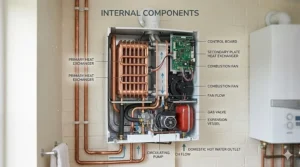
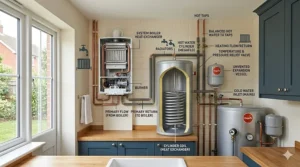
System boilers take a fundamentally different approach to domestic hot water, separating the heating and storage functions into distinct components. The boiler unit itself heats water using gas, which then either flows through radiators for central heating or fills a separate unvented hot water cylinder where it’s stored until needed. When you run a hot tap, you’re drawing from this pre-heated reservoir rather than waiting for the boiler to heat cold mains water on demand.
This architectural difference creates distinct performance characteristics that matter enormously for certain household types. A typical 250-litre unvented cylinder stores enough hot water for three generous showers back-to-back without any drop in temperature or pressure. The mains-fed cylinder maintains consistent pressure regardless of how many outlets are drawing simultaneously—a crucial advantage in multi-bathroom British homes where morning routines often overlap.
The integrated nature of system boilers simplifies installation compared to older regular (heat-only) boilers. All major components—pump, expansion vessel, pressure relief valve—are built into the boiler unit itself, eliminating the need for a separate cold water tank in the loft. This makes system boilers considerably more space-efficient than traditional setups whilst retaining the cylinder-based hot water storage that larger households need.
However, you’re still dedicating significant space to the cylinder itself. A typical unvented cylinder measures roughly 1.8m tall by 0.5m diameter, requiring a dedicated airing cupboard or utility room location. For British homes already tight on storage, this represents a meaningful spatial commitment that can’t be ignored.
System Boiler Advantages for British Households
The simultaneous usage capability represents the fundamental advantage over combis. When multiple family members are showering, washing hands, running dishwashers, and doing laundry simultaneously, a system boiler maintains consistent hot water delivery to all outlets. The stored cylinder provides a buffer that’s completely independent of mains pressure fluctuations or boiler output limitations.
This matters enormously for families with overlapping routines. The stereotypical British household with two working parents and two teenagers all needing to shower between 7-8am simply cannot function smoothly with a combi boiler. The conflicts and compromises become a daily frustration. A properly sized system boiler eliminates this entirely.
Integration with renewable technologies opens pathways combis can’t access. Solar thermal panels can pre-heat the cylinder during summer months, substantially reducing gas consumption for hot water. The Energy Saving Trust notes that having a hot water cylinder allows you to store energy from solar panels, making system boilers compatible with renewable heating sources. Some UK homeowners report 60-70% reductions in hot water heating costs during peak solar months. Similarly, certain heat pump configurations work more efficiently when paired with thermal storage, future-proofing your installation as heat pumps become increasingly mainstream.
The independence from mains pressure means system boilers work brilliantly in rural UK locations or properties at the end of long water supply runs where pressure is inherently compromised. The cylinder maintains storage pressure using an integral expansion vessel and pressure relief system, delivering strong shower performance regardless of what’s happening with the incoming mains.
System Boiler Drawbacks to Consider
The space requirement is non-negotiable and genuinely limiting for many UK properties. If you don’t currently have a cylinder and are considering switching from a combi, you’ll need to identify where that cylinder can feasibly go. Modern new-builds often lack the airing cupboards that older properties take for granted, making cylinder placement problematic.
Installation costs run £2,800-£5,000 typically, reflecting the additional cylinder, its associated pipework, safety controls, and the extra labour involved. For budget-conscious buyers, that £600-£1,000+ premium over an equivalent combi installation isn’t trivial. You’re paying for capability you might genuinely need—but only if your household usage patterns actually justify it.
The cylinder recharge time matters if you exhaust the stored hot water. A 30kW system boiler reheating a depleted 250-litre cylinder from cold takes roughly 45-60 minutes to reach full temperature. This is rarely an issue in normal usage—the boiler tops up the cylinder progressively throughout the day. But if you host a large family gathering where eight people shower sequentially, the ninth person might face a wait.
Standby heat losses from the cylinder are real, even with modern insulation. A well-insulated cylinder might lose 1-2 kWh daily just maintaining temperature, which over a year adds up to £50-80 in wasted gas at current rates. For households with low, irregular hot water usage, this constant trickle of standby consumption makes system boilers less efficient than combis in practice despite similar headline efficiency ratings.
Installation Costs and Timelines: What British Homeowners Actually Pay
Understanding boiler installation costs in the UK requires breaking down the components rather than relying on misleading headline figures. The boiler unit itself typically accounts for only 30-50% of the total installed cost, with labour, materials, compliance certification, and ancillary components making up the remainder.
For combi boiler installations, most British homeowners pay between £2,200-£4,000 for a complete supply-and-fit package from a Gas Safe registered installer in 2026. Budget installations using entry-level brands like Baxi or Ideal sit at the lower end, whilst premium Worcester or Viessmann units with extended warranties and smart controls push towards the higher bracket. A straightforward like-for-like replacement—swapping an old combi for a new one in the same location—takes 6-8 hours typically, with most installers completing within a single day. All installations must comply with UK Building Regulations, which govern energy efficiency and safety standards for domestic heating systems.
System boiler installations run higher at £2,800-£5,000 primarily due to the cylinder cost and installation complexity. An unvented cylinder itself costs £400-£900 depending on capacity and quality, and fitting one requires an engineer qualified to work with pressurised vessels—not all Gas Safe engineers hold this additional G3 certification. The installation typically extends to 1.5-2 days for a straightforward replacement, longer if you’re converting from a combi or regular boiler.
Hidden Costs That Inflate Final Bills
Power flushing represents the most common unexpected cost addition, typically £400-£600 for a standard UK heating system. If your existing system contains sludge, debris, or scale deposits, most reputable installers will refuse to fit a new boiler without first cleaning the system. The alternative is voiding your warranty when that contamination damages the new heat exchanger within months.
Upgrading controls adds £150-£400 depending on sophistication. Many older British homes still run basic mechanical timers and single-zone control. Modern boilers perform substantially better with smart thermostats, weather compensation, and multi-zone control, but these aren’t always included in base installation quotes. Clarify what controls are included before committing.
Flue upgrades or relocations can add £200-£500 to the bill. Modern condensing boilers require specific flue types and positioning that may differ from your existing setup. If your current flue terminates near a neighbour’s window or doesn’t meet current Building Regulations clearance requirements, it’ll need modification.
Pipework modifications vary enormously but can add £300-£800 for complex jobs. Moving a boiler to a different location, converting between boiler types, or updating old 8mm microbore piping to modern 10mm or 15mm standards all require additional materials and labour.
How to Get Accurate UK Installation Quotes
Request itemised quotes separating boiler supply, labour, materials, and ancillary work. Lump-sum quotes make comparison impossible and hide where costs are concentrated. A proper itemised quote lists the specific boiler model and size, cylinder type and capacity (for system installations), controls being installed, flue type, whether power flushing is included, and estimated labour hours.
Obtain at least three comparable quotes from Gas Safe registered installers. The spread between cheapest and most expensive can genuinely exceed £1,000 for identical work. Verify Gas Safe registration numbers at gassaferegister.co.uk before accepting any quote—this is legally required for all gas work in the UK.
Check whether the installer is manufacturer-accredited for your chosen brand. Worcester, Vaillant, Viessmann, and other major brands offer extended warranties—often 10-12 years versus the standard 2-5 years—but only when installed by their accredited engineers. This accreditation matters enormously for long-term value.
Confirm what warranty coverage actually includes. Some warranties cover parts only, leaving you paying labour costs if something fails. The best warranties cover both parts and labour for the full term, but read the small print regarding annual servicing requirements—most extended warranties become void if you skip annual maintenance.
Real-World Performance in British Conditions: What the Specs Don’t Tell You
British weather and housing stock create unique performance demands that specification sheets don’t capture. Our damp climate, hard water in many regions, and frequent temperature cycling all impact long-term boiler reliability in ways that laboratory efficiency ratings simply don’t reflect.
The British rain factor affects outdoor components more than homeowners expect. Condensate drain pipes—which expel acidic water from the combustion process—can freeze during cold snaps, triggering boiler lockouts. Quality installations use larger diameter piping (32mm rather than the minimum 21.5mm) and insulate external runs, but many budget installations cut these corners. I’ve seen dozens of January emergency callouts that traced back to frozen condensate drains, leaving households without heating until they thawed.
Hard water scaling particularly impacts South East England, the Midlands, and other regions where water contains high mineral content. Stainless steel heat exchangers handle this substantially better than aluminium alternatives, which explains why Viessmann and ATAG models with stainless construction tend to outlast cheaper competitors in these areas. The gradual efficiency decline from scaling—typically 2-3% per year on unprotected aluminium exchangers—adds up to genuinely higher running costs over the boiler’s lifespan.
How British Household Patterns Affect Boiler Choice
The morning shower rush represents the critical stress test for British heating systems. In a typical four-person household with two bathrooms, the window between 7:00-8:00am sees peak simultaneous hot water demand. A combi boiler rated at 12 litres per minute struggles when two people shower simultaneously whilst a third runs the bathroom sink. Each user experiences pressure and temperature fluctuations as the others’ usage varies.
A system boiler with a 250-litre cylinder handles this scenario without drama. The stored hot water delivers consistent pressure and temperature regardless of simultaneous demands, and the cylinder recharges progressively throughout the day. For households where this morning overlap is daily routine rather than occasional inconvenience, the system boiler advantage is tangible rather than theoretical.
Evening usage patterns also matter. Households that run baths in the evening, often whilst simultaneously using kitchen hot taps for washing up, exceed most combi boilers’ instantaneous delivery capacity. A standard British bath holds 150-180 litres when filled to comfortable depth. Filling this whilst maintaining adequate pressure for other outlets stretches combis thin but barely taxes a system boiler’s stored reserve.
Cold Weather Performance Across UK Regions
Scottish winters test boiler performance more severely than Southern England’s milder climate. Incoming mains water temperatures drop to 3-5°C during January and February in much of Scotland, compared to 8-10°C in the South East. This temperature difference matters enormously for combi boiler output.
A 28kW combi delivering 11 litres per minute when heating 10°C water to 40°C sees its flow rate drop to around 8-9 litres per minute when incoming water is only 4°C. The physics are straightforward—the same boiler output must raise the temperature further, so flow rate drops proportionally. This seasonal performance variability catches many UK buyers unaware when they discover their shower performance deteriorates noticeably during winter months.
System boilers largely avoid this issue because the cylinder storage temperature is maintained regardless of incoming mains temperature. The boiler heats the cylinder progressively throughout the day, and what emerges at the tap maintains consistent temperature and pressure year-round.
Energy Efficiency and Running Costs: The British Reality
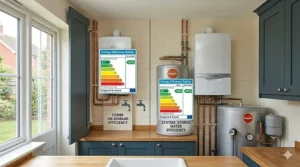
Modern condensing boilers—both combi and system types—achieve 92-94% efficiency ratings under laboratory test conditions, but real-world efficiency depends enormously on usage patterns and installation quality. According to the Energy Saving Trust, upgrading a G-rated boiler to an A-rated boiler with full heating controls could save you £420 in Great Britain on annual energy bills. Understanding how theoretical efficiency translates to actual gas bills matters more than comparing headline percentages.
Combi boilers achieve their efficiency advantage primarily by eliminating standby losses. A well-insulated hot water cylinder still loses approximately 1-2 kWh daily maintaining temperature—not enormous, but over a year this totals 365-730 kWh, equivalent to £50-80 in wasted gas at current British rates. For households with low, irregular hot water usage—single occupants, frequently travelling couples, or part-time occupied properties—this constant trickle represents genuinely wasted energy.
However, system boilers regain efficiency through reduced cycling. When properly sized and controlled, a system boiler runs longer, steadier cycles to heat the cylinder rather than the frequent on-off cycling combis experience during peak demand periods. Each time a boiler fires up, it operates less efficiently during the initial warm-up period before reaching optimal condensing temperatures. Fewer, longer cycles mean proportionally more time at peak efficiency.
How British Gas Prices Affect Total Running Costs
Current British gas prices in 2026 sit around 10p per kWh under the energy price cap, though fixed tariff rates vary. The average UK household uses approximately 11,500 kWh gas annually for heating and hot water, translating to £1,150 per year at current rates. The boiler type affects this cost, but perhaps less dramatically than marketing materials suggest.
Replacing a 15-year-old 70% efficient boiler with a modern 92% efficient unit—whether combi or system—typically saves £250-350 annually through improved efficiency alone. The difference in running costs between a well-installed combi versus a well-installed system boiler is modest, typically £30-80 annually depending on household usage patterns.
For low hot water usage households (single occupants, couples without children), combis save approximately £40-60 yearly by eliminating cylinder standby losses. For high usage households (families with multiple bathrooms), system boilers can actually prove slightly cheaper by reducing cycling losses, though the difference is marginal—perhaps £20-30 annually.
The controlling factor isn’t boiler type but rather installation quality and controls sophistication. A poorly balanced heating system, inadequate insulation, or basic timer-only controls waste far more energy than the inherent efficiency difference between boiler types. Investing £300 in a quality smart thermostat and proper system balancing delivers better savings than agonising over combi versus system efficiency percentages.
Smart Controls and British Weather Variability
British weather’s unpredictability makes smart controls particularly valuable. Apps like Hive, Nest, and Tado learn your routines and adjust heating automatically, but crucially they also provide remote override when British weather does its characteristic thing—shifting from mild to freezing within 24 hours with minimal warning.
The Energy Saving Trust estimates smart thermostats save British households £75-150 annually compared to basic timer controls, primarily through better matching of heating delivery to actual demand. The weather compensation function—adjusting boiler flow temperature based on outdoor conditions—optimises efficiency across the mild-to-cold spectrum that dominates British weather rather than the extreme cold that rarely materialises.
Load compensation and OpenTherm communication allow the boiler to modulate precisely to match actual demand rather than cycling on-off. This matters particularly during autumn and spring when heating is needed but not at full capacity. The ability to dial down to 20-30% output maintains comfort without wasting gas cycling repeatedly.
Making the Decision: Combi vs System Boiler for Your Specific UK Home
The boiler choice ultimately depends on matching technical capabilities to your household’s specific usage patterns, spatial constraints, and long-term plans. Generic advice fails because British homes vary enormously in age, size, construction, and occupant behaviour.
For flats and small terraced houses with 1-2 bedrooms and a single bathroom, combi boilers represent the logical choice. The space savings matter enormously in compact British housing stock, and the usage patterns rarely stress combi capabilities. A couple or small family using one bathroom sequentially rather than simultaneously will find a properly sized combi perfectly adequate.
For semi-detached and detached homes with 3-4 bedrooms and 2+ bathrooms, the decision becomes more nuanced. If morning routines involve multiple simultaneous showers—teenagers getting ready for school whilst parents prepare for work—a system boiler eliminates daily friction and frustration. The premium cost (£600-£1,000 over an equivalent combi installation) pays for tangible quality-of-life improvement rather than theoretical efficiency gains.
Key Questions to Ask Before Deciding
How many bathrooms does your home have, and do multiple people shower simultaneously during peak periods? This single question often determines the right answer. If two or more people regularly shower within the same 30-45 minute window, system boilers handle this smoothly whilst combis struggle.
What’s your mains water pressure? Before committing to a combi installation, have a Gas Safe engineer measure your dynamic mains pressure whilst taps are running. Poor mains pressure—below 1.5 bar dynamic—severely limits combi performance regardless of boiler quality. System boilers work independently of mains pressure.
Do you have space for a hot water cylinder? Measure your available airing cupboard or utility room space before assuming a system boiler fits. A typical 250-litre unvented cylinder requires roughly 1.8m vertical clearance and 0.5m diameter—non-trivial in British homes where storage space is perpetually tight.
How long do you plan to stay in this property? If you’re planning to move within 3-5 years, the boiler that maximises home value and broad buyer appeal might differ from what optimises your personal usage. Combis appeal to widest buyer demographic, whilst system boilers add value in larger family homes.
Are you planning future renewable integration? Solar thermal panels, certain heat pump configurations, and thermal storage systems all favour cylinder-based installations. If your long-term plan includes renewable energy, a system boiler keeps these pathways open. The UK Government’s Boiler Upgrade Scheme offers grants up to £7,500 for heat pump installations, which often work better with cylinder-based systems.
Installation Process and Timelines: What UK Homeowners Should Expect
A standard combi boiler replacement in the same location typically completes within 6-8 hours, allowing most installations to finish within a single working day. Your installer should arrive around 8:00-9:00am, and heating and hot water should be restored by late afternoon, assuming no unexpected complications arise.
The process begins with isolation of existing services, draining down the old boiler and system, then removing the old unit. The new boiler is positioned, secured to the wall, and connected to existing pipework—though competent installers will often replace final connection pipework to ensure clean joints and proper flow. Gas connection, electrical wiring, condensate drain, and flue installation follow, each requiring careful attention to Building Regulations compliance.
After physical installation completes, commissioning takes 1-2 hours minimum. This involves filling and bleeding the system, checking for leaks, setting optimal operating parameters, and conducting full function tests. Rushed commissioning causes problems months later when incorrectly configured settings lead to poor performance or premature failures.
System Boiler Installation Complexity
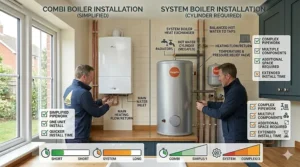
System boiler installations extend to 1.5-2 days typically, primarily due to cylinder installation and additional pipework complexity. If you’re converting from a combi or regular boiler, the installer must create suitable cylinder location (if none exists), run new pipework between boiler and cylinder, install expansion vessels and safety valves, and ensure proper integration.
Unvented cylinder installation requires specific G3 certification that not all Gas Safe engineers hold. This qualification ensures competent handling of pressurised vessels and proper installation of critical safety components—pressure relief valves, temperature limiters, expansion vessels. Verify your installer holds this certification before proceeding with system boiler installations.
The cylinder commissioning adds complexity beyond boiler commissioning alone. The installer must set appropriate cylinder thermostat temperatures (typically 60-65°C to prevent Legionella whilst minimising scale), configure the motorised valve operation, verify proper expansion vessel pre-charge pressure, and test all safety systems.
Minimising Installation Disruption
Schedule installations during milder months when heating loss is less critical. April-May or September-October typically offer reasonable weather whilst avoiding peak heating season when engineers are busiest and most expensive.
Prepare the installation area before the installer arrives. Clear the space around the existing boiler, remove items from nearby cupboards that might be affected by dust or debris, and ensure clear access paths. This seemingly obvious preparation saves time and reduces the risk of damage to your belongings.
Plan for a full day without heating and hot water even for “quick” combi replacements. Unexpected complications—seized pipework, hidden leaks revealed when draining, parts that don’t quite fit—occur more often than installers admit in quotes. Have alternative arrangements for critical needs rather than assuming everything will finish on schedule.
Request thorough explanation of new controls and systems before the installer leaves. Many British homeowners never properly learn their boiler controls, wasting energy through suboptimal settings. Insist the installer demonstrate seasonal adjustments, troubleshooting common issues, and optimal efficiency settings rather than rushing away to the next job.
Maintenance Requirements and Long-Term Costs in the UK
Annual servicing by a Gas Safe registered engineer costs £80-£130 typically across the UK in 2026, though rates vary regionally with London and South East commanding premium prices. This isn’t optional maintenance—most manufacturers require annual servicing to maintain warranty validity, and neglected boilers fail earlier and run less efficiently.
During a proper service, the engineer should inspect the combustion chamber and burner, test safety controls and gas pressure, check the heat exchanger for corrosion or scaling, verify proper expansion vessel pressure, test flue integrity, and analyse combustion emissions. The entire process takes 45-60 minutes when done properly, though some budget services rush through in 20 minutes and miss developing problems.
The British climate’s impact on component longevity can’t be ignored. Condensate pump failures—caused by acidic water from condensing combustion—occur more frequently in British installations than equivalent European setups because we run boilers at lower, more efficient temperatures year-round. Replacement typically costs £150-£250 including labour.
Common Failure Points in UK Boiler Installations
Heat exchanger scaling particularly affects hard water regions. South East England, the Midlands, and Eastern England all suffer high mineral content that gradually deposits on heat exchanger surfaces, reducing efficiency and eventually blocking flow paths. Aluminium heat exchangers in budget boilers show scaling damage within 5-7 years typically, whilst stainless steel exchangers in premium models often exceed 10-12 years before requiring attention.
Pump failures represent another common issue, typically occurring 8-12 years into the boiler’s life. Modern high-efficiency pumps run more quietly and efficiently than older models but seem less tolerant of system contamination. Replacement costs £180-£300 including labour, though the work itself is straightforward for competent engineers.
Pressure vessel failures occur when the diaphragm inside the expansion vessel degrades, losing its ability to accommodate pressure changes as the system heats and cools. This manifests as frequent pressure drops requiring repeated topping up. Replacement costs £120-£200 typically, though access can be difficult on some boiler models.
Total Lifetime Costs: What British Homeowners Actually Spend
A quality combi boiler installed in 2026 should deliver 12-15 years reliable service with proper maintenance. Total lifetime costs—purchase, installation, servicing, and likely repairs—typically run £5,000-£7,000 over this period, equivalent to £330-£465 annually.
System boilers often outlast combis slightly, potentially reaching 15-18 years with proper maintenance. However, the cylinder adds both upfront cost and eventual replacement expense. Unvented cylinders typically last 15-20 years, but replacement costs £600-£1,200 when that time comes. Total lifetime costs including cylinder replacement run £6,500-£9,000, or roughly £360-£500 annually.
These lifetime costs make the yearly difference between boiler types quite modest—perhaps £30-80 annually depending on specific circumstances. The decision should be driven by usage requirements and spatial constraints rather than agonising over marginal long-term cost differences.
Common Mistakes British Buyers Make (And How to Avoid Them)
Undersizing combi boilers represents the most frequent specification error. Many buyers focus solely on heating output requirements—typically 24-28kW for average British homes—without considering hot water delivery needs. A 24kW combi might adequately heat your home but delivers only 9-10 litres per minute hot water, barely adequate for a single decent shower. The 28kW model’s extra 2-3 litres per minute matters enormously for daily satisfaction.
Conversely, oversizing combi boilers to maximise hot water flow creates heating inefficiency. A 38kW combi in a small home with modest radiator capacity cycles on-off constantly when just maintaining temperature, reducing efficiency and accelerating wear. The optimal solution isn’t always the biggest combi but rather matching boiler type to usage pattern.
Ignoring Mains Pressure Before Choosing Combis
Failing to verify mains water pressure before committing to a combi installation causes profound disappointment months later. A Gas Safe engineer should measure dynamic pressure—the pressure whilst multiple taps are running—not just static pressure. Dynamic pressure below 1.5 bar severely limits combi performance regardless of boiler quality.
Rural properties particularly suffer poor mains pressure due to long supply runs from water mains. What appears adequate for normal tap usage proves insufficient when a powerful combi attempts to heat 12+ litres per minute flowing at speed. If your dynamic pressure is marginal, a system boiler eliminates this vulnerability entirely.
Choosing Boilers Based Purely on Upfront Cost
Selecting the cheapest installation quote without considering warranty coverage, parts availability, and installer reputation saves money initially but costs substantially more long-term. The £400-£600 saved by choosing a budget brand over Worcester or Viessmann evaporates quickly when you’re paying for out-of-warranty repairs five years later.
Similarly, accepting the lowest labour quote often means rushed installation, cut corners on materials, and minimal commissioning. The installer who’s £200 cheaper probably achieves this by spending four hours on a job that requires eight hours to do properly. The consequences—leaks, poor efficiency, premature failures—emerge months later when diagnosing problems costs more than paying for quality installation initially.
Neglecting Smart Controls and Proper Commissioning
Installing a modern boiler but connecting it to decades-old basic timer controls wastes the efficiency potential. The £200-£300 spent on a quality smart thermostat delivers that cost back in energy savings within 2-3 years whilst substantially improving comfort and convenience.
Equally wasteful is accepting minimal commissioning. Installers under time pressure often rush the optimisation process, leaving the boiler running at default factory settings rather than optimising for your specific system. Flow temperature set 5-10°C higher than optimal wastes hundreds of pounds over the boiler’s lifetime whilst reducing longevity.
Frequently Asked Questions
❓ Can I switch from a combi boiler to a system boiler in my UK home?
❓ Which boiler type is best for a large house in the UK with multiple bathrooms?
❓ Do system boilers have better warranties than combi boilers in the UK?
❓ Are combi boilers more energy efficient than system boilers for UK homes?
❓ How long does it take to install a system boiler compared to a combi boiler?
Conclusion: Matching Boiler Type to British Household Reality
The combi boiler vs system boiler decision ultimately comes down to honestly assessing your household’s hot water usage patterns, available installation space, and long-term property plans. For smaller British homes with 1-2 bedrooms, single bathrooms, and sequential rather than simultaneous usage, combi boilers deliver excellent value through space savings, lower installation costs, and genuinely efficient operation.
For larger households with multiple bathrooms where morning shower routines overlap, system boilers eliminate the daily frustrations that no combi can avoid regardless of specification. The £600-£1,000 installation premium pays for tangible quality-of-life improvement rather than marginal efficiency gains. If you’ve got the space for a cylinder and your usage patterns genuinely stress combi capabilities, that premium is money well spent.
What matters more than agonising over boiler type specifications is ensuring quality installation by a Gas Safe registered, manufacturer-accredited engineer who properly commissions and optimises your system. The efficiency difference between a well-installed combi versus a well-installed system boiler is minimal—perhaps £30-60 annually. However, the efficiency difference between a properly commissioned system with smart controls versus a rushed installation with basic controls easily exceeds £200 annually regardless of boiler type.
British homeowners should prioritise getting multiple detailed quotes, verifying installer credentials and manufacturer accreditation, understanding exactly what’s included in warranty coverage, and ensuring proper commissioning and control optimisation. The technical choice between combi and system matters less than these fundamental installation quality factors that determine long-term satisfaction and running costs.
For most British households, the decision tree is straightforward: 1-2 bedrooms with one bathroom favours combi boilers; 3+ bedrooms with 2+ bathrooms favours system boilers; edge cases depend on specific usage patterns and spatial constraints. Trust your honest assessment of how your household actually uses hot water rather than theoretical specifications, and you’ll make the choice that serves your needs for the next 12-15 years.
✨ Recommended for You
- Best Electric Boiler UK 2026: 7 Top Models Expert Review
- Best Combi Boilers 2026 UK: 7 Top Models Reviewed
- 7 Best Multifuel Stoves UK 2026 – DEFRA Approved Reviews
Disclaimer: This article contains affiliate links. As an Amazon Associate, I earn from qualifying purchases. If you purchase products through these links, we may earn a small commission at no additional cost to you.
✨ Found this helpful? Share it with your mates! 💬🤗
