
In This Article
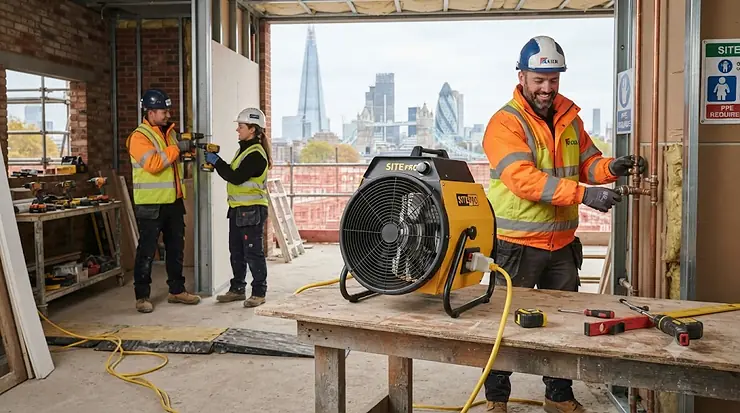
Nobody does their best brickwork with numb fingers. A fan heater for construction site use is exactly what it says on the tin, an electric heater tough enough to survive being kicked across a concrete floor, dropped off a pallet, and still switch on the next freezing Monday morning. Unlike the flimsy plastic thing you keep under your desk at home, these are built from steel, rated for demanding conditions, and often designed to run on the reduced voltage that keeps UK sites safe.
We’ve dug through genuine manufacturer specifications, aggregated customer review sentiment, and honest comparisons of seven real heaters currently sold on Amazon UK, from compact contractor units you can sling in the van to serious 15kW beasts that’ll heat an entire shell before first fix. This isn’t a rehashed listing page. It’s a proper look at what “heavy duty” actually means on a site that doesn’t care about your marketing copy.
Whether you’re a sole trader heating a single room before plastering, or a site manager trying to keep a whole crew’s fingers working through January, there’s a sensible option below. As the Health and Safety Executive’s own guidance makes clear, electrical equipment on UK construction sites has specific safety expectations that domestic heaters simply don’t meet, so we’ll cover that honestly too, not just the wattage figures. Let’s get into what’s actually worth your money.
Quick Comparison Table
| Heater | Voltage / Power | Best For | Price Range |
|---|---|---|---|
| Prem-I-Air 2kW Utility Fan Heater | 230V, 2kW | Sole traders and small rooms | £30-£45 range |
| Benross 42450 Industrial Fan Heater | 230V, 3kW, IPX4 | Budget dust and splash resistance | £45-£65 range |
| Igenix IG9301 Drum Fan Heater | 230V, 3kW, IP24 | General site cabins and workshops | £60-£85 range |
| Sealey EH3001 Fan Heater | 230V/16A, 3kW | Reliable everyday site workhorse | £85-£115 range |
| Clarke Devil 7003 Fan Heater | 230V, 3kW | Trusted brand, heavier steel build | £90-£130 range |
| Rhino FH3 Fan Heater | 110V or 240V, 2.8kW | Sites requiring reduced voltage | £95-£140 range |
| SIAL Industrial Space Heater | 400V, 15kW | Large shells, warehouses, big crews | £350-£500 range |
Scanning down that list, there’s a genuine fork in the road worth understanding before you spend anything. Most of these heaters run on standard 230-240V mains, which is perfectly fine for a small domestic job or a well-managed site with good cabling, but the Rhino FH3’s 110V option exists for a reason we’ll come back to properly further down. Meanwhile, that SIAL unit at the bottom isn’t for the same job as the Prem-I-Air at the top, one’s for warming your hands while you eat a bacon roll, the other’s for drying out an entire shell before the plasterers arrive.
💬 Just one click — help others make better buying decisions too!😊
Top 7 Fan Heaters for Construction Site: Expert Analysis
1. Prem-I-Air 2kW Utility Fan Heater — best contractor electric fan heater for small jobs
The standout feature is the PTC ceramic element, which self-regulates its own heat output rather than relying purely on a thermostat cycling on and off, a genuinely safer bit of engineering for anyone leaving a heater running unattended over a lunch break. Built with an adjustable angle bracket, a carry handle, and a tip-over switch, this compact 2kW unit is designed to be grabbed from the van and set up in seconds.
Based on the spec comparison against the bulkier 3kW options further down this list, the Prem-I-Air trades raw power for genuine portability, and that’s precisely the point. It’s the pick for sole traders and small teams heating a single room before plastering or painting, rather than anyone trying to warm an entire shell. Reviewers consistently mention how easy it is to angle the heat exactly where it’s needed, though a few note that 2kW simply isn’t enough for anything larger than a modest room with the windows still boarded.
Pros:
- ✅ Self-regulating PTC element for safer unattended use
- ✅ Genuinely compact and easy to transport
- ✅ Adjustable angle bracket directs heat precisely
Cons:
- ❌ Not powerful enough for large open spaces
- ❌ Plastic housing feels less rugged than steel rivals
Expect a price in the £30-£45 range, making this the most accessible entry point on this list for anyone who just needs to take the edge off a chilly room.
2. Benross 42450 Industrial Fan Heater — best dust-resistant fan heater on a budget
Here’s the standout worth dwelling on: an IPX4 waterproof rating on a heater this cheap is genuinely unusual, and it means splashes, damp air, and the general grime of a working site won’t kill it the way they’d kill a bargain-bin domestic fan heater. A stainless steel heating element sits inside a durable metal casing, with two heat settings (1500W and 3000W), a cool air setting for summer use, and dual overheat protection that trips before things get dramatic.
What most buyers overlook about this model is that the fully tilting design means you can point it up at head height on a bench or down at floor level toward cold feet, without needing a separate stand. It suits contractors who want dust resistance without paying premium prices, rather than anyone needing continuous heavy-duty use across a full working week. Aggregated review sentiment is broadly positive on value for money, with the metal casing praised for surviving genuine transport knocks, though the noise level at full power draws the occasional complaint.
Pros:
- ✅ IPX4 waterproof rating at a budget price
- ✅ Dual overheat protection with auto shutdown
- ✅ Fully tilting design for flexible positioning
Cons:
- ❌ Noticeably noisy at full 3000W setting
- ❌ Cord length is shorter than some rivals
Typically priced in the £45-£65 range, this represents genuinely strong value for anyone prioritising dust and splash resistance on a budget.
3. Igenix IG9301 Commercial Drum Fan Heater — best industrial fan heater 240v for site cabins
The standout feature here is the IP24 splash-proof rating combined with a genuine drum-style industrial design, which looks and feels like it belongs on a site rather than in a spare bedroom. A stainless steel heating element sits behind a heavy-duty metal grille, with two heat settings (2000W and 3000W), an adjustable thermostat, and a cool air setting that earns its keep once summer rolls around.
Based on the spec comparison against lighter domestic-style fan heaters, the drum design gives this unit a genuinely lower centre of gravity, which matters more than it sounds once you’ve watched a taller, top-heavy heater get knocked over on an uneven site floor. This is the pick for site cabins, workshops, and general commercial use where you want something that looks and feels properly industrial without the premium price tag of the heaviest-duty options. Owners consistently praise the thermostatic cut-off for genuine peace of mind, and the 2-year warranty registration is a small but appreciated touch for a heater in this price bracket.
Pros:
- ✅ IP24 splash-proof rating for damp site conditions
- ✅ Low-slung drum design resists tipping over
- ✅ Two-year warranty when registered
Cons:
- ❌ Heavier than compact contractor units
- ❌ Cool air setting output is fairly modest
Sitting in the £60-£85 range, this is a solid middle-ground pick for anyone wanting genuine industrial character without industrial pricing.
4. Sealey EH3001 Industrial Fan Heater — best reliable 3kw fan heater construction workhorse
The standout feature is refreshingly simple: this thing produces a totally dry heat with no condensation, no gas, no fumes, and no smell, which matters enormously in an enclosed site cabin where you’re breathing the same air all day. Two heat settings (1500W and 3000W) run off a 230V, 16A supply, with a fan-only mode for ventilation, a tip-over switch for safety, and a carry frame that makes hauling it between rooms genuinely painless.
What the spec sheet won’t tell you, but the layout implies, is that Sealey has built this specifically around trade reliability rather than flashy features, which is precisely why it’s become something of a workshop staple across the UK. It suits anyone wanting a dependable everyday heater for garages, workshops, and site cabins rather than someone chasing the absolute lightest or cheapest option available. Reviewers consistently describe it as doing exactly what it says without fuss, a heater bought once and simply used for years, though a handful note it’s supplied with cable only, so budget for a 16A industrial plug separately.
Pros:
- ✅ Completely dry heat with no fumes or condensation
- ✅ Tip-over switch adds genuine safety on uneven floors
- ✅ Trusted trade brand with a strong reliability track record
Cons:
- ❌ Supplied with cable only, no plug included
- ❌ No IP rating stated for wet conditions
Expect this to sit in the £85-£115 range, a fair mid-tier investment for a heater that simply keeps working.
5. Clarke Devil 7003 Industrial Electric Fan Heater — best heavy duty fan heater for building site on a trusted brand
The standout feature is the sheer robustness of the build, a heavy-duty steel cabinet, insulated handles for safe handling even when warm, and a stable stand that genuinely resists tipping on uneven ground. High and low heat settings run through adjustable thermostatic control, backed by a thermal cut-out for overheat protection, all wrapped in the kind of no-nonsense construction that’s made Clarke a familiar name on British building sites for decades.
Here’s what to weigh honestly: this is a 3kW heater running through a standard 13A plug, which means it sits right at the edge of what a domestic-style socket can comfortably handle during extended use, so a dedicated circuit is worth considering if you’re running it for hours at a stretch. It’s the pick for contractors who want a recognisable, trusted brand backing their purchase, rather than anyone needing the absolute cheapest 3kW option on the market. Aggregated review sentiment is mixed but leans positive, most owners report solid, reliable heat for garages and workshops, while a smaller number found the output underwhelming in larger, uninsulated spaces, a reminder that even a well-built 3kW heater has real physical limits.
Pros:
- ✅ Heavy-duty steel cabinet built for site knocks
- ✅ Insulated handles for safe handling when warm
- ✅ Recognisable, established UK trade brand
Cons:
- ❌ Runs near the limit of a standard 13A socket
- ❌ Output can feel modest in large, uninsulated spaces
Priced in the £90-£130 range, this suits buyers who value brand trust and build quality over squeezing out the last watt of performance.
6. Rhino FH3 Fan Heater — best robust fan heater site use with genuine 110V option
The standout feature is the one that actually matters most on a proper construction site: this heater is genuinely available in 110V as well as 240V, built around a unique fin heating element that heats up quicker and hotter than standard alternatives. A heavy-duty industrial steel body houses three heat settings, a built-in adjustable thermostat, an overheating shut-off system, and a directional air outlet that actually gets warm air where you point it rather than just vaguely into the room.
Based on the spec comparison against every other heater on this list, the 110V version is the one genuinely purpose-built for sites running a reduced-voltage electrical system, which, as HSE guidance makes clear, is standard practice on the majority of UK construction sites for good reason. This suits site managers and contractors working under proper site electrical protocols, rather than anyone plugging straight into a domestic-style socket at a smaller residential job. Owners consistently praise how quickly it throws out heat and how sturdy the steel body feels compared with lighter, more consumer-oriented alternatives, a heater that clearly expects to be knocked about a bit.
Pros:
- ✅ Genuine 110V option for reduced-voltage site systems
- ✅ Unique fin element heats faster than standard designs
- ✅ Heavy-duty steel body built for regular knocks
Cons:
- ❌ 110V version requires a suitable site transformer
- ❌ Heavier than plastic-bodied contractor units
Expect a price in the £95-£140 range depending on voltage option, a fair cost for a heater genuinely engineered around UK site electrical practice.
7. SIAL Industrial Space Heater 15000W — best heavy-duty option for large sites and shells
The standout feature is scale, plain and simple: a 15kW output running on a 400V, 5-core industrial supply, mounted on wheels with a 0-30 degree outlet angle adjustment so you can aim serious heat exactly where an entire shell needs drying out. Stainless steel heating serpentine blades sit inside a rugged casing designed for continuous operation, built specifically for warehouses, factories, and large-scale construction environments rather than a single site cabin.
What most buyers overlook about heaters at this scale is that they’re not really competing with the smaller units on this list at all, they’re solving an entirely different problem, drying plaster across a whole floor, taking the chill out of an unheated shell before internal work begins, or keeping a large open structure workable through a hard winter. This is strictly for larger sites with proper 400V industrial supply already in place, not a small residential job or a single-room contractor task. Reviewers consistently highlight how quickly it raises the temperature of genuinely large spaces, though naturally this comes with a price and power requirement well beyond anything else on this list.
Pros:
- ✅ Genuine 15kW output for large-scale heating
- ✅ Wheeled base with adjustable outlet angle
- ✅ Built for continuous heavy-duty operation
Cons:
- ❌ Requires 400V, 5-core industrial supply
- ❌ Overkill and expensive for small jobs
Usually priced in the £350-£500 range, this is a premium pick that only makes sense once your site genuinely needs its scale.
Practical Usage Guide: Setting Up a Site Fan Heater Electric Safely
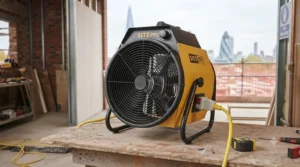
Getting the placement right in the first week matters more than most people expect. Start by positioning the heater on a flat, stable surface, away from combustible materials like timber offcuts, insulation, or stacked packaging, since HSE guidance on construction site fire safety specifically flags portable heaters as an ignition source worth treating with the same caution as hot work. Never leave a common mistake unaddressed here: running a heater directly beneath scaffolding boards or tarpaulin sheeting, where rising heat has nowhere sensible to go.
Check the voltage supply before you even unbox the thing. If your site runs a 110V centre-tapped-to-earth system, a 240V heater simply won’t work, and forcing the issue with adapters is exactly the kind of makeshift fix that causes accidents. Once positioned, let the heater run on its lower setting for the first ten minutes in a new location, partly to confirm it’s not tripping a shared circuit, and partly to let you sanity-check that nothing nearby is warming up that shouldn’t be.
Maintenance-wise, wipe down the casing and grille weekly to stop dust building up around the heating element, since dust accumulation is a genuine fire risk on longer-running units. Check the cable and plug for damage before every shift, not just occasionally, since site cables take a genuine beating from foot traffic, trolleys, and general site chaos that a domestic cable would never see.
Real-World Scenarios: Matching Heaters to Site Conditions
Picture a sole trader plastering a single bedroom in an otherwise unheated renovation project. A compact unit like the Prem-I-Air 2kW makes complete sense here: cheap, portable, and genuinely sufficient for taking the worst of the chill off a small, enclosed space while the plaster cures properly.
Now picture a small building firm running a two-storey extension through winter, with a site cabin, a couple of trade vans, and a crew of four or five working staggered shifts. A mid-range, genuinely robust unit like the Sealey EH3001 or Clarke Devil 7003 earns its keep here, reliable enough for daily use, tough enough to survive being moved between rooms, and priced sensibly for a job that isn’t enormous but isn’t trivial either.
Finally, consider a developer converting a large industrial shell into residential units, running a proper 110V site electrical system with dozens of trades on site simultaneously. Here, the Rhino FH3’s genuine 110V compatibility becomes non-negotiable rather than a nice-to-have, and for drying out the largest open areas before internal walls go up, the SIAL 15000W solves a problem that no amount of smaller contractor heaters, however many you buy, could realistically match.
Problem → Solution: Common Site Heating Headaches
Problem 1: You’re not sure whether your site needs 110V or 240V equipment. This matters more than most people initially realise. HSE guidance is clear that reduced low voltage systems, typically 110V centre-tapped to earth, are the recommended standard for site tools and equipment in harsh environments, and it’s worth reading their full guidance on electrical systems in buildings before choosing your heater’s voltage.
Problem 2: Your current heater keeps tripping the circuit. This usually means you’re running a 3kW heater alongside power tools on a shared domestic-style circuit that was never designed for it. Either dedicate a separate circuit to the heater or step down to a lower-wattage unit like the Prem-I-Air for smaller spaces.
Problem 3: You’re worried about fire risk from a heater left running unattended. Portable heaters are genuinely treated as an ignition source under HSE construction fire safety guidance, worth reading their construction fire safety FAQ for the full picture, and the practical takeaway is simple: never leave a heater running near combustible materials, and always position it where a knock or fall can’t tip it into anything flammable.
Problem 4: Dust and debris seem to be shortening your heater’s lifespan. Choose a dust-resistant fan heater with a genuine IP rating, like the Benross 42450’s IPX4 or the Igenix IG9301’s IP24, rather than a basic domestic model with no ingress protection stated at all.
Problem 5: You need heat in a space with no fixed electrical supply nearby. Compact, lightweight units with a proper carry handle, like the Prem-I-Air or Benross, are genuinely built to be moved from room to room throughout the day, following the work rather than forcing the work to come to a fixed heater.
How to Choose a Fan Heater for Construction Site
Choosing the right fan heater for construction site work comes down to six practical criteria worth weighing against your actual job:
- Voltage compatibility — confirm whether your site runs 110V or 240V before buying anything, since this genuinely can’t be fixed after the fact with a simple adapter.
- Power output versus room size — a 2kW unit suits a single small room, while a 3kW or larger unit is needed for genuinely open or larger spaces.
- Ingress protection rating — an IP-rated, dust-resistant fan heater will simply last longer in genuine site conditions than an unrated domestic model.
- Build material — steel-bodied units survive drops and knocks that plastic-cased heaters simply won’t.
- Safety features — tip-over switches, overheat protection, and thermostatic control are worth prioritising over marginal wattage differences.
- Portability needs — a genuine carry handle and manageable weight matter enormously if the heater needs to move between rooms throughout the working day.
Industrial Fan Heater 240V vs 110V: Which Wins for Site Use?
This is genuinely one of the most important decisions on this entire list, and the honest answer depends entirely on your site’s existing electrical setup rather than personal preference. An industrial fan heater 240v is perfectly suitable for smaller residential jobs, single-room renovations, or workshops running standard domestic-style supply, and every heater on this list except the Rhino FH3’s 110V option and the SIAL’s 400V unit falls into this category.
A 110V heater earns its place, and genuinely becomes close to essential, once you’re working on a larger site running a proper reduced-voltage electrical system. As HSE guidance explains, 110V centre-tapped-to-earth systems reduce the maximum shock voltage to around 55V, a significant safety margin over standard mains voltage in the kind of harsh, damp, high-traffic environment a busy site guarantees. The practical takeaway: if you’re a sole trader or small firm working directly off domestic supply, 240V is fine; if you’re operating under a site-wide 110V electrical protocol, buy accordingly, no exceptions, no adapters, no shortcuts.
Heavy Duty Fan Heater for Building Site: What Robust Actually Means
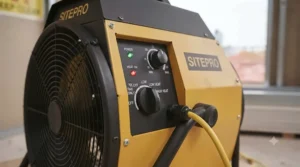
The phrase “heavy duty” gets thrown around loosely in product listings, so it’s worth being precise about what it should actually mean. A genuinely heavy duty fan heater for building site use has a steel, not plastic, outer casing capable of surviving being dropped, kicked, or stacked under other equipment without cracking. It has a stable base or stand that resists tipping on uneven, debris-strewn floors, and it has a heating element built to withstand continuous use across a full working day, not just intermittent domestic bursts.
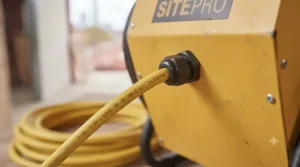
Genuine heavy-duty design also extends to the cable and plug, insulated, properly rated for the current draw, and resistant to the kind of abrasion a site cable takes from foot traffic and trolleys. The Clarke Devil 7003, Rhino FH3, and SIAL 15000W all genuinely earn the heavy-duty label on this list, while the Prem-I-Air, despite being a perfectly good product, is honestly better described as a portable contractor heater than a heavy-duty industrial one, and there’s nothing wrong with that as long as you’re buying it for the right job.
| Feature | Basic Domestic Heater | Genuine Heavy-Duty Site Heater |
|---|---|---|
| Casing material | Plastic | Steel |
| Typical IP rating | None stated | IP24 or IPX4 |
| Safety cut-out | Often basic thermostat only | Tip-over switch plus thermal cut-out |
| Cable rating | Light domestic grade | Reinforced, site-rated |
| Best For | Bedrooms, offices | Building sites, workshops, shells |
The comparison above makes the practical gap obvious rather than just theoretical. A basic domestic heater might undercut a genuine site heater on price, but the missing IP rating and lighter cable grade mean it’s simply not designed to survive the conditions it would face, and replacing a failed cheap heater every few months usually costs more over a year than buying the right tool once.
✨ Don’t Miss These Exclusive Deals!
🔍 Take your site heating seriously this winter with a genuine fan heater for construction site conditions. Click through on any of the models above to check current pricing and availability, and stop losing working hours to cold fingers.
Dust-Resistant Fan Heater Features That Actually Matter (And Those That Don’t)
Genuinely useful features worth paying for include a stated IP rating, IP24 or IPX4 being common and sensible for site conditions, a stainless steel heating element that resists corrosion from ambient moisture, and dual overheat protection that shuts the unit down before dust buildup becomes a fire risk. A low centre of gravity or wide stable base also matters more than most buyers initially realise, since a heater knocked over on a dusty floor is far more likely to ingest debris into its element than one sitting securely.
Features that generate more marketing noise than genuine value include elaborate digital displays that add cost without improving actual heat output, oversized wattage far beyond what your space requires, and cosmetic finishes that look tough in product photos but add nothing to actual durability. A heater with a proper IP rating and a sensible thermostat will consistently outlast a flashier-looking unit lacking either.
3kW Fan Heater Construction: Long-Term Cost & Maintenance
Total cost of ownership for a 3kw fan heater construction purchase rarely stops at the sticker price, and it’s worth being honest about running costs before committing. A 3kW heater running for a full eight-hour shift consumes a genuinely noticeable amount of electricity, so matching wattage sensibly to room size, rather than defaulting to the biggest unit available, saves real money across a winter’s worth of use.
Replacement parts, elements, thermostats, and cables, are widely available for established trade brands like Sealey and Clarke, keeping long-term maintenance costs modest compared with replacing an entire unit. Regular dusting of the element and grille genuinely extends service life, and for any 110V equipment, remember that HSE guidance recommends portable tools and heaters be tested every three months, a habit worth building into your site’s existing PAT testing schedule rather than treating heaters as an afterthought.
Common Mistakes When Buying a Contractor Electric Fan Heater
The most common mistake is buying based on wattage alone without checking voltage compatibility first, only to discover on delivery day that a 240V heater is useless on a site running 110V supply. Always confirm your site’s electrical system before ordering anything.
A second frequent error is underestimating how much a genuine IP rating matters, assuming any “industrial-sounding” heater will survive dusty, damp site conditions when in reality many budget models carry no ingress protection rating at all. Finally, many buyers skip checking whether a plug is actually included, several trade-focused heaters, including the Sealey EH3001, are supplied with cable only, and discovering this after your order arrives means an unplanned trip to buy a suitable industrial plug before you can even switch the thing on.
Safety, Regulations and Compliance for Site Heating
Electrical safety on a construction site isn’t optional extra reading, it’s genuinely central to how these heaters should be chosen and used. The Electricity at Work Regulations 1989 place a clear legal duty on employers and site managers to ensure electrical equipment is safe and properly maintained, and it’s worth reading the full text of the regulations if you’re responsible for site compliance rather than simply buying for yourself.
Practically, this means confirming your site’s voltage standard before purchasing, keeping heaters away from combustible materials as HSE fire safety guidance recommends, and building regular visual inspections of cables and plugs into your daily routine rather than treating that as a once-a-year task. A heater that looks fine on the outside can still develop internal faults, so if in doubt, take it out of service and have it checked by someone competent before plugging it back in.
FAQ
❓ What is the best fan heater for construction site use?
❓ Do I need a 110V or 240V fan heater on site?
❓ What does IP rating mean on a dust-resistant fan heater?
❓ How much does a decent industrial fan heater 240v cost?
❓ Can one heavy duty fan heater for building site heat an entire shell?
Conclusion
Choosing between these seven heaters ultimately comes down to being honest about the size of the job and the electrical system you’re actually working with, not which one looks toughest in the photos. For a single small room, the Prem-I-Air’s compact 2kW output is genuinely sufficient. For everyday site and workshop reliability, the Sealey EH3001 or Igenix IG9301 will simply keep working, shift after shift. And if your site runs a proper 110V system or needs to heat something genuinely large, the Rhino FH3 or SIAL 15000W are the ones actually built for that job, not just marketed toward it.
Whatever you choose, remember that voltage compatibility and a genuine IP rating matter more than an extra few hundred watts on a spec sheet. A well-matched heater that survives a full winter of site conditions will always beat a powerful one that dies in week three. Combine the right heater with sensible placement and a bit of regular maintenance, and cold fingers stop being part of the job description.
✨ Ready to Stop Working Cold?
🔍 Browse the seven fan heater for construction site picks above and find the build quality, voltage, and power output that actually match your job, whether that’s a single small room or an entire shell before first fix.
Recommended for You
- Propane Forced Air Heater: 7 Best Site Heaters for Winter 2026
- Propane Heater for Construction Site: 7 Best Picks 2026
- Diesel Indirect Heater: 7 Best Fume-Free Site Heaters for 2026
Disclaimer: This article contains affiliate links. As an Amazon Associate, I earn from qualifying purchases. If you purchase products through these links, we may earn a small commission at no additional cost to you.
✨ Found this helpful? Share it with your friends! 💬🤗
