
In This Article
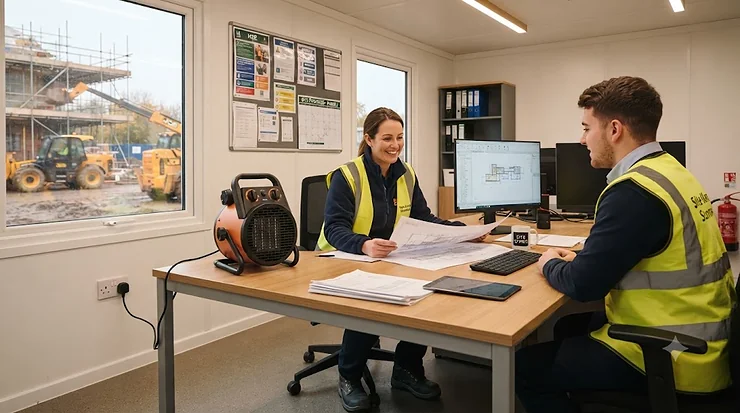
There’s a particular kind of cold that only exists inside a steel-and-plywood box parked on a muddy compound in January. It creeps in through the floor, it settles in your knees, and no amount of tea makes it budge. If you’ve ever tried to fill in a delivery ticket with fingers too numb to grip a pen properly, you already understand exactly why a powerful fan heater for site office use isn’t a luxury, it’s basic kit. So what actually counts as a fan heater for a site office? It’s a portable electric heater, usually somewhere between 2kW and 5kW, built to blast warm air fast into a small, poorly insulated space like a portacabin, a welfare unit, or a temporary cabin, rather than gently warming a cosy living room over the course of an evening.
Site offices are brutal little microclimates. Thin walls, draughty doors that never quite seal, and workers wandering in and out all day carrying the outside weather with them on their boots. A decent electric heater for temporary site office use has to work harder than anything you’d buy for a spare bedroom, and it has to survive being knocked, dragged around, and occasionally used by someone in muddy gloves who isn’t reading the manual first. HSE guidance on workplace facilities sets out that a reasonable working temperature, usually at least 16°C, is a genuine baseline employers need to meet, not a nice-to-have.
This guide rounds up seven genuine products worth your money in 2026, from no-nonsense budget PTC heaters to full 3kW industrial units with ducting attachments, plus the honest analysis you need to pick the right one for your cabin rather than just the biggest number on the box. No invented reviews, no exact prices (they shift too often to be worth quoting), just real spec comparison and genuine buying advice, because getting this decision wrong means shivering through February with a heater that’s all noise and no warmth.
Quick Comparison Table
Here’s the shape of the market before we dig in properly. Site heating splits roughly into two camps: compact PTC units built for desks and small spaces, and full industrial fan heaters built to shift serious heat through an entire cabin.
| Product | Power | Heat Settings | Best For |
|---|---|---|---|
| Draper 2.0kW PTC Portable Electric Space Heater | 2.0kW | 2 | Compact office site heater use |
| Prem-I-Air Elite 2kW Turbo Fan PTC Industrial Space Heater | 2.0kW | 3 | Small cabins, quick warm-ups |
| Prem-I-Air Elite 2.8kW Turbo Fan PTC Metal Space Heater | 2.8kW | 3 | Mid-sized site offices |
| Benross 42450 3000W Industrial Fan Heater | 3.0kW | Adjustable + cool | Damp or exposed cabins |
| Sealey EH3001 3kW Industrial Fan Heater | 3.0kW | 2 + fan only | Reliable everyday workhorse |
| Sealey DEH3001 3kW Industrial Fan Heater with Ducting | 3.0kW | 2 + fan only | Portacabin heating solution via ducting |
| Sealey EH5001 5kW 415V Industrial Fan Heater | 5.0kW | 2 + fan only | Larger welfare units |
Reading across that table, the honest pattern is this: the further right you go, the more the heater stops being a desk gadget and starts being genuine infrastructure. A fan heater for site cabin thermostat control matters enormously here too, since a unit without one just runs flat-out until you switch it off, wasting power and occasionally cooking whoever’s sat closest to it. Anything from 3kW upward on a standard 230V, 16A supply also needs the right plug and circuit, so check your site’s electrics before ordering the beefier units.
💬 Just one click — help others make better buying decisions too!😊
Top 7 Powerful Fan Heaters for Site Offices: Expert Analysis
Seven genuine products currently sold on Amazon UK, spanning budget PTC units through to full 415V industrial kit, so there’s a sensible option whether you’re heating a two-person portacabin or a proper welfare block.
1. Draper 2.0kW PTC Portable Electric Space Heater — best entry point for a compact office site heater
Sometimes you don’t need a monster, you need something that fits under a desk and does its job without complaint. The Draper 2.0kW PTC Portable Electric Space Heater uses PTC ceramic heating elements, which warm up almost instantly rather than making you wait around for a coil to glow, and it’s built with a proper indoor-outdoor rating so it can handle the occasional draught without sulking. In practical terms, 2kW is enough to take the edge off a small single-occupancy cabin or a corner office within a larger structure, though it’ll struggle if you’re trying to heat a whole open-plan welfare unit. Based on the spec comparison, its 1.3m cable length is genuinely on the short side, so anyone planning to run it from a socket across the room will want an extension lead rated for the load. Reviewers consistently note that it heats up fast and runs quietly enough not to drown out a phone call, which matters more than you’d think in a small enclosed space.
Pros:
- ✅ Genuinely fast PTC ceramic heat-up
- ✅ Compact size suits small desks and corners
- ✅ Rated for both indoor and outdoor use
Cons:
- ❌ Short 1.3m cable limits placement options
- ❌ Underpowered for anything beyond a small cabin
At around £25-£40, the Draper 2.0kW PTC Portable Electric Space Heater is the sensible starting point for anyone who just needs to stop shivering at a single desk.
2. Prem-I-Air Elite 2kW Turbo Fan PTC Industrial Space Heater — best budget pick with genuine safety features
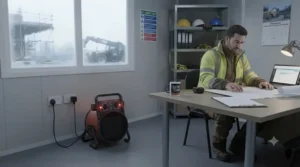
Here’s what most buyers overlook about this model: it looks like a budget option, but it’s built with a metal body and a proper tip-over switch, which matters enormously the moment someone’s toolbox catches the cable mid-shift. The Prem-I-Air Elite 2kW Turbo Fan PTC Industrial Space Heater runs three fan speeds alongside a PTC element and an integrated thermostat, so once you’ve dialled in a temperature it cycles on and off automatically rather than blasting away regardless. On paper this means noticeably lower running costs than a fixed-output heater left on full power all day. Aggregated review sentiment across retailers consistently praises the carry handle and the robust build, with a recurring note that it copes well in workshops, garages, and small site cabins alike without feeling flimsy underfoot. The PTC element also brings a genuine safety advantage: it self-regulates against overheating, which is one less thing to worry about when a heater’s running unattended in a locked cabin overnight.
Pros:
- ✅ Metal construction with proper tip-over protection
- ✅ Integrated thermostat cuts running costs
- ✅ Three fan speeds for flexible heat output
Cons:
- ❌ 2kW ceiling limits it to smaller spaces
- ❌ Fan noise is noticeable on the highest setting
Typically priced around £30-£45, the Prem-I-Air Elite 2kW Turbo Fan PTC Industrial Space Heater punches well above its price tag for anyone heating a modest cabin on a modest budget.
3. Prem-I-Air Elite 2.8kW Turbo Fan PTC Metal Space Heater — best mid-range step-up for larger cabins
Take everything good about its smaller sibling, add another 800 watts, and you’ve got the Prem-I-Air Elite 2.8kW Turbo Fan PTC Metal Space Heater, a genuinely sensible middle ground for anyone whose cabin is a bit bigger than “cosy.” The lightweight body pushes a large volume of air through the heating element, which in real-world terms means the room warms through more evenly rather than leaving one toasty corner and three cold ones. Here’s what to weigh before buying: 2.8kW still isn’t industrial-grade, so if you’re heating a full welfare unit with multiple rooms, this is a supplement rather than a solution on its own. Reviewers consistently mention how quickly it takes the chill off a workshop or small office, with the adjustable switch and thermostat combination praised for genuine day-to-day usability rather than a one-setting-fits-all gimmick. It’s the heater equivalent of a reliable hatchback: not flashy, but it’ll get you through winter without drama.
Pros:
- ✅ Higher 2.8kW output than entry-level PTC models
- ✅ Even air distribution across the space
- ✅ Adjustable thermostat for genuine temperature control
Cons:
- ❌ Still modest for larger multi-room cabins
- ❌ Heavier than the smaller 2kW version
Usually found around £40-£55, the Prem-I-Air Elite 2.8kW Turbo Fan PTC Metal Space Heater suits a mid-sized site office that’s outgrown a basic desk heater but doesn’t need full industrial power.
4. Benross 42450 3000W Industrial Fan Heater — best for damp or exposed site conditions
Building sites don’t always offer a bone-dry cabin, and that’s exactly where the Benross 42450 3000W Industrial Fan Heater earns its keep. Carrying an IPX4 waterproof rating, it’s built to shrug off the odd splash or damp morning that would leave a domestic heater sulking in a corner refusing to switch on. The adjustable thermostatic control lets you set a target temperature rather than manually flicking it on and off through the day, and a genuine cool air setting means the same unit can double up as ventilation once summer rolls around, useful when a cabin turns into a greenhouse the moment the sun comes out. What reviewers consistently note is the tilting design, which lets you angle the airflow toward a specific desk or doorway rather than heating the ceiling uselessly. The carry handle and portable build mean it moves easily between cabins if your site has more than one, which is a genuine practical win over heavier fixed units.
Pros:
- ✅ IPX4 rating copes with damp site conditions
- ✅ Tilting design directs heat where it’s needed
- ✅ Doubles as a cool air fan through summer
Cons:
- ❌ No fan-only night setting for quiet ventilation
- ❌ Bulkier than the PTC-based alternatives
Priced around £35-£50, the Benross 42450 3000W Industrial Fan Heater is the practical choice for anyone whose site office sees more weather than most.
5. Sealey EH3001 3kW Industrial Fan Heater — best reliable everyday workhorse
If site heaters had a reputation for turning up to work every single day without complaint, the Sealey EH3001 3kW Industrial Fan Heater would be the poster child. Producing 10,000 BTU/hr from a 230V 16A supply, it heats an area of roughly 60 cubic metres, comfortably enough for a standard-sized portacabin, and it does so with completely dry heat: no condensation, no fumes, no gas smell lingering in a small enclosed space. Based on the spec comparison, the two heat settings (full 3kW or half 1.5kW) plus a fan-only mode give it more day-to-day flexibility than a single fixed-output unit, letting you run it gently through a mild afternoon rather than roasting everyone out of the cabin. The carry frame genuinely makes a difference when you’re moving it between sites or storing it away at the end of a job, and the tip-over switch adds a sensible layer of safety for a unit this powerful. Reviewers consistently describe it as the heater they reach for first when a site office genuinely needs warming rather than just taking the edge off.
Pros:
- ✅ Genuine 3kW output for a full-sized cabin
- ✅ Completely dry heat with no fumes or smell
- ✅ Carry frame and tip-over switch built in
Cons:
- ❌ Requires a 16A supply, not a standard 13A socket
- ❌ Power cable only, no plug included as standard
At roughly £50-£70, the Sealey EH3001 3kW Industrial Fan Heater is the dependable middle-of-the-road pick most site managers eventually settle on.

6. Sealey DEH3001 3kW Industrial Fan Heater with Ducting — best portacabin heating solution for awkward layouts
Sometimes the problem isn’t power, it’s geography. A cabin split into two rooms, a heater that needs to sit outside a hazardous area, or a welfare unit where the socket is nowhere near where the warmth actually needs to go: this is where the Sealey DEH3001 3kW Industrial Fan Heater with Ducting genuinely earns its keep. Supplied with a 6-metre duct hose, it lets you position the heater itself in one spot, perhaps a dry storage area or an adjoining plant room, while channelling warm air directly into the space where people are actually working. Adjustable outlet louvre panels give you extra control over direction once the air arrives, and the same 1500/3000W dual setting as its non-ducted sibling keeps running costs sensible on milder days. What most buyers overlook about this model is how useful the ducting becomes in shared-site situations, where one heater can genuinely serve two adjoining spaces rather than needing a second unit bought and plugged in separately.
Pros:
- ✅ 6m ducting solves awkward or split-room layouts
- ✅ Same dry, fume-free 3kW heat as standard Sealey units
- ✅ Adjustable louvres fine-tune where warm air lands
Cons:
- ❌ Ducting adds bulk and setup time versus a standalone unit
- ❌ Still needs a 16A supply like its non-ducted sibling
Generally priced around £70-£95, the Sealey DEH3001 3kW Industrial Fan Heater with Ducting is the specialist’s answer to a cabin layout that a normal fan heater simply can’t reach properly.
7. Sealey EH5001 5kW 415V Industrial Fan Heater — best heavy-duty pick for larger welfare units
When 3kW isn’t cutting it, the Sealey EH5001 5kW 415V Industrial Fan Heater is the answer, though it comes with a genuine caveat worth understanding before you buy: this runs on a 415V three-phase supply, not a standard household or basic site socket, so it’s built specifically for sites already wired for that kind of power. In exchange, you get a serious step up in heating capacity, ideal for larger welfare blocks, multi-room cabins, or any site office where a couple of 3kW units would otherwise be needed to do the same job. On paper this means genuinely faster warm-up across a bigger footprint, and the same dry, condensation-free heat that runs through the rest of the Sealey range. Here’s what to weigh before buying: if your site doesn’t already have three-phase power available, this isn’t the heater for you, and stepping down to the DEH3001 or a pair of EH3001 units will likely serve you better. For sites that do have the supply, though, it’s genuinely the most capable option on this list.
Pros:
- ✅ Serious 5kW output for larger spaces
- ✅ Same reliable dry-heat technology as smaller Sealey models
- ✅ Two heat settings plus fan-only mode
Cons:
- ❌ Requires a 415V three-phase supply, not standard sites
- ❌ Highest price point of any heater covered here
Typically priced around £100-£140, the Sealey EH5001 5kW 415V Industrial Fan Heater is the heavyweight choice for sites already equipped to run it properly.
✨ Don’t Miss These Exclusive Deals!
🔍 Whichever size cabin you’re heating, getting the right unit in place before the cold really bites is one decision that pays for itself fast. Click through to check current prices and availability before the next site delivery.
How to Set Up and Run a Fan Heater in a Portacabin: Practical Usage Guide
Getting a fan heater for portacabin use right isn’t complicated, but it’s easy to get lazy about, and laziness is exactly how heaters end up either useless or genuinely dangerous. Start with positioning: place the unit on a stable, level surface, ideally raised slightly off a wet or muddy floor, and keep at least a metre of clearance from paperwork, coats, or anything flammable that tends to accumulate in a busy cabin. It sounds obvious until you’ve seen a hi-vis jacket draped over a running heater because someone was in a hurry.
Next, think about the electrics properly rather than just plugging in and hoping. Anything above 2kW genuinely benefits from its own circuit rather than sharing a socket with a kettle and a laptop charger, since overloaded extension leads are a real fire risk on site, not a theoretical one. If you’re running a 3kW-plus unit like the Sealey EH3001, check the supply matches the stated amperage before you switch it on for the first time.
Finally, get the thermostat working for you rather than against you. A fan heater for site cabin thermostat setting somewhere around 18-19°C, in line with typical workplace comfort guidance, is usually enough to keep a small office genuinely comfortable without cranking through electricity unnecessarily. Running a unit flat-out with no thermostat control all day is the single easiest way to inflate your site’s energy bill for very little extra comfort.

Real-World Scenarios: Who Actually Needs a Powerful Site Office Heater
Scenario one — the single-desk site manager’s cabin. One person, one desk, and a door that lets in a draught every time someone walks past outside. A compact office site heater like the Draper 2.0kW PTC Portable Electric Space Heater or the Prem-I-Air Elite 2kW Turbo Fan PTC Industrial Space Heater solves this cleanly without wasting power heating empty corners.
Scenario two — the multi-desk site office serving five or six people. Bigger footprint, more doors opening and closing, and a genuine need for heat that reaches every corner rather than just the desk nearest the heater. The Prem-I-Air Elite 2.8kW Turbo Fan PTC Metal Space Heater or the full Sealey EH3001 3kW Industrial Fan Heater are the sensible step up here.
Scenario three — the welfare unit split across two rooms, or a cabin with the socket in the wrong place entirely. This is precisely the awkward layout problem the Sealey DEH3001 3kW Industrial Fan Heater with Ducting was built to solve, letting one heater serve a space its own cable would never reach unassisted. For genuinely large welfare blocks on sites with three-phase power already run in, the Sealey EH5001 5kW 415V Industrial Fan Heater is the heavier-duty answer.
Common Site Office Heating Problems (and How to Fix Them)
Problem: the cabin warms up then cools straight back down. This usually means poor door seals or a heater running without a thermostat, cycling full blast rather than maintaining a steady temperature. Switching to a thermostat-equipped model like the Prem-I-Air Elite 2kW Turbo Fan PTC Industrial Space Heater solves the second issue immediately.
Problem: one corner’s roasting while the rest of the cabin’s still freezing. Usually down to poor airflow direction rather than insufficient power. A tilting design like the Benross 42450 3000W Industrial Fan Heater lets you angle output toward the coldest area rather than simply blasting straight ahead.
Problem: the heater keeps tripping the circuit. Almost always an overloaded socket or extension lead rather than a faulty heater. Anything 3kW and above, like the Sealey EH3001, needs its own properly rated 16A supply rather than sharing a standard 13A circuit with other equipment.
Problem: condensation on the windows every morning. This points to a heater producing moist heat, or simply insufficient ventilation alongside the heating. Dry-heat electric units like the entire Sealey range genuinely help here, since they add zero moisture to the air compared with some fuel-burning alternatives.
Problem: the heater can’t reach a second room or an awkward layout. Rather than buying a second unit outright, the ducted Sealey DEH3001 3kW Industrial Fan Heater with Ducting channels warm air exactly where it’s needed from a single source.
How to Choose the Best Fan Heater for a Site Office
Picking the right unit comes down to seven practical questions worth running through before you order anything:
- How big is the cabin, genuinely? A single desk needs 2kW; a full-sized portacabin usually wants 3kW or more.
- What power supply do you actually have? Standard 13A sockets suit smaller units; 3kW-plus models need a 16A supply, and 5kW models need three-phase power.
- Does the layout need ducting? Split rooms or awkward socket positions favour the Sealey DEH3001 3kW Industrial Fan Heater with Ducting over a standalone unit.
- Is the cabin exposed to damp or splashing? An IPX-rated model like the Benross 42450 3000W Industrial Fan Heater copes better than a purely indoor design.
- Do you want thermostat control? A genuine thermostat, present on most models here bar the most basic, cuts running costs significantly over a fixed-output heater.
- Will it be moved between sites? Carry handles and frames, standard on the Sealey range, matter more than they sound once you’re loading a van at 6am.
- How many people use the space? Multi-desk offices need more consistent, even heat distribution than a single-occupancy cabin.
Fan Heater vs Convector/Oil-Filled Radiator for Site Cabins
Fan heaters win on speed, full stop. A Sealey EH3001 or Prem-I-Air Elite unit will noticeably warm a cold cabin within minutes, which matters enormously on a site where people arrive frozen and need relief fast rather than gradually. Oil-filled radiators and convector heaters, by contrast, warm more slowly but hold heat longer once switched off, and they run quieter, a genuine advantage in a small office where fan noise competes with phone calls all day. An electric heater for temporary site office use, particularly on a short-duration job, generally favours the fan heater category simply because there’s no time to wait around for a radiator to gradually take the chill off.
| Factor | Fan Heater | Convector/Oil Radiator |
|---|---|---|
| Warm-up speed | Fast, minutes | Slow, gradual |
| Noise level | Noticeable fan hum | Near-silent |
| Best For | Sealey, Prem-I-Air styles for quick relief | Overnight background warmth |
Looking at that comparison, the practical answer for most site offices is speed over silence, since people generally aren’t sitting still enough on-site to notice a bit of fan noise, but they’ll absolutely notice ten minutes of shivering while a radiator slowly wakes up.
Fan Heaters for Site Welfare Units and Larger Cabins
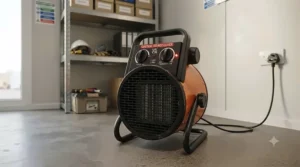
Site welfare unit heater requirements sit at the sharper end of why proper heating specification matters rather than being a nice-to-have. HSE guidance on construction site welfare makes clear that rest and eating areas must be adequately provided for and sheltered from adverse weather, and that where heating is needed it should be safe to use in a confined space. For a genuinely large welfare block, whether that’s a six-person unit or a full multi-room facility, a single 2kW desk heater simply won’t cut it. This is precisely the territory of the Sealey EH5001 5kW 415V Industrial Fan Heater where three-phase power is available, or a combination of ducted and standard Sealey units feeding warmth into separate rooms from fewer overall heaters. HSE’s overview of welfare facilities on construction sites sets out exactly what dutyholders need to provide, and heating a rest area properly isn’t an optional extra buried in the small print, it’s a core part of that obligation.
Features That Actually Matter (And Those That Don’t)
Not every spec on the box carries equal real-world weight. A genuine thermostat matters enormously, since the difference between a heater that cycles automatically and one that just runs flat-out shows up directly on the electricity bill, and models like the Prem-I-Air Elite range earn their keep here. Dry, fume-free heat also matters, particularly in a confined cabin where anything producing moisture or a lingering smell becomes genuinely unpleasant within an hour, which is exactly why the entire Sealey range leans on that as a core selling point.
What matters less than the marketing suggests: maximum wattage alone, without context. A 5kW heater in a tiny single-desk cabin is genuinely overkill, wasting power and likely forcing you to run it on a low setting most of the time anyway, in which case a smaller, cheaper unit would’ve done exactly the same job. Colour options and cosmetic styling, occasionally mentioned in product listings, matter essentially not at all for a piece of kit that’s going to live under a desk covered in dust within a fortnight.
Safety and Regulations: Heating Temporary Site Offices Properly
Heating equipment in a small, occupied cabin isn’t something to treat casually, and there’s genuine guidance worth following rather than winging it. Electrical Safety First’s advice on portable heaters recommends placing units on a level surface well away from anything that could knock them over, keeping at least a metre of clearance from combustible materials, and never leaving a heater running unattended, guidance that applies just as squarely to a site cabin as it does to a living room.
On the workplace side, minimum temperature standards genuinely apply to site offices the same as any other workplace. Under general workplace guidance, employers should provide a reasonable working temperature, usually at least 16°C, or 13°C for more physically demanding work, and there are specific rules for higher-risk workplaces like construction sites layered on top of that baseline. Choosing a properly rated, thermostat-equipped heater like those covered in this guide isn’t just about comfort, it’s a genuine step toward meeting that basic duty of care rather than leaving it to chance.
Long-Term Cost and Running Costs of Site Office Heaters
Buying the heater is only half the sum. Running costs across a full winter matter just as much, and a unit with a genuine thermostat, cycling on and off to maintain a set temperature, will cost noticeably less to run than a fixed-output heater left blasting away at full power regardless of whether the cabin’s already warm.
| Heater Type | Typical Price Range | Running Cost Pattern |
|---|---|---|
| Draper 2.0kW PTC (no thermostat cycling) | £25-£40 | Runs continuously at set output |
| Prem-I-Air Elite (thermostat-equipped) | £30-£55 | Cycles off once target reached |
| Sealey EH3001/DEH3001 (dual heat settings) | £50-£95 | Flexible between full and half power |
The pattern here is straightforward: paying a little more upfront for genuine thermostat control, as with the Prem-I-Air Elite range or the dual-setting Sealey units, tends to claw back the difference across a single hard winter through lower ongoing electricity use. HSE’s information sheet on welfare facilities during construction work also notes that rest facilities will normally require heating, and that properly maintained electrical equipment is the safer route compared with improvised alternatives, a point worth remembering before reaching for whatever heater happens to be lying around a yard.
FAQ
❓ What size fan heater do I need for a site office?
❓ Can I run a 3kW heater from a standard socket?
❓ Is it safe to leave a fan heater running overnight in a cabin?
❓ Do fan heaters use a lot of electricity?
❓ Can a fan heater cause damp or condensation in a portacabin?
Conclusion
Choosing a powerful fan heater for site office use really comes down to matching output and features to your actual cabin, not just grabbing the biggest wattage on the shelf. Single-desk setups are well served by the compact Draper 2.0kW PTC Portable Electric Space Heater or the safety-conscious Prem-I-Air Elite 2kW Turbo Fan PTC Industrial Space Heater, while larger or busier offices genuinely benefit from stepping up to the Prem-I-Air Elite 2.8kW or the dependable Sealey EH3001 3kW Industrial Fan Heater. Damp or exposed sites should look seriously at the IPX4-rated Benross 42450 3000W Industrial Fan Heater, awkward layouts are best solved by the ducted Sealey DEH3001, and genuinely large welfare units with three-phase power available should consider the heavyweight Sealey EH5001 5kW 415V Industrial Fan Heater. Whichever you land on, remember that a thermostat and a bit of common sense around placement will do more for your comfort and your electricity bill than raw wattage alone ever will.
Recommended for You
- 7 Best Fan Heater for Construction Site 2026: Beat the Cold
- Propane Forced Air Heater: 7 Best Site Heaters for Winter 2026
- Propane Heater for Construction Site: 7 Best Picks 2026
Disclaimer: This article contains affiliate links. As an Amazon Associate, I earn from qualifying purchases. If you purchase products through these links, we may earn a small commission at no additional cost to you.
✨ Found this helpful? Share it with your friends! 💬🤗
