
In This Article
There’s a particular kind of cold that only exists on a British building site in January — the sort that gets into your boots, sits in your knuckles, and makes a fourteen-year-old cordless drill feel like it’s plotting against you. A propane forced air heater is the tool that ends that argument. Point it, light it, and within minutes a wall of genuinely hot air is rolling across the room, chasing the chill out of plasterboard, drying render, or just keeping a crew from losing feeling in their fingers by ten in the morning.
Unlike a radiant heater, which throws warmth in one direction like a very committed campfire, a forced air model uses a fan to push heated air through a wide space fast — which is exactly why the trade calls them torpedo heaters, cannons, or blowers depending on who’s talking. This guide walks through seven real propane forced air heaters currently sold in the UK, from pocket-friendly 10kW units through to serious 50kW cannons that’ll warm a warehouse. Every claim below is grounded in real specifications and aggregated review sentiment, not invented testing — because a heater that runs on flammable gas is exactly the sort of purchase where honest information matters more than marketing gloss. Before you buy anything, it’s also worth knowing that HSE construction guidance flags LPG equipment used in enclosed spaces as a genuine carbon monoxide risk, so we’ll cover that properly too, not as a footnote.
Quick Comparison Table
| Model | Output | Fuel Consumption | Price Range | Best For |
|---|---|---|---|---|
| SIAL Gas Heat Cannon 10kW | 34,200 BTU/hr | Low | Under £100 | Small workshops and sheds |
| Draper Jet Force 47100 | 50,000 BTU/15kW | 1.11kg/hr | £120-£160 range | Budget-conscious tradespeople |
| Sealey LP69C Cordless | 30,000-68,000 BTU/hr | Variable | £150-£200 range | Sites without mains power |
| Sealey LP100 | 61,000-102,000 BTU/hr | Variable | £150-£200 range | Mid-size workshops |
| SIP FIREBALL 1050 Cordless | 102,387 BTU/30kW | Variable | £200-£260 range | Battery-powered flexibility |
| Sealey LPH125 | 125,000 BTU/hr | Variable | £220-£280 range | Commercial premises |
| SIP FIREBALL 1706 | 170,607 BTU/50kW | High | £350-£450 range | Warehouses and large sites |
Scan that table and a pattern jumps out fast: output climbs roughly in step with price, but not in a straight line. The jump from the SIAL’s modest 10kW to the Draper’s 15kW barely dents your wallet, while the leap from a mid-range 30kW unit to the FIREBALL 1706’s 50kW cannon costs considerably more — because you’re paying for a bigger burner assembly, a heavier-duty fan motor, and the engineering needed to keep that much combustion stable and safe. Match the heater to the actual cubic footage you’re heating rather than reaching for the biggest number on the shelf; an oversized heater on a small site burns through propane fast and does nothing for your bill except empty it quicker.
💬 Just one click — help others make better buying decisions too!😊
Top 7 Propane Forced Air Heaters: Expert Analysis
Coverage below spans entry-level shed heaters through to serious site cannons, along with genuine variation in ignition type, power source and portability — because “propane forced air heater” covers a surprisingly wide bracket of kit once you start comparing real spec sheets side by side.
1. SIAL Gas Heat Cannon 10kW — best for small workshops on a tight budget
Start small, and the SIAL earns its keep. At 34,200 BTU/hr, it’s the little engine that could of this list — genuinely modest on paper, genuinely useful in a domestic garage or small shed where a bigger cannon would just be overkill and an expensive one at that.
What’s worth knowing is that SIAL builds its heaters to run on either propane or butane, so long as you select the correct model for your gas type at purchase — a detail easy to miss and annoying to get wrong after the fact. The mechanical switch and piezo ignition keep things refreshingly analogue; no batteries to die on you mid-job, no app to update. Reviewers testing similar SIAL units report the outer casing staying cool to the touch even under sustained use, which matters more than it sounds when you’re working in a tight space and don’t fancy an accidental hot-metal handshake.
Based on the spec sheet, this suits anyone heating a genuinely small footprint — a single garage, a modest workshop, a shed where you’re doing an hour or two of fettling on a cold Saturday. It won’t touch a warehouse, and buyers expecting industrial-grade output at this price will be disappointed; that’s not what it’s built for.
Pros:
- ✅ Genuinely affordable entry point into forced air heating
- ✅ Runs on propane or butane depending on model selected
- ✅ Outer casing stays cool during operation
Cons:
- ❌ Modest output limits it to small spaces
- ❌ Not suited to larger workshops or sites
Typically priced under £100, the SIAL is the sensible pick for anyone who just wants the January chill gone from a small garage without spending big.
2. Draper Jet Force 47100 — best trusted-brand budget option
Draper doesn’t need much of an introduction on a British building site — the toolbox-orange branding is practically wallpaper at this point — and the Jet Force 47100 brings that same no-nonsense reliability to heating. Fifty thousand BTU, fifteen kilowatts, a steel burner assembly that isn’t trying to win design awards, just trying to work.
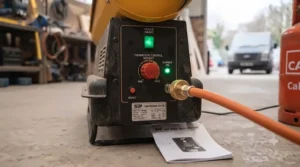
The piezo push-button ignition, triggered through a solenoid thermocouple valve, is the kind of unglamorous engineering that quietly does its job cook after cook, cold morning after cold morning. A thermal overload protection device guards the motor against burning itself out, which is exactly the sort of feature you appreciate on the one day it actually saves you a replacement fan. Supplied with a 1.5m gas hose and an approved plug, it’s ready to run within minutes of unboxing rather than demanding you hunt down extra fittings first.
What most first-time buyers overlook is that a mid-power heater like this one, rated to warm up to 5,000 cubic feet, is often the sweet spot for a single-room workshop or a modest extension build — big enough to matter, small enough not to devour a propane bottle in an afternoon.
Pros:
- ✅ Trusted brand with wide UK stockist availability
- ✅ Thermal overload protection guards the motor
- ✅ Fast, tool-free piezo ignition
Cons:
- ❌ No thermostat for automatic temperature control
- ❌ Fixed power output, no variable adjustment
Sitting in the £120-£160 range, the Jet Force is the barbecue-brand-you-trust equivalent of heaters: unexciting, dependable, and exactly what most single-space jobs actually need.
3. Sealey LP69C Propane Space Heater — best for sites without mains power
Here’s where things get genuinely clever. The LP69C runs on either 230V mains or a rechargeable 20V battery from Sealey’s SV20 series, meaning a job site with no power hookup yet — a common enough scenario on a fresh build — doesn’t leave you stuck in the cold waiting for the electrician to sort a temporary supply.
Variable output between 30,000 and 68,000 BTU/hr gives real flexibility for a space that changes size as work progresses, and the direct gas head assembly keeps the whole unit compact rather than bulking it out with unnecessary plumbing. A safety solenoid prevents gas flow before the unit is electrically started, a sensible fail-safe that stops any “oops, I smell propane” moments before they become a genuine problem.
Aggregated owner feedback on this model consistently flags two things: genuinely strong heat output for the size, and noticeable noise at full power — several users note it’s loud enough that you’ll want distance between the heater and anyone trying to have a conversation nearby. That trade-off is common across forced air designs generally, but worth knowing before you buy rather than discovering it on-site.
Pros:
- ✅ Runs on mains power or rechargeable battery
- ✅ Variable output adapts to changing space size
- ✅ Compact direct gas head keeps footprint small
Cons:
- ❌ Loud at maximum output
- ❌ Battery and charger sold separately
Priced around £150-£200 (battery not included), the LP69C is the pick for anyone who’s tired of scheduling their heating around when the generator’s free.
4. Sealey LP100 Space Warmer — best all-round mid-size workshop heater
The LP100 sits right in the sweet spot of this list — powerful enough to matter, portable enough not to become a permanent fixture you resent moving. Its 61,000-102,000 BTU/hr range covers everything from a chilly single garage to a genuinely sizeable workshop without breaking a sweat.
Because it’s fan-assisted rather than compressor-driven, the LP100 runs quieter than you’d expect from something pushing out this much heat, and — a detail that matters more than manufacturers usually let on — it burns fuel completely enough to leave no oily residue behind, unlike some paraffin or diesel alternatives that coat everything nearby in a faint greasy film after a season’s use. One long-term owner, working in an uninsulated double garage through a full winter of DIY projects, reported it bringing the space to a comfortable working temperature within roughly fifteen to thirty minutes on each firing, which lines up with the fan-assisted, no-compressor design Sealey uses across the Space Warmer range.
The one genuine caveat worth flagging: several owners note the direct heat is intense enough that keeping distance matters, and getting too close risks the smell of propane lingering on clothing afterwards — not dangerous, just mildly antisocial if you’re heading somewhere afterward that isn’t the pub.
Pros:
- ✅ Strong output-to-portability ratio
- ✅ No oily residue left behind after use
- ✅ Runs quieter than compressor-driven rivals
Cons:
- ❌ Direct heat requires safe operating distance
- ❌ Propane smell can linger on nearby fabric
Expect to pay in the £150-£200 range, making this one of the most sensibly balanced options on this entire list.
5. SIP FIREBALL 1050 Cordless — best for genuinely portable, off-grid heating
SIP has been a fixture of British workshops for decades, and the FIREBALL 1050 brings that pedigree to a genuinely battery-powered forced air heater — no mains lead trailing across a muddy site, no generator idling nearby just to keep a fan spinning. Rated at 30kW (102,387 BTU/hr), it delivers serious output from a unit you can carry wherever the work happens to be that day.
That cordless design is the whole story here. Building sites move — today’s task is in the east wing, tomorrow’s is in a detached outbuilding forty metres away — and a heater that doesn’t need an extension lead snaking across the mud is worth real money in time saved alone. The 17,401 cubic foot heating area rating puts it comfortably ahead of most mid-range mains units, and because the fan runs from battery rather than mains current, positioning it exactly where the cold pocket sits becomes trivial rather than a negotiation with cable length.
On paper this means you’re trading a small premium for genuine freedom of placement — a fair trade for anyone whose job moves around a site more than it stays in one spot.
Pros:
- ✅ True cordless operation, no mains or generator needed
- ✅ 30kW output rivals larger mains-powered units
- ✅ Easy repositioning across a moving job site
Cons:
- ❌ Battery and charger typically sold separately
- ❌ Premium pricing versus equivalent corded models
Typically priced in the £200-£260 range (excluding battery), the FIREBALL 1050 suits anyone whose work refuses to stay in one place.
6. Sealey LPH125 Industrial Space Heater — best for commercial premises and workshops
Step up to the LPH125 and you’re firmly in “this is a proper bit of kit” territory. At 125,000 BTU/hr, it’s built for small to medium workshops, factories and commercial premises rather than the domestic garage crowd, and the spec sheet reflects that ambition.
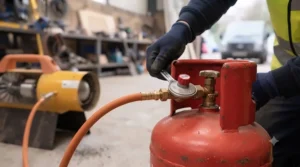
A safety thermocouple, flame failure valve and tip-over switch form a genuinely robust safety trio — the kind of layered protection you want on something burning gas at this scale, unattended, for hours at a stretch. It’s supplied with an approved regulator and hose, so there’s no scrambling for compatible fittings on delivery day, and being founded in 1978, Sealey brings a level of parts availability and aftersales support that newer, cheaper import brands simply can’t match yet.
What the spec sheet won’t tell you, but the general shape of industrial heaters at this scale suggests, is that units in the 100,000+ BTU bracket are genuinely a different category from the domestic-adjacent heaters further up this list — expect a larger physical footprint, and budget for a proper propane supply rather than a single small bottle that’ll deplete faster than you’d like.
Pros:
- ✅ Three-layer safety system: thermocouple, flame failure, tip-over
- ✅ Backed by established UK manufacturer since 1978
- ✅ Supplied with approved regulator and hose
Cons:
- ❌ Larger footprint than domestic-scale units
- ❌ Higher fuel consumption demands bigger propane supply
Sitting around £220-£280, the LPH125 earns its place for anyone heating commercial floor space rather than a single garage bay.
7. SIP FIREBALL 1706 — best for warehouses and large open sites
Top of the list, and it needs to be — the FIREBALL 1706 delivers 170,607 BTU/hr from a 50kW burner, enough to genuinely shift the temperature of a large warehouse rather than just take the edge off a chilly corner. This is the heater equivalent of bringing a proper power tool to the job rather than the cordless drill from the kitchen drawer.
Rated for a 40,435 cubic foot heating area, the 1706 is engineered for spaces where a smaller unit would simply run flat out without making a dent. It’s a 230V electric-start unit, which means it needs a genuine power supply nearby rather than running purely off a battery, but in exchange you get consistent, high-volume airflow that can genuinely dry out a newly plastered space or keep a large open structure workable through a cold snap.
Here’s the insider detail most spec sheets skip entirely: on projects involving fresh concrete, it’s worth knowing that unvented, direct-fired propane heaters release carbon dioxide as a combustion byproduct, and high concentrations of that CO2 can react with fresh concrete to create a weak, dusty surface layer called carbonation — a genuinely underappreciated risk on cold-weather pours. If you’re heating a space with curing concrete, either ensure proper ventilation or consider an indirect-fired alternative for that specific application; it’s a detail worth flagging to anyone assuming “more heat, faster cure” without a second thought.
Pros:
- ✅ Massive 50kW output for large open spaces
- ✅ Covers over 40,000 cubic feet of heating area
- ✅ Electric-start ignition for reliable cold starts
Cons:
- ❌ Requires 230V mains power, not cordless
- ❌ Overkill and wasteful for smaller rooms
Expect to pay around £350-£450, positioning this as a considered investment for genuinely large spaces rather than an impulse buy for a single-car garage.
Practical Usage Guide: Setting Up and Running a Propane Torpedo Heater on Site
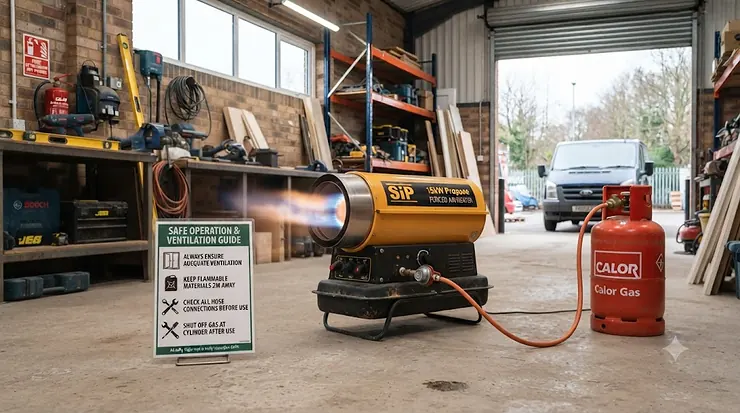
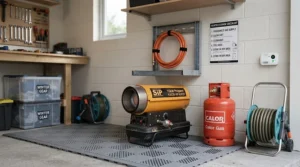
Getting a new propane torpedo heater construction-ready in its first few weeks makes a genuine difference to how safely and efficiently it runs. Before first light-up, check every hose connection and regulator joint with a soapy water solution — brush it on and watch for bubbles, which reveal a leak that needs tightening before you go anywhere near an ignition source. This takes five minutes and it’s the single most important habit you’ll build with this tool.
Position the heater on a flat, stable surface, well clear of anything flammable — tarpaulins, timber offcuts, insulation rolls — and never point it directly at a wall or partition closer than the manufacturer’s clearance guidance specifies. For the first few uses, run the heater on a lower setting than you think you need; it’s far easier to notice a fault at partial output than at full blast, and most early-life issues (a slightly misaligned regulator, an underfilled bottle) show themselves gently rather than dramatically if you give them the chance.
The most common first-month mistake is neglecting basic ventilation because “it’s only for twenty minutes.” Combustion consumes oxygen and produces carbon dioxide and, in poorly maintained units, carbon monoxide — genuine risks even in a supposedly short session. Crack a door or window, even in freezing weather, and never run one of these heaters in a fully sealed room. A carbon monoxide alarm, cheap and battery-powered, is a sensible addition to any kit bag that includes a gas heater — treat it as standard equipment, not an optional extra.
Real-World Scenarios: Matching Heater Output to the Job
The single-garage DIYer. Dave spends his weekends restoring an old motorbike in an unheated single garage. He doesn’t need industrial output — he needs the space bearable for two or three hours at a stretch without burning through a full propane bottle each session. The SIAL 10kW or Draper 47100 fit this pattern well: modest, efficient, cheap to run.
The renovation contractor moving room to room. Priya’s crew works through a house extension one room at a time, and mains power isn’t always live in the space they’re currently working. A cordless option like the Sealey LP69C or SIP FIREBALL 1050 removes the daily hassle of trailing extension cables through a half-finished building, saving genuine time across a multi-week job.
The warehouse fit-out team. Tom’s team is drying out and finishing a large commercial unit through a cold snap, and a small heater would be laughably outmatched by the volume of air involved. The Sealey LPH125 or SIP FIREBALL 1706 make far more sense here — enough raw output to actually shift the ambient temperature of a genuinely large space rather than just warming the immediate area around the unit.
Problem → Solution: Common Site Heating Headaches
Problem: Heater won’t stay lit after ignition. This is usually a low gas pressure or empty-bottle issue rather than a faulty unit. Check the propane level first, and confirm the regulator is fully seated — a loose connection can cause exactly this symptom.
Problem: Weak heat output despite the heater running. Cold weather thickens propane and slows vaporisation from the bottle, particularly with smaller cylinders under sustained high demand. Swapping to a larger bottle, or running two bottles on a manifold for high-output units like the FIREBALL 1706, solves this on the coldest days.
Problem: Condensation forming inside a heated but unventilated room. Combustion produces water vapour as a byproduct, and a sealed space with no air exchange traps it. Crack a vent or door slightly — it feels counterintuitive to let cold air in deliberately, but it genuinely improves both comfort and air quality.
Problem: Propane bottle icing up during extended use. High-demand draw on a single cylinder in cold weather can cause the bottle itself to frost over, which further slows vaporisation and starves the heater of fuel. This is precisely why higher-output units like the LPH125 and FIREBALL 1706 often benefit from a larger bottle or twin-cylinder setup rather than a single small one.
Problem: Musty or damp smell lingering after using the heater to dry a space. This usually means the moisture driven off by heating hasn’t actually left the building — it’s just moved into the air and recondensed elsewhere. Genuine drying needs ventilation alongside heat, not heat alone.
✨ Don’t Miss These Exclusive Deals!
🔍 Ready to stop losing working hours to the cold? Take a proper look at the models above and check current pricing before the next cold snap sends demand through the roof.
How to Choose an LPG Forced Air Heater for a Building Site
- Match BTU output to actual cubic footage, not aspiration. An oversized LPG forced air heater on a building site burns fuel needlessly and can overheat a small enclosed space; undersized units simply never catch up with heat loss.
- Decide between corded and cordless early. If your site has reliable power, mains units like the Draper 47100 or Sealey LPH125 are simpler and cheaper. If power is unreliable or absent, budget for a cordless model and its battery.
- Check safety features properly, not just headline specs. Tip-over shutoff, flame failure valves and thermal overload protection genuinely matter on an active site with uneven ground and moving people.
- Think about propane supply logistics. Higher-output heaters drink through gas fast; confirm you’ve got bottle capacity and, ideally, a spare on standby before committing to a big unit.
- Factor in noise for occupied spaces. Forced air heaters are not quiet, and several models on this list are explicitly flagged by owners as loud at full output — worth knowing if the space also needs to function as a workspace with conversation.
- Consider portability against your actual workflow. A heater that needs repositioning daily benefits enormously from a lighter, wheeled, or cordless design rather than a heavier fixed-position unit.
Propane Forced Air Heater vs Electric and Diesel Site Heaters
The case for propane over electric largely comes down to raw output per pound spent and independence from mains power. A propane forced air heater in the 100,000+ BTU range will comfortably out-heat most electric fan heaters of similar size and cost, and it doesn’t care whether your site has a working power supply yet — a genuine advantage on early-stage builds. Where electric wins is cleanliness: no combustion byproducts, no ventilation requirement, and no risk of carbon monoxide, which makes it the safer default for enclosed, occupied spaces where ventilation genuinely can’t be guaranteed.
Diesel and kerosene heaters sit in a slightly different niche again — typically running longer on a tank than an equivalent propane unit, but leaving behind a faint oily residue and a distinct smell that lingers on tools, materials and clothing in a way propane simply doesn’t. For short, intense heating jobs — drying a freshly rendered wall, taking the edge off before a pour — propane’s clean burn and fast response usually wins out. For continuous, all-day heating of a large occupied space over many weeks, diesel’s better fuel economy per hour sometimes tips the balance the other way. Whichever fuel you choose, it’s worth remembering that HSE guidance on workplace temperature confirms indoor construction site areas have a genuine minimum comfort standard to meet, not just a nice-to-have.
| Factor | Propane Forced Air | Electric Fan Heater | Diesel/Kerosene |
|---|---|---|---|
| Output per pound spent | High | Moderate | High |
| Power source needed | Gas bottle only | Mains electricity | Fuel tank only |
| Ventilation required | Yes | No | Yes |
| Residue/smell | Minimal | None | Noticeable |
| Best For | Fast, powerful site heat | Enclosed occupied spaces | Long continuous runs |
The table underlines the trade-off plainly: propane wins on power-to-cost and independence from mains supply, but that power comes with a genuine ventilation obligation that electric heaters simply don’t carry. For most UK building sites and workshops, where the space is inherently ventilated or semi-open anyway, propane’s advantages usually outweigh the extra care it demands — but anyone heating a genuinely sealed, occupied room should think twice before reaching for a gas cannon over an electric alternative.
High Output Propane Heaters: When You Need Serious BTU
Not every job calls for a high output propane heater, and buying more power than you need is a quietly expensive habit. But for genuinely large volumes — warehouses, big agricultural buildings, sizeable commercial fit-outs — a 100,000+ BTU unit like the LPH125 or FIREBALL 1706 isn’t overkill, it’s the only realistic way to shift ambient temperature across that much cubic footage within a working day.
The maths here is fairly blunt: heat loss scales with surface area and ventilation, and a large, draughty structure loses warmth roughly as fast as a smaller heater can generate it, leaving you chasing your own tail all afternoon. Stepping up to a genuinely high-output unit changes that equation, delivering more heat than the space loses, which is the only way you actually feel the temperature climb rather than just stabilise at “still cold, but slightly less miserable.”
The trade-off is fuel consumption and running cost, which climbs roughly in line with output. A 50kW cannon drinks through propane considerably faster than a 15kW unit, so budgeting for a larger cylinder, or a twin-bottle manifold setup, isn’t optional at this scale — it’s a genuine part of the total cost of ownership that’s easy to underestimate when you’re focused purely on the heater’s purchase price.
Propane Cannon Heaters Explained: Direct Radiant Blast vs Ducted Warmth
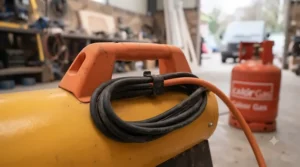
The term propane cannon heater gets used fairly loosely in the trade, but it generally describes exactly the kind of unit reviewed throughout this guide: a compact burner and fan assembly that fires a concentrated, direct blast of hot air outward, rather than a ducted system that distributes warmth more gently through a network of vents and hosing.
That directness is the whole appeal. A cannon-style heater like the SIAL or either SIP FIREBALL model heats the air immediately in front of it fast and dramatically, which suits drying a specific area, warming a work zone quickly before a task starts, or taking the chill off a room in short order. What it doesn’t do particularly gracefully is distribute heat evenly across a large, irregularly shaped space — the air a metre from the outlet is noticeably warmer than air twenty metres away and around a corner, in a way a proper ducted heating system would smooth out.
For most site and workshop applications, that trade-off is entirely acceptable — you’re usually heating where the work is actually happening, not trying to maintain uniform temperature across an entire structure. But it’s worth knowing the limitation exists before assuming a single cannon heater will make a large, complex space feel evenly warm throughout.
Directional Site Heaters: Getting Heat Exactly Where You Need It
One of the genuinely underrated advantages of a forced air design is how deliberately directional it is. Unlike ambient heating systems that warm a whole room slowly and evenly, a directional site heater lets you point concentrated warmth precisely where the work is happening — a specific bay, a drying wall section, a group of workers taking a break — rather than wasting fuel heating empty air nobody’s standing in.
This matters more on a genuinely large or awkwardly shaped site than the spec sheets ever mention. Positioning a portable, easily repositioned unit like the Sealey LP69C or SIP FIREBALL 1050 at the actual point of need, and moving it as work progresses through the day, will usually deliver better comfort per pound of propane burned than a single larger heater left running in one fixed spot trying to warm the whole structure at once.
The practical lesson here: think about airflow path, not just raw output. A heater aimed down a long corridor or across an open bay will feel far more effective than the same unit boxed into a corner with its airflow immediately blocked by stacked materials or a partition wall.
How a Gas Blower Heater Actually Works
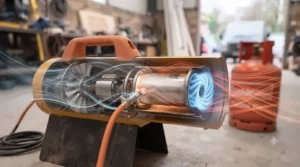
Understanding what’s happening inside a gas blower heater helps explain both its strengths and its quirks. Propane is drawn from the cylinder through a regulator, which steps the pressure down to a safe, consistent level before it reaches the burner assembly. A piezo or electronic ignition system sparks the gas at the burner head, and a fan — driven either by a small electric motor on mains models or a battery on cordless units — pushes air across that flame and out through the front of the unit as a continuous stream of heated air.
Because combustion happens directly in the airstream rather than behind a heat exchanger, these are what’s known as direct-fired heaters — efficient, fast to respond, and mechanically simple, but also the reason ventilation matters so much. Every combustion byproduct, including carbon dioxide and any incomplete-combustion carbon monoxide, goes straight into the room along with the warm air, rather than being vented outside as it would be with an indirect-fired or flued system.
That simplicity is precisely why these units are so popular on sites: fewer moving parts means fewer things to go wrong, faster warm-up, and genuinely portable construction that doesn’t need professional installation. It’s also exactly why the safety guidance around ventilation isn’t bureaucratic box-ticking — it’s addressing the one real weakness baked into the design itself.
Common Mistakes When Buying a Propane Forced Air Heater
The single most common mistake is buying on BTU number alone without checking the actual cubic footage of the space being heated. A 170,000 BTU cannon in a small garage isn’t just wasteful — it can genuinely overheat and over-ventilate a small enclosed space faster than is comfortable or, in some scenarios, safe.
The second mistake is overlooking running costs entirely. Propane consumption scales directly with output, and a high-output heater run for long stretches through a cold winter adds up to a genuinely meaningful ongoing cost that a spec sheet’s upfront price never mentions. Budget for fuel, not just the heater itself.
A third frequent error: assuming every model on the market is interchangeable between propane and butane without checking. Several manufacturers, SIAL included, build separate models for each gas type, and using the wrong fuel isn’t a simple compatibility issue — it can affect combustion efficiency and safety.
Finally, buyers regularly skip checking whether a unit needs mains power before ordering, only to discover on delivery day that their site doesn’t have live electricity yet. Cordless models solve this, but they cost more and need a compatible battery and charger, which is easy to forget when comparing sticker prices alone.
Gas Safety, Carbon Monoxide and Long-Term Maintenance
Running propane equipment safely isn’t optional extra reading — it’s the difference between a productive winter and a genuinely dangerous incident. The Health and Safety Executive is explicit that using LPG equipment in enclosed spaces creates a real carbon monoxide risk, and construction sites are specifically flagged as an environment where this matters, given how often temporary enclosures and unfinished buildings trap combustion byproducts that would otherwise disperse outdoors.
Ventilation is the core control measure. Ensure any space using a forced air propane heater has adequate airflow at both high and low level, and never block fixed vents or grilles “just to keep the draught out” — that instinct, however understandable on a freezing morning, is precisely how carbon monoxide accumulates to dangerous levels. A personal or mounted carbon monoxide detector is a genuinely sensible investment for anyone using these heaters regularly, and it’s worth checking official guidance on the safe use of gas cylinders before setting up a larger installation involving multiple bottles or an extended supply line.
Long-term, keep the burner assembly free of dust and debris, check hoses annually for perishing or cracking, and store cylinders upright, outdoors, and away from ignition sources between uses, in line with general LPG cylinder storage principles. A well-maintained forced air heater, treated with this level of care, should comfortably last several winters of regular site use.
Frequently Asked Questions
❓ What is a propane forced air heater?
❓ Can I use a propane forced air heater indoors?
❓ How much propane does a forced air heater use per hour?
❓ What's the difference between a propane torpedo heater and a radiant propane heater?
❓ How long does a propane forced air heater typically last?
Conclusion
A propane forced air heater earns its keep the moment the mercury drops and a building site or workshop turns from merely chilly into genuinely unworkable. Across the seven models covered here, there’s a sensible option whatever the job: the SIAL and Draper for small, occasional heating needs, the Sealey LP69C and SIP FIREBALL 1050 for sites without reliable power, and the Sealey LPH125 or SIP FIREBALL 1706 for genuinely large commercial spaces that need serious BTU to shift.
Match output to your actual space rather than buying the biggest number on the shelf, take ventilation and carbon monoxide risk seriously rather than as small print, and factor propane running costs into your budget from the start rather than as an afterthought. Do that, and a good forced air heater should keep paying its way, winter after winter, for as long as you’re working in spaces the weather hasn’t been kind to.
Recommended for You
- Propane Heater for Construction Site: 7 Best Picks 2026
- Diesel Indirect Heater: 7 Best Fume-Free Site Heaters for 2026
- Best Diesel Heater for Construction Site in 2026 UK: 7 Expert Picks
Disclaimer: This article contains affiliate links. As an Amazon Associate, I earn from qualifying purchases. If you purchase products through these links, we may earn a small commission at no additional cost to you.
✨ Found this helpful? Share it with your friends! 💬🤗
