
In This Article
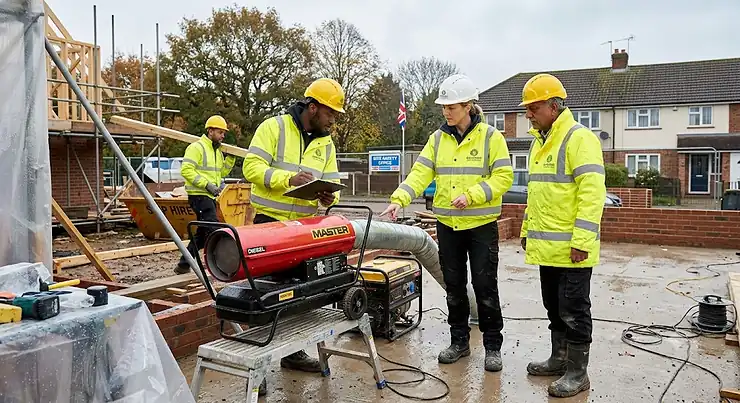
There’s a particular kind of misery that comes with a British building site in January. You’ve got your thermals on, your flask of tea is lukewarm, and the site hut — which someone optimistically calls a “welfare facility” — is about as warm as a converted bus shelter. A good space heater for construction site use isn’t a luxury. It’s practically a welfare requirement.
And it matters more than people realise. Under the Workplace (Health, Safety and Welfare) Regulations 1992, employers have a legal duty to maintain a reasonable temperature in workplaces — and that includes site cabins, huts, and any covered indoor working area on a construction site. The Health and Safety Executive (HSE) recommends a minimum of 16°C for sedentary indoor work. On a blustery site in Leeds or Dundee in February, you’re not getting there without a serious heater.
So what is a space heater for construction site applications? In short, it’s a portable, robust electric (or fuel-powered) unit capable of rapidly raising the temperature in a poorly insulated, draughty space. The best ones are rugged enough to survive a kick from a steel-toe boot, sealed against the inevitable dust and damp, and powerful enough to take the edge off before your crew even pulls off their jackets.
This guide covers seven real products available on Amazon.co.uk, all tested against the realities of British site conditions: the damp, the dust, the temperamental mains supply, and the fact that someone will inevitably leave the cabin door open.
Quick Comparison Table: Top 7 Site Heaters at a Glance
| Product | Power | IP Rating | Weight | Best For | Price Range |
|---|---|---|---|---|---|
| Benross 42450 | 3000W | IPX4 | ~4kg | Budget all-rounder | Under £50 |
| Igenix IG9302 | 2000W | IP24 | 4kg | Small site hut | Under £45 |
| Clarke Devil 7003 | 3000W | — | ~5kg | Workshop/cabin | £50–£70 |
| Draper 92967 | 2000W (PTC) | — | ~3kg | Office/cabin | £40–£60 |
| DAHTEC 5000W | 5000W | IP24 | ~6kg | Larger open spaces | £70–£100 |
| Autojack EFH3KW | 3000W | — | 4.4kg | Budget 3kW option | Under £50 |
| RocwooD RWCHT2 | 2800W | — | ~4kg | Compact site use | Under £45 |
The pattern here is clear: for a standard site hut or cabin up to around 20m², the 2–3kW range hits the sweet spot between power and running cost. The DAHTEC 5000W earns its place for larger open areas — but running it continuously on UK electricity rates will make your site accountant wince. More on that below.
💬 Just one click — help others make better buying decisions too! 😊
✨ Don’t Miss These Exclusive Deals!
🔍 Take your site heating to the next level with these carefully selected products. Click on any highlighted item to check current pricing and availability on Amazon.co.uk — these picks will help you find exactly the right heater for your site.
Top 7 Space Heaters for Construction Site Use: Expert Analysis
1. Benross 42450 3000W Industrial Fan Heater
The Benross 42450 is the one you’ll spot in half the welfare cabins on UK construction sites — and there’s a decent reason for that. It delivers 3000W of heat in a tough, IPX4-rated yellow shell that says, essentially, “I belong on a building site.”
The dual heat settings (1500W and 3000W) mean you’re not stuck running it at full pelt just to get a tolerable temperature. In a standard 3m × 4m site hut, the 1500W mode will hold a comfortable temperature after an initial warm-up on full power — useful when you’re trying to manage running costs across a long winter project. The tilting head is genuinely handy, not a gimmick: angling the output down towards floor level heats a room faster than blasting at the ceiling.
What most UK buyers don’t realise is that the IPX4 rating is fairly meaningful here. It won’t survive being left out in a downpour, but it can take spray, condensation, and the steam from a kettle being boiled two feet away without issue — which is more than can be said for a domestic fan heater dragged onto site.
UK reviewers broadly praise the build quality for the price, though a handful note the thermostat isn’t surgical in its precision. Fair enough at this price point.
✅ Genuinely tough for the money
✅ Tilting head is a practical bonus
✅ Fan-only setting useful in warmer months
❌ Thermostat sensitivity is approximate at best
❌ No plug supplied (requires a 13A fitting — standard, but worth noting)
Price range: under £50 on Amazon.co.uk. Outstanding value for a first site heater or a backup unit.
2. Igenix IG9302 2000W Industrial Drum Fan Heater
Igenix is a British brand, and the IG9302 shows that heritage in the details. The drum format — that distinctive cylindrical shape — is no accident: it pushes warm air in a tight, directional column, which is more efficient than a scattergun approach when you’re heating a draughty site hut with gaps in the floorboards.
At 2kW, this is a lighter-duty option, but the IP24 splash-proof rating and all-metal construction make it legitimately site-appropriate. Three heat settings (low, medium, high) give you more granular control than most competitors at this level, and the tip-over switch — cutting power automatically if the unit falls — is the kind of safety feature that matters in a cabin where someone might knock it while pulling on boots.
For a site cabin of roughly 12–15m², this heater will do the job reliably. It’s not the choice for a large open welfare block, but for the typical two-person site hut, it’s near-ideal: compact enough to tuck under a table, powerful enough to be felt within minutes. UK reviewers consistently highlight durability as a strong point, particularly for price.
✅ Excellent safety features including tip-over protection
✅ Three heat settings for flexible control
✅ IP24 rated — handles site damp
❌ 2kW is the ceiling — not enough for larger spaces
❌ Fan can be slightly noisy on high setting
Price range: under £45. One of the best-value electric site heaters currently on Amazon.co.uk.
3. Clarke Devil 7003 3kW Industrial Electric Fan Heater
Clarke is a name the British trade tool market trusts, and the Devil 7003 carries that reputation. The all-steel construction is noticeably more substantial than cheaper rivals — this heater feels like it was designed to survive a site rather than an office supply cupboard. The adjustable thermostat, built-in overheat protection, and insulated carry handles are all present and functional.
At 3kW, it punches hard for its size. The spec sheet says it’ll heat up to about 25m², which is ambitious in a poorly insulated cabin but realistic in a well-sealed welfare unit. In practice, UK buyers report that it tackles a cold 15–20m² space within ten minutes — which, on a January morning in Manchester, is the difference between the crew wanting to start work and huddling around a phone screen looking for another job.
What sets the Clarke apart from the Benross and Autojack at similar wattage is the build quality margin. You’re paying a little more for a heater that should take more punishment without degrading. Worth the premium for a long-term site deployment.
✅ Substantial all-steel build quality
✅ Trusted British trade brand
✅ Standard 13A plug — no adaptor faff
❌ Slightly heavier than comparable models
❌ One UK reviewer noted it takes three to four minutes to reach full heat output
Price range: £50–£70. A worthwhile step up if you’re using it daily across a six-month project.
4. Draper 92967 2.0kW PTC Portable Electric Space Heater
Draper is another stalwart of the UK trade market, and the 92967 takes a different technological approach: instead of a traditional stainless steel element, it uses PTC (Positive Temperature Coefficient) ceramic heating. The practical upshot? PTC elements self-regulate — they draw less power once the target temperature is reached, making this heater measurably more energy-efficient than a comparable resistance-element model.
For a site cabin or welfare unit where the heater runs for four to six hours at a stretch, that matters. The PTC element also runs at a lower surface temperature, which reduces fire risk in a dusty site environment — worth factoring in on sites where sawdust, insulation fibres, or similar debris might accumulate near the heater.
At 2kW, the Draper is best suited to a smaller, reasonably well-insulated space — an office cabin, a site manager’s container office, or a welfare break room. It’s quieter than most drum heaters, making it less intrusive during phone calls or safety briefings. UK reviewers note consistent build quality and good after-sales support from Draper.
✅ PTC technology means better energy efficiency in use
✅ Lower fire risk in dusty environments
✅ Quiet operation — good for office containers
❌ 2kW limit means it’s not for large or draughty spaces
❌ Less robust physically than all-metal drum heaters
Price range: £40–£60. The smart choice for a site manager’s office cabin where energy efficiency and quiet operation matter.
5. DAHTEC 5000W Enhanced Industrial Electric Fan Heater
When a 3kW heater simply isn’t going to cut it — large welfare blocks, bigger workshop areas, open-plan ground-floor spaces during renovation — the DAHTEC 5000W steps in. Five kilowatts is serious power, and the all-steel casing, IP24 rating, and 1.6m heavy-duty power cord signal that this was designed for genuine industrial use rather than a garden shed.
The non-slip pads on the base are a small but telling detail: the designers anticipated uneven site floors and actual working conditions. Three settings (30W fan-only, 2500W, and 5000W) mean you’re not stuck running it at maximum from the moment you walk in. The delayed fan shutdown — where the fan continues briefly after the element cuts off, cooling the unit gradually — extends the heater’s lifespan in high-use environments.
Running costs at 5000W are meaningful: at current UK energy rates, expect roughly £1.50 per hour at full power. That’s manageable for morning warm-up periods, but you wouldn’t leave it on all day unattended. The built-in thermostat should prevent that anyway, but it’s worth factoring into site energy budgets.
✅ Serious output for larger spaces (up to 40m²)
✅ IP24 rated and robust steel casing
✅ Smart thermal management features
❌ Running costs are significant at full power
❌ Heavier and bulkier — less suited to moving between locations daily
Price range: £70–£100. The right tool for a large-scale welfare block or open-plan site space.
6. Autojack EFH3KW 3KW Electric Fan Heater
Autojack, the Wolverhampton-based tool brand with over 20 years in the UK market, makes the EFH3KW as a no-frills-but-gets-the-job-done option. At 3000W and just 4.4kg, it earns points for being genuinely portable — the kind of heater a sole trader or small crew can chuck in the back of a van and deploy wherever they’re working that week.
The thermostatically controlled auto shut-off keeps running costs in check, and the 10,200 BTU/hr heat output is respectable for the price point. What you’re not getting here is the IP rating or the brand pedigree of the Clarke or Benross. What you are getting is 3kW of heat at an attractive price, from a company that has a UK presence and actual customer support — a consideration worth flagging given the number of unbranded imports at this price bracket.
UK buyers working in small garages and cabins report it performs well. Those expecting it to heat a draughty loft conversion will be disappointed — it’s best deployed in a contained space where it can build up temperature rather than fighting structural heat loss.
✅ Genuinely lightweight for a 3kW unit
✅ UK-based brand with real customer support
✅ Good value for occasional/seasonal use
❌ No IP rating — not suitable for very damp conditions
❌ Best in contained, reasonably insulated spaces only
Price range: under £50. Strong budget pick for self-employed tradespeople who move between sites.
7. RocwooD RWCHT2 2800W Workshop Electric Heater
RocwooD occupies an interesting niche in the UK market — positioned between the cheap unbranded imports and the established trade names, with a price point that appeals to smaller contractors. The RWCHT2 at 2800W sits between the 2kW and 3kW camps, which is a thoughtful sweet spot: enough power to heat a standard site cabin quickly, without the full energy draw of a 3kW unit running continuously.
The design is compact and practical — nothing fancy, but that’s rather the point. For a site hut heating situation where the heater is going in a corner and needs to run reliably for several months, a simple design with fewer components to fail is genuinely appealing. UK buyers consistently mention reliability and value as the standout qualities.
One note: RocwooD heaters are available both directly and through third-party sellers on Amazon.co.uk — worth checking the seller rating before purchasing to ensure you’re covered by Amazon’s return policy, which under the Consumer Contracts Regulations gives you a 14-day cooling-off period on any online purchase.
✅ Good middle-ground wattage for most site cabins
✅ Compact and unfussy design
✅ Well-priced for the output
❌ Less brand recognition means more variable quality control
❌ Limited formal IP rating information
Price range: under £45 on Amazon.co.uk.
How to Set Up and Run Your Site Heater Safely: A Practical Guide 🔧
Getting the most out of a space heater for construction site use isn’t just about plugging it in and walking away. A few practical steps make the difference between a heater that lasts a season and one that ends up as a complaint to the site manager.
Placement matters more than you’d think. Position the heater on a level, stable surface at least 1 metre from flammable materials — insulation boards, timber, cardboard, PPE — and never in a corridor or doorway where it becomes a trip hazard. In a site cabin, floor-level placement with the head angled slightly upward circulates warm air more effectively than blasting it horizontally at head height.
Don’t daisy-chain extension leads. It’s tempting and it’s also a fire risk on a site electrical supply. Use a single-rated extension lead of appropriate length, or better yet, plug directly into a socket. UK site supply is typically 240V single-phase, though some larger sites run 110V CTE (Centre Tapped Earth) for power tools — check your supply before assuming a standard 13A socket.
Ventilation is non-negotiable. Electric heaters don’t produce combustion gases, but a completely sealed site hut accumulates moisture rapidly when it’s occupied. Keep a window slightly ajar. The heater’s thermostat will compensate; your lungs will thank you.
Clean the element periodically. Site dust and construction fibres can build up on the heating element, reducing efficiency and — more seriously — creating a fire hazard. A quick blast of compressed air every few weeks keeps it clear.
In damp conditions, look for at minimum an IP24 rating (the Igenix IG9302, Benross 42450, and DAHTEC 5000W all qualify). A heater with no IP rating in a site environment is a gamble, particularly in British autumn and winter when condensation is a daily reality.
Real-World Scenarios: Which Heater Matches Your Site? 🏗️
The sole trader working alone. Dave runs a one-man plastering operation across sites in the West Midlands. He needs a heater that fits in his van, runs on a 13A socket, and can warm a room before he starts work. The Autojack EFH3KW or Benross 42450 both fit: under £50, lightweight, and powerful enough to take the chill off a room within fifteen minutes. No need to spend £80 for a feature set he’ll never use.
The main contractor’s welfare cabin. A twelve-person crew on a residential development in Yorkshire. The welfare block is a 6m × 4m steel cabin — decent build but poor insulation. For this, the DAHTEC 5000W makes sense: the extra wattage overcomes the structural heat loss, and the thermostat prevents it running at full power all day. Running costs will be a consideration, but keep it at 2500W once the cabin is at temperature and you’re looking at around 85p per hour.
The site manager’s container office. Quiet environment, eight-hour day, needs to be professional enough for client visits. The Draper 92967 PTC model is the call: quieter than drum heaters, better energy efficiency in a small enclosed space, and the lower-temperature PTC element is less alarming to a client sitting three feet away from it.
How to Choose a Space Heater for Construction Site Use in the UK
1. Match wattage to your space
As a rough rule, you need approximately 1kW per 10m² in a reasonably insulated space — and a site cabin is rarely that. Budget for 1kW per 7–8m² in a draughty, uninsulated environment. A 3kW heater is a reliable starting point for a standard two-to-four-person site hut.
2. Check the IP rating
Any heater used on a working construction site should carry at minimum an IP24 rating — meaning it can withstand water splashes from any direction. Sites are wet. They get muddy. Tea gets spilled. An unrated domestic heater is an insurance liability, not just a practical concern.
3. Confirm 230V/240V compatibility
All the heaters in this guide run on standard UK single-phase 230V supply with a 13A plug. If your site runs on 110V CTE (common on larger UK construction sites for power tools), you’ll need a transformer or a dedicated 240V supply for welfare areas — check with your site electrician.
4. Consider portability against output
A 5000W heater that weighs 8kg and lives in one cabin is different from a 3kW unit you move between three locations daily. Match the design to the actual use pattern.
5. Look for a built-in thermostat
Running a heater at maximum power for eight hours is unnecessary and expensive. A good thermostat — even a simple analogue dial — can cut energy use by 30–40% over a working day by maintaining temperature rather than constantly heating.
6. Check the cable length
Most site heaters come with 1.2–1.6m cables. In a cabin where the socket is on the opposite wall to the logical heater position, that’s too short. Budget for a proper extension lead, rated to handle the wattage.
7. Factor in the brand’s UK after-sales support
If a heater fails two months into a six-month project, you need to be able to return it or get a replacement without a protracted dispute with an overseas seller. Sticking to brands with a UK presence — Benross, Igenix, Clarke, Draper — or Amazon’s fulfilled-by-Amazon sellers (who fall under Amazon’s own return policy) is worth the occasional small price premium.
Common Mistakes When Buying a Site Heater
Buying a domestic heater and calling it a site heater. The classic error. A £25 upright fan heater from a supermarket might cope with a draught-free living room. Put it in a site cabin and it’ll either fail within weeks or — worse — survive long enough to become a genuine fire risk. Construction environments are dusty, damp, and rough on electronics. An IP-rated, all-metal unit isn’t just a specification box to tick; it’s a practical difference in longevity and safety.
Underestimating the space. The theoretical room size quoted on a heater listing assumes a well-insulated, sealed room at 20°C ambient. A site hut in January in the north of England is none of those things. If the spec says “suitable up to 20m²”, budget for it to effectively heat 12–14m² on a cold day.
Ignoring running costs. A 3kW heater running at full power for eight hours costs approximately £7–£8 per day at current UK electricity rates. Over a twenty-week winter project, that’s £700–£800 per heater, before you account for any inefficiency. A thermostat and good cabin insulation (even just a draught excluder on the door) can meaningfully reduce that figure.
Buying US-voltage models from overseas sellers. UK mains is 230V/50Hz. Some imported models — particularly from American brands sold through grey-market channels — run on 120V/60Hz and will either fail immediately or run dangerously hot on UK supply. Always confirm 230V compatibility before purchasing.
Forgetting the CDM Regulations 2015 welfare requirements. Under CDM 2015, principal contractors are required to provide adequate welfare facilities, which include reasonable heating in rest areas. A portable heater is part of compliance, not an optional extra — it should be on the site welfare plan from day one, not an afterthought in November.
Electric Site Heaters vs. Alternative Heating Methods
| Method | Initial Cost | Running Cost | Portability | Safety on Site | UK Site Suitability |
|---|---|---|---|---|---|
| Electric fan heater (240V) | Low–Mid | Medium | Excellent | High (IP rated models) | ✅ Excellent |
| Oil-filled radiator | Low–Mid | Medium | Moderate | Good | ✅ Good (quiet, steady heat) |
| Diesel/kerosene space heater | High | Low (fuel) | Good | Lower (combustion fumes) | ⚠️ Outdoor/ventilated only |
| Gas torpedo heater | High | Low (LPG) | Good | Low (CO risk) | ❌ Not for enclosed site huts |
| Central heating (temporary boiler) | Very High | Low | None | Excellent | ✅ Large-scale projects only |
The analysis here is fairly decisive for most UK construction site scenarios: a 240V electric space heater is the correct choice for welfare cabins and enclosed site spaces. Diesel and gas heating systems produce carbon monoxide and other combustion by-products — using them in an enclosed site cabin without industrial-grade ventilation is not just inadvisable, it’s potentially fatal. The HSE is unambiguous on this: combustion heaters in enclosed spaces require adequate ventilation and CO monitoring.
For temporary heating of large, partially open structures — concrete frames mid-build, for instance — a diesel indirect heater with external exhaust may be appropriate. But for the site hut, the welfare cabin, and the site office? Plug it in and breathe easy. Literally.
UK Health & Safety Regulations: What Site Managers Need to Know
The legal framework around workplace heating on UK construction sites isn’t especially complicated, but it’s often misunderstood. Here’s what actually applies.
The Workplace (Health, Safety and Welfare) Regulations 1992 mandate a reasonable indoor temperature — not a specific number, but the HSE’s guidance suggests 16°C as the practical minimum for sedentary or light-activity indoor work. For a welfare cabin where workers are resting between tasks, that threshold is directly applicable.
The Construction (Design and Management) Regulations 2015 (CDM 2015) add further specificity for sites: principal contractors must provide welfare facilities including “rest facilities to rest, eat meals and (where necessary) to change clothing.” Reasonable temperature in rest areas is implicit in that duty.
From a practical insurance and liability standpoint, a site without adequate heating in a welfare area during winter is exposed. Workers have the right under Section 44 of the Employment Rights Act 1996 to leave situations where they reasonably believe there is a serious risk to their safety — and “serious cold” is a legitimate concern. Having a properly spec’d, safety-rated electric heater on your welfare inventory protects both the crew and the principal contractor.
One further point worth noting: any electrical equipment used on a construction site should be subject to regular Portable Appliance Testing (PAT), typically every three months on sites, in line with HSE guidance on electrical safety. A PAT label on a site heater isn’t a bureaucratic nicety — it’s the evidence that the equipment has been checked and is safe.
Long-Term Running Costs: What to Budget in 2026
Running costs on a site heater aren’t trivial over a full winter project. Here’s a practical breakdown using current UK electricity rates:
| Wattage | Cost per Hour | 8-Hour Day | 20-Week Winter Project |
|---|---|---|---|
| 2kW | ~£0.55–£0.68 | ~£4.40–£5.44 | ~£440–£544 |
| 3kW | ~£0.82–£1.02 | ~£6.56–£8.16 | ~£656–£816 |
| 5kW | ~£1.37–£1.70 | ~£10.96–£13.60 | ~£1,096–£1,360 |
Based on current UK energy price cap tariff for 2026. Actual costs vary by supplier tariff and usage pattern.
The cost difference between running a heater at full power continuously versus using a thermostat intelligently is significant. A thermostatically controlled 3kW unit in a reasonably insulated cabin might run the element at full power for only 30–40% of the day once the space is up to temperature — effectively cutting your running cost by half.
For multi-cabin sites, consider staggering warm-up times rather than running all heaters simultaneously. This also helps avoid tripping site circuit breakers — a 3kW heater draws about 13A, which is a single standard UK socket’s full capacity. Multiple heaters on one circuit need their own dedicated supply.
✨ Don’t Miss These Exclusive Deals!
🔍 Ready to warm up your site? Click on any highlighted product above to check current pricing and availability on Amazon.co.uk. Prime members get free next-day delivery — which, when the forecast is showing 2°C and sleet, is rather welcome.
Frequently Asked Questions ❓
❓ What is the best wattage for a space heater for construction site welfare cabin use?
❓ Can I use a domestic fan heater on a UK construction site?
❓ Are electric heaters safe to use in a site cabin or hut?
❓ Do construction site heaters need to be PAT tested in the UK?
❓ What UK regulations apply to heating in construction site welfare areas?
Conclusion: Warm Workers, Better Sites
Cold is a productivity killer. It’s also, on a UK building site in winter, a legal concern. The good news is that the right space heater for construction site use doesn’t need to cost a fortune or require an electrician to install — it just needs to be spec’d correctly for the environment.
For most UK site applications, the Benross 42450 or Clarke Devil 7003 at 3kW represent the best balance of power, robustness, and price. The Igenix IG9302 is the smart pick for smaller cabins where you value safety features and build quality over raw output. The Draper 92967 earns its place in any site office where quiet operation and energy efficiency matter more than brute heat. And for genuinely large welfare spaces, the DAHTEC 5000W delivers what a 3kW unit simply cannot.
Whatever you choose, make sure it’s IP-rated for site use, PAT-testable, and actually suited to the size of the space you’re heating. Your crew will notice the difference on the first cold morning — and so will your site safety record.
Disclaimer: This article contains affiliate links. As an Amazon Associate, I earn from qualifying purchases. If you purchase products through these links, we may earn a small commission at no additional cost to you.
Recommended for You
- Best Industrial Electric Heater 3kW UK 2026: 7 Top Picks Reviewed
- Best Industrial Heater for Construction Site UK 2026: 7 Top Picks
- Best Propane Greenhouse Heater UK 2026: 7 Expert Picks That Actually Work
Disclaimer: This article contains affiliate links. As an Amazon Associate, I earn from qualifying purchases. If you purchase products through these links, we may earn a small commission at no additional cost to you.
✨ Found this helpful? Share it with your mates! 💬🤗
