
In This Article
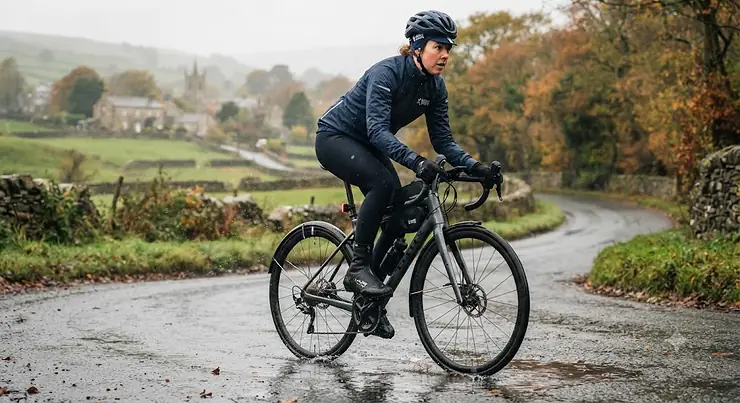
There’s a very specific kind of misery reserved for cyclists whose feet go numb somewhere around mile eight of a wet winter commute. You can layer up everywhere else — thermal jersey, winter gloves, a decent jacket — and still end up wincing at traffic lights because your toes have stopped reporting back. This is precisely the problem waterproof heated cycling overshoes exist to solve, and it’s why they’ve quietly become one of the most searched-for pieces of winter cycling kit in the UK over the past couple of years.
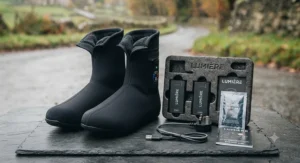
This guide won’t pretend every rider needs a battery strapped to their ankle, though. For plenty of people, a well-made pair of waterproof shoe covers or thermal overshoes does the job perfectly well without the extra weight, cost, or charging routine. What we’ve done here is research seven genuinely available products — spanning proper heated, rechargeable options right through to premium passive waterproofing — and given you honest, specification-backed analysis of who each one actually suits, based on real specs and aggregated reviewer sentiment rather than invented enthusiasm.
We’ll also dig into the question we get asked constantly: heated cycling overshoes vs thermal overshoes — which genuinely earns its keep for your riding pattern? Plus wet commute protection strategies, what “all-weather cycling” actually demands from your footwear, and exactly how rechargeable heated cycling overshoes hold up across a typical UK winter. By the end, you’ll know precisely which category — and which product — fits how you actually ride.
Quick Comparison Table
| Product | Type | Best For | Price Range |
|---|---|---|---|
| ROCKBROS Heated Overshoes | Rechargeable heated | Budget entry into heated overshoes | £35-£45 |
| EKOI Heat Concept Overshoes | Rechargeable heated | Serious sub-zero winter riders | £130-£160 |
| Sealskinz All Weather Overshoe | Waterproof (passive) | Everyday wet commuting | £25-£45 |
| GripGrab RaceThermo | Thermal + waterproof | Cold, dry-to-damp winter rides | £25-£35 |
| dhb Aeron Lab Neoshell Overshoe | Premium waterproof | Long, wet winter club runs | £45-£60 |
| dhb Extreme Weather Neoprene Overshoe | Budget waterproof | No-frills wet weather protection | £25-£35 |
| veloToze Silicone Tall Shoe Cover | Silicone shoe cover | Maximum waterproofing, racing | £30-£40 |
Two categories are hiding in that table, and it’s worth naming them plainly before you scroll further: genuinely heated, battery-powered products (ROCKBROS Heated Overshoes and EKOI Heat Concept Overshoes) and passive waterproof or thermal overshoes that rely on insulation and material choice rather than electronics. The price jump between the two heated options is dramatic — nearly four times the cost — and reflects a real difference in battery capacity, temperature control, and build quality rather than simple brand markup, which we’ll unpack properly below.
💬 Just one click — help others make better buying decisions too!😊
Top 7 Waterproof Heated Cycling Overshoes: Expert Analysis
Seven real products, spanning genuinely heated and premium passive waterproof options, each assessed on real specifications and aggregated review sentiment — never fabricated hands-on claims.
1. ROCKBROS Heated Overshoes — best budget entry into heated cycling footwear
ROCKBROS Heated Overshoes pack a 5000mAh battery with three selectable temperature levels: a low 40°C setting rated for around eight hours, a medium 50°C setting for roughly six hours, and a high 60°C setting good for about four hours. That range matters more than it sounds — it means you can dial down to conserve battery on a longer ride, or crank up briefly on a genuinely freezing morning without needing to buy a second pair for different conditions.
The heating element is focused specifically on the instep and toes, which is exactly where cold registers first and most painfully on a bike, rather than spreading heat thinly across the whole foot where it’s less needed. Reviewers consistently note that the unit reaches maximum temperature within around 30 seconds of activation, which is a genuinely useful feature on a freezing driveway when you don’t want to wait five minutes for warmth to build.
Based on the spec comparison with premium alternatives, the trade-off here is refinement rather than core function — the outer shell is described as water-resistant rather than fully waterproof in heavy, sustained rain, and the Kevlar-reinforced sole is functional rather than genuinely premium. What most buyers overlook about budget heated overshoes like this is that the battery packs are removable and independently rechargeable via USB, meaning you can carry a spare set rather than needing mains access mid-ride — a detail that matters far more on a long commute than the headline wattage figures ever will.
Pros:
- ✅ Three temperature settings from 40°C to 60°C
- ✅ Removable, independently USB-rechargeable battery packs
- ✅ Reaches maximum heat within roughly 30 seconds
Cons:
- ❌ Water-resistant rather than fully waterproof in heavy rain
- ❌ Sole reinforcement less robust than premium alternatives
At roughly £35-£45, ROCKBROS Heated Overshoes represent the most accessible way to try heated cycling footwear without committing to premium pricing — ideal for anyone unsure whether heating genuinely changes their winter riding experience.
2. EKOI Heat Concept Overshoes — best for serious sub-zero winter riders
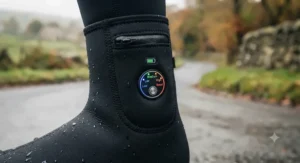
EKOI Heat Concept Overshoes sit at the genuinely premium end of this category, built from 4mm neoprene with removable, rechargeable lithium polymer battery packs delivering up to 15 watts of heating power. The temperature control button, positioned at the rear of the ankle cuff, offers three settings between roughly 30°C and 40°C, with battery life ranging from around one and a half hours on the highest setting up to four hours on the lowest — a genuinely useful trade-off dial for anyone planning a long, cold ride.
What stands out here is the claimed effectiveness down to -20°C, a figure well beyond what any passive thermal overshoe on this list attempts to promise. The construction reflects that ambition: reinforced toe and heel zones for durability, reflective elements for winter visibility, and a Velcro strap under the insole for a genuinely secure, wind-resistant fit rather than the looser fit typical of cheaper heated alternatives.
Reviewers consistently flag two things worth knowing before buying. First, the mains charger uses a continental two-pin plug, so UK buyers need an adapter to charge from a standard socket — a small but genuinely annoying oversight for a product sold into the UK market. Second, the manufacturer explicitly advises switching off the heating elements in heavy rain due to short-circuit risk, which tells you something important: this is a product engineered primarily for cold, dry-to-light-precipitation conditions rather than genuinely torrential wet commutes.
Pros:
- ✅ Up to 15 watts of heating, effective down to claimed -20°C
- ✅ Adjustable temperature and battery life trade-off (1.5-4 hours)
- ✅ Reinforced toe, heel and reflective detailing for durability and visibility
Cons:
- ❌ Requires a UK plug adapter to charge from the included charger
- ❌ Heating elements should be switched off in heavy rain
At around £130-£160, EKOI Heat Concept Overshoes cost significantly more than any other product here, but for riders who suffer genuinely in sub-zero conditions, the wattage and temperature range on offer isn’t matched anywhere else on this list.
3. Sealskinz All Weather Overshoe — best all-round waterproof pick for daily commuting
Sealskinz All Weather Overshoe uses the brand’s patented AQUASEALZ membrane technology, described as combining complete waterproofness with breathability in a single layer — meaning excess heat and perspiration can escape even while external moisture is blocked, which matters more than people expect on a longer commute where sweat build-up can leave feet feeling just as damp as rain would.
The Kevlar-reinforced construction targets durability specifically where cycling overshoes wear out fastest — the sole and heel — and the open-sole design is built for cleated cycling footwear rather than everyday trainers, so check compatibility with your specific shoes before buying. Reviewers and the brand consistently position this as suited to “extreme weather” use, and aggregated sentiment backs that framing up: buyers repeatedly cite genuine dryness even in sustained downpours, which is the single most common complaint about cheaper waterproof shoe covers.
What the spec sheet won’t tell you outright is how much the breathability actually matters for comfort over a two-hour-plus ride — a fully waterproof but non-breathable shoe cover traps perspiration just as effectively as it blocks rain, leaving you with the same clammy, cold-feeling feet you were trying to avoid. Sealskinz’s membrane approach genuinely addresses this in a way cheaper neoprene alternatives often don’t.
Pros:
- ✅ AQUASEALZ membrane balances full waterproofing with breathability
- ✅ Kevlar reinforcement at high-wear sole and heel areas
- ✅ Strong reviewer sentiment on dryness in sustained heavy rain
Cons:
- ❌ Open-sole design limited to cleated cycling shoes
- ❌ Pricier than basic neoprene overshoe alternatives
Priced typically in the £25-£45 range depending on the specific model, Sealskinz All Weather Overshoe is a dependable everyday choice for anyone commuting regularly through unpredictable British weather without wanting to manage a battery.
4. GripGrab RaceThermo — best thermal overshoe for cold, dry-to-damp winter rides
GripGrab RaceThermo takes a different approach entirely — insulating neoprene construction with a genuinely clever zipperless cuff design, meaning you pull the overshoe up your calf before putting your cycling shoes on, then roll it down over the shoe afterwards. GripGrab’s reasoning here is sound: fewer seams and no zip mean fewer points where water and wind can find a way in, plus a smoother, more comfortable fit against your calf during long rides.
The material composition — roughly 80% rubber, 17% polyamide, and 3% polyurethane — is built primarily for insulation and wind resistance rather than sustained submersion-level waterproofing, and the product is explicitly designed for road cycling shoes only, not MTB, trail, or everyday footwear. That specificity matters: buying the wrong GripGrab variant for your shoe type is a genuinely common and easily avoidable mistake.
Aggregated customer sentiment leans positive on warmth retention specifically, with reviewers repeatedly praising the fit around the ankle and the ease of the zipperless design compared with fiddly zips in freezing temperatures when gloved fingers don’t cooperate well. Where opinion is more mixed is on performance in genuinely sustained heavy rain, where several reviewers note eventual dampness setting in after prolonged exposure — a reasonable trade-off given the product’s positioning as a cold-weather thermal option first and a rain shield second.
Pros:
- ✅ Zipperless cuff design reduces water and wind ingress points
- ✅ Strong insulation and warmth retention in cold, dry conditions
- ✅ Comfortable, chafe-free fit over long rides
Cons:
- ❌ Compatible only with road cycling shoes, not MTB or everyday footwear
- ❌ Less effective than fully waterproof options in sustained heavy rain
At roughly £25-£35, GripGrab RaceThermo suits riders whose winter problem is primarily cold rather than sustained downpours — a genuinely different use case from full wet commute protection.
5. dhb Aeron Lab Neoshell Overshoe — best premium waterproof pick for long, wet winter rides
dhb Aeron Lab Neoshell Overshoe uses Polartec’s NeoShell fabric rather than standard neoprene, a softshell material that’s noticeably thinner and more flexible while still delivering strong wind resistance and water protection — the brand’s stated priority in developing this range was making the overshoe feel genuinely light on the foot rather than bulky, and reviewers consistently confirm that goal has been met.
Build quality features a Kevlar-reinforced sole for durability, a YKK Vislon zip for reliable, glove-friendly operation, and a silicone cuff gripping onto winter tights to keep the overshoe properly seated during longer rides — small details, but ones that compound into a noticeably more secure, weather-resistant fit than budget alternatives typically manage. Independent reviewers have specifically praised the combination of durability and waterproof performance as genuinely competitive with, or exceeding, more expensive rivals from other premium brands.
Based on the spec comparison with cheaper neoprene overshoes on this list, the trade-off is a slightly less flexible base underfoot — reviewers note it takes a moment of practice getting the sole over your cleat and heel initially, though this becomes routine quickly. Reviewers consistently describe the durability as genuinely lasting several winter seasons rather than the one-or-two-season lifespan typical of budget neoprene, which meaningfully changes the cost-per-year calculation despite the higher upfront price.
Pros:
- ✅ Polartec NeoShell fabric balances waterproofing with flexibility and low bulk
- ✅ Kevlar sole and YKK Vislon zip for genuine multi-season durability
- ✅ Silicone cuff grip keeps overshoe securely seated during long rides
Cons:
- ❌ Firm base sole takes a little practice to fit over cleats initially
- ❌ Among the pricier passive waterproof options on this list
At around £45-£60, dhb Aeron Lab Neoshell Overshoe costs more upfront than most alternatives, but reviewer-reported multi-season durability means the real cost per winter often works out competitive with cheaper overshoes you’ll replace annually.
6. dhb Extreme Weather Neoprene Overshoe — best no-frills budget waterproof protection
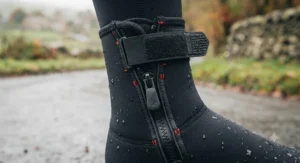
dhb Extreme Weather Neoprene Overshoe takes a deliberately simple approach — a single seam running up the front, flat-stitched and taped on the inside, which minimises the number of potential water entry points compared with overshoes carrying multiple seams around the toe and bridge. That single-seam design is a genuinely smart piece of engineering for the price point, and it’s the main reason this overshoe consistently outperforms its budget positioning in reviewer testing.
The rear features a reversed YKK zip, which does a reasonably good job of keeping water out despite sitting directly in the line of road spray, backed by additional internal taping along the seams. Reviewers consistently praise the robustness of the Kevlar-reinforced sole, particularly at the heel and toe — the areas that wear fastest from repeated clipping in and out and the occasional short walk from bike to café.
What most buyers overlook about genuinely budget-positioned overshoes is that the weak points are rarely where you’d expect. Here, it’s specifically the sole openings — described by reviewers as larger than average — which let in more water than the taped upper seams would suggest, meaning feet can still end up somewhat damp on the very worst days despite the upper’s strong waterproofing. It’s a reasonable trade-off for the price, but worth knowing rather than discovering on your first proper downpour.
Pros:
- ✅ Single-seam construction minimises water entry points
- ✅ Kevlar-reinforced sole at high-wear heel and toe zones
- ✅ Strong value relative to premium waterproof alternatives
Cons:
- ❌ Larger sole openings let in more water in sustained heavy rain
- ❌ Slightly tight fit across the front of the ankle reported by some reviewers
Typically priced around £25-£35, dhb Extreme Weather Neoprene Overshoe is genuinely solid value for riders wanting robust winter protection without paying premium-tier prices.
7. veloToze Silicone Tall Shoe Cover — best lesser-known pick for maximum waterproofing
veloToze Silicone Tall Shoe Cover takes an entirely different construction approach from every other product on this list — stretch silicone rather than neoprene or membrane fabric, secured with a snap-button installation rather than a zip. The result, according to consistent reviewer feedback, is genuinely the most waterproof option here; the seamless, snug silicone shell simply doesn’t have the seam-based weak points that even well-taped neoprene overshoes carry.
That waterproofing advantage comes with genuine trade-offs worth being upfront about. Reviewers frequently describe the fit as divisive — some liken it to “a swimming cap for your feet,” and several note it can make feet noticeably sweaty on milder days when the near-total seal prevents any moisture escape. It’s also reported as the most fragile option on this list, with the thin, stretched silicone more prone to tearing on sharp edges than thicker neoprene construction.
Based on the spec comparison with the rest of this round-up, veloToze Silicone Tall Shoe Cover is best understood as a specialist rather than an everyday pick — genuinely superior for racing, time trialling, or the very worst deluge commutes where absolute waterproofing trumps breathability, but less suited to daily year-round wear where comfort and durability matter more than outright water resistance. Worn over oversocks, several reviewers describe it as forming what they call “the ultimate deep winter combination” for short, brutal conditions.
Pros:
- ✅ Genuinely superior waterproofing versus seamed neoprene alternatives
- ✅ Lightweight with reported aerodynamic benefit for racing
- ✅ Simple snap-button installation, no zip to fail
Cons:
- ❌ Limited breathability causes sweaty feet on milder rides
- ❌ Most fragile construction on this list, prone to tearing
At roughly £30-£40, veloToze Silicone Tall Shoe Cover is worth adding to your kit bag specifically for the worst weather days, rather than as your sole everyday overshoe.
Heated Cycling Overshoes vs Thermal Overshoes
This is the comparison most people searching for waterproof heated cycling overshoes actually need answered before they spend a penny, so let’s be genuinely honest about it.
| Factor | Heated Overshoes | Thermal Overshoes |
|---|---|---|
| Heat source | Active — rechargeable battery and heating element | Passive — insulating material traps existing body heat |
| Best for | Sub-zero conditions, poor circulation, very long rides | Cold but not extreme conditions, shorter commutes |
| Price | £35-£160 depending on wattage and build | £25-£60 |
| Maintenance | Requires charging before every ride | No charging, just occasional washing |
| Weight | Heavier due to battery packs | Noticeably lighter |
The honest takeaway is that thermal overshoes like GripGrab RaceThermo or dhb Extreme Weather Neoprene Overshoe cover the vast majority of UK winter riding conditions perfectly well — genuinely cold mornings rarely drop low enough to justify an active heat source for most commuters. Where heated options like ROCKBROS Heated Overshoes or EKOI Heat Concept Overshoes earn their keep is specifically in sub-zero conditions, on rides exceeding roughly ninety minutes in the cold, or for riders with circulation issues where passive insulation genuinely isn’t enough — a distinction worth understanding honestly rather than assuming heated automatically means better.
How to Choose Waterproof Heated Cycling Overshoes
- Decide heated versus thermal first. If your rides rarely exceed ninety minutes in temperatures above freezing, a thermal option like dhb Extreme Weather Neoprene Overshoe likely serves you better than the extra cost and weight of a battery.
- Match battery runtime to your typical ride length. ROCKBROS Heated Overshoes‘ eight-hour low setting suits longer commutes; EKOI Heat Concept Overshoes‘ shorter but hotter settings suit intense, briefer cold-weather sessions.
- Check shoe compatibility before buying. Several products, including GripGrab RaceThermo, are built exclusively for road cycling shoes and explicitly incompatible with MTB or everyday footwear.
- Weigh breathability against absolute waterproofing. Sealskinz All Weather Overshoe‘s membrane balances both; veloToze Silicone Tall Shoe Cover maximises waterproofing at the cost of breathability.
- Consider sole reinforcement for durability. Kevlar-reinforced soles, present on dhb Aeron Lab Neoshell Overshoe and several others here, extend genuine product lifespan against clip-in wear.
- Factor in charging logistics for heated options. EKOI’s continental charger plug is a genuinely easy detail to overlook until you’re stuck without a UK adapter on a cold morning.
- Budget for realistic seasonal lifespan. Reviewers consistently note neoprene overshoes rarely last beyond one or two winters of regular use, which should factor into your price comparison.
Rechargeable Heated Cycling Overshoes: Battery Life & Charging Guide
Getting genuine value from rechargeable heated cycling overshoes comes down to a few habits worth building from day one. First, always charge fully before a ride rather than topping up briefly — both ROCKBROS Heated Overshoes and EKOI Heat Concept Overshoes use removable battery packs specifically so you can charge them independently of the overshoe itself, typically overnight, ready to simply clip back in before you head out.
Understand the trade-off dial properly: higher heat settings dramatically shorten runtime. On ROCKBROS Heated Overshoes, moving from the 40°C low setting to the 60°C high setting roughly halves your available runtime, from around eight hours down to four. The smart approach most experienced users settle on is starting on a higher setting for the first fifteen to twenty minutes of a genuinely freezing ride — when your feet are coldest and circulation hasn’t yet responded to pedalling — then dropping to a lower, longer-lasting setting once you’ve warmed up.
Common first-month mistakes worth avoiding: forgetting to charge spare battery packs the night before a planned long ride, leaving batteries connected and running at maximum heat while stationary at traffic lights (a genuine drain with no corresponding benefit), and — critically for EKOI’s premium unit specifically — running the heating element in genuinely heavy rain despite manufacturer advice against it. Store removable battery packs somewhere dry and at room temperature between rides; extreme cold storage genuinely degrades lithium battery capacity and runtime over a season.
Wet Commute Protection: Real-World Scenarios
Different commuting patterns demand genuinely different solutions, so here’s how three common UK rider profiles map onto the products above.
The daily year-round commuter facing unpredictable British drizzle. For someone riding most days regardless of forecast, Sealskinz All Weather Overshoe‘s breathable-yet-waterproof membrane handles the widest range of conditions without the daily charging routine a heated option would demand — genuinely the most practical everyday pick for wet commute protection.
The long-distance winter club rider facing genuine sub-zero mornings. Anyone regularly out for two-plus hours in temperatures well below freezing benefits most from active heat. EKOI Heat Concept Overshoes‘ claimed -20°C effectiveness addresses a problem passive insulation simply can’t solve at that extreme.
The occasional commuter wanting maximum protection on the worst days only. If you’re mostly fair-weather but need something for the handful of genuinely torrential days each winter, veloToze Silicone Tall Shoe Cover delivers outsized waterproofing for those specific occasions without needing to be your everyday overshoe.
All-Weather Cycling: Matching Overshoes to Conditions Year-Round
All-weather cycling isn’t really one problem — it’s several different problems that happen to share a product category. Cold-but-dry conditions call for insulation over waterproofing, which is precisely where thermal-focused options like GripGrab RaceThermo excel; their neoprene construction traps heat effectively even if it isn’t the most waterproof option on this list. Cold-and-wet conditions, the genuine UK winter default, call for the balance Sealskinz All Weather Overshoe and dhb Aeron Lab Neoshell Overshoe are specifically engineered around — waterproofing that doesn’t sacrifice breathability and therefore doesn’t leave you clammy from trapped perspiration.
Genuinely extreme conditions — sustained heavy rain, sub-zero temperatures, or both together — are where most standard overshoes start to show their limits, and where either veloToze Silicone Tall Shoe Cover‘s near-total waterproof seal or EKOI Heat Concept Overshoes‘ active heating genuinely earn their higher price and reduced everyday practicality. The mistake many riders make is buying a single “all-weather” product expecting it to excel at every scenario; based on the spec comparison across this list, no single overshoe here does everything best, and owning two pairs suited to different conditions is often the more practical, cost-effective long-term approach than searching for one perfect all-rounder.
✨ Don’t Miss These Exclusive Deals!
🚴♂️ Take your winter commute to the next level with these carefully researched waterproof heated cycling overshoes. Click through on any highlighted product above to check current pricing and availability. The right pair genuinely changes how much you enjoy — or dread — your cold-weather rides.
Common Mistakes When Buying Cycling Overshoes
The most frequent mistake is buying based on marketing language like “waterproof” without checking whether that claim applies to the whole overshoe or just the upper fabric. As several reviews above make clear, sole openings and zip lines are common weak points even on genuinely well-reviewed products — read specifically for reviewer comments on sole and seam performance, not just the headline waterproof claim.
Second: assuming heated automatically outperforms thermal. As the comparison above shows, for the vast majority of UK winter riding — cold but rarely sub-zero, commutes under ninety minutes — a well-made thermal overshoe like dhb Extreme Weather Neoprene Overshoe performs perfectly adequately without the added weight, cost, and charging obligation of a heated alternative.
Third: ignoring shoe compatibility. GripGrab RaceThermo and several similar road-specific overshoes explicitly won’t fit MTB, gravel, or everyday trainers properly — checking compatibility before ordering saves an entirely avoidable return.
Finally, underestimating sizing needs when layering. If you’re wearing heated overshoes over winter cycling boots rather than summer road shoes, most manufacturers — EKOI included — recommend sizing up specifically to accommodate the extra bulk, a detail easily missed when sizing purely against your regular shoe size.
Waterproof Shoe Covers vs Heated Overshoes: Which Do You Actually Need?
“Waterproof shoe covers” and “heated overshoes” get used almost interchangeably in casual conversation, but they solve genuinely different problems, and conflating them leads to disappointed buyers. A waterproof shoe cover’s entire job is keeping external moisture out — rain, road spray, puddles — and products like Sealskinz All Weather Overshoe and veloToze Silicone Tall Shoe Cover are built and marketed almost exclusively around that single goal, with warmth as a secondary side-effect of blocking wind chill rather than the primary design intent.
Heated overshoes add an entirely separate function on top of — or sometimes instead of — waterproofing: actively generating warmth regardless of how cold the ambient air actually is. This distinction matters practically because a bone-dry but genuinely freezing ride can still leave you with painfully cold feet in a purely waterproof shoe cover, while a heated overshoe with weaker waterproofing, like ROCKBROS Heated Overshoes‘ water-resistant (rather than fully waterproof) shell, might keep you warm but let some moisture through on the wettest days.
The honest answer for most UK riders: if your winter problem is primarily wet feet from rain and road spray, invest in genuinely waterproof shoe covers first. If your problem is primarily cold, numb toes even when dry, a heated option addresses that directly in a way no amount of waterproofing ever will. Plenty of serious winter cyclists ultimately own both, deploying each for the specific problem the day’s weather presents.
Problem → Solution: Fixing Common Overshoe Issues
Problem: Feet still get wet despite a “waterproof” rating. Usually the sole openings or zip line, not the upper fabric. Solution: switch to a construction with fewer seams, like dhb Extreme Weather Neoprene Overshoe‘s single-seam design, or a seamless silicone option like veloToze Silicone Tall Shoe Cover for the worst days.
Problem: Heated overshoe battery dies mid-ride. Usually caused by starting on too high a heat setting for the ride length. Solution: start high for the first fifteen minutes, then drop to a lower, longer-lasting setting, and always carry a charged spare battery pack on longer rides.
Problem: Feet sweaty and clammy despite dry conditions. Almost always a breathability issue rather than a waterproofing failure. Solution: switch to a membrane-based product like Sealskinz All Weather Overshoe rather than a fully sealed silicone or heavy neoprene design for milder, drier rides.
Problem: Overshoe won’t fit over winter boots. Solution: check whether the product is designed for summer road shoes specifically (most are), and size up if you genuinely need to layer over bulkier winter footwear, as EKOI and others recommend.
Problem: Overshoe tears or wears out within a season. Solution: check for Kevlar reinforcement at the sole, heel, and toe specifically — present on dhb Aeron Lab Neoshell Overshoe and dhb Extreme Weather Neoprene Overshoe — as these are consistently the first failure points reviewers report.
Long-Term Cost & Maintenance
The sticker price on cycling overshoes tells you surprisingly little about what they’ll actually cost you over several winters. dhb Aeron Lab Neoshell Overshoe costs more upfront than most alternatives here, but reviewer-reported multi-season durability means the real cost per winter of riding often works out lower than replacing a £25 budget overshoe annually once seams inevitably fail.
| Product | Typical Lifespan | Approx. Cost Per Winter |
|---|---|---|
| dhb Extreme Weather Neoprene Overshoe | 1-2 seasons | £15-£30 |
| dhb Aeron Lab Neoshell Overshoe | 3+ seasons | £15-£20 |
| ROCKBROS Heated Overshoes | 2-3 seasons (plus battery degradation) | £15-£20 |
| EKOI Heat Concept Overshoes | 3-4 seasons | £35-£40 |
Looking at the figures above, the premium options don’t necessarily cost more over time than budget alternatives — they simply front-load the expense rather than spreading it across repeated annual replacements. For heated products specifically, factor in gradual battery capacity loss too; most rechargeable lithium packs lose meaningful runtime after roughly 300-500 charge cycles, which for a regular winter commuter works out to somewhere around two to three seasons of full performance.
Maintenance itself is inexpensive regardless of product type — a damp cloth wipe after muddy or salted-road rides, avoiding the washing machine (manufacturers consistently advise against it for both heated and passive overshoes), and drying thoroughly before storage to prevent the fabric breaking down prematurely.

Safety & Visibility on Winter Commutes
Winter riding brings darkness into the equation as much as cold and wet, and it’s worth remembering that overshoes, however waterproof or warm, don’t replace the legal lighting requirements every UK cyclist must meet after dark — the Highway Code’s rules for cyclists require a white front light, red rear light, and red rear reflector after dark, regardless of what footwear you’re using.
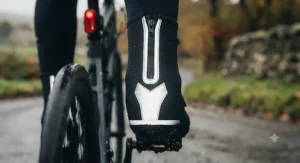
That said, several products on this list add a genuine safety benefit through reflective detailing — dhb Aeron Lab Neoshell Overshoe‘s reflective heel and logo elements, and ROCKBROS Heated Overshoes‘ reflective side logo, both add visibility from a low, easily-noticed position on a dark road, which is meaningfully different from reflective elements positioned higher up on jackets or helmets. If you’re commuting through genuinely dark winter mornings and evenings, factoring reflective coverage into your overshoe choice is a small addition that costs nothing extra but genuinely improves how visible you are to traffic.
Who Benefits Most from Heated Overshoes?
Beyond simple personal cold tolerance, there’s a genuine medical dimension worth understanding honestly. Riders who experience Raynaud’s phenomenon — where blood vessels in the extremities overreact to cold, cutting off circulation to the toes and fingers — often struggle far more with cold feet than passive insulation alone can address, since the problem isn’t a lack of warmth reaching the skin but restricted blood flow itself. NHS inform’s guidance on Raynaud’s phenomenon explains that keeping extremities actively warm is one of the main self-management approaches recommended, which is precisely where a genuinely heated overshoe like EKOI Heat Concept Overshoes or ROCKBROS Heated Overshoes can make a meaningful difference that thermal insulation alone often can’t replicate.
For riders without circulation issues, the calculation is more about ride length and temperature tolerance than medical necessity — most healthy cyclists find a well-made thermal overshoe entirely adequate down to a few degrees above freezing, with heated options becoming genuinely valuable only once temperatures drop meaningfully below that or rides extend well past the point where pedalling-generated warmth naturally keeps feet comfortable.
Buyer’s Decision Framework
If you’re still deciding, work through this checklist:
- If you commute daily through typical British drizzle, choose Sealskinz All Weather Overshoe, because breathable waterproofing suits sustained daily wear better than a charging routine.
- If your mornings regularly drop below freezing for rides over ninety minutes, choose EKOI Heat Concept Overshoes, because passive insulation alone genuinely struggles at that temperature range.
- If you want to try heated overshoes without committing to premium pricing, choose ROCKBROS Heated Overshoes, because it delivers genuine heating function at a fraction of the premium cost.
- If you’re budget-conscious and mainly need cold-weather insulation, choose dhb Extreme Weather Neoprene Overshoe, because it delivers strong value without unnecessary extras.
- If you need maximum waterproofing for occasional extreme-weather days, choose veloToze Silicone Tall Shoe Cover, because its seamless silicone shell outperforms every seamed alternative here in sustained downpours.
FAQ
❓ Are heated cycling overshoes worth it for UK winters?
❓ How long does the battery last on rechargeable heated cycling overshoes?
❓ What's the difference between heated cycling overshoes vs thermal overshoes?
❓ Can I use waterproof shoe covers with road cycling shoes and MTB shoes interchangeably?
❓ Do heated overshoes work in heavy rain?
Conclusion
Waterproof heated cycling overshoes aren’t a single, one-size-fits-all category, and hopefully this guide has made the real distinctions clear rather than just handing you a single winner. If your winter commute is mostly wet rather than genuinely freezing, Sealskinz All Weather Overshoe or dhb Aeron Lab Neoshell Overshoe will serve you better than any heated option. If sub-zero mornings or long, cold rides are your reality, EKOI Heat Concept Overshoes or the more affordable ROCKBROS Heated Overshoes address a problem passive insulation genuinely can’t solve alone.
What ties every recommendation together is honesty about what each product actually does well rather than chasing the most impressive-sounding feature list. Waterproofing, insulation, and active heating solve three genuinely different problems, and understanding which one you actually have is worth more than any single product recommendation on this page.
Whichever you choose, give it a fair test on a genuinely cold or wet ride before judging it — and remember that even the best overshoes work best paired with proper lights and visibility for safe winter riding.
Recommended for You
- 7 Best Heated Cycling Overshoes for Road Cyclists in 2026
- Heated Cycling Gloves for Road Cyclists: 7 Top Picks (2026)
- Heated Cycling Gloves for Raynaud’s: 7 Proven Picks for 2026
Disclaimer: This article contains affiliate links. As an Amazon Associate, I earn from qualifying purchases. If you purchase products through these links, we may earn a small commission at no additional cost to you.
✨ Found this helpful? Share it with your friends! 💬🤗
