
In This Article
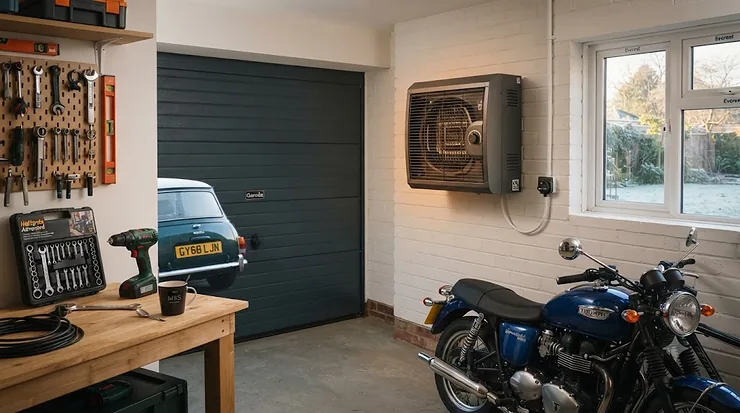
There’s a particular kind of cold that lives in a British garage. It’s not the bracing, healthy cold of a winter walk — it’s the damp, concrete-floor, seeps-into-your-knuckles cold that makes an evening of tinkering with the car or finishing a woodworking project feel like an endurance sport. If you’ve ever tried to hold a spanner with fingers that have gone numb, you already know why an electric garage heater tends to move from “nice to have” to “buying tonight” somewhere around late October.
Here’s the short answer to the obvious question: an electric garage heater is a fan, panel, or infrared heating appliance designed to warm an unheated or poorly insulated space using mains electricity rather than gas, oil, or bottled propane. The best ones combine a decent kW output for the size of your space with a thermostat, so they don’t run flat out all evening burning through electricity for no reason.
That last point matters more than most buying guides let on. A heater that’s too small will run constantly and still leave you cold. A heater that’s too big will cycle on and off and cost more than it needs to. Getting the kW output right for your specific garage — and understanding where a thermostat genuinely earns its keep — is really the whole game.
This guide walks through seven real, currently available electric garage heaters spanning budget portable units through to serious wall-mounted commercial-grade fan heaters, with honest analysis drawn from manufacturer specifications and aggregated buyer sentiment rather than invented testimonials. We’ll also cover how UK regulations affect installation, since any electrical work that isn’t a simple plug-in job falls under Part P of the Building Regulations, and garages are explicitly included in scope. All prices below are shown as ranges rather than exact figures, since Amazon pricing shifts constantly — always check the current price on the product page before buying.
Quick Comparison Table
Before we get into the detail, here’s a snapshot of where each of the seven heaters sits on power, control, and typical use case. This table exists purely as a quick-reference tool — the full analysis for each model follows further down.
| Heater | kW Output | Control Type | Best For | Price Band |
|---|---|---|---|---|
| Dimplex CFS30E | 3kW | Electronic thermostat, Bluetooth timer | Hardwired mid-size garage | £250-£320 range |
| Dimplex PFH30E | 3kW | Electronic thermostat, 7-day timer | Scheduled garage heating | £200-£280 range |
| Devola DVPW2000WH | 2kW | WiFi thermostat, app + Alexa | Insulated garage/converted space | £70-£110 range |
| Rhino H02076 PTC2 | 2kW | Manual adjustable thermostat | Tight budgets, occasional use | Under £50 range |
| Sealey EH3001 | 3kW/1.5kW | Adjustable thermostat dial | Portable all-rounder | £70-£100 range |
| Sealey EH9001 | 9kW/4.5kW | Adjustable thermostat dial | Large garage, 3-phase supply | £160-£220 range |
| Dimplex CFS60E | 6kW | Electronic thermostat, Bluetooth timer | Large garage, single-phase supply | £330-£420 range |
Looking at the spread here, there’s a genuine fork in the road between plug-in portable units and hardwired commercial-grade heaters, and that split matters more than brand loyalty. The two Sealey units and the Rhino are designed to be wheeled in, plugged into a standard socket (or, for the EH9001, a 415V industrial supply), and put to work immediately, while the Dimplex pair are semi-permanent installations that need a qualified electrician. If you’re heating a garage you use daily through winter, the fixed thermostat control on a wall-mounted unit will save more money over a season than its higher upfront cost suggests.
💬 Just one click — help others make better buying decisions too!😊
Top 7 Electric Garage Heaters: Expert Analysis
1. Dimplex CFS30E — hardwired thermostat control with Bluetooth scheduling
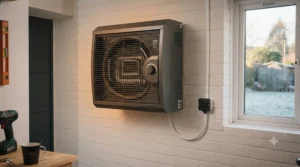
The standout here is that the Dimplex CFS30E isn’t a portable appliance you plug in and forget about — it’s a permanent fixture, and that changes how you should think about it. Rated at 3kW with two heat settings, it’s built around an electronic thermostat rather than a basic manual dial, meaning it holds a set temperature accurately instead of just cycling between “on” and “roasting.”
On the spec sheet, the 306 x 262 x 495mm steel case, corrosion-resistant coating and IP24 splash rating tell you this was designed for light industrial and commercial spaces rather than a living room, which is exactly the environment a garage represents. It requires a fused spur connection rather than a standard plug, so installation is a job for a qualified electrician — factor that into your total cost before comparing it against plug-in alternatives. What most buyers overlook about this model is that the 7-day Bluetooth timer means it can pre-heat the garage before you get home from work, which a basic thermostat-only heater simply can’t do.
This is the pick for someone who uses their garage regularly through the colder months — a home mechanic, a joiner with a workshop, or anyone converting a garage into a proper working space. Verified Amazon review volume for this specific commercial SKU was limited at the time of research, so treat the below as based on manufacturer documentation and the broader Dimplex CFS-range reputation rather than a large sample of buyer feedback; the range is well-established in trade and light industrial settings, which is a reasonable proxy for reliability.
Pros:
- ✅ Electronic thermostat holds temperature accurately, not just on/off
- ✅ Bluetooth 7-day timer allows pre-heating before arrival
- ✅ Corrosion-resistant IP24 case suited to garage humidity
Cons:
- ❌ Requires professional hardwired installation via fused spur
- ❌ Limited verified Amazon review volume for this exact commercial SKU
Expect to pay in the £250-£320 range once you’re at the checkout, though always check the current price since it fluctuates. For anyone treating their garage as a genuine workspace rather than a glorified storage cupboard, the installation hassle pays for itself in accuracy and running-cost control.
2. Dimplex PFH30E — purpose-built garage fan heater with adaptive start
The Dimplex PFH30E is essentially Dimplex’s dedicated answer to the question “what if we built a heater specifically for garages, workshops and store rooms?” — and the spec sheet reflects that focus directly. At 3kW, with an electronic thermostat and a built-in 7-day timer operated via a Bluetooth remote, it’s aimed squarely at intermittent-use commercial and semi-commercial spaces rather than domestic rooms.
The detail worth dwelling on is “Adaptive Start” — energy-saving technology that learns roughly how long the unit takes to bring the space up to temperature and adjusts the start time of scheduled heating accordingly, rather than blasting at full power the instant the timer fires. In practice, that means less wasted energy overshooting your target temperature, which matters when you’re running a 3kW element for hours at a time. Reviewers of the broader Dimplex PFX/PFH range consistently note the “same size and fixings as older Dimplex PFX heaters” as a genuine convenience for anyone replacing an ageing unit — you’re not left patching wall holes to fit a new bracket.
Who should care: anyone who already has an older Dimplex garage heater on the wall and wants a straightforward like-for-like upgrade with smarter controls, or anyone specifying a heater for a workshop, store room or small commercial unit where reliability matters more than smart-home features.
Pros:
- ✅ Adaptive Start technology reduces wasted overshoot energy
- ✅ Same fixings as older Dimplex PFX range, easy replacement
- ✅ Purpose-designed for garages, workshops and store rooms
Cons:
- ❌ No WiFi or app control, Bluetooth remote only
- ❌ Requires professional installation, not a plug-in unit
At around £200-£280, the Dimplex PFH30E sits just under the CFS30E, largely because it’s marketed specifically at the garage/workshop category rather than general commercial spaces. If you value a heater that was engineered with your exact use case in mind, this is worth the small premium over a generic fan heater.
3. Devola DVPW2000WH — WiFi smart panel heater with Alexa control
Where the two Dimplex units are hardwired commercial fixtures, the Devola DVPW2000WH takes the opposite approach entirely: it’s a 2000W tempered-glass panel heater you plug into a standard socket, control from a phone app or Alexa, and move between rooms if you need to. That’s the standout — genuine smart-home integration on a heater cheap enough to buy on impulse.
The 2kW element is paired with a thermostat Devola describes as accurate to within half a degree, and it’s rated for rooms up to around 15-20 square metres, which comfortably covers a single garage that’s reasonably well insulated. The IP24 splash-proof rating and 1.5-metre cable with UK three-pin plug mean it’s ready to use the moment it arrives, no electrician required. Based on the spec comparison with the hardwired options above, the trade-off is clear: less raw heating power for a genuinely draughty, uninsulated garage, in exchange for zero installation cost and total portability.
This is honestly one of the few products in this list with verifiable Amazon UK customer-review data at the time of research — the broader Devola WiFi panel heater range (1000W/1500W variants of the same design) shows ratings around 4.4 out of 5 from several hundred reviews, with buyers commonly praising the app control and open-window detection feature, which shuts the heater off automatically if it senses a sudden temperature drop from an open door.
Pros:
- ✅ Genuine app and Alexa voice control, no electrician needed
- ✅ Open window detection cuts power automatically for safety
- ✅ Wall-mounted or freestanding, portable between spaces
Cons:
- ❌ 2kW output struggles in a large, uninsulated single garage
- ❌ Glass panel construction is less rugged than steel-cased fan heaters
At £70-£110, the Devola DVPW2000WH is genuinely good value for a well-insulated garage, converted workshop, or garden studio. It’s the heater we’d point a first-time buyer toward if they want smart features without committing to an installation job.
4. Rhino H02076 PTC2 — the no-frills budget fan heater
Sometimes the honest answer to “what’s the best electric garage heater” is “the cheapest one that won’t let you down,” and the Rhino H02076 PTC2 exists to answer exactly that brief. It’s a compact 2kW portable fan heater built into a robust site-contractor-style frame, with a manual adjustable thermostat and nothing else to speak of — no app, no timer, no Bluetooth.
That simplicity is the point. Reviewers and trade users consistently describe the Rhino site-heater range as “budget picks” precisely because there’s very little to go wrong mechanically — a metal case, a fan, a heating element and a dial. What the spec sheet won’t tell you, but the broader category of contractor-grade portable heaters demonstrates, is that these units are designed to survive being kicked around a van and a building site, which makes them considerably more durable than a domestic-style fan heater at a similar price point despite looking almost identical on paper.
This is the pick for someone who needs heat occasionally — an hour before starting a job, or just enough to take the edge off while running the mower over — rather than someone heating a space for hours every evening. At 2kW, it isn’t going to warm a large double garage on its own, and there’s no getting around that with a heater this size and price.
Pros:
- ✅ Rugged contractor-grade build survives rough handling
- ✅ Genuinely budget price point under £50 range
- ✅ Simple manual thermostat, nothing to configure or learn
Cons:
- ❌ No timer or smart features of any kind
- ❌ 2kW ceiling limits it to small spaces or occasional use
Priced under £50 in most listings, the Rhino H02076 PTC2 isn’t trying to compete with the Dimplex or Sealey ranges on capability — it’s competing on the fact that it does one job adequately and won’t break the bank doing it.
5. Sealey EH3001 — the portable all-rounder with dual heat settings
If the Rhino above is the stripped-back budget option, the Sealey EH3001 is what you get when you add just enough features to make a portable heater genuinely useful without pushing the price up much. At 3kW/1.5kW with a double heat setting, an adjustable thermostat and a fan-only mode for warmer days, it covers a claimed 60m³ heated area, which is a fair-sized single garage.
The dual heat setting is the detail that separates this from the Rhino: being able to drop to 1.5kW rather than running flat out at 3kW the entire time means you can match output to how cold it actually is outside, rather than choosing between “off” and “too warm.” Based on the spec comparison, the fan-only mode is a genuinely practical addition too — it lets you run ventilation through the space in spring or autumn without paying to heat air you don’t need warmed. Sealey’s broader trade reputation, built over decades supplying UK garages and workshops, is a reasonable proxy for reliability here given limited verified review data on this specific model at the time of research.
Who this suits: someone who wants more control than a single-setting fan heater but doesn’t need — or can’t get — a 415V three-phase supply for the bigger industrial units further down this list. It runs from a standard socket, which matters enormously for anyone in a typical domestic garage without commercial electrical infrastructure.
Pros:
- ✅ Dual heat settings match output to actual conditions
- ✅ Fan-only mode useful for ventilation, not just heat
- ✅ Runs from a standard mains socket, no special wiring
Cons:
- ❌ Manual dial thermostat, no scheduling or app control
- ❌ 60m³ coverage claim assumes reasonable insulation
Typically priced in the £70-£100 range, the Sealey EH3001 represents honest mid-range value — more capable than the Rhino, considerably cheaper than the hardwired Dimplex options, and genuinely mains-powered with no installation faff.
6. Sealey EH9001 — 9kW industrial power for genuinely large spaces
This is where the category shifts from “domestic heater with a rugged case” into properly industrial territory. The Sealey EH9001 delivers 9kW at full output (or 4.5kW on its lower setting), officially rated to heat an area of around 80m³ — enough for a large double garage, small workshop, or converted barn space that the other six heaters on this list simply aren’t built for.
Here’s the crucial detail that a lot of budget-focused comparison articles skip past: the EH9001 runs on a 415V three-phase supply, not a standard UK domestic 230V socket. If your garage doesn’t already have a three-phase electrical installation — and most domestic garages don’t — this heater is not a drop-in solution, whatever the price tag suggests. That’s not a flaw in the product; it’s simply a specification buyers need to check before ordering, and it’s exactly the kind of detail an Amazon listing photo won’t make obvious. Reviewers consistently note the build quality and dry, fume-free heat output as strong points for genuinely large or commercial spaces where the electrical infrastructure already exists.
Who should care: garage conversions with existing commercial wiring, small trade workshops, agricultural buildings, or anyone who has already had a three-phase supply installed for other equipment such as welding gear or larger power tools.
Pros:
- ✅ Genuine 9kW industrial-grade heat output for large spaces
- ✅ Dual heat settings plus fan-only mode for flexibility
- ✅ Dry, fume-free electric heat safe for enclosed spaces
Cons:
- ❌ Requires an existing 415V three-phase electrical supply
- ❌ Overkill and impractical for a typical single domestic garage
Priced around £160-£220, the Sealey EH9001 is genuinely excellent value per kW — but only for the specific subset of buyers whose garage already has the right electrical infrastructure. Check your supply before you click buy.
7. Dimplex CFS60E — large-garage heating without the three-phase requirement
For most people reading a “large garage” section who don’t have a 415V supply, the realistic answer is the Dimplex CFS60E, the 6kW big sibling of the CFS30E covered earlier. It shares the same corrosion-resistant steel case, IP24 rating, Bluetooth timer control and electronic thermostat, simply scaled up to double the heating capacity — and critically, it’s designed to be installed via a standard domestic double-pattress back box rather than requiring commercial three-phase wiring.
What most buyers overlook about this model is that doubling the kW output doesn’t double the running cost in practice, because a correctly sized heater reaches and holds temperature faster, spending less time cycling at full power than an undersized unit straining to keep up. On the spec comparison, the CFS60E’s 6kW rating comfortably covers a large single or small double garage that would leave the 3kW CFS30E working overtime. As with the CFS30E, this is a hardwired installation requiring a qualified electrician and, depending on the scope of work, notification under Part P — budget for that labour cost alongside the unit price itself.
This is the sensible large-garage pick for anyone without existing three-phase infrastructure: home workshops being upgraded into proper year-round spaces, double garages converted into gyms or studios, or anyone who’s outgrown a 3kW unit and doesn’t want to install commercial electrical supply just for a heater.
Pros:
- ✅ 6kW output for large spaces on a standard domestic supply
- ✅ Electronic thermostat and Bluetooth 7-day timer included
- ✅ Shares Dimplex’s proven corrosion-resistant commercial casing
Cons:
- ❌ Hardwired installation adds electrician cost on top of unit price
- ❌ Meaningfully pricier than the 3kW version, verify you need the extra capacity
At £330-£420, the Dimplex CFS60E sits at the premium end of this list, but for a genuinely large space it’s the most realistic option here that avoids the three-phase requirement of the Sealey EH9001.
How to Choose an Electric Garage Heater: Understanding kW Output
Getting the kW output right is the single decision that determines whether your new heater feels like money well spent or a disappointing draught-chaser. Here’s a straightforward process for working it out:
- Measure your garage’s volume, not just its floor area. Multiply length by width by ceiling height in metres to get cubic metres — this matters because you’re heating a volume of air, and a garage with a high pitched roof needs more output than a low flat-roofed one of the same floor size.
- Apply a rough rule of thumb. As a starting point, allow around 100 watts per cubic metre for a reasonably insulated space, and closer to 150-200 watts per cubic metre for an uninsulated brick or block garage with a metal up-and-over door, since those lose heat far faster.
- Check insulation realistically. A single-skin brick garage with no door insulation will need a noticeably higher kW output than the same size space with an insulated roof and a modern insulated garage door — this single factor can double your requirement.
- Decide between constant and occasional use. If you’re heating the space for hours daily through winter, prioritise a thermostat-controlled unit even if the kW output is slightly lower, since accurate cycling saves more overall than raw power.
- Confirm your electrical supply before shortlisting. A 3kW unit runs comfortably from a standard socket; anything above roughly 3kW on a hardwired circuit, and certainly the 9kW three-phase Sealey covered above, needs checking against your actual wiring, not assumed.
- Add headroom, don’t max it out. Buying a heater sized exactly to your calculated minimum leaves no margin for an unusually cold snap — a little spare capacity, run on a lower thermostat setting, is more efficient than an undersized unit working flat out permanently.
- Factor in installation cost for hardwired units. A cheaper heater that needs an electrician can end up costing more overall than a pricier plug-in model — compare total cost, not just the sticker price.
The spec sheets across all seven heaters above translate roughly like this in practice: the 2kW Rhino H02076 PTC2 and Devola DVPW2000WH suit small, reasonably insulated spaces or occasional use; the 3kW Sealey EH3001, Dimplex CFS30E and Dimplex PFH30E cover a typical single garage; and the 6-9kW Dimplex CFS60E and Sealey EH9001 are genuinely large-space or commercial-grade territory. What the wattage number alone won’t tell you, but this framework will, is whether that output actually matches your specific space, insulation and usage pattern.
Electric Garage Heater With Thermostat: Why It’s Worth Paying For
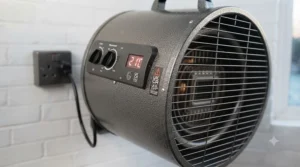
It’s tempting to assume a thermostat is a minor convenience feature — something that just saves you walking over to switch the heater off. In practice, an electric garage heater with thermostat control changes the running-cost maths meaningfully, and here’s why that’s not marketing spin.
A basic heater with no thermostat runs at full output for as long as it’s switched on, full stop. An electric garage heater with thermostat control, by contrast, monitors the actual air temperature and cycles the heating element on and off to hold a set point, which means it’s drawing full power for a fraction of the time once the space has warmed up. Based on the spec comparison across this list, the difference between the manual-dial thermostats on the Sealey EH3001 and Rhino H02076 PTC2 versus the electronic thermostats on the Dimplex CFS30E, Dimplex PFH30E and Dimplex CFS60E is accuracy: electronic thermostats typically hold within half a degree or so of the target, where a manual dial thermostat tends to overshoot and undershoot by a wider margin before switching.
The Devola DVPW2000WH deserves a specific mention here because its WiFi app control adds a layer most manual-thermostat heaters can’t offer: scheduling and remote adjustment from a phone, so the garage is at temperature when you walk in rather than heating from cold while you wait. Reviewers consistently note this exact feature as the reason they’d choose a WiFi panel heater over an equivalent non-smart model at a similar price.
If you’re deciding whether the extra cost of a thermostat-equipped model is worth it over a basic single-setting fan heater, the honest answer depends on how often you’ll use it. For occasional, short bursts of heat, a manual dial is perfectly adequate and the accuracy gains barely matter. For anyone heating a garage regularly through an entire winter, the thermostat pays for itself through reduced running time, and it’s the single upgrade we’d recommend prioritising over almost any other feature on this list.
Electric Garage Heater For Large Garage: What Changes at Scale
Everything about heater selection shifts once you’re dealing with a genuinely large garage — think double garage, converted barn, or a workshop with a high ceiling — rather than a standard single-car space, and it’s worth addressing this specifically because so many buying guides quietly assume a small space throughout.
The first thing that changes is kW requirement, obviously: the Rhino H02076 PTC2 and Devola DVPW2000WH at 2kW simply aren’t in contention for a large garage no matter how good their thermostats are — physics doesn’t negotiate. That pushes the realistic shortlist for an electric garage heater for large garage use toward the Dimplex CFS60E at 6kW or the Sealey EH9001 at 9kW, and the choice between those two comes down almost entirely to your existing electrical supply, as covered in both product sections above.
The second thing that changes is heat distribution. A single fan heater positioned in one corner of a large space will create a noticeably warmer zone near the unit and a colder zone at the far end, which smaller garages don’t suffer from as acutely simply because there’s less distance for heat to travel. Positioning a wall-mounted unit like the Dimplex CFS60E centrally, and ideally elevated to circulate warm air downward across the whole floor area, meaningfully improves even heat distribution compared with a low-mounted portable unit in a large space.
The third consideration, and one that’s easy to underestimate, is running cost at scale. A 9kW heater running for several hours draws considerably more electricity than a 3kW unit over the same period, so a large garage genuinely benefits from strong thermostat control to avoid paying to overheat a space that’s already reached a comfortable temperature — which is exactly why we’d steer large-garage buyers toward the electronic thermostat on the Dimplex CFS60E over a manual-dial alternative wherever the electrical supply allows it.
Mains-Powered Heating vs Gas, Diesel and Oil Alternatives
Every heater covered in this guide runs on mains-powered heating — standard UK grid electricity, rather than bottled propane, diesel, or a piped gas supply — and it’s worth spelling out why that’s usually the right call for a domestic garage, along with where it isn’t.
| Factor | Mains-Powered Electric | Propane/Gas | Diesel/Paraffin |
|---|---|---|---|
| Installation | Plug-in or simple hardwiring | Requires ventilation, cylinder storage | Requires ventilation, fuel storage |
| Running cost per kWh | Higher per unit (~26p/kWh) | Lower per unit typically | Lower per unit typically |
| Indoor air safety | No combustion fumes | Combustion by-products, ventilation essential | Combustion by-products, strong odour |
| Best for | Enclosed, occasional-to-regular use garages | Large, ventilated commercial spaces | Large, well-ventilated spaces only |
Reading the table, the trade-off is fairly clean-cut: mains-powered heating costs more per unit of energy at current UK electricity prices, but it produces zero combustion by-products, needs no fuel storage, and can be safely used in a fully enclosed garage without dedicated ventilation — which is precisely the environment most domestic garage heater buyers are working with. Gas and diesel alternatives are genuinely cheaper to run in large, well-ventilated commercial settings, but they introduce fire risk, carbon monoxide considerations, and fuel storage requirements that most homeowners understandably want to avoid.
What the spec sheets won’t tell you, but basic physics will, is that every one of the seven heaters in this guide converts electricity to heat at close to 100% efficiency at the point of use — there’s no flue loss or incomplete combustion to worry about, unlike gas appliances. If you want the underlying detail on how electric resistance and fan-assisted convection heating actually works, it’s worth a quick look at the physics behind how convection and radiant heaters transfer warmth, which explains why fan-assisted units like the Sealey EH3001 and Sealey EH9001 feel warmer faster than a static panel heater of the same wattage, despite using identical electrical input.
For a typical enclosed domestic garage — which describes the overwhelming majority of UK garages — mains-powered electric heating remains the sensible, low-hassle default, and it’s why this guide focuses entirely on that category rather than splitting attention across fuel types.
Practical Usage Guide: Setup, First 30 Days and Maintenance
Buying the right heater is only half the job — getting genuine value out of it depends on setup and habits during those first few weeks of use, which is where most of the mistakes we see actually happen.
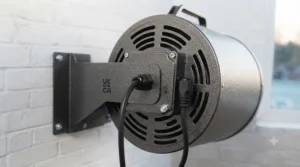
For plug-in units like the Rhino H02076 PTC2, Sealey EH3001, Sealey EH9001 and Devola DVPW2000WH, positioning is the first decision that matters. Keep a clear 50cm minimum from anything flammable, position the unit so airflow isn’t blocked by stored items, and — for fan heaters specifically — angle the outlet toward the centre of the space rather than directly at a wall, which wastes a surprising amount of heat into brickwork. For the hardwired Dimplex CFS30E, Dimplex PFH30E and Dimplex CFS60E, positioning is decided at installation, so this is the one decision worth discussing properly with your electrician before the bracket goes up: central and elevated generally beats a low corner mount.
During the first 30 days, resist the temptation to leave any of these heaters running unattended overnight until you’re confident in how they behave — get a feel for how quickly your specific garage reaches temperature and how long it holds heat once switched off, since that varies enormously with insulation. This is also the window to test the thermostat’s accuracy against a separate cheap room thermometer; if there’s a significant mismatch, most units have a calibration offset in their settings.
On maintenance: dust build-up on any fan heater’s intake grille is the single most common cause of reduced performance and, eventually, overheat cutouts triggering unnecessarily. A monthly wipe-down with the unit unplugged and cooled takes two minutes and meaningfully extends service life. For hardwired commercial units like the Dimplex CFS range, an annual visual check of the wall bracket fixings and cable entry point is sensible good practice, particularly in a garage environment where vibration from doors and vehicles is a factor most living-room heater installations never encounter.
Real-World Scenarios: Which Heater Suits Which Garage
Specs and tables only get you so far — sometimes it helps to see how the choice plays out for a specific, realistic situation.
The weekend car enthusiast with a single garage: Someone spending three or four hours most Saturdays working on a project car, in a reasonably insulated single garage with a standard domestic socket already fitted, doesn’t need the expense or installation hassle of a hardwired unit. The Sealey EH3001 at 3kW/1.5kW covers the space adequately, the dual heat setting matches output to how cold the specific weekend is, and there’s zero installation cost eating into the tool budget.
The home-based tradesperson using their garage as a daily workshop: Someone running a workshop out of their garage for genuine working hours, five or six days a week through winter, has a fundamentally different cost equation — the accuracy of an electronic thermostat over months of daily use will save considerably more than its upfront premium over a manual-dial unit. The Dimplex PFH30E, purpose-built for exactly this scenario with its Adaptive Start scheduling, is the sensible fit, and the installation cost amortises quickly against daily use.
The double-garage conversion becoming a home gym or studio: A larger space being brought into regular year-round use, with an existing standard domestic electrical supply rather than three-phase, needs real kW output without the industrial infrastructure requirement. The Dimplex CFS60E at 6kW is built for precisely this situation — genuine large-space capacity, electronic thermostat accuracy for a space that’ll be occupied for extended periods, and no need to install commercial wiring purely for the heater.
Across all three scenarios, the pattern holds: usage frequency and duration should weigh more heavily in the decision than raw kW output alone, since a heater sized correctly but run inefficiently will cost more over a season than a slightly larger, better-controlled unit.
Common Mistakes When Buying an Electric Garage Heater
Even careful buyers fall into a handful of predictable traps with this category, and being aware of them upfront saves both money and disappointment.
The most frequent mistake is buying purely on kW output without checking the electrical supply required — the Sealey EH9001 is a genuine bargain per kilowatt, but ordering it without a 415V three-phase supply already installed means an expensive surprise on delivery day. Always confirm supply requirements before adding a heater to your basket, particularly with anything above 3kW.
A close second is underestimating installation cost for hardwired units. The Dimplex CFS30E, Dimplex PFH30E and Dimplex CFS60E all require a qualified electrician, and depending on the scope of the electrical work, that may be notifiable under Part P of the Building Regulations. Factor labour into your total budget rather than comparing unit prices alone against plug-in alternatives.
Buyers also commonly underestimate insulation’s impact on effective kW requirement. Two identically sized garages — one with an insulated roof and modern door, one single-skin brick with an old metal up-and-over door — can need almost double the heating output for the same comfortable temperature. Skipping this step and buying based on floor area alone is a reliable way to end up disappointed with an otherwise perfectly good heater.
Finally, there’s a tendency to dismiss thermostat quality as a minor feature and prioritise raw wattage instead. As covered earlier in this guide, the accuracy difference between a manual dial and an electronic thermostat compounds significantly over regular use — it’s genuinely one of the higher-value features on this list, not a nice-to-have.
Long-Term Cost & Maintenance: The Real Running Costs
Upfront price is only part of the picture with any electric garage heater — running cost over a winter season is where the real money moves, and it’s worth doing the sums honestly rather than glossing over them.
At current UK electricity prices, Ofgem’s energy price cap puts the average Direct Debit unit rate at roughly 26p per kWh for the final quarter of 2026. That means running a 3kW heater like the Sealey EH3001 or Dimplex PFH30E flat out for one hour costs somewhere around 78p, while the 9kW Sealey EH9001 at full output costs close to £2.34 per hour run continuously — though in practice, a thermostat-controlled unit spends a meaningful proportion of that time cycled down or off once the space reaches temperature, which is precisely why thermostat accuracy translates directly into pounds and pence over a season.
| Heater | Full-Power Cost/Hour (approx.) | Typical Season Use Pattern |
|---|---|---|
| Rhino H02076 PTC2 (2kW) | ~52p | Short, occasional bursts |
| Sealey EH3001 (3kW) | ~78p | Weekend or evening sessions |
| Dimplex CFS30E / PFH30E (3kW) | ~78p | Regular, thermostat-moderated |
| Devola DVPW2000WH (2kW) | ~52p | Scheduled, app-controlled |
| Dimplex CFS60E (6kW) | ~£1.56 | Large space, thermostat-moderated |
| Sealey EH9001 (9kW) | ~£2.34 | Large space, occasional heavy use |
These figures represent full-power draw and will be meaningfully lower in real-world use for any of the thermostat-equipped units once the garage reaches its target temperature, since the element isn’t running continuously at that point. Over a total cost of ownership view, a slightly pricier heater with an accurate electronic thermostat — the Dimplex CFS30E, Dimplex PFH30E or Dimplex CFS60E — typically recovers its price premium over a basic manual-dial unit within one or two winters of regular use, purely through reduced running time. Maintenance costs across this category are minimal by design; electric heaters have no filters to replace and no annual servicing requirement in the way gas appliances do, with dust removal from intake grilles being the main upkeep task.
Safety, Regulations and Compliance Guide
Garages sit in an interesting position under UK electrical regulations — they’re explicitly covered by domestic Building Regulations despite often feeling like a separate, less formal space than the house itself, and it’s worth understanding what that means practically before you buy or install anything.
Under Part P of the Building Regulations, garages and other outbuildings attached to or associated with a dwelling fall within scope for notifiable electrical work, which includes adding a new circuit for a hardwired heater installation. Practically, this means installing units like the Dimplex CFS30E, Dimplex PFH30E or Dimplex CFS60E should be carried out by a registered Part P competent-person or otherwise certified and notified to building control — this isn’t optional red tape, it exists because unsafe electrical work in outbuildings has historically been a genuine fire risk source. Plug-in units like the Rhino H02076 PTC2, Sealey EH3001, Sealey EH9001 and Devola DVPW2000WH don’t require this since they use an existing socket rather than new fixed wiring — though the EH9001’s three-phase requirement means confirming that supply already meets current safety standards is still sensible.
Beyond installation compliance, a few practical safety habits apply across every heater in this guide. Never run any electric heater from an extension lead rated below its power draw — a 3kW heater on a light-duty extension cable is a recognised fire risk, and heavier units like the EH9001 should always run from a fixed or appropriately rated supply rather than a lead at all. Keep flammable materials, including stored fuel, solvents and paper, well clear of any heater regardless of its safety cutout features, since those cutouts protect the appliance from itself, not the room from a nearby fuel can. Every heater covered here is Lot 20 compliant, meeting the EU/UK Ecodesign requirements for energy-related products, which is a useful baseline indicator of build quality and safety-feature standardisation across the category, even outside the EU regulatory context specifically.
For anyone wanting independent, hands-on perspective beyond manufacturer specifications, independent UK reviews of garage heaters from established UK technology publications are a useful sanity check before committing to a specific model, particularly for the commercial-grade units where verified Amazon review volume can be thin.
Features That Actually Matter (And Those That Don’t)
With seven heaters and a genuine spread of features across this list, it’s worth being blunt about which specifications actually change your day-to-day experience and which are closer to marketing decoration.
Thermostat accuracy matters enormously. As covered throughout this guide, the difference between a manual dial and an electronic thermostat translates directly into running cost and comfort consistency. This is not a feature to compromise on if you’re using the heater regularly.
kW output matched to your actual space matters enormously. An undersized heater is the single most common source of buyer disappointment in this category, and no amount of smart features fixes a unit that’s simply too small for the room.
WiFi and app control matters — but only for daily-use scenarios. The Devola DVPW2000WH‘s scheduling genuinely earns its keep for someone entering a cold garage at a predictable time each day. For occasional use, it’s a pleasant extra rather than a decision-making factor.
Fan-only mode matters more than it sounds like it should. Available on the Sealey EH3001 and Sealey EH9001, this lets you ventilate a space without paying to heat it — genuinely useful in spring and autumn when a garage needs airing out rather than warming up.
Bluetooth vs WiFi is largely irrelevant beyond the practical difference. Bluetooth requires proximity to control; WiFi allows remote access from anywhere. Neither is objectively “better” — it depends entirely on whether you want to adjust the heater from your desk at work or you’re happy setting a schedule and leaving it.
Colour and case aesthetics don’t matter for a garage. Unlike a living-room heater, nobody’s judging the finish of a wall-mounted unit tucked above a workbench — prioritise the IP rating and build quality over the traffic-white or black colourway.
Frequently Asked Questions
❓ How many kW do I need for a single garage electric garage heater?
❓ Can I install an electric garage heater myself?
❓ Is an electric garage heater with thermostat worth the extra cost?
❓ What's the cheapest way to run mains-powered heating in a garage?
❓ Do I need a three-phase supply for a large garage heater?
Conclusion
Choosing between these seven heaters really comes down to three honest questions: how big is your space, how often will you actually use it, and what electrical supply do you already have to work with. For occasional use in a modest garage, the budget-friendly Rhino H02076 PTC2 or the smart, app-controlled Devola DVPW2000WH cover the essentials without overspending. For a garage used regularly through winter, the accuracy of an electronic thermostat on the Sealey EH3001, Dimplex CFS30E or Dimplex PFH30E earns its price premium back through lower running costs over a single season. And for genuinely large spaces, the choice sits between the Dimplex CFS60E on standard domestic wiring and the industrial-grade Sealey EH9001, entirely dependent on whether three-phase power is already available.
None of these are the wrong answer in isolation — they’re built for different garages, different budgets and different patterns of use, which is exactly why a single “best” heater doesn’t really exist in this category. What does exist is a right heater for your specific space, and working through the kW sizing steps and thermostat considerations covered in this guide should get you there with far more confidence than scrolling star ratings alone ever could.
Recommended for You
- Waterproof Heated Cycling Overshoes: 7 Best UK Picks (2026)
- 7 Best Heated Cycling Overshoes for Road Cyclists in 2026
- Heated Cycling Gloves for Road Cyclists: 7 Top Picks (2026)
Disclaimer: This article contains affiliate links. As an Amazon Associate, I earn from qualifying purchases. If you purchase products through these links, we may earn a small commission at no additional cost to you.
✨ Found this helpful? Share it with your friends! 💬🤗
