
In This Article
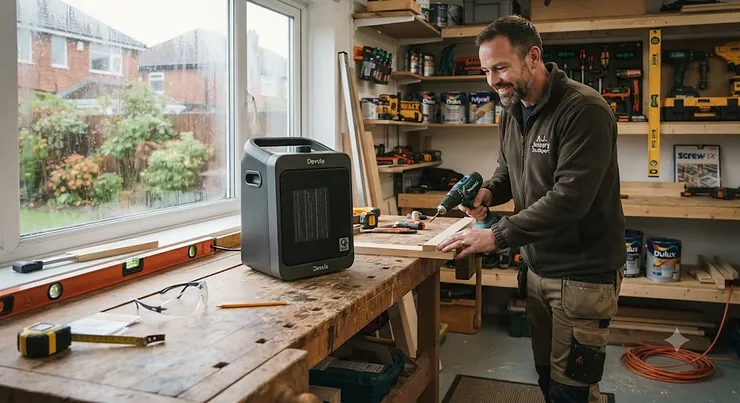
There’s a particular kind of misery reserved for anyone who’s tried to concentrate on a delicate bit of joinery while a cheap fan heater roars away like a jet engine taxiing for take-off. You can’t hear the radio. You can’t hear your phone ring. You definitely can’t hear the kettle boiling in the corner, which, if you’re British, borders on a crisis. A quiet workshop heater solves that specific problem: it’s a heating appliance engineered to keep background noise low — typically under 40 decibels — while still producing enough warmth to make a garage, shed, or outbuilding bearable through a British winter. For anyone working in a converted garage, a brick outbuilding, or a timber shed at the end of the garden, noise isn’t a minor gripe; it’s the difference between a workshop you actually want to spend time in and one you dread walking into after dark. Below, we’ve dug into seven genuinely available models on amazon.co.uk, weighed up their real specifications against honest, sourced review sentiment, and worked out which one actually earns a place in a quiet, damp-prone, often cramped British workshop.
Quick Comparison Table: Quiet Workshop Heaters at a Glance
| Heater | Type | Noise Level | Damp Resistance | Best For |
|---|---|---|---|---|
| Dreo Atom 316 | Ceramic fan | ~34dB | Standard (indoor use) | Overall quietest small workshop |
| TOUGH MASTER Industrial Ceramic Heater | PTC ceramic fan | Low-moderate | Standard | Budget mid-size workshop |
| Jet Heat 3kW Industrial Fan Heater | Industrial fan | ~51dB | IPX4 splashproof | Damp garages and outbuildings |
| Zexum IP44 Tubular Heater | Tubular convection | Near-silent (no fan) | IP44 | Background frost protection |
| De’Longhi Radia S 2000W | Oil-filled radiator | Near-silent | Standard | Premium quiet all-day heat |
| Russell Hobbs RHOFR3001 | Oil-filled radiator | Near-silent | Standard | Budget silent radiator |
| Prem-i-air Elite 2kW Turbo Fan | PTC industrial fan | Low-moderate | Standard | Compact portable small spaces |
Looking at this table, a genuine pattern emerges: the quietest options in raw decibel terms are either ceramic units built around brushless motors, like the Dreo Atom 316, or fanless designs, like oil-filled radiators and tubular heaters, which have no moving air-pushing parts to generate whirring noise at all. Where the table gets interesting is damp resistance — only the Jet Heat 3kW Industrial Fan Heater and the Zexum IP44 Tubular Heater carry a proper ingress protection rating suited to unheated brick or timber structures that see condensation. If your workshop is genuinely damp rather than merely unheated, that IP rating should outrank the decibel figure on your priority list.
💬 Just one click — help others make better buying decisions too!😊
Top 7 Quiet Workshop Heaters: Expert Analysis
1. Dreo Atom 316 — quietest ceramic heater on the UK market
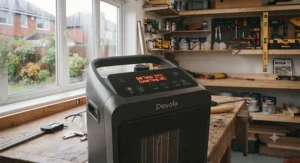
The Dreo Atom 316 built its reputation almost entirely on one number: 34dB, a noise level genuinely comparable to a quiet library reading room. That’s achieved through a brushless DC motor rather than the cheap AC motors found in budget fan heaters, which is precisely the component that tends to whine and rattle after a few months of daily use. Specification-wise, it’s a 1,500W ceramic unit with 60° tilt and remote control, positioning it as a personal-zone heater for a bench or desk area rather than a whole-garage solution — ceramic elements heat air quickly but don’t hold warmth once switched off, unlike oil-filled alternatives. This makes it best suited to someone working at a single fixed spot: a hobbyist at a workbench, a home-office corner of a converted garage, or anyone who wants near-silent warmth pointed directly at them rather than radiating through a whole room. Aggregated UK buyer sentiment consistently flags the low noise and compact footprint as the standout traits, while some reviewers note it struggles to warm larger, draughtier spaces without help from a second heat source. It isn’t rated for damp environments, so a bone-dry shed or insulated garage suits it far better than an open-sided outbuilding.
Pros:
- ✅ Genuinely one of the quietest ceramic heaters sold in the UK
- ✅ Remote control and tilt head for hands-free operation at the bench
- ✅ Compact enough to tuck under a workbench overnight
Cons:
- ❌ Not damp or splash rated, so unsuitable for exposed outbuildings
- ❌ Better for a single zone than heating a whole detached garage
At the time of research, the Dreo Atom 316 typically sits in the £40-£65 range on amazon.co.uk — always check current price before buying, as retailer promotions shift regularly. For a dry workshop where near-silence at the bench matters more than blasting the whole room, this is difficult to beat on value.

2. TOUGH MASTER Industrial Ceramic Heater — best budget pick for mid-size workshops
Where the Dreo prioritises whisper-quiet operation for a single zone, the TOUGH MASTER Industrial Ceramic Heater takes a different route: a 2kW PTC ceramic element rated to cover spaces up to roughly 40 square metres, which is a genuinely useful figure for anyone with a double garage or a larger timber workshop rather than a cupboard-sized shed. PTC (positive temperature coefficient) ceramic elements self-regulate their output as they heat up, which in practice means steadier performance and a lower fire risk than older exposed-coil designs — worth knowing if your workshop doubles as timber or paint storage. The adjustable thermostat and dual heat settings let you drop to a lower wattage for background maintenance heat once the space is up to temperature, which matters for anyone conscious of running costs during a long session at the bench. Based on the spec sheet, this sits in the mid-noise bracket rather than the ultra-quiet tier — you’ll hear the fan, but it’s a steady hum rather than the harsh whine some budget heaters produce. Reviewers researching this category tend to prioritise coverage and thermostat reliability over absolute silence, and this model answers that brief more than it answers a “silent workshop” brief specifically.
Pros:
- ✅ 40m² rated coverage suits larger single or double garages
- ✅ PTC ceramic element self-regulates for safer sustained use
- ✅ Adjustable thermostat allows lower-cost background heat mode
Cons:
- ❌ Noticeably louder than dedicated whisper-quiet models
- ❌ No IP rating, so avoid genuinely damp or unsealed structures
Check current price, but this model typically lands in the £30-£50 bracket, making it one of the more affordable ways to heat a full-size workshop rather than just a single corner of one.
3. Jet Heat 3kW Industrial Fan Heater — best for genuinely damp workshops
This is the one to reach for if your workshop is a converted outbuilding with a history of condensation on the walls. The Jet Heat 3kW Industrial Fan Heater carries an IPX4 splashproof rating, meaning it’s built to tolerate water splashed from any direction — a specification most domestic-style fan heaters simply don’t have, and one that matters enormously in a brick garage where damp air condenses on cold metal casings overnight. What most buyers overlook about this category is that a standard (non-rated) heater used in a damp space isn’t just less durable — it’s a genuine electrical hazard, which is exactly the kind of risk the UK’s Health and Safety Executive flags in its official guidance on maintaining portable electric equipment (hse.gov.uk). At 51dB, it’s honestly not whisper-quiet — this is a proper industrial unit with a powder-coated steel casing, wheels, and a 60m³ heating area, so some fan noise is the trade-off for that ruggedness and damp tolerance. Three heat outputs (fan-only, half, and full) give useful flexibility, letting you run it fan-only overnight purely to keep air circulating and condensation at bay without burning full wattage.
Pros:
- ✅ IPX4 splashproof rating genuinely suited to damp garages
- ✅ Wheeled, robust steel casing built for workshop knocks
- ✅ Fan-only mode useful for overnight condensation control
Cons:
- ❌ At 51dB it’s the loudest heater on this list, not a quiet-first pick
- ❌ Bulkier and heavier than the ceramic or tubular alternatives
At the time of research, industrial fan heaters of this specification tend to sit around the £70-£100 mark — always confirm current pricing, as industrial-category listings vary more than domestic ones.
4. Zexum IP44 Tubular Space Heater — best silent background heater for damp resistance
If noise really is your number-one concern and you’re happy to sacrifice rapid heat-up time, the Zexum IP44 Tubular Space Heater deserves serious consideration. Tubular heaters have no fan at all — they work through simple convection, meaning the only sound you’ll ever hear is the faint tick of the metal casing expanding as it warms. That’s about as close to silent as electric heating gets. The IP44 rating (protected against solid objects over 1mm and splashing water from any direction) makes it a genuinely sound choice for a damp brick garage, a workshop with an outward-opening door that lets rain in, or a greenhouse-adjacent space. It’s sold in multiple lengths, from roughly one foot up to six feet, which is a detail Amazon listings rarely explain well: a longer tube doesn’t heat faster, but it distributes the same wattage over a larger surface area, producing gentler, more even background warmth rather than a hot spot. Here’s what to weigh: this is fundamentally a frost-protection and background-warmth heater, not a rapid-heat solution — don’t expect to walk into a cold workshop and feel warm within five minutes, the way you would with a ceramic fan heater.
Pros:
- ✅ No fan means genuinely silent, tick-free background operation
- ✅ IP44 rating built specifically for damp garage and shed use
- ✅ Multiple lengths let you match wattage distribution to your space
Cons:
- ❌ Slow to bring a cold workshop up to a comfortable temperature
- ❌ Needs wall mounting, which adds a small installation step
Prices vary by length, but expect somewhere in the £30-£45 range for a mid-size unit — check current price for your chosen length before ordering.
5. De’Longhi Radia S 2000W — best premium near-silent oil-filled radiator
Oil-filled radiators work on a genuinely different principle to fan heaters: a sealed reservoir of diathermic oil is heated internally, then radiates warmth outward through the metal fins, with no fan needed at all. The De’Longhi Radia S 2000W applies that century-old technology with a modern ECO function and LED display, automatically moderating power draw once the room reaches your target temperature rather than cycling on full-blast repeatedly. What the spec sheet won’t tell you, but the underlying physics make clear, is that oil retains heat for a surprisingly long time after switching off — useful if you want residual warmth in the workshop after you’ve finished for the evening without leaving anything running. This is a genuinely premium pick within the oil-filled category, and De’Longhi’s reputation for build quality generally translates into a unit that survives years of workshop use rather than one or two winters. The trade-off, as with all oil-filled radiators, is a slower initial warm-up than a fan heater — if you want to walk in and feel heat within two minutes, this isn’t that heater.
Pros:
- ✅ Near-silent radiant heat with no fan noise whatsoever
- ✅ ECO mode automatically moderates running costs once warm
- ✅ Retains residual heat well after switching off
Cons:
- ❌ Slower to warm a cold workshop than any fan-based model here
- ❌ Not rated for damp or splash-prone environments
At the time of research, this model typically sits in the £80-£115 range, positioning it as the premium choice on this list rather than a budget option — but for a dry workshop where silence is non-negotiable, the price reflects genuinely different underlying technology, not just branding.
6. Russell Hobbs RHOFR3001 — best budget silent oil-filled radiator
Not everyone needs — or can justify — a premium radiator, and that’s where the Russell Hobbs RHOFR3001 earns its place. It applies the same fundamentally silent oil-filled principle as the De’Longhi above, just without the ECO electronics and LED display, at a noticeably lower price point. Based on the spec comparison, you’re trading smart features for cost here, not trading away the core benefit — it’s every bit as quiet as its pricier oil-filled sibling, because the physics (no fan, radiant heat from warmed oil) is identical regardless of brand. Multiple heat settings let you dial output up or down depending on how cold the workshop is, and the compact footprint suits smaller sheds or a corner of a garage rather than an open industrial space. Reviewers researching budget oil-filled radiators tend to flag genuinely silent running as the category’s core appeal, alongside safety — because there’s no exposed heating element or fast-spinning fan, they’re widely considered one of the safer heater types for spaces where flammable materials like sawdust or solvents might be present.
Pros:
- ✅ Completely silent oil-filled operation at a genuinely budget price
- ✅ No exposed element — safer around sawdust and solvents
- ✅ Compact enough for smaller sheds and single-bay garages
Cons:
- ❌ Lacks the ECO/smart features of pricier oil-filled models
- ❌ Slow warm-up time, typical of the entire oil-filled category
Check current price, but expect somewhere around the £35-£55 mark — one of the more genuinely affordable routes to fully silent heating on this list.
7. Prem-i-air Elite 2kW Turbo Fan — best compact heater for small workshop spaces
Small workshops — think a single-car garage bay, a garden office corner repurposed for tool storage, or a tight shed — often need something that heats fast without eating up floor space. The Prem-i-air Elite 2kW Turbo Fan is a PTC industrial heater with three heat settings, a built-in carry handle, and a compact enough footprint to tuck against a wall rather than dominate the room. What most buyers overlook about small-space heating specifically is that wattage-to-room-size ratio matters more than absolute power — a 2kW unit in a small, well-sealed workshop will feel considerably warmer than the same wattage in a large draughty one, so don’t assume you need the biggest heater available. This model has picked up a solid UK review base, sitting around 4.6 out of 5 across roughly 20 verified ratings at the time of research, with the carry handle and rapid heat-up consistently mentioned as practical positives. On noise, it sits in a similar bracket to the TOUGH MASTER above — a steady fan hum rather than a whisper, so it’s a stronger fit for a small workshop where you’re moving around and working than for a spot where you need dead silence to concentrate.
Pros:
- ✅ Compact footprint genuinely suited to small garages and sheds
- ✅ Carry handle makes it easy to move between work zones
- ✅ Strong, consistent UK buyer ratings for reliability
Cons:
- ❌ Fan noise is noticeable rather than whisper-quiet
- ❌ 2kW output may underwhelm in larger, poorly insulated spaces
At the time of research, this model typically sits in the £35-£50 range — a sensible mid-budget option for anyone whose priority is a compact heater that fits a small workshop footprint rather than one built to cover a full double garage.
Practical Usage Guide: Getting the Most From Your Quiet Workshop Heater
Buying the right heater is only half the job — how you set it up in the first thirty days genuinely affects both noise levels and running costs. Start by placing the heater on a stable, level surface at least a metre from anything flammable, including sawdust piles, solvent tins, and stacked timber; this isn’t box-ticking, it’s the single most common cause of workshop heater incidents according to UK fire safety guidance. For fan-based models like the Dreo Atom 316 or TOUGH MASTER Industrial Ceramic Heater, resist the temptation to position them directly against a wall — a few centimetres of clearance around the intake reduces the strained, higher-pitched motor noise that develops when airflow is restricted. If you’ve gone for a damp-resistant option like the Jet Heat 3kW Industrial Fan Heater or the Zexum IP44 Tubular Heater, check the socket and cable route are also suitably protected, since an IP-rated heater plugged into an exposed extension lead in a puddle-prone corner defeats the point entirely. A common first-month mistake is running a heater at maximum output constantly rather than using the thermostat to maintain a steady temperature — this both wastes electricity and accelerates component wear, particularly on cheaper PTC fan units. Finally, build a simple maintenance habit: once a month, unplug the heater and gently vacuum any visible dust from the intake grille, since dust build-up is one of the more common causes of that gradually worsening fan whine reviewers so often complain about on budget models.
Real-World Scenarios: Matching the Right Quiet Workshop Heater to Your Setup
Picture three genuinely different British workshop situations, because the “best” heater genuinely depends on which one you recognise yourself in. First: a hobbyist woodworker with a single-car garage, insulated but not damp, working evenings after the family’s gone to bed — noise matters enormously here, both for concentration and for not waking the house, so the Dreo Atom 316 or a fanless option like the Russell Hobbs RHOFR3001 fits best, since silent running trumps rapid heat-up when you’re settling in for a two-hour session anyway. Second: someone with a detached brick outbuilding at the end of a damp garden, prone to condensation on the walls through winter, using it a few times a week for general DIY — here the IP rating on the Jet Heat 3kW Industrial Fan Heater or the Zexum IP44 Tubular Heater matters more than absolute silence, because a non-rated heater in that environment is a genuine safety and longevity risk regardless of how quiet it runs. Third: a tradesperson or serious hobbyist with a larger workshop space, using power tools that already generate noise throughout the day, where the ambient soundscape means whisper-quiet heating is less critical than raw coverage — the TOUGH MASTER Industrial Ceramic Heater, with its 40m² rating, suits this profile better than any of the ultra-quiet single-zone options. Matching the scenario to the heater, rather than chasing the lowest decibel figure on paper regardless of context, is genuinely the smarter buying approach.
How to Choose a Quiet Workshop Heater
Picking the right unit comes down to working through a handful of criteria in order, rather than fixating on a single spec.
- Establish your noise ceiling first. Decide honestly whether you need near-silent (under 35dB, typically fanless or brushless-motor ceramic) or simply “quieter than a standard fan heater” (40-55dB) — this single decision eliminates roughly half the market immediately.
- Check for damp or IP-rated needs. If your workshop has ever shown condensation, mould, or a damp smell in winter, an IP44 or higher-rated model like the Zexum IP44 Tubular Heater isn’t optional — it’s a genuine safety requirement.
- Match wattage to floor area, not ambition. As a rough rule, budget around 100W per square metre in a reasonably insulated space, rising to 150W per square metre in an uninsulated brick or timber structure.
- Decide between rapid heat and steady background warmth. Fan-based ceramic and PTC units heat fast but cool fast once off; oil-filled radiators and tubular heaters warm slowly but hold heat far longer.
- Factor in portability versus fixed positioning. A heater with a carry handle, like the Prem-i-air Elite 2kW Turbo Fan, suits a workshop where you move between zones; a wall-mounted tubular unit suits a fixed background-heat role.
- Look at genuine safety certification, not marketing copy. UK-compliant models should carry a CE or UKCA mark alongside overheat protection and, ideally, tip-over cut-out — details worth checking on the listing before you buy, not after.
- Set a realistic budget band rather than chasing the cheapest listing. The very cheapest fan heaters on Amazon tend to be the loudest and shortest-lived; spending in the mid-range typically buys noticeably better noise control and longevity.
Damp-Resistant Heaters: Understanding IP Ratings for Workshop Heater for Damp Conditions
If there’s one specification that genuinely separates a workshop heater from a domestic bedroom heater, it’s ingress protection — better known as an IP rating. This is a two-digit code (IP44, IPX4, and so on) that tells you exactly how well an appliance resists solid objects and moisture, and it’s a globally standardised system rather than marketing jargon, as Wikipedia’s technical breakdown of the IP Code explains in detail. The first digit covers protection against solid intrusion — dust, fingers, small tools — while the second covers water, ranging from light dripping right up to full submersion. For a workshop heater for damp conditions specifically, you’re generally looking for at least IP44 (protected against splashing water from any direction), which is exactly what both the Jet Heat 3kW Industrial Fan Heater (rated IPX4) and the Zexum IP44 Tubular Heater offer on this list. Reviewers consistently note that non-rated heaters used in damp garages show visible corrosion on internal components within a single winter — not a dramatic failure, just a steadily shortening lifespan that eventually shows up as intermittent tripping or a burning smell, both of which are genuine warning signs to stop using the appliance immediately. It’s worth being honest here: an IP rating protects against splashing and humidity, not submersion or direct hosing down, so even a rated heater still needs sensible placement away from standing water or leaking guttering.
Workshop Heater for Small Spaces: Features That Actually Matter (And Those That Don’t)
Small-space heating gets marketed with a lot of noise about maximum wattage, when in practice the figures that matter most for a workshop heater for small spaces are quite different. Coverage area in square metres matters far more than raw kilowattage — a 2kW unit rated for 20m² will comfortably heat a single-bay garage, while the same 2kW figure on a poorly designed unit without proper airflow might struggle in half that space. Footprint and mounting options matter too: a heater like the Prem-i-air Elite 2kW Turbo Fan that can sit on a shelf or be carried between a bench and a doorway is genuinely more useful in a cramped space than a large floor-standing radiator that eats into already-limited walking room. What tends not to matter as much as the marketing suggests: oscillation. It’s a common feature on domestic fan heaters, sweeping side to side to “spread” warmth, but in a small workshop where you’re typically stationed at one bench or workstation, a fixed, directional heat output aimed precisely where you’re working is usually more useful than a heater politely warming the empty half of the room. Similarly, elaborate smart-app connectivity is rarely worth paying extra for in a workshop context — a simple mechanical or digital thermostat does the job just as well without the setup faff, and there’s one fewer thing to go wrong in a dusty environment.
Low-Noise Operation Explained: What the Decibel Numbers Actually Mean
Decibel figures on heater listings are genuinely useful, but only if you understand the scale isn’t linear — it’s logarithmic, meaning a jump from 30dB to 40dB represents roughly a doubling of perceived loudness, not a 10% increase. For context that’s actually useful when comparing the models on this list: 30-35dB (the territory of the Dreo Atom 316 at roughly 34dB) sits around the level of a quiet library or rustling leaves; 40-50dB is comparable to a normal conversation or a quiet office; and the 51dB rating on the Jet Heat 3kW Industrial Fan Heater sits closer to background office chatter — noticeable, but far from disruptive in an already-active workshop environment. What most buyers overlook is that manufacturer-quoted decibel figures are typically measured at a fixed distance, often one metre, under laboratory conditions — real-world noise in a small brick garage can sound louder simply because hard surfaces reflect and amplify sound rather than absorbing it, the way soft furnishings would in a living room. This is precisely why fanless technologies — oil-filled radiators like the De’Longhi Radia S 2000W and Russell Hobbs RHOFR3001, and tubular convection heaters like the Zexum IP44 Tubular Heater — represent the genuine gold standard for low-noise operation: there’s no moving air-pushing component to generate noise in the first place, so the acoustic environment of the room barely matters.
Quiet Workshop Heater vs Traditional Space Heaters
The distinction between a genuinely quiet workshop heater and a traditional domestic space heater comes down to engineering choices most shoppers never see on the box. Traditional cheap fan heaters typically use basic AC induction motors, which are inexpensive to manufacture but produce a characteristic higher-pitched whine that tends to worsen with age as bearings wear. Purpose-built quiet models, by contrast, either eliminate the fan entirely (oil-filled radiators, tubular convectors) or use brushless DC motors, as in the Dreo Atom 316, which run smoother and quieter by design rather than through added sound-dampening materials. On raw heating speed, traditional fan heaters generally win — they move warm air directly into a room far faster than oil-filled or tubular alternatives, which is genuinely why the TOUGH MASTER Industrial Ceramic Heater and Jet Heat 3kW Industrial Fan Heater remain worthwhile options despite not being the quietest on this list. Where quiet-focused workshop heaters pull ahead is in sustained, session-length use — if you’re spending two or three hours at a bench, the cumulative fatigue of background fan noise on concentration and stress levels is a real, measurable factor, not just a comfort preference. On durability, fanless designs also tend to win long-term, simply because they have fewer moving parts that can wear out or need replacing, which matters in a workshop environment where dust and sawdust inevitably find their way into every mechanical gap.
Home Workshop Use: Long-Term Cost and Maintenance
Running costs deserve honest attention here, because a quiet heater bought without checking wattage against realistic usage patterns can become an expensive habit over a British winter. With the UK’s Ofgem energy price cap setting the current standard electricity unit rate at around 26p per kWh for the final quarter of 2026 (ofgem.gov.uk), a 2kW heater run for three hours an evening, five evenings a week, works out to roughly £8-£9 a week in electricity alone — a figure worth genuinely budgeting for rather than discovering on the next bill. This is where oil-filled radiators like the De’Longhi Radia S 2000W and Russell Hobbs RHOFR3001 can claw back some of their slower warm-up disadvantage: because they retain heat in the oil reservoir after the thermostat cuts the element, actual running time — and therefore cost — is often lower than the wattage figure alone suggests. Maintenance-wise, fanless designs again have the edge for total cost of ownership: there’s no motor or bearing to eventually fail, no filter to clean, and generally a longer realistic lifespan before replacement. Fan-based and PTC ceramic units, meanwhile, benefit from that monthly dust-clearing habit mentioned earlier in the Practical Usage Guide, since a clogged intake both increases noise and forces the element to work harder, quietly inflating running costs over a season without you necessarily noticing.
Common Mistakes When Buying a Quiet Workshop Heater
The most frequent mistake is buying purely on decibel rating without checking whether the space needs an IP-rated model at all — a whisper-quiet heater with no damp resistance, used in a condensation-prone brick garage, is a genuinely poor long-term purchase regardless of how peaceful it sounds while it lasts. A close second is underestimating wattage requirements for larger or poorly insulated spaces, leaving buyers running a small, quiet heater on maximum output constantly rather than the moderate, efficient cycling it was actually designed for — which, ironically, often ends up louder in practice than a correctly sized larger unit running on a lower setting. Consumer group Which? has consistently flagged unsafe design and missing safety certifications as a recurring issue across the budget end of the electric heater market (which.co.uk), which makes checking for a genuine CE or UKCA mark, rather than assuming all listings are equally compliant, a genuinely worthwhile five-minute step before ordering. Another common error is ignoring cable length and placement — running an extension lead across a workshop floor to reach a socket increases both trip hazards and, in damp spaces, moisture exposure risk at connection points. Finally, plenty of buyers skip checking overheat and tip-over protection entirely, treating it as a given rather than a feature to actively confirm on the listing, which matters considerably more in a workshop where sawdust, offcuts, and solvents are routinely nearby.
Frequently Asked Questions
❓ What's the quietest type of workshop heater available in the UK?
❓ Can I use a normal fan heater in a damp garage?
❓ How many watts do I need for a small home workshop?
❓ Are oil-filled radiators cheaper to run than fan heaters?
❓ Is it safe to leave a quiet workshop heater running overnight?
Conclusion
There isn’t a single “best” quiet workshop heater — there’s a best one for your specific workshop, and the honest answer depends far more on your walls than your wish list. If you’re working in a genuinely damp brick or timber outbuilding, the IP-rated Jet Heat 3kW Industrial Fan Heater and Zexum IP44 Tubular Heater deserve priority over anything chasing a lower decibel figure, because damp resistance is a safety issue, not a nice-to-have. If your workshop is dry and insulated and silence at the bench is the whole point, the Dreo Atom 316 or either oil-filled radiator — the premium De’Longhi Radia S 2000W or budget Russell Hobbs RHOFR3001 — will serve you far better through a long evening session. And if space and coverage matter more than either extreme, the TOUGH MASTER Industrial Ceramic Heater and compact Prem-i-air Elite 2kW Turbo Fan both strike a sensible middle ground. Whichever you choose, match the wattage honestly to your floor area, check the IP rating against your actual conditions rather than hoping for the best, and remember that the cheapest listing on the page is rarely the quietest one in practice.
Recommended for You
- Industrial Workshop Heater: 7 Best Trade Picks for UK Winter (2026)
- Best Workshop Heater: 7 Top UK Picks for Winter 2026
- Infrared Garage Heater for Draughty Spaces: 7 Best Picks (2026)
Disclaimer: This article contains affiliate links. As an Amazon Associate, I earn from qualifying purchases. If you purchase products through these links, we may earn a small commission at no additional cost to you.
✨ Found this helpful? Share it with your friends! 💬🤗
