
In This Article
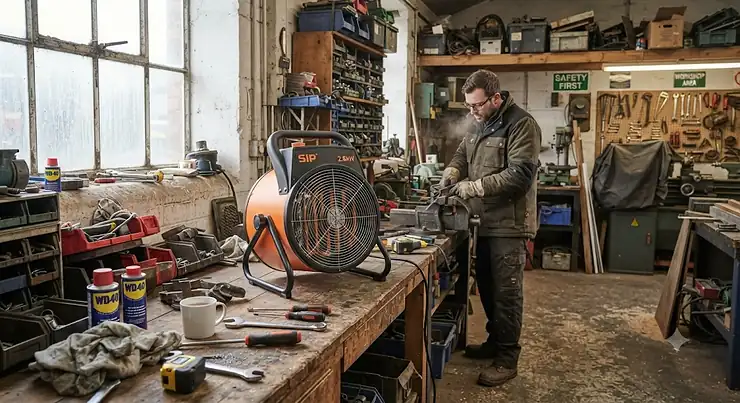
There’s a specific kind of misery reserved for anyone who’s tried to finish a job in a workshop at 4°C with numb fingers and a fan heater that’s doing absolutely nothing. Workshops are brutal spaces to heat — high ceilings, poor insulation, draughty doors left open for ventilation — and the wrong heater just throws money at cold air rather than actually warming you or your tools.

Finding the best workshop heater isn’t about buying the biggest wattage you can find. It’s about matching heat output, running cost and safety features to the actual size and condition of your space, whether that’s a small insulated garden shed or an open-sided garage with a roller door that never quite seals. This guide compares seven real heaters currently sold on amazon.co.uk, spanning budget electric fan heaters through to a serious propane unit for larger spaces, with honest analysis of who each one actually suits.
We’ll also cover the question that trips up most first-time buyers: workshop heater vs garage heater — are they really different products, or just marketing labels? And because choosing the wrong heater type carries real electrical and carbon monoxide risks, safety runs through every section below rather than being an afterthought.
Quick Comparison Table
| Workshop Heater | Type | Heat Output | Best For |
|---|---|---|---|
| Kingavon 2kW Ceramic Fan Heater | Electric ceramic | 2kW | Cheapest usable option for small spaces |
| Draper 92967 PTC Electric Space Heater | Electric PTC | 2kW | Fast warm-up in enclosed spaces up to 20m² |
| TOUGH MASTER Industrial Ceramic Heater | Electric ceramic | 2kW | Budget pick with adjustable thermostat |
| Kingavon BB-FH210 Tilting Cylinder Heater | Electric fan | 3kW | Mid-size workshops up to 60m³ |
| Dimplex RUG3TS Rugged 2-in-1 Heater | Electric fan/cooler | 3kW | Year-round heating plus summer cooling |
| Devola 1000W WiFi Glass Panel Heater | Electric radiant panel | 1kW | Thermostatic control and app scheduling |
| Draper 47063 Jet Force Propane Heater | Gas (propane) | 10kW | Large, uninsulated or unheated workshops |
Scanning across the table, the split isn’t really budget versus premium — it’s electric versus gas, and compact versus high-output. Electric options like the Kingavon 2kW Ceramic Fan Heater and Draper 92967 PTC Electric Space Heater suit small, enclosed spaces where mains power is already running. The Draper 47063 Jet Force Propane Heater sits in a different category entirely, built for volume heating in spaces too large or draughty for electric heaters to cope with economically.
💬 Just one click — help others make better buying decisions too!😊
Top 7 Workshop Heaters: Expert Analysis
1. Kingavon 2kW Ceramic Electric Fan Space Heater — cheapest usable option for small spaces
The Kingavon 2kW Ceramic Electric Fan Space Heater is a compact, portable unit built around a ceramic heating element rather than a bare wire coil, which means it heats up quickly without the fire risk associated with older exposed-element designs. It offers three heat settings and a manual overheat thermostat, all packed into a 1kg unit with a carry handle.
On paper, 2kW (6,824 BTU) sounds modest, but for a small insulated shed or a workbench corner of a garage, it’s genuinely enough to take the chill off within 15-20 minutes. What most buyers overlook about compact ceramic heaters like this is that the fan-forced airflow matters as much as the wattage — moving warm air around a cluttered workshop beats a static radiant heater that only warms whatever’s directly in front of it.
Reviewers consistently note it’s straightforward and does what it says, though the plastic housing feels noticeably less robust than the metal-cased units further down this list. This is honestly a “get through the winter cheaply” heater rather than a long-term workshop fixture, and it’s worth saying so rather than oversell it.
Pros:
- ✅ Genuinely affordable entry point into workshop heating
- ✅ Ceramic element heats up faster than older coil designs
- ✅ Compact and portable with a carry handle
Cons:
- ❌ Plastic housing feels less durable than metal-cased rivals
- ❌ 2kW output struggles in larger or draughty spaces
Typically priced under £30 on amazon.co.uk, this is one of the cheapest realistic starting points for anyone heating a small workshop.
2. Draper 92967 PTC Electric Space Heater — fast warm-up in enclosed spaces up to 20m²
The Draper 92967 PTC Electric Space Heater uses Positive Temperature Coefficient (PTC) ceramic technology, a step up from standard ceramic elements in terms of how quickly it responds to temperature changes. Draper rates it for enclosed spaces up to 20 square metres, with a stainless steel heating element and dual overheat safety protection built in.
Here’s what the spec sheet doesn’t spell out plainly: PTC elements self-regulate their resistance as they heat, which means they’re inherently harder to overheat than basic coil elements — a genuinely useful safety feature for a workshop where the heater might get knocked or partially covered by dust sheets. The adjustable capillary thermostat with two heat settings gives reasonable control, though it’s a mechanical dial rather than a digital display.
Based on the spec comparison with the Kingavon unit above, the Draper’s stainless steel element and dual safety cut-outs justify its slightly higher price for anyone planning to leave the heater running unattended for short periods. Aggregated review sentiment sits around 4.3 stars, with buyers frequently praising the build quality relative to price, though a few note the 1.3m cable is shorter than ideal for larger workshops.
Pros:
- ✅ PTC element self-regulates for added safety
- ✅ Dual overheat protection built into the design
- ✅ Rated for enclosed spaces up to 20m²
Cons:
- ❌ Short 1.3m power cable limits placement
- ❌ Mechanical thermostat lacks digital precision
Prices generally sit in the £30-£45 range, positioning it as a sensible step up from the cheapest ceramic fan heaters.
3. TOUGH MASTER Industrial Ceramic Heater 2000W — budget pick with adjustable thermostat
The TOUGH MASTER Industrial Ceramic Heater 2000W is aimed squarely at garage and workshop use, with a turbo fan mechanism designed to circulate warm air across spaces up to roughly 40m². It includes an adjustable thermostat and two heat settings, plus overheating protection as standard.
What stands out here compared with the more basic ceramic sets is the claimed coverage area — 40m² is double what Draper rates its PTC heater for, though real-world performance depends heavily on ceiling height and draughts, which workshops rarely lack. The turbo fan setting pushes air further than a standard fan heater, useful for a long, narrow workshop rather than a square room.
Reviewers aggregated from Amazon UK listings describe it as good value for the price, with the adjustable thermostat singled out as more precise than expected at this price point. The recurring criticism, as with most budget ceramic heaters, is noise — the turbo fan setting is noticeably louder than the low setting, which matters if you’re working somewhere that needs to stay reasonably quiet.
Pros:
- ✅ Turbo fan setting pushes air further than standard models
- ✅ Adjustable thermostat offers genuine temperature control
- ✅ Claimed coverage up to 40m² on paper
Cons:
- ❌ Turbo fan setting is noticeably loud
- ❌ Real coverage depends heavily on draughts and ceiling height
At around £25-£35, it directly rivals the Kingavon and Draper sets above on price while adding a genuine thermostat.
4. Kingavon BB-FH210 3kW Tilting Workshop Cylinder Heater — mid-size workshops up to 60m³
The Kingavon BB-FH210 3kW Tilting Workshop Cylinder Heater steps up to three heat settings (450W, 1,500W and 3,000W), a stainless steel heating element, and a tilting cylinder design that lets you angle warm air toward a specific workbench rather than heating the whole room evenly. Kingavon rates it for working areas up to roughly 60 cubic metres.
The tilting function is a genuinely practical touch that most flat-panel or box-shaped heaters don’t offer — being able to angle heat directly at where you’re standing rather than the ceiling or an empty corner makes a real difference in a large, uninsulated space where heating the whole volume evenly simply isn’t realistic. The insulated carry handle and full metal casing also suggest this is built for rougher workshop conditions than the plastic-housed budget units above.
Compared with the TOUGH MASTER heater, this trades a wider fixed coverage claim for genuinely adjustable output across three distinct wattages, which matters for controlling running costs — there’s little point running 3,000W constantly once a small space has warmed up. Aggregated reviewer sentiment is mixed but leans positive, with praise for the tilting feature and build quality, alongside occasional comments about fan noise on the highest setting.
Pros:
- ✅ Three heat settings allow genuine output control
- ✅ Tilting design directs heat where you’re working
- ✅ Full metal casing suited to rougher workshop use
Cons:
- ❌ Noticeable fan noise on the 3,000W setting
- ❌ Heavier and bulkier than compact ceramic alternatives
Typically found in the £35-£50 range, it’s a sensible mid-tier pick for anyone outgrowing a basic 2kW fan heater.
5. Dimplex RUG3TS Rugged 2-in-1 3kW Electric Fan Heater — year-round heating plus summer cooling
The Dimplex RUG3TS Rugged 2-in-1 3kW Electric Fan Heater comes from a genuinely established heating brand rather than a generalist tool label, and it shows in the build: a rugged casing, two heat settings, a cool-blow function for summer use, a thermostat, sturdy carry handles and a washable air inlet filter to stop dust clogging the internals.
The dual heating-and-cooling function is the standout feature here, and it’s a legitimately useful piece of engineering rather than a marketing gimmick — a workshop that gets uncomfortably hot in July benefits just as much from the cool-blow fan setting as it does from 3kW of heat in January. Dimplex’s dust filter is also a genuine practical addition for a woodworking or metalworking space where airborne debris regularly clogs cheaper fan heaters over a season or two.
Reviewers consistently mention the build quality and the year-round usefulness as the main draw, justifying a price roughly double that of the Kingavon cylinder heater above. The main criticism in aggregated reviews is that 3kW, while solid, isn’t dramatically more powerful than cheaper 3kW alternatives — buyers are largely paying for durability and the cooling function rather than raw heat output.
Pros:
- ✅ Genuine dual heating and cooling function
- ✅ Washable air filter suits dusty workshop environments
- ✅ Established heating brand with rugged build quality
Cons:
- ❌ Priced well above comparable 3kW electric heaters
- ❌ Heat output isn’t dramatically stronger than cheaper rivals
At roughly £70-£85, this suits buyers who want one appliance covering both winter heating and summer cooling rather than two separate units.
6. Devola 1000W WiFi Glass Panel Heater — thermostatic control and app scheduling
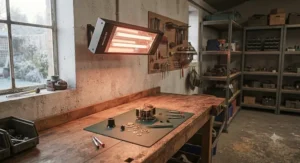
The Devola 1000W WiFi Glass Panel Heater is a different type of heater entirely — a slim radiant glass panel rather than a fan-forced unit, designed for rooms up to roughly 15m². It connects to WiFi for app and voice control via Alexa or Google Assistant, includes open window detection, and offers a genuine 24/7 digital timer alongside precise thermostatic control.
This is squarely the workshop heater with thermostat option on this list for anyone who wants set-and-forget temperature management rather than manually flicking a dial. The open window detection feature is a smart practical touch for a workshop, automatically reducing output if it senses a sudden temperature drop from a door being left open, which helps control running costs in a space that’s rarely fully sealed.
Based on the spec comparison with fan-forced alternatives, the trade-off is speed versus precision: radiant panel heaters like this warm more gradually than a 3kW fan heater, making them better suited to a workshop that’s insulated well enough to hold heat, rather than a draughty space needing rapid warm-up. Aggregated reviews are strongly positive on the app control and build quality, with occasional comments that WiFi setup can be fiddly on first use.
Pros:
- ✅ Precise thermostatic control via app or voice
- ✅ Open window detection helps manage running costs
- ✅ Slim glass panel design suits wall mounting
Cons:
- ❌ Slower warm-up than fan-forced heaters
- ❌ WiFi setup can be fiddly for some users
Typically priced in the £90-£120 range depending on wattage and colour, this is the premium, thermostat-focused pick on this list.
7. Draper 47063 Jet Force Propane Space Heater — large, uninsulated or unheated workshops
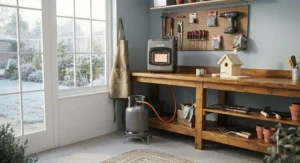
The Draper 47063 Jet Force Propane Space Heater is in a different league entirely, delivering up to 34,000 BTU (roughly 10kW) from bottled propane gas rather than mains electricity. It’s designed for large, well-ventilated spaces where electric heaters simply can’t deliver enough output economically — think a detached double garage, a barn conversion workshop, or a large uninsulated outbuilding.
The obvious advantage is raw heat output without needing a high-amperage electrical circuit, but this comes with a genuinely important caveat: gas heaters of this kind produce carbon monoxide and must only be used in spaces with adequate ventilation, never in a sealed room. What most buyers overlook about propane space heaters is that “portable” doesn’t mean “safe to leave running unattended” — proper CO detection and airflow are non-negotiable, not optional extras.
Reviewers consistently praise the sheer heat output relative to price for large spaces, with aggregated sentiment strongly positive on how quickly it warms a big volume compared with any electric alternative on this list. The consistent caution raised, echoed by UK safety guidance, is that this category of heater demands genuine ventilation awareness rather than casual use.
Pros:
- ✅ Far higher heat output than any electric option here
- ✅ No dependence on a high-amperage electrical supply
- ✅ Well suited to large, poorly insulated spaces
Cons:
- ❌ Requires proper ventilation and carbon monoxide awareness
- ❌ Ongoing propane bottle costs add up with regular use
Typically priced in the £110-£140 range, this is a specialist buy for large-space heating rather than a general workshop starter purchase.
Setting Up and Running Your Workshop Heater Safely
Getting a new workshop heater right from day one comes down to placement and power supply more than anything on the spec sheet. First, never run a heater from an extension lead shared with other high-draw tools — a 2-3kW heater already pulls close to the limit of a standard UK 13A socket, and adding a table saw or compressor on the same circuit risks tripping breakers or, worse, overheating a cable. Route power directly to a wall socket wherever possible.
A common first-month mistake is positioning the heater too close to sawdust, solvents, rags or paper stock. Even ceramic and PTC elements run hot enough on their casing to be a genuine fire risk near combustible material, so keep at least a metre of clearance on all sides, and never drape anything over a heater to dry it, however tempting on a damp winter morning.
For gas heaters specifically, check the propane connection for leaks before every session using a simple soapy water test on the fittings, and never run one in a fully sealed space. For electric heaters, an annual visual inspection of the cable and plug for fraying or damage takes two minutes and catches most faults before they become dangerous. Finally, dust build-up inside fan heaters reduces efficiency and can be a fire risk over time — an occasional vacuum of the intake grille, done with the unit unplugged and cooled down, keeps most units running safely for years.
✨ Don’t Miss These Exclusive Deals!
🔍 Take your workshop set-up to the next level with these carefully selected products. Click on any highlighted item to check current pricing and availability. These heaters will help you keep working through the coldest months in comfort!
Which Workshop Heater Fits Your Space?
Not every workshop needs the same heating approach, so here are three realistic scenarios matched to sets from this guide.
The small shed or garage corner user: if you’re heating a compact, mostly insulated space where you work for an hour or two at a time, the Kingavon 2kW Ceramic Fan Heater or Draper 92967 PTC Electric Space Heater deliver fast, affordable warmth without needing a big electrical supply.
The regular weekend workshop user: someone spending whole weekends in a mid-size garage workshop, especially one used year-round, gets real value from the flexibility of the Kingavon BB-FH210 Tilting Cylinder Heater or the Dimplex RUG3TS 2-in-1 Heater, both of which offer multiple output settings and, in Dimplex’s case, summer cooling too.
The large or poorly insulated space owner: for a detached garage, barn workshop or large outbuilding without proper insulation, electric heaters generally can’t deliver enough heat economically. The Draper 47063 Jet Force Propane Heater is built for exactly this scenario, provided ventilation is genuinely adequate. For anyone wanting precise, hands-off control in a smaller but well-sealed space instead, the Devola 1000W WiFi Glass Panel Heater offers thermostatic scheduling that a basic fan heater simply can’t match.
What Is a Workshop Heater?
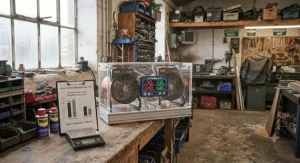
A workshop heater is a portable or semi-fixed heating appliance designed to warm a non-domestic working space — typically a garage, shed or outbuilding — quickly and robustly enough to cope with draughts, dust and occasional rough handling that a standard household heater isn’t built for.
Unlike home heating systems, workshop and space heaters are generally portable, single-room units rather than part of a whole-building system, which is exactly why heat output, safety features and running cost per hour matter so much more when choosing one — you’re heating one specific space efficiently, not relying on a central boiler doing the background work.
How to Choose a Workshop Heater
- Measure your space honestly, including ceiling height. A 2kW heater rated for 20m² of floor area struggles in a workshop with a 4-metre apex roof, since volume matters more than footprint.
- Decide between electric and gas based on power supply and ventilation. Electric suits smaller, better-sealed spaces with mains access; gas suits larger, ventilated spaces needing serious heat output.
- Check for thermostatic control if you’ll leave it running. A workshop heater with thermostat capability, like the Devola 1000W WiFi Glass Panel Heater, avoids wasted running costs once the space reaches temperature.
- Consider noise if you’re working nearby. Turbo fan settings on budget ceramic heaters are noticeably louder than radiant panel or lower-fan-speed alternatives.
- Look at genuine safety features, not marketing claims. Overheat protection, tip-over cut-offs and, for gas heaters, adequate ventilation guidance all matter more than headline wattage.
- Factor in portability versus fixed use. A tilting cylinder heater like the Kingavon BB-FH210 suits moving between workbenches; a wall-mounted panel heater suits a fixed working area.
- Match running cost to how often you’ll actually use it. A powerful gas heater used twice a month may cost less overall than an electric heater run daily at full output.
Workshop Heater vs Garage Heater: What’s Actually Different?
The phrase workshop heater vs garage heater gets used almost interchangeably in product listings, and honestly, there’s rarely a meaningful technical difference between the two labels — both describe portable or semi-fixed heaters built for non-domestic, less insulated spaces than a living room. What differs in practice is usually the marketing angle rather than the appliance itself.
Where a genuine distinction does sometimes appear: heaters marketed specifically as “workshop” heaters, like the Kingavon BB-FH210 Tilting Cylinder Heater, more often emphasise directional heat and rugged casing for standing near tools, while heaters marketed as “garage” heaters occasionally lean toward larger coverage claims for whole-space heating rather than spot warmth at a bench. Neither label is a reliable guide to actual performance, though — the spec sheet (wattage, coverage area, safety features) tells you far more than whether the box says “workshop” or “garage.”
The practical takeaway: don’t let the product name drive your decision. A heater badged for garages that has the right wattage, thermostat and safety features for your space will outperform one badged specifically for workshops that’s underpowered or lacks proper temperature control.
Heater Types Comparison: Electric, Gas, Ceramic and More
Understanding the underlying heater types comparison matters more than comparing individual products, since it explains why two heaters with similar wattage can feel completely different in use. Ceramic and PTC electric heaters, like the Kingavon 2kW Ceramic Fan Heater and Draper 92967 PTC Electric Space Heater, heat air quickly via a fan and suit smaller, enclosed spaces where fast warm-up matters more than sustained even heating.
Radiant panel heaters, represented here by the Devola 1000W WiFi Glass Panel Heater, work differently — warming objects and people directly via infrared-style radiant heat rather than heating the air itself, which makes them quieter and often more efficient in well-insulated spaces, but slower to make a cold room feel warm. Cylinder and industrial fan heaters like the Kingavon BB-FH210 sit between these extremes, offering adjustable, directional forced-air heat suited to mid-size spaces.
Gas heaters, exemplified by the Draper 47063 Jet Force Propane Heater, operate on an entirely different principle — burning fuel directly rather than converting electricity to heat — which delivers far higher output per pound spent on the unit itself, at the cost of needing proper ventilation and ongoing fuel costs. There’s no universally “best” type here: the right choice depends entirely on space size, insulation, ventilation and how long you’ll run the heater per session.
Common Mistakes When Buying a Workshop Heater
The most frequent mistake is buying based on wattage alone without considering room volume. A 3kW heater rated for a 20m² floor area in a manufacturer’s marketing assumes a standard domestic ceiling height — a workshop with an open apex roof or high ceiling can easily need more output than the headline figure suggests.
The second common error is ignoring electrical supply limits. Running a 3kW heater from a long, thin extension cable, or sharing a circuit with power tools, is a genuine fire risk rather than a minor inconvenience — always check the heater’s amperage against what your workshop wiring can actually handle. A third mistake is choosing gas for convenience without properly assessing ventilation; carbon monoxide risk from fuel-burning heaters in enclosed spaces is a serious, well-documented hazard, not a theoretical one.
Finally, many buyers overlook noise tolerance entirely until they’re trying to work near a heater on its loudest fan setting. If you’re doing precise or quiet work, test or research noise levels before committing, since a turbo fan heater running constantly can genuinely disrupt concentration over a long session.

Workshop Heater with Thermostat: Why Thermostatic Control Matters
A workshop heater with thermostat control does more than just add convenience — it directly affects running cost. A heater without thermostatic control runs at full output constantly, which wastes energy once a space has actually reached a comfortable temperature, particularly in smaller or better-insulated workshops where heat builds up faster than expected.
Thermostatic control comes in two broad forms across this guide: mechanical dial thermostats, found on the Draper 92967 PTC Electric Space Heater and TOUGH MASTER Industrial Ceramic Heater, and digital or app-based control, found on the Devola 1000W WiFi Glass Panel Heater. Mechanical thermostats are simpler and cheaper but less precise, typically cycling within a wider temperature band; digital thermostatic control offers tighter temperature management and, in the Devola’s case, scheduling so the workshop is warm exactly when you plan to use it rather than heating an empty space beforehand.
For anyone using a workshop heater regularly through an entire winter, thermostatic control genuinely pays for itself over a season through reduced energy waste, making it worth prioritising over raw wattage for regular users rather than occasional ones.
Workshop Insulation: Why It Matters More Than Heater Wattage
No workshop heater, however powerful, fully compensates for poor workshop insulation. Heat loss through gaps, draughts and uninsulated surfaces can undo much of what even a 3kW heater achieves, particularly around roller doors, single-glazed windows and unsealed roof spaces common in garages and sheds.
Simple, low-cost improvements make a disproportionate difference before spending more on heating power. Draught-proofing strips around doors and windows, a foam or rubber seal at the base of a roller door, and blocking unused vents (while keeping essential ventilation for gas heaters or general air quality) all reduce the volume of warm air escaping. For workshops with a single skin metal or timber roof, even basic reflective foil insulation between roof purlins can noticeably slow heat loss upward, which matters given how much warm air simply rises and escapes through an uninsulated ceiling.
The honest advice here: if you’re choosing between spending more on a bigger heater or spending a similar amount on basic workshop insulation and draught-proofing, the insulation spend generally delivers better long-term value, since it reduces running costs for whichever heater you already own rather than just adding more raw output to compensate for heat escaping as fast as it’s produced.
Long-Term Cost and Running Costs
Thinking in running cost rather than sticker price changes which heater looks like the best deal over a winter. A cheap 2kW electric heater run for four hours a day through a cold season adds up meaningfully on an electricity bill, while a heater with genuine thermostatic control, like the Devola 1000W WiFi Glass Panel Heater, can reduce total running time by cycling off once the space reaches temperature rather than running constantly.
Gas heaters like the Draper 47063 Jet Force Propane Heater flip this calculation: the unit itself costs more upfront, but bottled propane can work out more cost-effective per kWh of heat delivered for large-volume, infrequent heating sessions, though this varies with current gas bottle pricing and how efficiently the space holds heat.
The real long-term cost trap is buying underpowered repeatedly rather than buying appropriately once. Someone running a 2kW heater constantly on full power because it’s not actually warming a larger space adequately often spends more over a winter than someone who bought a correctly sized 3kW unit with proper thermostatic control from the outset.
Safety and Ventilation: Electric, Gas and Carbon Monoxide
Electrical and gas workshop heaters carry genuinely different risk profiles, and understanding both matters more than most buyers realise until something goes wrong. For electric heaters, the core risks are fire from combustible materials placed too close, and electrical overload from sharing circuits with power tools — both entirely preventable through sensible placement and dedicated sockets, as covered in the setup section above.
For gas heaters like the Draper 47063 Jet Force Propane Heater, the primary risk is carbon monoxide, a colourless, odourless gas produced during incomplete combustion. UK health and safety guidance is clear that fuel-burning heaters require proper ventilation and should never be used in sealed or poorly ventilated spaces, and a working carbon monoxide alarm is strongly recommended wherever a gas heater is in regular use, positioned according to the manufacturer’s guidance rather than tucked in a corner.
Whichever heater type you choose, an annual visual check of cables, plugs and gas fittings for damage takes minutes and catches the vast majority of developing faults before they become genuinely dangerous. Treating heater safety as an ongoing habit rather than a one-off purchase decision is, honestly, the single biggest factor in a safe winter workshop.
Frequently Asked Questions
❓ What size workshop heater do I need for a single garage?
❓ Is a gas heater cheaper to run than an electric workshop heater?
❓ Do I need a carbon monoxide alarm with a gas workshop heater?
❓ What's the real difference between a workshop heater and a garage heater?
❓ Does workshop insulation really reduce how much heater I need?
Conclusion
There’s no single best workshop heater — only the right one for your space, your power supply and how often you actually use it. For small, occasional use, the Kingavon 2kW Ceramic Fan Heater or Draper 92967 PTC Electric Space Heater deliver fast, affordable warmth. Regular users of a mid-size workshop get real value from the flexibility of the Kingavon BB-FH210 Tilting Cylinder Heater or the Dimplex RUG3TS 2-in-1 Heater. Anyone wanting precise thermostatic control should look to the Devola 1000W WiFi Glass Panel Heater, while large, uninsulated spaces are better served by the raw output of the Draper 47063 Jet Force Propane Heater, provided ventilation is genuinely adequate.
Whichever you choose, pair it with basic workshop insulation and sensible safety habits — draught-proofing, dedicated sockets, and carbon monoxide awareness for gas heaters matter more to a safe, cost-effective winter than any single feature on this list. Heat output solves a symptom; insulation and safe practice solve the actual problem.
Recommended for You
- Infrared Garage Heater for Draughty Spaces: 7 Best Picks (2026)
- Infrared Garage Heater for Small Workshop: 7 Top Picks (2026)
- Infrared Garage Heater: 7 Best Picks for UK Garages (2026)
Disclaimer: This article contains affiliate links. As an Amazon Associate, I earn from qualifying purchases. If you purchase products through these links, we may earn a small commission at no additional cost to you.
✨ Found this helpful? Share it with your friends! 💬🤗
