
In This Article
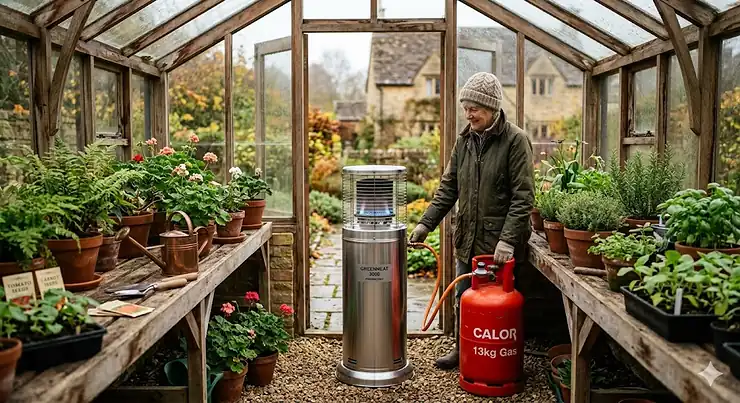
Britain is, to put it charitably, not a tropical paradise. November through March, our growing season doesn’t so much pause as collapse entirely — temperatures plummet, condensation forms on every pane of glass, and the tender plants you’ve spent all summer nurturing start looking distinctly sorry for themselves. A good propane greenhouse heater changes all of that. It buys you months of extra growing time, protects overwintering geraniums and citrus from frost, and means you can start seeds in February rather than waiting for April like everyone else.
But here’s the thing: not all gas heaters are created equal, and the British market has some specific requirements you won’t find on American buying guides. You need propane compatibility (butane becomes unreliable below -2°C, which is rather unhelpful during a British cold snap), sensible safety features, and ideally a thermostat that does the thinking for you so you’re not trogging down the garden at midnight. Whether you’ve got a compact 6×4 lean-to or a serious 10×12 production greenhouse on an allotment with no mains supply, there’s a propane greenhouse heater on this list that’ll suit you.
Quick Comparison Table: Top 7 Propane Greenhouse Heaters UK 2026
| Product | Output | Coverage | Thermostat | Best For | Price Range (GBP) |
|---|---|---|---|---|---|
| Bimson Power BP-G15T | 7–15kW | Up to 300m³ | ✅ Adjustable | Best all-rounder | Around £150–£200 |
| SIP FIREBALL 512 | 15kW | ~345m³ | ✅ Electric | Large greenhouses | Around £200–£280 |
| Draper 47100 Jet Force | 15kW | ~280m³ | ✅ Manual | Reliable workhorse | Around £160–£230 |
| Draper 47063 Jet Force | 10kW | ~200m³ | ✅ Thermocouple | Mid-size spaces | Around £120–£170 |
| Autojack 15kW Gas Heater | 15kW | ~225m³ | ✅ Adjustable | Budget upgrade | Around £100–£150 |
| fam famgizmo 30kW LPG | 30kW | ~500m³ | ❌ Mechanical | Large/commercial | Around £200–£300 |
| GEEPAS 4.2kW Gas Heater | 4.2kW | Small–medium | ✅ 3-setting | Compact greenhouses | Around £80–£120 |
From the table above, it’s clear the sweet spot for most UK hobby gardeners sits in the 10–15kW range — powerful enough to handle a serious frost but not so industrial that you’re burning through propane cylinders at an alarming rate. Budget buyers eyeing the Autojack or GEEPAS should note that lower price points often mean less refined thermostatic control, which in a cold snap can mean the difference between a stable 7°C and a glacial 1°C at 3am.
💬 Just one click — help others make better buying decisions too! 😊
✨ Don’t Miss These Exclusive Deals!
🔍 Take your greenhouse heating to the next level with these carefully selected picks. Click on any highlighted product name to check current pricing and availability on Amazon.co.uk. All Prime-eligible — next-day delivery available for most.
Top 7 Propane Greenhouse Heaters: Expert Analysis
1. Bimson Power BP-G15T 15kW Propane Space Heater — Best All-Rounder
The Bimson Power BP-G15T is currently one of the top-selling propane heaters on Amazon.co.uk for very good reason: it’s honest, uncomplicated, and gets the job done without theatre.
The output range of 7–15kW (23,000–51,000 BTU/hr) is more useful than a fixed-output model because you can dial it down on a mild March evening and crank it up when February decides to go properly Siberian. Coverage extends to around 300m³, which comfortably handles a 10×12 greenhouse with headroom to spare. The spark ignition system — no mains electricity required — is the critical feature for off-grid allotment greenhouses, and the included propane hose and regulator mean you’re heating within minutes of unboxing. One welcome touch: a 13A UK plug is pre-fitted for the electronic ignition, so there’s none of that voltage-adapter faff. The claim of up to 12 hours from a standard 13kg gas bottle at maximum output is, in this reviewer’s experience, fairly accurate at mid-setting.
Who is this for? The British allotment holder with a medium-to-large greenhouse and no mains electricity — particularly in rural areas of Scotland, Wales, or the more remote parts of England where gas cylinders are a practical necessity rather than a choice. UK customers on Amazon consistently praise the ease of setup and the reliability across cold nights.
Pros:
✅ Adjustable 7–15kW output
✅ Runs 12hrs on 13kg bottle
✅ 3-year manufacturer’s warranty
Cons:
❌ No dedicated ODS safety system
❌ Quite bulky for smaller greenhouses
🇬🇧 Prime-eligible. Price range: around £150–£200. Strong value at this output for the UK market.
2. SIP FIREBALL 512 Propane Gas Space Heater — Best for Large Greenhouses
SIP is a long-established British brand — they’ve been making workshop tools and heating equipment in the UK for over 60 years — and the FIREBALL 512 reflects that accumulated experience in its construction.
The 15kW / 51,182 BTU/hr output covers approximately 345m³, and the 230V electric ignition gives a more controlled, reliable start than piezo systems in very cold temperatures. This is worth knowing: standard piezo igniters can sometimes struggle in sub-zero conditions, particularly if there’s moisture in the connections (and in a British greenhouse in January, there invariably is). The electric element means you’ll need a nearby socket, but if your greenhouse has mains power, that’s a non-issue. The build quality is notably solid — a heavy-gauge steel body that won’t rattle apart after one winter season.
What most buyers overlook: the SIP FIREBALL 512 produces a directed forced-air output rather than radiant heat, meaning it warms the air volume quickly but you need to position it with some thought — pointing it down the length of the greenhouse, not at the end wall. UK reviewers particularly note its performance consistency across long winter nights, which is exactly what you need when you’re not there to babysit it.
Pros:
✅ Reliable 230V electric ignition
✅ Heavy-duty UK brand
✅ Consistent long-run performance
Cons:
❌ Requires mains electricity
❌ Heavier and less portable than alternatives
🇬🇧 Prime-eligible. Price range: around £200–£280.
3. Draper 47100 Jet Force Propane Space Heater — The Reliable Workhorse
Draper Tools is a family-run British business that’s been going since 1919 — a centenary company, in other words, which is the sort of track record that earns genuine trust. The Jet Force 47100 delivers 15kW / 50,000 BTU with piezo push-button ignition and a solenoid thermocouple valve for gas safety cut-off.
The thermocouple is the underrated hero here. It’s a small rod that sits in the flame: if the flame goes out unexpectedly — a draught, an accidental knock, a brief gas pressure drop — the thermocouple detects the temperature loss and shuts off the gas flow automatically. In a greenhouse you might leave running overnight, that’s not just convenient; it’s essential. The manual thermostat is straightforward rather than sophisticated, but for frost-protection purposes (keeping things above 3–5°C), you don’t need a NASA-grade control panel.
This suits the competent British gardener who wants industrial build quality at a reasonable price, and who perhaps already has Draper tools in the shed. UK reviewers consistently praise the ignition reliability even after long storage periods between heating seasons.
Pros:
✅ Solenoid thermocouple flame-failure device
✅ Established British brand
✅ Robust build
Cons:
❌ Manual thermostat less precise than electronic models
❌ Louder fan than some competitors
🇬🇧 Prime-eligible. Price range: around £160–£230.
4. Draper 47063 Jet Force Propane Space Heater — Best for Mid-Size Greenhouses
The smaller sibling in the Draper Jet Force range, the 47063 delivers 10kW / 34,000 BTU — and for the majority of UK hobby greenhouses in the 8×6 to 10×8 range, this is genuinely the more appropriate choice than going straight for 15kW.
The same solenoid thermocouple valve and piezo push-button ignition system appear on this model, meaning you get identical safety architecture at a lower output and price. The practical implication of the reduced output? Your propane cylinder lasts longer between fills, and the thermostat cycles on and off more frequently rather than running at full bore — which is actually better for maintaining a stable, plant-friendly temperature. Think of it like choosing a 1.4-litre car for town driving rather than a 2.0-litre: the smaller engine works harder and more efficiently in the environment it was designed for.
Coverage runs to around 200m³, which handles a glass-to-ground 8×10 greenhouse on a cold night. For allotment holders in the Midlands or northern England where winter temperatures regularly touch -5°C, this provides meaningful frost protection without excessive gas consumption.
Pros:
✅ Right-sized for most UK hobby greenhouses
✅ Better gas efficiency for medium spaces
✅ Flame-failure safety valve
Cons:
❌ Not sufficient for large or poorly insulated structures
❌ Manual thermostat only
🇬🇧 Prime-eligible. Price range: around £120–£170.
5. Autojack 15kW Electric Propane Gas Heater — Best Budget Upgrade
Autojack occupies an interesting niche: genuinely capable specifications at a price that’s considerably lower than the Draper or SIP equivalents. The 15kW output covers up to 225m³, and the adjustable thermostat is electric-assisted for more precise control.
Here’s the honest caveat: you get what you pay for in build quality. The casing is lighter-gauge than the Draper or SIP models, and the thermostat calibration can be a touch approximate — “medium” might mean slightly different things at different ambient temperatures. That said, if your greenhouse is well-insulated (bubble wrap lining, sealed door and vents) and you’re looking for frost protection rather than tropical growing temperatures, the Autojack performs its core function without complaint. UK reviewers in this price bracket tend to be forgiving of minor quirks when the unit simply works, and by and large, this one does.
Worth noting: it requires 230V for the electric-assisted ignition, so you’ll need a socket nearby. For off-grid allotment use, the Bimson or Draper piezo models are more practical.
Pros:
✅ Strong output for the price
✅ Electric thermostat
✅ Good value entry point
Cons:
❌ Lighter build quality
❌ Requires 230V supply
🇬🇧 Prime-eligible. Price range: around £100–£150.
6. fam famgizmo 30kW LPG Propane Gas Space Heater — Best for Large or Commercial Spaces
At 30kW / 102,000 BTU/hr, the famgizmo is a serious piece of kit that belongs in a production polytunnel, a large commercial greenhouse, or an agricultural building — not your average back-garden 8×6. That output will heat approximately 500m³ of space, which is the greenhouse equivalent of bringing a flamethrower to a campfire situation if you’re working with a modest structure.
The double-coated heavy-duty body and electric fan assistance give it the durability and air circulation needed for continuous, large-scale heating applications. The mechanical switch and piezo ignition mean it operates independently of mains power, which is valuable in remote agricultural settings. The absence of a sophisticated thermostat is the notable trade-off: you’re adjusting output manually, which requires more attention in variable British weather conditions.
This suits the serious market gardener in rural Wales or the Scottish Borders who’s running a commercial cut-flower or vegetable operation through winter. For the hobby gardener — look elsewhere. You’d be overpowering your space, consuming propane at an unnecessary rate, and possibly stressing plants with excessive heat variations.
Pros:
✅ Massive 30kW output
✅ Robust commercial build
✅ No mains electricity needed
Cons:
❌ No electronic thermostat
❌ Overkill for most domestic greenhouses
🇬🇧 Available on Amazon.co.uk. Price range: around £200–£300.
7. GEEPAS 4.2kW Portable Gas Heater — Best for Small Greenhouses
Don’t dismiss the GEEPAS on account of its modest 4.2kW output — for a compact 6×4 or 6×6 greenhouse, this is actually the sensible choice, and the three adjustable heat settings give you more flexibility than a fixed-output unit at a similar price.
The LPG/butane compatibility is worth a flag: butane performs poorly below -2°C, which can happen in a cold British winter. For year-round reliability, always use propane in this unit during the winter months. The wheeled design and lightweight build make it genuinely portable in a way the larger workshop heaters simply are not — useful if you want to move heat between a greenhouse and a potting shed on the same day. UK buyers in smaller gardens, particularly in urban areas where space is at a premium, find this an admirably compact solution that tucks away easily in summer.
The three heat settings rather than a stepless thermostat mean you’re making cruder temperature adjustments than with the Draper or Bimson models. But at this price point and for a small enclosed space, that’s an acceptable trade-off.
Pros:
✅ Portable with wheels
✅ Compact and easy to store
✅ Affordable entry point
Cons:
❌ 3-setting control, no stepless thermostat
❌ Butane performs poorly in very cold temperatures
🇬🇧 Prime-eligible. Price range: around £80–£120.
Setting Up Your Propane Greenhouse Heater Safely: A UK Practical Guide
This is the section that Amazon product listings simply won’t give you — and it matters, because greenhouse gas heaters carry real safety considerations that require more than a paragraph of fine print.
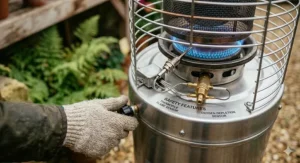
Ventilation is non-negotiable. Propane combustion consumes oxygen and produces carbon dioxide, water vapour, and — if combustion is incomplete — carbon monoxide. The Health and Safety Executive is unequivocal: gas appliances must not be used in poorly ventilated spaces. In a sealed greenhouse on a cold night, this is exactly the risk you’re managing. The practical rule is to leave a roof vent slightly ajar — even a centimetre or two — to allow combustion gases to escape. Yes, you lose some heat. No, this is not optional.
Invest in a CO alarm. Carbon monoxide is colourless and odourless; you won’t smell it, and the early symptoms — headache, nausea, drowsiness — are easily mistaken for feeling a bit under the weather. A battery-operated CO detector mounted at head height in the greenhouse costs around £20–£30 and could save your life if you’re working inside during a heating cycle. Look for models to BS EN 50291 standard.
Position the heater correctly. Place it on a flat, stable, non-combustible surface — never directly on wooden staging. Keep a minimum clearance of 1 metre from any combustible materials including potting compost bags, plastic pots, and horticultural fleece. The forced-air output should be directed along the length of the greenhouse for even heat distribution.
Thermostat sensor placement: If your heater has a remote sensor on a lead, position it mid-greenhouse away from draughts and direct heat. Placing it near the door (cold) or directly above the heater (warm) gives your thermostat completely wrong information and results in either an overheated or underheated greenhouse.
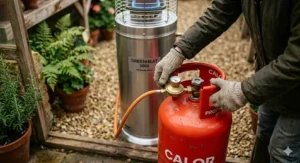
Gas cylinder storage: Store propane cylinders upright and outdoors — never inside the greenhouse itself. Keep them away from the building and direct sunlight. A standard 13kg propane cylinder from Calor Gas (widely available from merchants across the UK) is the practical standard for most hobby greenhouse setups.
Which UK Gardener Needs Which Heater? Real-World Scenarios
The Allotment Holder in Yorkshire — No mains power, 10×8 wooden-framed greenhouse, overwintering brassica seedlings and some tender perennials. Frost protection to around 3°C is the goal. Best pick: Bimson Power BP-G15T or Draper 47063. Both operate without mains electricity, run well on a 13kg propane cylinder for multiple nights, and offer reliable thermostat control. The Draper’s thermocouple flame-failure device is particularly reassuring when you’re not on site every day.
The Suburban Gardener in Surrey — Mains power available, 6×8 aluminium greenhouse, growing tomatoes and peppers through until late autumn, wants to start seeds in February. Temperature target: 8–10°C minimum. Best pick: Draper 47063 or SIP FIREBALL 512. With power available, the SIP’s electric ignition delivers consistent performance; the Draper suits a tighter budget without major compromise.
The Market Gardener in Rural Wales — Large polytunnel, 15×30 metres, cut flowers and salad leaves for local farm shops. Commercial operation, needs to run reliably through November to March. Best pick: fam famgizmo 30kW. Nothing else on this list has the output to make a meaningful difference in that volume of space. Pair it with polytunnel-grade insulation for cost-effective results.
The Urban Gardener in a Terraced House — Small back garden, 6×4 lean-to greenhouse against the house wall, a few overwintering fuchsias and a lemon tree. Budget is a consideration. Best pick: GEEPAS 4.2kW. Perfectly sized for a small enclosed space, easy to store in a cupboard through summer.
Propane vs Paraffin Greenhouse Heaters: The Honest Comparison
This debate has been running on British allotment forums for decades, and the answer is more nuanced than most people admit.
| Factor | Propane | Paraffin |
|---|---|---|
| Running cost per kWh | ~19p | ~25–30p |
| Low-temperature reliability | ✅ Excellent | ✅ Good |
| Thermostat availability | ✅ Most models | ❌ Rarely |
| Moisture produced | ⚠️ Some | ⚠️ Significant |
| Odour | Minimal | Noticeable |
| Fuel availability UK | ✅ Widespread | ✅ Widespread |
| Best For | Overnight heating with thermostat | Short-term emergency heat |
The numbers tell an interesting story. Greenhouse Stores UK’s 2026 running cost analysis puts propane at roughly 19p per kWh versus 25–30p for paraffin — a significant difference over a five-month British winter. More importantly, propane heaters almost universally include thermostats, meaning they cycle on and off rather than burning continuously. A thermostatically controlled propane heater set to 5°C will use dramatically less fuel than a paraffin heater burning at a fixed rate all night regardless of ambient temperature.
Paraffin’s one genuine advantage is that it requires no cylinder storage and the fuel is available almost everywhere. But the smell, the moisture production (which actively encourages botrytis and other fungal diseases on your plants), and the higher running cost mean propane is the more practical choice for most UK greenhouse owners.
For a comprehensive take on heating options, the Royal Horticultural Society’s guidance on greenhouse management is worth reading — they’re characteristically clear-eyed about the trade-offs.
How to Choose a Propane Greenhouse Heater in the UK: 6 Key Criteria
- Calculate the output you actually need. A rough rule: allow 1kW for every 25–30m³ of greenhouse volume in average UK winter conditions. A 10×8 greenhouse with a ridge height of 2.2m has roughly 140m³ — so a 5–6kW heater provides frost protection; 10kW handles more ambitious temperature targets.
- Thermostat quality matters more than output rating. A 15kW heater with a crude on/off thermostat is less efficient than a 10kW unit with a precise electronic controller. The thermostat determines how much gas you actually burn, not the nameplate output.
- Mains electricity requirement. If your greenhouse has no power supply, you need piezo ignition. Several heaters in the mid-range require 230V for ignition or fan operation — check this before purchasing, especially for allotment use.
- Safety features. Look for a flame-failure device (thermocouple) as a minimum. Some models include ODS (Oxygen Depletion System), which cuts the gas if oxygen levels drop — highly recommended for enclosed spaces where ventilation might be imperfect.
- Gas cylinder compatibility. All propane heaters on this list accept standard UK propane cylinders (Calor, Flogas, or supermarket-branded LPG). Confirm the hose connector is UK-standard before buying — most come with a regulator included, but check.
- Warranty and parts availability in the UK. Draper, SIP, and Bimson Power all operate from UK warehouses with UK customer service — important if something goes wrong in January when you need the heater most.
Greenhouse Gas Safety: What UK Regulations Actually Say
This is the bit most buying guides skip, and it rather shouldn’t. Propane combustion in an enclosed space carries real risks if managed carelessly — but managed correctly, it’s perfectly safe.
According to the HSE, gas appliances and flues should be checked for safety at least once every 12 months. For greenhouse heaters used seasonally, this means inspecting the hose for cracks or perishing each autumn before you light up for the first time. A propane hose showing any signs of cracking, discolouration, or stiffness should be replaced — they typically cost around £10–£15 and the peace of mind is worth considerably more.
The HSE’s guidance on carbon monoxide is clear that CO is produced when combustion is incomplete, and that adequate ventilation is the primary control measure. In a greenhouse, “adequate ventilation” means at least one opening — a roof vent, a slightly ajar door — even on the coldest nights. The CO produced by a properly functioning propane heater in a ventilated greenhouse is minimal; the risk increases sharply if the heater is old, poorly maintained, or the space is completely sealed.
Practically: if you or anyone working in the greenhouse begins to feel headachy, dizzy, or inexplicably tired during a heating session, get outside immediately and investigate the heater and ventilation before returning. These are classic early CO symptoms, and they’re easy to dismiss as “just feeling a bit off.”
Under UK consumer protection, all heaters sold on Amazon.co.uk must comply with relevant UK product safety regulations. Post-Brexit, look for UKCA marking (which replaced CE marking for GB market products) or, during the ongoing transition period, CE marking that was valid prior to Brexit. Either is currently acceptable under Trading Standards guidance.
Long-Term Running Costs & Maintenance in the UK
Let’s talk money, because propane isn’t free and the numbers are worth knowing before you commit.
A 13kg propane cylinder from Calor Gas runs to approximately £35–£50 depending on supplier and region (collecting vs delivery, and whether you own or rent the cylinder). At mid-setting on a 15kW heater, you’re looking at roughly 8–12p per hour in gas costs — a 10-hour winter night therefore costs around 80p to £1.20 in propane. Over a five-month winter heating season (October to February), running on frost-protection thermostat settings rather than continuous full-blast, a realistic annual propane cost for a medium greenhouse is in the £80–£150 range. Not nothing, but considerably less than the electricity cost of running a comparable 3kW electric heater continuously.
Annual maintenance is minimal: inspect the hose and regulator each autumn (replace if in doubt), clean the burner head with a soft brush to remove any spider webs or debris (genuinely a thing — spiders love propane heater burner heads over summer), and test the ignition before the first cold night of the season rather than on it. Store the cylinder outdoors year-round, connected hose removed and cap fitted.
✨ Don’t Miss These Exclusive Deals!
🔍 Ready to find your perfect greenhouse heater? Click any product name above to check the latest pricing and Prime delivery options on Amazon.co.uk.
FAQ: Propane Greenhouse Heaters UK
❓ Is a propane greenhouse heater safe to leave on overnight in the UK?
❓ How long does a 13kg propane cylinder last in a greenhouse heater?
❓ Can I use butane instead of propane in my greenhouse heater UK?
❓ Do I need UKCA certification on a propane greenhouse heater in the UK?
❓ What size propane heater do I need for an 8×6 greenhouse?
Conclusion: Finding the Right Propane Greenhouse Heater for Your UK Garden
The honest truth is that the best propane greenhouse heater for you depends far more on your specific circumstances than on any league table. Your greenhouse size, whether you have mains electricity, your local climate (a gardener in the Scottish Highlands has different requirements to one in coastal Cornwall), and your temperature ambitions all matter enormously.
For most British hobby gardeners, the Bimson Power BP-G15T represents the most balanced package: strong output, flexible adjustment, no mains electricity required, and a three-year warranty from a company with a functioning UK customer service line. Serious larger-greenhouse owners should look at the SIP FIREBALL 512 or the Draper 47100 for the combination of output and build quality. Budget-conscious owners of compact greenhouses will find the GEEPAS 4.2kW perfectly adequate — just remember to switch to propane in winter and leave a vent open.
Whichever heater you choose, please take the safety elements seriously. Read the HSE guidance, fit a CO alarm, and inspect your hose and regulator every autumn. A warm greenhouse full of thriving plants is genuinely one of the great pleasures of British gardening — and it’s even more enjoyable when you’re not worrying about the heater.
✨ Don’t Miss These Exclusive Deals!
🔍 Found your perfect match? Click on any highlighted product name above to view current pricing and check Prime availability on Amazon.co.uk — and make sure those plants have a warm winter.
Recommended for You
- Best Paraffin Heater for Greenhouse UK 2026: 7 Top Picks
- Best Electric Greenhouse Heater UK 2026: 7 Expert Picks Reviewed
- Best Fire Bowl for Garden UK 2026: 7 Top Picks Reviewed
Disclaimer: This article contains affiliate links. As an Amazon Associate, I earn from qualifying purchases. If you purchase products through these links, we may earn a small commission at no additional cost to you.
✨ Found this helpful? Share it with your mates! 💬🤗
