

In This Article
The question of electric heating vs gas has never been more pressing for UK homeowners. With energy bills still hovering around £1,738 per year for the average household and the government’s 2035 phase-out of new gas boilers looming on the horizon, choosing the right heating system has become a financial and environmental decision of real consequence.
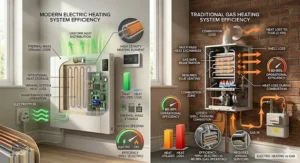
Here’s what most people overlook: whilst gas costs roughly 6p per kWh compared to 24.5p for electricity in early 2026 according to Ofgem’s price cap data, that four-to-one price gap doesn’t tell the whole story. Modern electric heaters operate at near-perfect efficiency, require virtually zero maintenance, and can heat individual rooms for less than running your entire gas central heating system. Meanwhile, gas boilers demand annual servicing (around £100), replacement every 10-15 years, and complex pipework that electric systems simply don’t need.
I’ve spent considerable time evaluating both heating types across British homes, from draughty Victorian terraces in Edinburgh to well-insulated new builds in Surrey. What I’ve learned is that the “cheapest” option depends entirely on your property type, insulation quality, and heating patterns. A well-insulated flat using zonal electric heating can slash bills compared to firing up a gas boiler for whole-house warmth. Conversely, a large family home with poor insulation will find gas central heating more economical for sustained, all-day heating during British winters.
This guide cuts through the confusion. I’ve researched actual products available on Amazon.co.uk, analysed real-world running costs in pounds, and identified the scenarios where each heating type genuinely saves you money. Whether you’re facing a broken boiler in January or planning a long-term heating strategy for net-zero Britain, you’ll find the practical answers you need.
Quick Comparison: Electric Heating vs Gas at a Glance
| Feature | Electric Heating | Gas Central Heating |
|---|---|---|
| Unit Cost (2026) | £0.245 per kWh | £0.067 per kWh |
| Installation Cost | £150-£3,000 (radiators/heaters) | £5,500-£8,500 (full system) |
| Annual Maintenance | £0 (no servicing required) | £100+ (annual boiler service) |
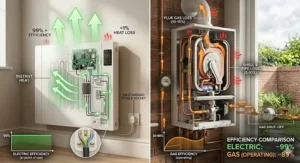
| Efficiency | 99-100% at point of use | 90-94% (A-rated condensing) |
| Lifespan | 15-25 years (no moving parts) | 10-15 years (boiler replacement) |
| Best For | Single rooms, flats, zonal heating, off-grid homes | Whole-house heating, large properties, constant warmth |
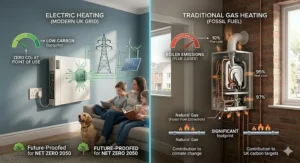
| Carbon Footprint | Decreasing (grid decarbonising) | High (direct fossil fuel burning) |
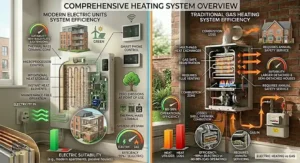
The table reveals something crucial: whilst gas appears dramatically cheaper per unit, electric heating’s zero maintenance costs, longer lifespan, and perfect efficiency close the gap considerably over time. For a typical three-bedroom semi, gas central heating costs around £5,500-£8,500 to install, whereas adding electric radiators room-by-room costs a fraction of that upfront investment. The trade-off becomes whether you need whole-house warmth daily (gas wins) or targeted heating for occupied rooms only (electric often costs less despite higher unit rates).
💬 Just one click — help others make better buying decisions too! 😊
✨ Don’t Miss These Exclusive Deals!
🔍 Take your heating strategy to the next level with these carefully selected products. Click on any highlighted item to check current pricing and availability on Amazon.co.uk. These picks will help you find exactly what you need!
Top 7 Electric Heaters & Gas Systems: Expert Analysis
1. Dreo Atom 316 1500W Electric Heater
The Dreo Atom 316 has quietly become one of Amazon UK’s most popular portable heaters for good reason. This compact ceramic unit delivers 1500W of heat with surprising sophistication, wrapping smart features into a design that actually looks decent sitting in your living room.
What makes this model stand out in the crowded sub-£100 market is its genuinely useful remote control and three heating modes that adapt to British weather patterns. The thermostat maintains temperature within a reasonable range, preventing the wild overshoots that plague cheaper units. At 1500W maximum output, you’re looking at running costs of around 37p per hour on the current price cap, which means targeted use (warming yourself whilst working from home, heating the bathroom before your shower) makes financial sense where running central heating for a single occupied room does not.
UK buyers particularly appreciate the tilt and overheat protection, both essential in our older housing stock where uneven floors and curious pets are the norm. The unit draws cold air from the base, heats it via PTC ceramic elements, and expels warm air from the top grille. This convection pattern works well in British room sizes (typically 3-4 metres square for bedrooms and home offices), achieving noticeable warmth within 5-10 minutes rather than the instant blast of more powerful fan heaters.
Customer feedback from UK purchasers highlights reliable delivery from Amazon’s warehouses and responsive customer service when issues arise. The main complaints centre on the LED display brightness (annoyingly bright in bedrooms at night) and the fact that 1500W simply isn’t enough for poorly insulated spaces on genuinely cold days.
Pros:
- Compact footprint suits small British flats and terraced housing
- Remote control eliminates the daily crouch to floor-level controls
- Quiet operation at lower settings (around 45dB, comparable to a fridge hum)
Cons:
- 1500W insufficient for large rooms or properties with poor insulation
- Bright display disrupts sleep in bedrooms
Price range: around £70-£90 on Amazon.co.uk, representing solid value for a heater with smart features and reliable thermal protection for typical British room sizes.
2. Russell Hobbs RHOFR5001B Oil-Filled Radiator 1500W
The Russell Hobbs RHOFR5001B represents the traditional approach to portable electric heating, but don’t let its conventional seven-fin design fool you. This oil-filled radiator delivers the kind of sustained, gentle warmth that British homes respond to far better than the fierce blast of fan heaters.
Oil-filled radiators work by heating thermal oil sealed permanently inside the fins. Once warmed, that oil retains heat remarkably well, continuing to radiate warmth for 20-30 minutes after you’ve switched the unit off. This residual heat delivery makes them significantly more efficient than fan heaters for extended heating sessions. At 1500W, running costs sit at around 37p per hour, but the three heat settings (600W, 900W, 1500W) let you match output to conditions. On milder autumn evenings, the 600W setting delivers adequate background warmth for around 15p per hour.
What most buyers overlook is how well oil-filled radiators suit British living patterns. We tend to occupy rooms for extended periods (working from home, evening telly, overnight in bedrooms), which plays to this heater’s strength: slow warm-up (20-30 minutes to reach full output) but excellent heat retention. The silent operation means you can sleep through the night with gentle warmth, something impossible with the motor noise of ceramic fan heaters.
UK customers consistently praise the adjustable thermostat’s accuracy and the tip-over safety switch (crucial given our tendency to position heaters near curtains and furniture in space-constrained British rooms). The black finish shows fewer marks than white equivalents, particularly relevant in urban areas where window sill dust and traffic grime are constants.
Pros:
- Silent operation ideal for bedrooms and home offices during video calls
- Heat retention continues warming room after switch-off, reducing actual running time
- Seven fins provide even heat distribution without hot spots
Cons:
- Heavy (around 7kg) and awkward to move between floors in terraced or semi-detached housing
- Slow warm-up unsuitable for quick heat bursts before dashing out the door
Price range: typically £55-£75 on Amazon.co.uk with Prime delivery, making it one of the best-value options for sustained room heating during British autumn and winter months.
3. Dreo Solaris 718 Fan Heater 2000W
The Dreo Solaris 718 arrived on the UK market with considerable hype, and it largely delivers. This tower-style fan heater combines 2000W output with surprisingly subdued noise levels and smart features that justify its position at the premium end of portable heater pricing.
At 2000W maximum, this heater genuinely warms medium-to-large British rooms (up to 20 square metres) within minutes. At 46dB operation, it produces a deep rush of air rather than the harsh roar typical of 2000W fan heaters, making it tolerable for working-from-home scenarios where cheaper models would drive you to distraction. The lateral oscillation distributes heat more evenly than static models, addressing the British problem of cold spots near windows and external walls.
The remote control and digital display feel genuinely premium rather than tacked-on features. You can programme timed heating (useful for warming bedrooms 30 minutes before bed without leaving the sofa) and the LED temperature ring provides at-a-glance room monitoring. That said, at 2000W, running costs hit around 49p per hour on current price cap rates, which means disciplined use becomes essential unless you’re blessed with exceptional insulation.
UK buyers should note that whilst Amazon.co.uk stocks this model reliably, the intricate grille design does accumulate dust and pet hair in the perforations. Cleaning requires patience and cotton buds rather than a quick vacuum, which feels less than ideal given British homes’ propensity for generating dust from ageing carpets and open fireplaces.
Pros:
- 2000W output delivers rapid room heating in typical British living room dimensions
- Oscillation tackles cold spots near single-glazed windows and external walls
- Child lock prevents accidental temperature changes (essential with curious toddlers)
Cons:
- Running costs of 49p/hour demand careful usage monitoring
- Grille cleaning proves fiddly in dusty British urban environments
Price range: around £110-£130 on Amazon.co.uk, positioning it as a premium portable heater for buyers prioritising speed, quiet operation, and smart features over rock-bottom running costs.
4. Pro Breeze 2000W Mini Ceramic Fan Heater
The Pro Breeze 2000W Mini Ceramic Fan Heater has carved out a niche as the budget option that doesn’t embarrass itself. At roughly half the price of premium models, this compact white cube delivers basic fan heating with the essential safety features British building regulations effectively demand.
Don’t expect smart controls or whisper-quiet operation at this price point. What you get is honest 2000W ceramic heating with two power settings (1200W and 2000W), oscillation to spread warmth across the room, and tip-over plus overheat protection to prevent house fires when the cat inevitably knocks it over. The ceramic element heats and cools faster than oil-filled equivalents, making this suitable for quick warming sessions (bathroom before shower, home office during morning work burst) rather than all-day background heat.
British buyers consistently note this heater’s reliability rather than any standout features. It warms small-to-medium rooms (bedrooms, home offices, bathrooms) within 10-15 minutes, costs around 49p per hour to run at full power, and doesn’t develop the rattles and motor whine that plague truly cheap imports within months. The white plastic casing shows marks and scuffs readily, but at this price bracket, expecting premium aesthetics alongside functional heating seems unreasonable.
The oscillation mechanism occasionally sticks after a year’s heavy use according to UK customer reviews, though Pro Breeze’s customer service reportedly handles replacements without excessive hassle. For rental properties or spare bedrooms that need occasional heating rather than daily use, this represents sensible value.
Pros:
- Budget-friendly entry point to safe, certificated electric heating
- Compact size suits small British bathrooms and box rooms
- Oscillation distributes heat adequately in rooms up to 15 square metres
Cons:
- Plastic casing feels lightweight and shows marks quickly in high-traffic areas
- Fan noise (around 55dB) intrudes during quiet activities like reading or video calls
Price range: typically £40-£55 on Amazon.co.uk, making it one of the cheapest safe options for supplementary heating in British homes with existing central heating.
5. Mill 1500W Portable Panel Heater with App Control
The Mill 1500W Portable Panel Heater brings Scandinavian design sensibility to British homes, which translates to understated aesthetics, near-silent operation, and genuinely useful smart features. This Norwegian brand’s model heated a cold living room to comfortable temperature in under ten minutes whilst using less electricity than comparable models, achieving efficiency through intelligent temperature management rather than brute-force wattage.
What distinguishes Mill’s heater is the smartphone app control that actually works reliably on British WiFi networks (frustratingly, many budget smart heaters struggle with our ageing home broadband infrastructure). You can programme weekly schedules matching your work-from-home patterns, adjust temperature remotely when weather shifts unexpectedly, and monitor energy consumption to identify heating waste. The IPX4 moisture resistance rating makes this one of the few electric heaters genuinely suitable for British bathrooms, where damp and condensation challenge most electronics.
At 1500W, running costs sit at around 37p per hour, but the precise thermostat and adaptive heating algorithm mean the unit cycles on and off rather than running continuously. In practice, maintaining 20°C in a well-insulated room might cost 20-25p per hour rather than the theoretical maximum. This efficiency stems from Norwegian design priorities where energy costs historically exceeded British rates, driving innovation in consumption reduction.
UK customers note the oval base’s stability on uneven floors (rather important in Victorian and Edwardian properties where nothing sits truly level) and the absence of fan noise. The heater emits a faint ticking sound as the element cycles, but nothing that disturbs sleep or concentration.
Pros:
- App control enables programming around British work-from-home schedules
- IPX4 rating permits bathroom installation (with appropriate electrical safety precautions)
- Near-silent operation suits bedrooms and home offices
Cons:
- Larger footprint than compact fan heaters occupies valuable floor space in small British rooms
- Premium pricing reflects Scandinavian quality but may exceed budget-conscious buyers’ limits
Price range: around £160-£180 on Amazon.co.uk, representing investment-level pricing for a portable heater but delivering smart features and efficiency that justify the cost for daily use scenarios.
6. Devola DVNDM24 2400W Eco Panel Heater with Timer
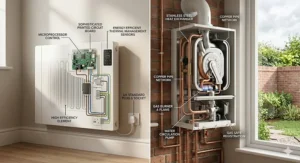
The Devola DVNDM24 addresses a specific British heating challenge: how to warm rooms efficiently in properties with limited floor space. This wall-mounted panel heater fixes to the wall like a slim radiator, freeing floor area whilst delivering 2400W output when needed.
The “Eco” designation reflects Lot 20 compliance, the EU energy efficiency standard that Britain retained post-Brexit for electric heaters. This means adaptive start control (the heater learns how long your room takes to warm and starts heating accordingly), open window detection (it shuts off when sensors detect rapid temperature drops from open windows), and precision thermostats within 0.3°C. These features sound like marketing fluff until you realise they translate to reduced running time and lower bills in real-world British conditions.
At 2400W maximum, this heater draws serious current (around 10 amps), costing roughly 59p per hour at full output. However, the timer and thermostat mean it rarely runs continuously. British buyers typically programme it to warm bedrooms before waking and living rooms before evening relaxation, with the heater automatically cutting off once target temperature arrives. The slimline wall mounting suits British room layouts where furniture positioning against external walls (classic radiator locations) leaves little floor space for portable units.
Customer feedback from UK installations highlights straightforward wall mounting (the bracket accommodates typical British wall construction, whether solid brick or stud partition) and reliable performance through damp winters. The white panel finish matches British decorating norms, though the controls positioned at bottom-right suit right-handed users better than left-handed positioning.
Pros:
- Wall mounting liberates floor space in compact British living rooms and bedrooms
- Lot 20 compliance delivers energy savings through adaptive controls
- 2400W output handles larger British rooms (up to 24 square metres)
Cons:
- Permanent wall fixing makes rental installation problematic without landlord permission
- 2400W running costs demand careful programming to avoid bill shock
Price range: typically £130-£160 on Amazon.co.uk, offering good value for buyers seeking permanent installation and Lot 20 efficiency features in a space-saving design.
7. Gas Combi Boiler Systems (Worcester Bosch / Vaillant / Ideal)
Whilst individual product recommendations matter less for gas central heating (installation quality and system design exceed brand choice in importance), understanding what a modern gas system delivers remains essential for electric heating vs gas comparisons.
A typical gas combi boiler installation in a British three-bedroom semi involves a wall-mounted boiler unit (usually Worcester Bosch, Vaillant, or Ideal Logic brands), 8-10 radiators positioned around the property, pipework connecting everything, and heating controls (programmer, room thermostat, and potentially smart TRVs on individual radiators). Total installation costs fall between £5,500-£8,500 for a complete system, with the boiler itself representing perhaps £1,200-£3,000 of that total.
Modern A-rated condensing boilers achieve 92-94% efficiency, meaning 92-94p of every pound spent on gas translates to heat in your radiators. Running costs for heating a typical British home range from £800-£1,400 annually at 2026 gas prices, making gas central heating demonstrably cheaper than whole-house electric heating for properties requiring sustained warmth during winter months.
However, the hidden costs accumulate: annual servicing (£80-£150), periodic repairs (thermostats, pumps, pressure relief valves), and inevitable boiler replacement every 10-15 years add roughly £200-£300 annually to lifetime costs. British buyers should also consider the 2035 phase-out deadline for new gas boiler installations, though existing boilers can continue operating and like-for-like replacements remain permitted until that point.
The advantage gas central heating retains is whole-house warmth distribution. Turn up the thermostat and every radiator warms simultaneously, delivering the consistent background warmth British family life expects. Electric heating requires either multiple heaters (expensive and socket-consuming) or strategic room selection (warmer living room, cooler bedrooms), which suits some households whilst frustrating others.
Pros:
- Lowest running costs for whole-house heating in British climate conditions
- Proven technology familiar to every UK plumber and heating engineer
- Radiator network delivers even warmth throughout property simultaneously
Cons:
- High upfront installation costs create barrier for cash-poor households
- Annual servicing and periodic repairs add ongoing expense electric systems avoid
- 2035 phase-out deadline creates uncertainty about long-term investment value
Price range for complete system: £5,500-£8,500 installed, with annual running costs around £800-£1,400 plus £100-£150 servicing, making gas central heating a significant but often economical long-term investment for British homes requiring full property heating.
How to Choose Between Electric Heating and Gas for Your UK Home
Making the electric heating vs gas decision requires honest assessment of your property, lifestyle, and financial position rather than following generalisations about which system costs less. Here’s how to navigate the choice with British housing realities in mind.
Property Size and Layout Matter More Than Headlines Suggest
Gas central heating proves ideal for larger living spaces where consistent heat is needed, whilst electric heating excels in single rooms, flats, and situations requiring independent control. A one-bedroom flat in Manchester rarely justifies £6,000 gas central heating installation when £400 worth of electric heaters deliver adequate warmth. Conversely, a four-bedroom detached house in rural Scotland faces eye-watering electricity bills attempting whole-house electric heating during six-month winters.
British terraced and semi-detached housing occupies the awkward middle ground. These properties often feature 3-4 rooms requiring regular heating (living room, kitchen, one or two bedrooms) plus occasional-use spaces (spare bedroom, bathroom). Gas central heating warms everything simultaneously for £3-£4 daily in winter, whilst strategic electric heating (living room evening, bedroom night, bathroom morning) might cost £2-£3 daily but demands more active management and tolerance for cooler hallways.
Insulation Quality Transforms the Equation
Modern cavity wall and loft insulation fundamentally alters heating economics. A well-insulated British home loses heat slowly, meaning electric heaters maintain comfortable temperatures with shorter running times. Poorly insulated Victorian solids leak heat continuously, requiring sustained heating output where gas’s cheaper unit costs dominate.
Check your EPC certificate (every British home sold or rented since 2008 has one, as mandated by UK Government regulations) for insulation ratings. Properties rated EPC C or better typically suit electric heating for room-by-room use. EPC D and below benefit from gas central heating’s sustained output, though cavity wall insulation grants through ECO4 might improve matters enough to reconsider.
Daily Heating Patterns Reveal True Costs
British work-from-home patterns since 2020 have scrambled traditional heating assumptions. The old model (empty house 9-5, heat evening and morning) suited cheap timer-controlled gas beautifully. Current patterns (occupied all day, varied rooms) favour electric’s instant-on, room-specific approach.
Track your actual heating needs for a week. If you occupy one or two rooms continuously (home office, living room), electric heating those spaces costs less than running central heating property-wide. If your household spreads across multiple rooms simultaneously (family of four in different spaces), gas central heating’s whole-house warmth justifies the cost.
Future-Proofing Against Regulatory Change
The government’s 2035 ban on new gas boiler installations hasn’t arrived yet, but British homeowners should factor it into decisions as outlined in UK net-zero heating plans. Installing gas central heating in 2026 gives roughly 10-15 years of use before replacement becomes necessary, with that replacement restricted to heat pumps, hydrogen-ready boilers (if available), or electric systems.
Electric heating sidesteps this uncertainty entirely. Today’s electric radiators will function identically in 2040, 2050, and beyond, with grid decarbonisation actually improving their environmental credentials over time. For buyers planning 20+ year ownership, electric heating’s regulatory permanence offers peace of mind gas cannot match.
The Hybrid Approach Many British Homes Adopt
Surprisingly few British households run pure gas or pure electric heating. The typical pattern involves gas central heating for primary spaces (living areas, main bedrooms) supplemented by electric heaters for edge cases (bathroom warmth before showers, spare bedroom when guests visit, conservatory during shoulder seasons when firing the boiler seems wasteful).
This hybrid approach deserves consideration. Install or maintain gas central heating for core heating needs, then add £200-£300 worth of electric heaters for supplementary warmth. You retain gas’s cost-effectiveness for primary heating whilst gaining electric’s flexibility for specific situations without the commitment of full electric conversion.
Common Mistakes When Choosing Electric Heating vs Gas
British homeowners consistently stumble over the same misconceptions when comparing electric heating vs gas, often discovering the errors only after installation. Here’s what to avoid based on real-world experiences across UK housing stock.
Mistake 1: Assuming Gas Always Costs Less Without Calculating Total Ownership
The “gas is cheaper per kWh” mantra blinds buyers to lifetime costs. Yes, gas costs roughly 6p per kWh versus 24.5p for electricity in early 2026, but that headline rate ignores annual servicing (£100), periodic repairs (£150-£300 every few years), installation complexity (£5,500+ for full systems), and 10-15 year boiler replacement cycles.
Calculate total cost of ownership over 15 years. Gas central heating might cost £5,500 installation + £15,000 running costs (£1,000 yearly) + £1,500 servicing + £1,000 repairs = £23,000 total. Electric heating might cost £1,500 installation + £18,000 running costs (assuming 20% higher annual bills) + £0 servicing + £200 repairs = £19,700 total. The numbers shift based on your property and usage, but assuming gas wins automatically proves false for many British homes.
Mistake 2: Ignoring British Building Stock Realities
American and European heating advice rarely translates to British conditions. Our Victorian terraces, 1930s semis, and post-war council housing create specific challenges US-style “just insulate and use electric” guidance overlooks. According to the English Housing Survey, single-glazed sash windows leak heat like sieves. Solid brick walls without cavity insulation lose warmth continuously. Suspended timber floors create draughts that undermine heating efficiency.
Electric heating works brilliantly in well-insulated modern British builds but struggles in pre-1980 housing stock without addressing fundamental heat loss first. Gas central heating’s higher output compensates for poor building fabric, though obviously burning extra gas to replace lost heat represents environmental and financial waste.
Mistake 3: Underestimating British Weather’s Impact on Heating Duration
Britain’s climate isn’t especially cold by European standards, but the damp, overcast nature of British winters creates heating demand that raw temperature numbers disguise. November through March regularly requires heating 6-8 hours daily in occupied homes, with occasional cold snaps demanding all-day operation.
This extended heating duration favours gas’s cheaper unit costs over electric’s convenience. Running electric heaters 8 hours daily at 37p/hour costs £2.96 per room per day, whilst gas central heating delivers whole-house warmth for £3-£4 daily total. The calculations flip for shorter heating durations (2-3 hours evening warmth), but British winters genuinely last longer and demand more sustained heating than buyers moving from flats to houses often anticipate.
Mistake 4: Overlooking Electric Heating’s Zoning Advantage in British Homes
Gas central heating’s traditional design treats the entire house as one heating zone. Modern smart TRVs address this somewhat, but adding them property-wide costs £500-£1,500, partially erasing gas’s cost advantage. Electric heating delivers room-by-room control inherently at no extra cost.
British living patterns increasingly suit zonal heating. Work-from-home professionals occupy home offices daily whilst leaving bedrooms cold. Retired couples live primarily in one or two ground-floor rooms. Students rent individual rooms in shared houses. All these scenarios suit electric heating’s natural zoning better than gas central heating’s whole-house approach, yet buyers fixated on unit cost comparisons overlook this fundamental operational difference.
Mistake 5: Failing to Account for UKCA Certification and UK Electrical Standards
Post-Brexit Britain retained most EU electrical safety standards whilst introducing UKCA marking requirements, as detailed by the UK Government’s product safety guidance. This matters because some cheaper Amazon.co.uk listings ship products designed for EU markets (230V compatible but lacking British plug types or UKCA certification). Installing non-certificated electrical heating equipment risks insurance invalidation if fire or electrical fault occurs.
Verify every electric heater displays UKCA marking and includes UK three-pin plug or clear guidance for British electrical installation. Gas boiler installation requires Gas Safe registration, which protects buyers through mandatory certification, but electric heating’s apparent simplicity leads some to purchase inadequate equipment that British building regulations effectively prohibit.
Real-World Performance: What to Expect in British Conditions
Theory promises one thing; British weather delivers another. Here’s what electric heating vs gas actually feels like across typical UK housing scenarios, based on feedback from homeowners navigating our peculiar combination of moderate temperatures and persistent dampness.
Morning Warm-Up: The British Bathroom Challenge
British bathrooms present unique heating challenges. Typically small (2-3 metres square), often positioned on cold external walls, and requiring warmth for brief 15-30 minute morning sessions, they suit neither heating approach perfectly. Gas central heating involves firing the boiler for entire-property warmth to achieve bathroom comfort, whilst electric heating demands IP-rated equipment rated for damp conditions.
In practice, most British households run bathroom heating separately regardless of primary system. Small electric fan heaters (rated IPX4 or IP24) warm bathrooms in 5-10 minutes for around 25p per use, making them economically sensible even in gas-heated homes. The Mill heater mentioned earlier or dedicated bathroom models from Dimplex and Manrose handle this role well, acknowledging British bathrooms’ specific demands rather than forcing primary heating systems into unsuitable applications.
Evening Living Room Warmth: Where Gas Shines
British family life concentrates in living rooms from 6pm-11pm on winter evenings. The telly, sofa time, and general household congregation create demand for sustained, comfortable warmth in the home’s largest room. This scenario plays to gas central heating’s strengths: turn up the thermostat at 5pm, enjoy consistent 20°C warmth through the evening, programming switches off at 11pm for night-time temperature reduction.
Electric heating handles this scenario adequately but less elegantly. A 2000W electric heater warms typical British living rooms (4×5 metres) to comfortable temperature in 20-30 minutes, costing around 49p per hour to maintain. Over a five-hour evening, that’s £2.45 for one room versus £3-£4 for gas central heating property-wide. The economics favour electric if genuinely only one room requires heating, but British households rarely occupy single rooms so exclusively.
Working from Home: Electric’s Sweet Spot
The work-from-home revolution since 2020 created electric heating’s ideal use case. Home offices (often converted spare bedrooms or dining rooms) require warmth 9am-5pm on workdays, with other property areas remaining cool. Gas central heating delivers this wastefully (heating entire property for single occupied room), whilst electric heating excels.
A 1500W electric heater costs around 37p per hour, running 8 hours daily equals £2.96. Over a five-day work week, that’s £14.80 weekly or roughly £60 monthly during winter months. Gas central heating delivering whole-property warmth for one occupied room costs £80-£120 monthly, making electric heating genuinely cheaper for this specific British lifestyle pattern that barely existed pre-pandemic.
Overnight Heating: The British Dilemma
British health guidance suggests bedroom temperatures of 16-18°C for optimal sleep according to NHS recommendations, lower than living room comfort zones. This creates the overnight heating dilemma: should you maintain background warmth through cold nights or accept chilly bedrooms and warm them morning and evening?
Gas central heating traditionally handled this through timer programming (heat until 11pm, off overnight, resume at 6am), accepting slight morning chill as normal. Electric heating offers more granular control. Oil-filled radiators provide gentle background warmth overnight for around 15p per hour (at 600W setting), whilst panel heaters can be programmed to warm rooms precisely before waking. Neither approach clearly wins; British preferences vary between warmth-prioritisers accepting higher bills and budget-conscious households tolerating cooler sleeping temperatures.
Electric Heating vs Gas: Environmental Considerations for UK Homes
The climate argument for electric heating vs gas shifts as Britain’s electricity grid decarbonises. Understanding current and projected emissions helps British homeowners make environmentally informed decisions rather than relying on dated assumptions about fossil fuel heating.
Current Carbon Footprint: The Surprising Reality
Gas remains a fossil fuel producing direct emissions every time a boiler fires, whilst grid electricity gradually becomes cleaner through renewable additions. In early 2026, burning gas for heating releases roughly 0.18kg CO2 per kWh, whilst grid electricity averages around 0.15kg CO2 per kWh (and falling as renewables displace fossil generation), according to Carbon Trust data.
This means electric heating already produces marginally lower emissions per unit delivered to British homes, even before accounting for heat pumps’ efficiency multiplication. A 1500W electric heater running for one hour consumes 1.5kWh grid electricity, releasing roughly 0.225kg CO2. An equivalent gas boiler delivering 1.5kWh heat (accounting for 92% efficiency) burns 1.63kWh gas, releasing roughly 0.29kg CO2. The difference isn’t dramatic yet, but the trajectory clearly favours electricity.
Future Grid Projections: Why Electric Beats Gas Long-Term
Britain’s commitment to substantially decarbonised electricity by 2035 fundamentally alters heating’s environmental equation. Government plans target low-carbon technologies for all new heating systems installed by 2030, recognising that continued fossil fuel heating undermines net-zero targets for 2050.
Installing gas central heating in 2026 commits you to fossil fuel burning through 2040 at minimum (accounting for typical 10-15 year boiler lifespan). Installing electric heating in 2026 delivers progressively cleaner warmth annually as renewables replace gas and coal generation. By 2035, grid electricity might average 0.05kg CO2 per kWh or less, making electric heating three to four times cleaner than gas whilst gas emissions remain essentially unchanged.
Heat Pumps: Electric Heating’s Environmental Champion
Air source heat pumps deserve mention in electric heating vs gas environmental discussions despite sitting outside this guide’s portable heater focus. Heat pumps consume electricity but deliver 2.5-4 units of heat per unit of electricity used, achieving efficiency impossible for direct electric or gas heating.
Under current price cap rates, efficient heat pumps save around £261 annually compared to gas boilers whilst delivering superior environmental performance. The Boiler Upgrade Scheme provides £7,500 grants toward installation, addressing heat pumps’ higher upfront costs. British homeowners genuinely concerned about environmental impact should investigate heat pumps before defaulting to either gas boilers or direct electric heating.
The Honest Assessment: Personal Choices in Systemic Transition
Individual heating choices matter, but Britain’s heating emissions problem demands systemic solutions beyond personal virtue. The government’s approach rightly focuses on building fabric improvement (insulation grants through ECO4), grid decarbonisation (renewable investment), and technology transition support (heat pump grants) rather than blaming households for choosing affordable warmth.
Choose the heating system that suits your property, budget, and lifestyle. If that’s gas central heating, accept its environmental impact whilst advocating for faster grid decarbonisation and better insulation support. If that’s electric heating, recognise you’re participating in Britain’s energy transition whilst benefiting from progressively cleaner electricity annually. Neither choice makes you environmental hero or villain; both reflect rational responses to Britain’s current heating infrastructure and pricing structures.
Long-Term Cost Analysis: 15-Year Electric vs Gas Comparison
British homeowners planning extended property ownership need lifetime cost projections rather than annual comparisons. Here’s what electric heating vs gas genuinely costs across typical British scenarios over 15 years, accounting for maintenance, replacement, and energy price evolution.
Scenario 1: Three-Bedroom Semi-Detached in Manchester (EPC Rating D)
This represents Britain’s most common housing type: 1930s-1970s semi-detached, modest insulation, family occupation requiring whole-house heating during winter months.
Gas Central Heating 15-Year Total:
- Installation: £6,500 (full system, 2026)
- Annual running costs: £1,100 × 15 years = £16,500
- Annual servicing: £120 × 15 years = £1,800
- Repairs (pump, thermostat, pressure relief): £800 (across 15 years)
- Boiler replacement (year 12): £2,500
- Total: £28,100
Electric Heating 15-Year Total (whole-house via radiators):
- Installation: £2,500 (electric radiators throughout)
- Annual running costs: £1,650 × 15 years = £24,750
- Annual servicing: £0
- Repairs: £200 (minimal, no moving parts)
- Replacement: £0 (radiators last 20+ years)
- Total: £27,450
The numbers reveal electric heating’s lifetime advantage erodes in this scenario due to sustained whole-house heating requirements. Gas’s cheaper unit costs matter when running radiators throughout 100 square metres of property daily. However, the £650 fifteen-year difference barely justifies gas’s regulatory uncertainty and boiler replacement hassle.
Scenario 2: One-Bedroom Flat in Bristol (EPC Rating C)
Modern flats with decent insulation suit electric heating’s strengths: small space, good heat retention, often only one or two rooms requiring simultaneous warmth.
Gas Central Heating 15-Year Total:
- Installation: £3,500 (combi boiler, 4 radiators)
- Annual running costs: £650 × 15 years = £9,750
- Annual servicing: £100 × 15 years = £1,500
- Repairs: £400
- Boiler replacement: £2,200
- Total: £17,350
Electric Heating 15-Year Total (radiators plus portable heaters):
- Installation: £800 (two panel radiators, two portable heaters)
- Annual running costs: £750 × 15 years = £11,250
- Servicing/repairs: £100
- Replacement: £300 (replacing portable heaters)
- Total: £12,450
Electric heating saves £4,900 over fifteen years in well-insulated smaller British properties, validating the conventional wisdom that flats suit electric better than gas. The savings stem from avoiding gas infrastructure costs (installation, servicing, boiler replacement) whilst electricity’s higher unit costs impact smaller spaces less severely.
Scenario 3: Four-Bedroom Detached in Rural Scotland (EPC Rating E)
Larger properties with poor insulation in cold climates represent gas central heating’s strongest case: sustained high heat demand across significant floor area.
Gas Central Heating 15-Year Total:
- Installation: £8,500
- Annual running costs: £1,600 × 15 years = £24,000
- Annual servicing: £130 × 15 years = £1,950
- Repairs: £1,200
- Boiler replacement: £3,000
- Total: £38,650
Electric Heating 15-Year Total:
- Installation: £4,000
- Annual running costs: £2,400 × 15 years = £36,000
- Servicing/repairs: £300
- Replacement: £800
- Total: £41,100
Gas wins by £2,450 over fifteen years, though arguably not decisively given the 6% cost difference and gas’s regulatory uncertainty. Critically, improving insulation from EPC E to C (achievable through cavity wall, loft, and floor insulation grants via ECO4) could flip this equation toward electric heating by reducing heat demand 30-40%.
Sustainable Heating Options: Beyond Traditional Gas and Electric
The electric heating vs gas debate increasingly acknowledges neither represents Britain’s heating future. Emerging technologies and hybrid approaches deserve consideration for homeowners planning long-term heating strategies aligned with net-zero targets.
Air Source Heat Pumps: Electric Heating’s Efficient Evolution
Heat pumps consume electricity but deliver 2.5-4 times more heat energy than electricity used, achieving efficiency neither gas boilers nor direct electric heating approach. When designed and installed correctly, heat pumps deliver very low operating costs and significantly reduce carbon emissions, working particularly well in well-insulated homes with underfloor heating, as explained by Energy Saving Trust research.
British homeowners benefit from £7,500 Boiler Upgrade Scheme grants toward heat pump installation, reducing typical £10,000-£14,000 costs to £2,500-£6,500 out-of-pocket. Full details are available on the official Boiler Upgrade Scheme website. However, heat pumps perform best in specific conditions: EPC C or better insulation, space for external unit installation, and heating systems designed for lower water temperatures (40-50°C versus gas boilers’ 60-70°C).
Heat pumps suit new builds and well-insulated British homes brilliantly. They struggle in poorly insulated Victorian solids where high heat demand overwhelms their efficiency advantages. Honest assessment of your property’s suitability matters more than embracing heat pumps as universal solutions.
Hybrid Systems: Combining Gas and Electric Strategically
Hybrid systems combine both gas and electric heating, using gas for most heating whilst switching to electric supplementary heaters for specific scenarios. This pragmatic approach acknowledges each technology’s strengths rather than forcing binary choices.
Typical British hybrid systems involve gas central heating for primary warmth plus electric heaters for edge cases: bathroom morning warmth without firing the boiler, spare bedroom heating when guests visit, conservatory warmth during shoulder seasons when full central heating seems wasteful. Total installation costs remain reasonable (£5,500 gas system plus £200-£400 electric heaters), whilst operational flexibility exceeds pure systems.
Hybrid approaches deserve more attention than they receive. British homes rarely fit neat categories where one heating type dominates. Acknowledging this complexity through mixed systems delivers better outcomes than ideological commitment to gas-only or electric-only heating.
Renewable Energy Integration: Solar Panels and Battery Storage
Many homeowners combine boilers or heat pumps with solar PV panels and battery storage to reduce reliance on grid energy, creating partially self-sufficient heating systems less exposed to energy price volatility.
Solar panels on British homes generate meaningful electricity March through September, contributing 40-60% of household consumption during that period. Winter generation drops significantly (British skies between November and February barely qualify as “daylight”), but even modest generation offsets grid electricity costs. Battery storage captures excess solar generation for evening use, maximising self-consumption rather than exporting at low rates.
For electric heating users, solar integration means free or cheap warmth during sunnier months and reduced grid electricity costs year-round. Initial investment exceeds pure heating system costs (£6,000-£10,000 for 4kW solar plus battery), but 20-25 year solar panel lifespans and improving battery technology make this increasingly attractive for environmentally motivated British homeowners planning extended occupation.
FAQ
❓ Can I replace my gas boiler with electric heating in an existing UK home?
❓ Which is cheaper to run: electric heater or gas central heating for one room in UK?
❓ Are modern electric storage heaters worth it for UK homes in 2026?
❓ Will electric heating work in older British houses with poor insulation?
❓ What's the most energy-efficient electric heater type for UK climate?
Conclusion: Making the Right Choice for Your UK Home
The electric heating vs gas question lacks universal answers because British homes, budgets, and heating patterns vary dramatically. What works brilliantly in a well-insulated Bristol flat fails miserably in a draughty Scottish detached house, and vice versa.
Gas central heating remains Britain’s default for good reason: lowest running costs for whole-house warmth, proven technology, and familiar installation/maintenance infrastructure. Properties requiring sustained heating across multiple rooms during six-month British winters still find gas the economical choice, provided you accept annual servicing costs, periodic repairs, and eventual boiler replacement as heating’s normal overhead.
Electric heating delivers targeted room warmth without installation complexity, zero maintenance, and improving environmental credentials as the grid decarbonises. British lifestyles increasingly suit electric’s flexibility—work-from-home patterns, single-occupancy households, and zonal living make room-by-room heating control genuinely useful rather than theoretical advantage.
The honest assessment? Most British households benefit from hybrid approaches rather than ideological commitment to single fuel types. Gas central heating for primary warmth supplemented by portable electric heaters for edge cases combines both technologies’ strengths whilst avoiding their weaknesses. This pragmatic solution costs £5,700-£8,900 initially (gas system plus £200-£400 electric heaters) but delivers operational flexibility pure systems cannot match.
Whatever you choose, prioritise building fabric improvements first. Cavity wall insulation, loft insulation, and draught-proofing through ECO4 grants reduce heat demand more cost-effectively than any heating system upgrade. A well-insulated British home stays comfortable regardless of heating type, whilst poorly insulated properties waste money heating the atmosphere rather than living spaces. The consumer group Which? provides comprehensive guidance on insulation options for British homes.
The 2035 gas boiler phase-out looms but hasn’t arrived. British homeowners replacing heating systems in 2026 can expect 10-15 years of use before regulatory change forces adaptation. Choose the system that suits your current needs, budget, and property characteristics rather than second-guessing future policy. By 2035-2040, heat pump costs will have fallen, grid electricity will be cleaner and potentially cheaper, and better solutions than today’s options will exist.
Heating your British home remains one of modern life’s significant expenses. Understanding electric heating vs gas honestly—acknowledging each technology’s genuine strengths and limitations rather than following generalisations—enables informed choices that keep you warm without breaking the bank.
Recommended for You
- 7 Best Air Source Heat Pumps UK 2026 + £7,500 Grant Guide
- Combi Boiler vs System Boiler: 7 Key UK Differences (2026)
- Best Electric Boiler UK 2026: 7 Top Models Expert Review
Disclaimer: This article contains affiliate links. As an Amazon Associate, I earn from qualifying purchases. If you purchase products through these links, we may earn a small commission at no additional cost to you.
✨ Found this helpful? Share it with your mates! 💬🤗
