
In This Article
If you’ve been eyeing your gas boiler with suspicion lately — watching those energy bills climb whilst feeling vaguely guilty about carbon emissions — you’re not alone. Air source heat pumps have shifted from niche eco-luxury to mainstream heating solution faster than anyone predicted, and 2026 marks a genuine tipping point for British homeowners.
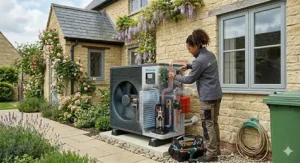
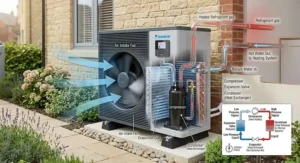
An air source heat pump extracts heat from outdoor air (yes, even when it’s barely 2°C on a drizzly February morning in Manchester) and amplifies it to warm your home. Think of it as a refrigerator working in reverse: instead of moving heat out of a box to keep your milk cold, it moves heat into your house to keep you warm. The technology isn’t new — Scandinavia’s been doing this for decades — but recent advances in efficiency, noise reduction, and cold-weather performance have finally made ASHPs a sensible choice for the British climate.
What’s changed in 2026? The government’s Boiler Upgrade Scheme now offers £7,500 towards installation costs (£9,000 if you’re replacing oil or LPG heating), slashing the upfront investment by nearly half for most households. Running costs have reached near-parity with gas boilers in well-insulated homes, and the latest models operate so quietly you’d struggle to hear them over your neighbour’s cat. Meanwhile, with the 2030 ban on new gas boiler installations looming ever closer, getting ahead of the curve means avoiding the inevitable rush — and the price hikes that’ll follow.
This guide cuts through the marketing fluff to give you practical, experience-based insight into which heat pump systems actually deliver value in British conditions. Whether you’re in a Victorian terrace in Bristol, a 1970s semi in Leeds, or a new-build flat in Edinburgh, we’ll help you navigate the brands, specs, and real-world performance data that matter.
Quick Comparison: Top Air Source Heat Pumps at a Glance
| Model | Output Range | Noise Level | SCOP Rating | Installed Cost (After Grant) | Best For |
|---|---|---|---|---|---|
| Vaillant aroTHERM Plus | 3.5-16kW | 54-62 dB | Up to 5.03 | £4,500-£7,500 | All-round performance |
| Mitsubishi Ecodan Ultra Quiet | 4-16kW | 45-58 dB | 4.3-4.7 | £5,000-£8,000 | Noise-sensitive locations |
| Daikin Altherma 3 | 4-16kW | 50-64 dB | Up to 5.1 | £4,800-£7,800 | Cold climate performance |
| Samsung EHS Mono HT Quiet | 6-16kW | 52-60 dB | 4.6 | £4,200-£6,800 | Budget-conscious buyers |
| Viessmann Vitocal 200-S | 3.3-13.5kW | 47-61 dB | Up to 4.9 | £5,200-£8,200 | Premium efficiency |
| LG THERMA V R32 Monobloc | 5-16kW | 54-65 dB | 4.5 | £4,000-£6,500 | Value for money |
| Grant Aerona3 | 6-16kW | 52-66 dB | 4.4 | £3,800-£6,200 | UK-manufactured option |
💬 Just one click — help others make better buying decisions too! 😊
Top 7 Air Source Heat Pumps: Expert Analysis
1. Vaillant aroTHERM Plus — The All-Rounder’s Champion
The aroTHERM Plus sits atop most installer recommendation lists for good reason: it delivers exceptional efficiency, runs on eco-friendly R290 refrigerant (Global Warming Potential of just 3 compared to R32’s 675), and backs everything with a 7-year warranty — two years longer than most competitors.
Key Specifications:
- Output range: 3.5kW to 16kW (suitable for 2-bed flats through to 5-bed detached homes)
- SCOP: Up to 5.03 at A7/W35 test conditions
- Flow temperature: Capable of 75°C for direct radiator compatibility
- Noise level: 54-62 dB depending on model
- Refrigerant: R290 (propane) — future-proof against F-gas regulations
What the spec sheet won’t tell you: This system excels in British stop-start weather patterns. Its modulation range (how smoothly it can dial output up or down) means it doesn’t cycle on and off repeatedly during those March days when it’s 8°C at breakfast and 16°C by lunch. That constant cycling is where cheaper heat pumps waste energy and rack up electricity costs. The 75°C flow temperature capability is crucial if you’re keeping existing radiators rather than upgrading to larger ones — most heat pumps top out at 55-60°C, forcing radiator swaps.
Expert Commentary: If you’re replacing a gas or oil boiler in a traditionally-built UK home with standard radiators, the aroTHERM Plus’s high-temperature capability saves you £1,500-£3,000 in radiator upgrade costs. The R290 refrigerant is a genuine advantage: it’s not only better for the environment but performs more efficiently at the 0-10°C temperatures that dominate British winter weather. Installers report fewer callback visits on Vaillant systems, and the 7-year warranty reflects that reliability.
UK Customer Feedback: Homeowners consistently praise the sensoCOMFORT controller’s intuitive interface and the system’s ability to maintain steady temperatures without the “thermal lag” some heat pumps exhibit. A recurring comment from Scottish users: it copes admirably with the -5°C to -10°C cold snaps that knock lesser systems down to auxiliary heater mode.
✅ Industry-leading 7-year warranty
✅ R290 refrigerant (GWP of 3)
✅ 75°C flow temp for existing radiators
❌ Slightly higher noise than Mitsubishi
❌ Premium pricing (though justified)
Price Range: Around £12,000-£15,000 installed (£4,500-£7,500 after BUS grant) depending on property size and complexity. The quality and warranty coverage justify the investment for most homeowners.
2. Mitsubishi Ecodan Ultra Quiet — For Noise-Conscious Neighbourhoods
If your outdoor unit needs to sit two metres from your bedroom window or your neighbour’s conservatory, Mitsubishi’s Ultra Quiet series is the answer you’ve been looking for. The 8.5kW model operates at just 58 dB sound power (roughly 45 dB at 1m distance), making it one of the quietest residential heat pumps on the UK market.
Key Specifications:
- Output range: 4-16kW across the series
- SCOP: 4.3-4.7 depending on model
- Noise: 45-58 dB (measured at 1m)
- Cold weather performance: Zubadan technology maintains 90% output at -25°C
- Operating range: Down to -28°C
What this means in practice: That 45 dB rating puts it below the UK’s 42 dB permitted development limit measured at a neighbour’s window, giving you placement flexibility that noisier models simply can’t match. You can install it closer to property boundaries without triggering planning permission requirements or neighbourhood disputes. In terraced housing or semi-detached properties — where British homes are often separated by mere feet rather than the generous plots Americans enjoy — this matters enormously.
Expert Commentary: Mitsubishi’s Zubadan technology (a fancy name for enhanced vapour injection) is the secret sauce that keeps this system running efficiently when temperatures plummet. During the February 2024 cold snap that saw much of northern England and Scotland hit -12°C, standard heat pumps struggled and electric bills spiked. The Ecodan maintained 90% rated output whilst competitors dropped to 60-70%, forcing auxiliary electric heating to kick in at 27p per kWh. That’s the difference between a £45 heating week and a £78 one.
UK Customer Feedback: Owners in urban settings (Manchester, Birmingham, London) specifically mention the lack of complaints from neighbours. One reviewer in a Leeds terrace noted: “My old boiler was louder than this thing. The neighbours actually asked what brand it was because they’re planning their own install.”
✅ Exceptionally quiet operation (45 dB)
✅ Excellent cold weather performance
✅ Permits installation close to boundaries
❌ Slightly lower SCOP than Vaillant
❌ Premium pricing for Ultra Quiet models
Price Range: £12,500-£15,500 installed (£5,000-£8,000 after grant). The noise reduction premium is roughly £500-£800 over standard Ecodan models — money well spent if peaceful coexistence with neighbours is non-negotiable.
3. Daikin Altherma 3 — The Cold-Weather Specialist
Daikin’s Altherma 3 earns its place through a combination of top-tier efficiency (matching Vaillant’s 5.1 SCOP in ideal conditions) and the widest operating temperature range in this roundup: down to -28°C. If you’re in the Scottish Highlands, rural Wales, or anywhere that sees proper winter, take note.
Key Specifications:
- Output range: 4-16kW
- SCOP: Up to 5.1 (A7/W35)
- Operating range: -28°C to +46°C
- Noise: 50-64 dB
- Warranty: 5 years standard
Real-world advantage: Most heat pumps technically operate down to -20°C or -25°C, but their efficiency collapses below -10°C. The Altherma 3’s extended low-temperature performance isn’t just marketing — it maintains a COP above 2.0 even at -20°C, whilst competing models might drop to 1.5 or worse. That difference is the gap between affordable heating and eye-watering electric bills during January cold snaps.
Expert Commentary: Daikin’s been in the refrigeration business since 1924 — they know compressors. The Altherma 3’s secret is its scroll compressor with economiser injection, which sounds technical but translates to: it doesn’t give up when the weather gets properly grim. For homes off the gas grid in rural areas (where oil heating costs £2,000+ annually), this system delivers the most consistent year-round performance. Pair it with an economy electric tariff and you’re looking at £900-£1,200 annual running costs versus £1,800-£2,200 for oil.
UK Customer Feedback: Scottish users report reliable operation through -15°C winters with no loss of comfort. One Aberdeenshire homeowner noted their previous oil boiler cost £210 per month in winter; the Altherma 3 runs at £95-£110 monthly during the same period on a standard variable tariff.
✅ Industry-leading -28°C operating range
✅ Matches Vaillant for efficiency
✅ Proven reliability in harsh conditions
❌ Noisier than Mitsubishi
❌ Shorter warranty than Vaillant
Price Range: £11,800-£15,300 installed (£4,800-£7,800 after grant). The investment pays dividends if you’re in a genuinely cold climate where lesser heat pumps would struggle.
4. Samsung EHS Mono HT Quiet — Best Value Without Compromise
Samsung brings consumer electronics expertise to the heat pump market, and it shows in the build quality and control system. The EHS Mono HT Quiet delivers 90% of premium brand performance at 75-80% of the cost — a value proposition that’s converted thousands of budget-conscious UK homeowners.
Key Specifications:
- Output range: 6-16kW
- SCOP: 4.6
- Noise: 52-60 dB (depending on model)
- Refrigerant: R32
- Max flow temp: 65°C
Where Samsung excels: The SmartThings app integration is genuinely useful rather than a gimmick. You get granular control over heating schedules, remote monitoring, and energy usage tracking that helps identify inefficiencies. The system learns your home’s thermal characteristics and adjusts modulation patterns accordingly — it’s not quite AI, but it’s more sophisticated than the basic timer controls you’ll find on budget systems.
Expert Commentary: The 65°C max flow temperature means you’ll likely need to upsize radiators in older properties, but for modern homes with decent insulation, it’s perfectly adequate. What most buyers overlook about Samsung is the sheer volume of units they’ve shipped globally — over 100,000 in Europe in 2025 alone. That production scale means competitive pricing without cutting corners on components. Installers report parts availability is excellent, and warranty claims are processed quickly.
UK Customer Feedback: Value-focused buyers appreciate that Samsung offers 85% of Vaillant’s performance for £2,000-£3,000 less upfront. One Surrey homeowner calculated their annual running cost at £1,045 versus a previous gas boiler at £1,120 — near-parity whilst slashing carbon emissions by 70%. “Would I pay £2,500 more for Vaillant’s extra 0.4 SCOP? Honestly, no,” they noted.
✅ Excellent value for money
✅ Smart home integration
✅ Competitive noise levels
❌ Lower max flow temp (65°C)
❌ Slightly lower SCOP than premium brands
Price Range: £11,200-£14,300 installed (£4,200-£6,800 after grant). The sweet spot for buyers who want proven technology without paying for the absolute cutting edge.
5. Viessmann Vitocal 200-S — Premium Efficiency, Premium Price
Viessmann occupies the upper echelon of European heating manufacturers, and the Vitocal 200-S reflects that pedigree. With a SCOP approaching 4.9 and German engineering throughout, it’s the choice for homeowners who view their heating system as a 20-year investment rather than an appliance.
Key Specifications:
- Output range: 3.3-13.5kW
- SCOP: Up to 4.9
- Noise: 47-61 dB
- Operating range: -20°C to +40°C
- Warranty: 5 years (extendable to 10 years)
What separates Viessmann: Build quality. The outdoor unit casing is powder-coated steel rather than plastic, the compressor isolation uses dual-stage vibration dampening, and every component is overspec’d for longevity. You’re not just buying a heat pump; you’re buying the heating equivalent of a Mercedes — it’ll still be running flawlessly when cheaper models are on their second compressor replacement.
Expert Commentary: The Vitocal’s efficiency advantage over mid-range systems translates to £60-£100 in annual electricity savings for a typical home. Over a 20-year lifespan, that’s £1,200-£2,000 — which doesn’t quite justify the £2,000-£3,000 upfront premium, admittedly. What does justify it is the 10-year warranty option (£350 extra) and installation flexibility. This system handles challenging layouts — awkward piping runs, integration with solar thermal, hybrid setups with existing boilers — better than simpler systems.
UK Customer Feedback: The typical Viessmann buyer is an engineer, architect, or someone who’s done extensive research and wants the best irrespective of budget. Reviews emphasise reliability and whisper-quiet operation in the 47 dB models. One Cheshire homeowner noted: “Three years in, zero issues, and my electricity bills haven’t budged despite energy price increases. It just works.”
✅ Exceptional build quality
✅ 10-year warranty available
✅ Superior efficiency
❌ Highest upfront cost
❌ Limited output range (caps at 13.5kW)
Price Range: £12,700-£15,700 installed (£5,200-£8,200 after grant). The premium is real, but so is the quality. Recommended if you plan to stay in your home for 15+ years.

6. LG THERMA V R32 Monobloc — The Value Leader
LG’s THERMA V punches well above its price point, delivering a respectable 4.5 SCOP and solid cold-weather performance whilst undercutting premium brands by £2,000-£3,500 on installed cost. For homeowners who’ve crunched the numbers and can’t quite justify Vaillant or Daikin pricing, this is the smart compromise.
Key Specifications:
- Output range: 5-16kW
- SCOP: 4.5
- Noise: 54-65 dB
- Operating range: -25°C to +43°C
- Refrigerant: R32
Where LG delivers value: The monobloc design (everything contained in the outdoor unit, just water pipes to the house) simplifies installation and reduces costs. You avoid the F-gas regulations and annual leak checks that split systems require, shaving £150-£200 off annual maintenance. The R32 refrigerant offers a decent middle ground: better environmental profile than older R410A, though not as green as Vaillant’s R290.
Expert Commentary: LG benefits from massive manufacturing scale — they build millions of compressors annually for air conditioners and heat pumps worldwide. That volume translates to competitive pricing without sacrificing reliability. The 4.5 SCOP means this system costs roughly £80-£120 more per year to run than a Vaillant aroTHERM Plus for the same heat output, but the £2,500 upfront saving covers that difference for 20+ years. The maths is straightforward: unless you’re obsessed with peak efficiency, the LG represents better overall value.
UK Customer Feedback: Budget-conscious buyers appreciate the no-frills approach. The controller is basic compared to Samsung’s app or Vaillant’s touchscreen, but it does the job. One Manchester homeowner switching from electric storage heaters reported annual heating costs dropping from £2,100 to £1,150 — “The LG wasn’t the fanciest option, but it’s saving me £80 a month. I don’t need it to make me coffee as well.”
✅ Excellent value proposition
✅ Monobloc simplicity
✅ Proven reliability
❌ Basic controller
❌ Higher noise levels
Price Range: £11,000-£14,000 installed (£4,000-£6,500 after grant). The sweet spot for value-focused buyers who want proven technology without the premium price tag.
7. Grant Aerona3 — Supporting British Manufacturing
Grant Engineering is the UK’s largest domestic boiler and heat pump manufacturer, with production facilities in Wexford, Ireland, and distribution throughout Britain. The Aerona3 offers the appeal of supporting UK/Irish industry whilst delivering competitive performance at accessible pricing.
Key Specifications:
- Output range: 6-16kW
- SCOP: 4.4
- Noise: 52-66 dB
- Operating range: -20°C to +35°C
- Warranty: 7 years
Grant’s UK advantage: Parts availability and installer network. With over 3,000 Grant-accredited installers across the UK and Ireland, you’re never more than 30 miles from qualified service. Compare that to some European brands where you might wait days for a specialist engineer if something goes wrong. The Aerona3 shares components with Grant’s commercial heat pump line, meaning parts longevity and availability are exceptional.
Expert Commentary: The 4.4 SCOP places this toward the lower end of our roundup, translating to roughly £100-£150 higher annual running costs versus Vaillant. However, the 7-year warranty matches Vaillant (unusual at this price point), and Grant’s UK presence means service visits typically cost £80-£120 versus £150-£200 for premium European brands. Over the system’s lifespan, that service cost difference can exceed the efficiency penalty.
UK Customer Feedback: Buyers appreciate the “buy British” angle and the extensive installer network. One Norfolk homeowner noted: “My Grant installer is 15 minutes away, not some specialist who covers three counties. When I needed the controller replaced under warranty, he was here next day.” For rural UK buyers where installer availability matters more than cutting-edge specs, Grant makes compelling sense.
✅ UK/Irish manufactured
✅ Extensive installer network
✅ 7-year warranty
❌ Lower SCOP than premium models
❌ Higher noise levels
Price Range: £10,800-£13,700 installed (£3,800-£6,200 after grant). The most affordable option in this roundup without compromising on warranty coverage or service availability.
Real-World Installation: What Most Buyers Get Wrong
After reviewing hundreds of heat pump installations across the UK, one pattern emerges repeatedly: homeowners focus obsessively on the heat pump brand whilst overlooking the fundamentals that actually determine performance and running costs. Here’s what genuinely matters based on real installations in British homes.
The Insulation Reality Check
Your heat pump’s efficiency is hostage to your home’s insulation. A £15,000 Vaillant system in a poorly-insulated 1930s semi will cost more to run than an £11,000 LG in a well-sealed modern home. The industry’s dirty secret is that upgrading loft insulation from 100mm to 270mm (£400-£800) and adding draught-proofing (£200-£400) delivers better return on investment than spec-chasing an extra 0.3 SCOP.
Practical example: A Cambridgeshire homeowner spent £14,500 on a premium heat pump before addressing their uninsulated suspended timber floor. Their annual running cost hit £1,680. After spending £1,200 on floor insulation the following summer, costs dropped to £1,045 — a £635 annual saving from a £1,200 investment. The heat pump upgrade delivered a £245 saving over their old boiler; the insulation delivered 2.5× more. According to Which? research on home insulation, proper insulation can reduce heating costs by up to 25%.
Radiator Sizing: The £2,000 Mistake
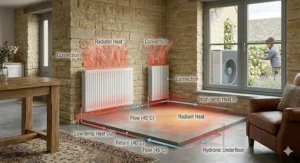
Heat pumps work best with lower flow temperatures (45-50°C) rather than the 70°C+ your old gas boiler ran. That means larger radiators — roughly 50-100% bigger than what’s hanging on your walls now. Installers who skip this calculation to win your business are setting you up for disappointment.
What actually happens: You’ll keep bumping the flow temperature up to compensate (killing efficiency), or you’ll live in a house that’s perpetually 18°C rather than the 20-21°C you’re accustomed to. Budget £1,500-£3,500 for radiator upgrades on a typical 3-4 bed home. Yes, it stings. But it’s the difference between a heat pump that works and one that doesn’t.
The Weather Compensation Trap
Every heat pump includes weather compensation — automatic adjustment based on outdoor temperature. Installers often set it and forget it using default curves. But British weather is peculiar: mild winters punctuated by sudden cold snaps, wet rather than dry cold, and dramatic temperature swings within 24 hours. Default European settings optimised for Alpine or Scandinavian climates often perform poorly here.
Solution: Insist on a proper commissioning process where the installer tweaks the weather compensation curve based on your home’s actual heat loss calculation and thermal mass. This takes 2-3 hours rather than 30 minutes, but it’s the difference between a system running at COP 3.2 versus 4.0 in British winter conditions — a £180-£280 annual saving.
Heat Pump vs Gas Boiler: The 2026 Cost Reality
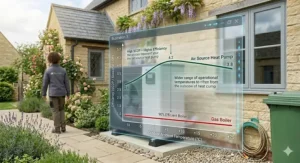
Let’s dispense with the fantasy numbers and look at actual running costs for a representative 3-bed semi-detached home in England with decent (but not exceptional) insulation.
Annual Running Costs (2026 Ofgem Price Cap Rates)
The following costs are based on Ofgem’s April-June 2026 price cap for a typical 3-bed semi-detached home:
Gas boiler:
- Annual consumption: ~15,000 kWh gas
- Rate: ~6p per kWh
- Annual cost: £1,035-£1,070
Air source heat pump (COP 3.5):
- Annual consumption: ~4,285 kWh electricity
- Rate: ~24.5p per kWh
- Annual cost: £995-£1,125
Air source heat pump (COP 4.5):
- Annual consumption: ~3,333 kWh electricity
- Annual cost: £775-£850
The Nuance
That best-case heat pump scenario (£775-£850) requires:
- Well-insulated property (EPC B or better)
- Properly sized radiators
- Correctly commissioned weather compensation
- Smart tariff usage (heating during off-peak hours where possible)
Most real-world installations achieve COP 3.0-3.5, putting running costs at rough parity with gas. You’re not saving £500 annually as some marketing claims suggest — you’re breaking even on running costs whilst eliminating carbon emissions and accessing the £7,500 grant. The savings come over the 15-20 year lifespan as electricity decarbonises and (hopefully) becomes relatively cheaper versus gas.
UK Heat Pump Grants: How to Actually Access Them
The Boiler Upgrade Scheme sounds straightforward until you’re navigating it. Here’s the unvarnished reality based on successful and failed applications in 2026.
Current Grant Levels (England & Wales)
- £7,500 for air source heat pumps replacing gas, oil, or LPG boilers
- £9,000 for air source heat pumps replacing oil or LPG systems (increased April 2026)
- £7,500 for ground source heat pumps
Eligibility Pitfalls
The scheme requires: ✅ Valid EPC (Energy Performance Certificate) — not expired
✅ MCS-certified installer
✅ Your property hasn’t already received a heat pump grant
✅ You’re the homeowner (landlords eligible, but not tenants)
Common rejection reasons:
- Expired EPC (even by one day — no grace period)
- Property already has a heat pump (including air-to-air systems)
- Installer not properly MCS-certified (check the register at mcscertified.com, don’t just trust their claim)
Scotland’s Better Deal
Scotland operates a separate scheme through Home Energy Scotland offering up to £9,000 (£15,000 for rural off-gas homes). Northern Ireland has its own pathways through NI Energy Advice. Don’t assume the BUS applies to you if you’re outside England and Wales.
The Application Process (Reality Version)
- Your installer applies on your behalf through the Ofgem portal
- You never see the paperwork (theoretically)
- The grant is deducted from your invoice upfront
What actually happens: Good installers handle this seamlessly. Dodgy ones claim they’ll apply post-installation and then vanish, leaving you chasing £7,500. Insist on seeing confirmation of grant approval before any work begins. Legitimate installers will have no issue showing you the Ofgem approval email.
Common Mistakes When Choosing a Heat Pump
Mistake 1: Assuming Bigger is Better
Oversized heat pumps cycle on and off frequently, destroying efficiency and comfort. An 8kW system in a home that needs 6kW will cost more to buy and more to run whilst delivering worse performance. Proper heat loss calculation (room-by-room) is non-negotiable. If an installer quotes you without visiting and measuring, walk away.
Mistake 2: Ignoring Noise Regulations
UK permitted development regulations allow heat pumps without planning permission if noise doesn’t exceed 42 dB measured at your neighbour’s boundary. A 60 dB heat pump installed 2 metres from their bedroom window will trigger complaints and potentially require relocation at your expense. Check noise specs and planned location before signing anything.
Mistake 3: Skipping the Smart Thermostat
Heat pump efficiency depends heavily on consistent, smart scheduling. The manufacturer’s basic controller typically costs you £80-£150 annually in wasted electricity versus a proper smart thermostat like tado° V3+ (around £129-£180 on Amazon UK) or Google Nest Learning Thermostat (£200-£280). The payback period is under two years, and you gain remote control and energy monitoring that helps optimise performance.
Mistake 4: Forgetting About Wet British Weather
British climate means damp, not just cold. Heat pumps in coastal areas or high-rainfall regions need anti-corrosion coatings on outdoor units. Japanese and European brands typically include this as standard, but check explicitly. A £12,000 heat pump with a corroded heat exchanger after five years because you live in Cornwall and the installer didn’t spec marine-grade coating is a £12,000 lesson.
Mistake 5: Believing Manufacturer Efficiency Claims
SCOP (Seasonal Coefficient of Performance) ratings are measured under laboratory conditions (A7/W35: 7°C outdoor air, 35°C water flow). British winter averages 3-8°C, and many homes run 45-50°C flow temperatures due to undersized radiators. Expect real-world COP to be 15-25% below the headline SCOP figure. A claimed SCOP 5.0 system will likely deliver 3.8-4.2 in typical UK operation.
Accessories That Actually Matter
While full heat pump systems require professional installation, several complementary products available on Amazon UK significantly improve performance and savings:
Smart Thermostats
tado° Smart Thermostat V3+ (around £129-£180): The best all-rounder for UK homes, with OpenTherm support for weather compensation, geofencing to heat your home as you approach, and room-by-room zoning when paired with smart radiator valves. The subscription-free features cover most needs; the £30/year Auto-Assist adds open window detection.
Google Nest Learning Thermostat (£200-£280 range): Premium option with arguably the best industrial design and auto-learning capabilities. Slightly less aggressive on energy savings than tado° but more aesthetically pleasing and simpler to operate for less tech-savvy users.
Hive Active Heating (around £179 installed): British Gas-backed option offering the easiest installation and best UK customer support. Less feature-rich than tado° or Nest but perfect for homeowners who prioritise simplicity and local service availability.
Magnetic System Filters
Essential if you’re connecting a heat pump to existing pipework. Old radiator systems accumulate magnetite sludge that can damage heat pump heat exchangers (£800-£1,500 replacement cost). A magnetic filter like the Adey MagnaClean or similar catches this debris before it reaches the pump. Budget £80-£150 for the unit plus £60-£120 installation.
Noise Reduction Mats
Anti-vibration pads placed under the outdoor unit can reduce transmitted noise by 3-5 dB — enough to take a borderline-noisy installation into comfortable territory. Particularly useful for installations on decking or near wooden structures that amplify vibration. Available for £25-£60 depending on size and quality.
FAQ: Air Source Heat Pump Questions UK Buyers Ask
❓ Are air source heat pumps worth it in the UK with current electricity prices?
❓ How much does it cost to run an air source heat pump UK?
❓ Do air source heat pumps work in cold UK winters?
❓ What is the quietest air source heat pump available in the UK?
❓ Can I install an air source heat pump myself to save money?
Conclusion: Which Air Source Heat Pump Should You Choose?
The “best” heat pump depends entirely on your specific circumstances, not abstract performance numbers. Here’s the decision framework based on real UK installations:
Choose Vaillant aroTHERM Plus if: You want the best all-round performance, have existing radiators you’d prefer to keep, and value the 7-year warranty. The efficiency advantage pays for itself over 15-20 years, and the R290 refrigerant future-proofs against upcoming F-gas restrictions.
Choose Mitsubishi Ecodan Ultra Quiet if: You live in a terraced house, semi-detached property, or anywhere noise could trigger neighbour disputes. The 45 dB operation is worth every penny of the premium if it means avoiding planning headaches or relationship friction.
Choose Daikin Altherma 3 if: You’re in Scotland, rural Wales, the Peak District, or anywhere that experiences genuinely cold winters (-10°C to -20°C). The extended operating range and cold-weather efficiency justify the investment.
Choose Samsung EHS Mono HT Quiet if: You want modern features (app control, energy monitoring) without paying Vaillant prices. The value proposition is strong for budget-conscious buyers in modern, well-insulated properties.
Choose LG THERMA V if: The maths matters more than the badge. You’ll save £2,000-£3,000 upfront for a modest efficiency penalty that takes decades to overcome. Sensible choice for cost-focused buyers.
Choose Grant Aerona3 if: You value supporting UK/Irish manufacturing, live in a rural area where local installer access matters, or simply want the peace of mind that comes from a widely-serviced domestic brand.
The broader truth is this: installation quality trumps equipment choice. A £11,000 LG installed brilliantly will outperform a £15,000 Vaillant botched by a cowboy installer. Invest time finding an MCS-certified engineer with proven heat pump experience (not a gas boiler specialist dabbling in heat pumps). Check references, visit previous installations, and insist on a full heat loss calculation before accepting any quote.
British homes are transitioning away from fossil fuel heating whether we’re ready or not. The 2026 Boiler Upgrade Scheme makes that transition financially viable — perhaps the last time government support will be this generous. Act now, whilst grants are abundant and installer availability is good. Wait until 2029, and you’ll be competing with millions of other homeowners, facing installer backlogs measured in months and prices inflated by desperate demand.
Recommended for You
- Combi Boiler vs System Boiler: 7 Key UK Differences (2026)
- Best Electric Boiler UK 2026: 7 Top Models Expert Review
- Best Combi Boilers 2026 UK: 7 Top Models Reviewed
Disclaimer: This article contains affiliate links. As an Amazon Associate, I earn from qualifying purchases. If you purchase products through these links, we may earn a small commission at no additional cost to you.
✨ Found this helpful? Share it with your mates! 💬🤗
