
In This Article
There’s a particular kind of misery reserved for British motorcyclists in November: the moment your fingers stop feeling like fingers and start feeling like ten separate, slightly annoyed strangers. You can have the best jacket, the priciest boots, a visor that doesn’t fog — and still arrive at the lights unable to work the clutch because your hands have gone numb somewhere around the third roundabout. That’s the problem heated motorcycle gloves vs heated grips is really trying to solve, and it’s not a trivial one. Cold hands aren’t just uncomfortable; they’re a genuine safety issue, because numb fingers lose fine motor control exactly when you need it most.

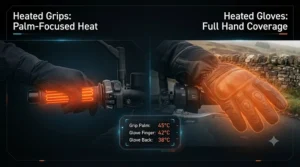
So, what is the difference, in plain terms? Heated grips replace or wrap your handlebars and warm your palms from a fixed point, wired permanently into the bike. Heated gloves warm the whole hand — palm, fingers and often the back of the hand — using their own battery or a lead into the bike’s electrics, and they travel with you between machines. Neither is objectively “better.” Each solves a slightly different cold-weather problem, and the right answer depends on your commute, your bike, and how much fiddling you’re willing to do on a frosty Tuesday morning.
As Motorcycle News’ own heated-grips testing puts it, cold hands are a very real risk for UK riders most of the year, not just in deep winter — even a bright spring morning can start cold enough to catch you out. This guide pulls together seven real, currently available products — a mix of retrofit grips and wearable gloves, spanning budget to premium — along with genuine comparative analysis, aggregated review sentiment, and practical guidance you won’t find on a standard Amazon listing. We’ll also dig into the specific questions UK riders keep asking: are heated gloves worth it for a fifteen-minute commute, what’s the real difference between retrofit and wearable heat, and where can you get decent warmth without remortgaging the house.
Quick Comparison Table: Gloves vs Grips at a Glance
| Feature | Heated Grips | Heated Gloves |
|---|---|---|
| Warms | Palms only (fixed point) | Full hand, fingers, often back of hand |
| Portability | Stays on one bike | Travels with you between bikes |
| Setup | One-time wiring install | Plug in each ride, or self-contained battery |
| Typical cost | Budget-to-mid | Mid-to-premium |
| Best for | Daily commuters on one bike | Multi-bike owners, pillions, tourers |
Reading across that table, the honest takeaway is that grips win on convenience once fitted — you press one button and forget about it — while gloves win on total-hand coverage and flexibility if you swap between machines or ride pillion on someone else’s bike. Riders with cold-sensitive fingertips specifically (rather than cold palms generally) tend to find gloves make the bigger practical difference, because grips can’t reach your fingertips or knuckles the way a properly designed heating panel can. Budget shouldn’t be the only deciding factor here either, since a mid-range glove and a premium grip set can end up costing roughly the same once you factor in a glove’s rechargeable battery packs.
💬 Just one click — help others make better buying decisions too!😊
Top 7 Heated Motorcycle Gloves and Grips: Expert Analysis
Affiliate disclosure: this post contains affiliate links, and as an Amazon Associate we earn from qualifying purchases at no extra cost to you.
1. Oxford HotGrips Advanced Sport — 9 heat settings for unpredictable British weather
The Oxford HotGrips Advanced Sport is a UK-specific version of Oxford’s popular retrofit grip line, and that regional tuning matters more than it sounds. Nine heat settings with intelligent memory mean the grip essentially learns your preferred output and holds it, rather than making you cycle through the same five clicks every cold morning. Drawing under 4A keeps the load modest enough that most bikes’ charging systems shrug it off, and the sealed-for-life construction is a sensible response to the fact that British winters are as wet as they are cold. Based on the spec sheet, the sport tread pattern favours shorter, firmer grips suited to naked and sportsbike riders rather than the bulkier ADV-style bar ends.
Who should care: commuters on a single bike who want a fit-once, forget-forever solution rather than something to charge or swap. Reviewers consistently note that installation is more involved than a wearable glove — expect an afternoon with heat-shrink tubing and a multimeter, or a trip to a garage — but that once wired in, reliability over multiple winters is the strongest selling point in the aggregated feedback for Oxford’s Advanced range.
Pros:
- ✅ Nine heat settings with intelligent memory function
- ✅ Weatherproof, sealed-for-life construction for UK conditions
- ✅ Low current draw protects smaller bike batteries
Cons:
- ❌ Requires proper wiring installation, not plug-and-play
- ❌ Only heats palms, not fingers or knuckles
Price range: expect these in the low-to-mid £100s at the time of research; always check current price before buying. For a single-bike commuter, this is a strong value verdict — you fit it once and the running cost is essentially zero.

2. Oxford HotGrips Premium Adventure — intelligent battery-saving controller
The Oxford HotGrips Premium Adventure sits a notch above the Advanced range with a genuinely clever bit of engineering: an intelligent heat controller that automatically shuts the grips down if the engine cuts out, so you can’t accidentally flatten your battery by forgetting to switch off. Five heat settings cover most UK winter scenarios, from a light autumn evening to a proper January frost, and the Adventure-specific tread pattern with its adjustable length (122–132mm) makes it compatible with a wider range of ADV and touring bars than the standard Sport version.
What most buyers overlook about the Oxford HotGrips Premium Adventure is the “cleanly cut to reduce size” detail — it means the same grip set can be trimmed to fit smaller-diameter bars without buying a different SKU, which is a genuinely practical touch for anyone running an older or less common adventure bike. Aggregated customer sentiment on Oxford’s own product pages and reseller sites is strongly positive on install ease and heat consistency, with the most common praise point being the automatic battery protection, and the most common criticism being that the mid-tier price sits uncomfortably close to the far more advanced Pro model.
Pros:
- ✅ Auto-off battery protection if engine stops
- ✅ Trimmable length fits more handlebar diameters
- ✅ Five heat settings suit varied UK conditions
Cons:
- ❌ Price sits close to the pricier Pro Adventure model
- ❌ Standard rubber wears faster than silicone alternatives
Price range: typically in the £100–£160 bracket depending on retailer and stock; prices may vary, so check current price. Solid value for adventure and touring riders who want smart safety features without paying for the top-tier silicone build.
3. Oxford HotGrips Pro Adventure — silicone build with one-button control
Here’s where things get genuinely premium. The Oxford HotGrips Pro Adventure swaps the usual rubber compound for full silicone construction, and on paper this means roughly double the lifespan compared with a conventional rubber grip, since silicone resists UV degradation and heat-cycling fatigue far better. A single integrated button replaces the separate control module older Oxford grips relied on, cycling through a multicoloured LED that dims automatically at night so it doesn’t distract you at a junction. A built-in thermistor auto-regulates temperature against ambient conditions, meaning the grip works harder on a genuinely freezing morning and eases off once the sun’s out.
Independent testing referenced by riding publications describes the Pro Adventure as effective and consistent across an eight-month, several-thousand-mile test period, with particular praise for how “OE” the finish looks once fitted — this doesn’t look like an aftermarket bolt-on. The trade-off, and it’s a real one, is cost: at close to £200, you’re paying a genuine premium for the integrated electronics and the doubled silicone lifespan, which only pays for itself if you keep the bike (and the grips) for several winters.
Pros:
- ✅ Full silicone construction roughly doubles grip lifespan
- ✅ Single-button control with auto-dimming LED display
- ✅ Thermistor auto-regulates heat against ambient temperature
Cons:
- ❌ Among the most expensive retrofit grips on the market
- ❌ Overkill for riders who only need occasional light warmth
Price range: sits in the upper £100s to around £200, so check current price before committing. Best value for high-mileage year-round riders who’ll get several winters of use from the extended silicone lifespan.
4. KEMIMOTO Heated Grip Pads — budget universal retrofit warmth
Not every rider wants to replace their grips entirely, and that’s exactly the gap the KEMIMOTO Heated Grip Pads fill. Rather than swapping the whole grip, these IP67-rated pads wrap around your existing grips, giving a genuinely budget-friendly route into retrofit heat without touching your bike’s original bar-end feel or grip compound. Multiple heat levels and reasonably fast warm-up times (Kemimoto’s own testing claims warm-up within roughly ten seconds on comparable models in the range) make this a sensible “try heated grips before you commit properly” option.
Here’s what the spec sheet won’t tell you, but user reports across Amazon’s automotive category suggest: fitment consistency varies more than with a purpose-built grip like Oxford’s, and the double-sided tape and bracket mounting system used on some KEMIMOTO variants is noticeably fiddlier to align neatly than a proper grip swap. That said, for the price, the actual heat output is genuinely reported as adequate for UK commuting temperatures, and the removable pad design means cleaning or replacement doesn’t require redoing the whole install.
Pros:
- ✅ Genuinely budget-friendly entry into retrofit heat
- ✅ IP67 waterproof rating for UK weather
- ✅ Removable pads simplify cleaning and replacement
Cons:
- ❌ Fitment and finish less polished than premium grip brands
- ❌ Adhesive/bracket mounting needs careful alignment
Price range: typically under £50, making this the most accessible retrofit option on this list; always check current price. Excellent value verdict for anyone testing whether heated grips suit their riding before spending on a premium set.
5. Savior Heat 7.4V Rechargeable Heated Gloves — self-contained wearable warmth
For riders whose bike doesn’t have easy wiring access — or who simply want warmth that isn’t tied to any one machine — the Savior Heat 7.4V Rechargeable Heated Gloves are a genuinely useful budget wearable option. Two 7.4V lithium-polymer batteries (commonly supplied around the 2200–3000mAh mark depending on the specific model) power heating elements across the back of the hand and fingers, charging fully in roughly three to four hours from a standard charger. Because there’s no bike wiring involved at all, these work identically whether you’re on a classic bike with a six-volt system, a modern machine, or simply walking the dog.
Based on a documented long-term review from a rider using them specifically on a vintage motorcycle without factory heated grips, real-world performance is described as decent value for the roughly £100-equivalent price bracket, particularly for short-to-moderate rides where you’re not relying on battery life for hours at a stretch. The honest caveat, repeated across owner feedback, is that longer tours will outlast the battery — this is a glove built for the commute and the weekend blat, not the four-hour Highland crossing.
Pros:
- ✅ No bike wiring required, fully self-contained
- ✅ Works across multiple bikes or off the bike entirely
- ✅ Budget-friendly entry point into wearable heat
Cons:
- ❌ Battery life limits use on longer tours
- ❌ Not independently PPE/CE motorcycle-glove certified
Price range: generally sits in the £70–£100 bracket at the time of research; check current price as this fluctuates. Strong value for short-journey commuters who want warmth without any bike modification.

6. Keis G701S Shorty Heated Gloves — wired simplicity, short-cuff comfort
The Keis G701S Shorty Heated Gloves trim the standard G701 design down to a shorter cuff, and in doing so, remove the battery pocket entirely — these are wired-only gloves, designed to plug straight into your bike’s 12V system rather than run from a portable pack. What most buyers overlook is that this is actually a deliberate simplification, not a missing feature: fewer components means less to go wrong, and Keis’s own construction — micro carbon fibre heating elements, 3M Thinsulate insulation for warmth even unpowered — carries across from the flagship model.
Aggregated review sentiment from Keis’s own customer feedback consistently highlights the “simple but very effective” nature of the Shorty line, with several UK owners specifically praising them as an easy, low-fuss upgrade for riders who already have accessible 12V wiring and don’t want to manage separate batteries. The obvious limitation is that you lose the off-bike flexibility of the full G701 — no battery pocket means no warming your hands at the petrol station or on a break, only while wired in.
Pros:
- ✅ Simplified wired-only design, fewer parts to fail
- ✅ Micro carbon fibre heating with Thinsulate insulation
- ✅ Shorter cuff suits riders who dislike bulky gauntlets
Cons:
- ❌ No battery pocket, so no off-bike or pillion use
- ❌ Requires accessible bike wiring to power
Price range: mid-tier, generally cheaper than the full battery-equipped G701, so budget roughly £90–£130; check current price for accuracy. Sensible value for wired commuters who don’t need portable power.
7. Keis G701 Heated Gloves — CE-certified premium touring glove
At the top of this list sits the Keis G701 Heated Gloves, and it’s worth explaining why they justify a premium price tag that a casual shopper might baulk at. These are certified to EN13594:2015 with Level 1 knuckle protection, meaning they’re tested motorcycle PPE, not just a warm glove that happens to fit on a bike — a distinction that genuinely matters given how much low-quality “heated glove” stock circulates online without proper certification. Dual-power capability lets you run them wired into the bike or from Keis’s own portable battery packs (commonly supplied around 2000mAh per glove, 4000mAh combined), with a cuff pocket designed specifically to house the pack.
Independent, hands-on testing across multiple UK motorcycle publications describes the build quality as immediately obvious “from the very box,” with genuine warmth delivered via far-infrared heating panels across the back, sides and fingers of the hand. One long-term tester logged around 1,500 miles and three months of use before writing up his findings, describing the battery-only runtime as comfortably over an hour per charge — enough for most commutes, tight for a genuine day-long tour without a spare pack. The scaphoid protection and hard rubber knuckle sliders add crash protection that none of the wearable competitors on this list offer.
Pros:
- ✅ EN13594:2015 certified motorcycle PPE with knuckle armour
- ✅ Dual-power: wired into bike or portable battery packs
- ✅ Far-infrared heating reaches fingers, not just palms
Cons:
- ❌ Among the most expensive gloves on this list
- ❌ Portable battery packs are sold separately at extra cost
Price range: typically £180–£220 for the gloves, with portable battery packs adding roughly £70–£90 on top; always check current price. Genuinely justified premium for riders who want certified PPE protection alongside heat.
Practical Usage Guide: Setting Up and Maintaining Your Heated Kit
Whichever route you take, the first thirty days set the tone for how well your heated kit performs all winter. For retrofit grips like the Oxford HotGrips Premium Adventure or Oxford HotGrips Advanced Sport, the single biggest first-use mistake is rushing the wiring — tap into a fused, switched-live circuit rather than straight off the battery, so the grips can’t drain your bike overnight if you forget to switch off. Route cabling away from moving parts and heat sources like the exhaust header, and use proper heat-shrink connectors rather than twisted wire and electrical tape, which corrodes and fails within a season in UK damp.
For wearable gloves such as the Keis G701 or Savior Heat 7.4V Rechargeable Heated Gloves, the equivalent mistake is charging habits. Lithium batteries prefer partial charge cycles to full drain-and-refill, so top up after most rides rather than waiting until they’re flat, and store them around 50% charge if you’re putting the kit away for summer. A maintenance schedule worth adopting: check grip wiring connections for corrosion every autumn before the cold sets in, wipe down glove exteriors after wet rides rather than letting road salt sit in the seams, and test battery packs a full charge cycle at the start of the season so you’re not discovering a dead cell on the first genuinely cold commute. One optimisation trick that rarely makes it onto Amazon listings: pairing a mid-heat grip setting with a lightweight glove liner often outperforms cranking the grips to maximum, because it avoids the sweaty-then-cold cycle that full-blast heat can cause on a long ride.
Real-World Scenarios: Which Rider Are You?
Consider Priya, a nurse doing a twenty-minute commute into central Manchester on the same 125 five days a week. She’s not touring, she’s not swapping bikes, and she wants to press one button and forget about it — for her, the Oxford HotGrips Advanced Sport or the budget-friendly KEMIMOTO Heated Grip Pads make more sense than a glove, because the wiring is a one-off job and the running cost afterwards is essentially nil.
Then there’s Tom, who owns two bikes — a naked for commuting and an adventure bike for weekend green-laning — and doesn’t want to wire heated grips into both. A wearable option like the Keis G701S Shorty or the fully portable Savior Heat 7.4V Rechargeable Heated Gloves travels with him regardless of which bike he’s swung a leg over. And finally, picture Aisha, who does genuine four-hour Peak District tours through proper winter conditions and wants certified protection alongside warmth — for her, the Keis G701 with its EN13594 rating and dual-power flexibility is worth the higher outlay, because it’s doing two jobs (protection and heat) that a cheaper glove or a grip alone can’t cover.
Retrofit vs Wearable Heat: The Core Decision
This is really the heart of the heated motorcycle gloves vs heated grips question, so it’s worth tackling head-on rather than dancing around it. Retrofit heat — grips like the Oxford HotGrips Pro Adventure or KEMIMOTO Heated Grip Pads — wins on long-term convenience and running cost. Once wired in, there’s nothing to charge, nothing to remember to pack, and no battery degrading over winters of use. The trade-off is that the heat is fixed to one bike and only reaches your palms, leaving fingertips and the backs of your hands exposed to wind chill.
Wearable heat — gloves like the Keis G701 or Savior Heat 7.4V Rechargeable Heated Gloves — wins on coverage and flexibility. The heating elements sit closer to where cold actually bites (fingertips, knuckles), and the whole system travels with you rather than staying bolted to a specific bike. What most buyers overlook is that this flexibility comes with an ongoing responsibility: batteries need charging, ageing cells lose capacity over a few winters, and portable packs are a genuine additional cost most retrofit grips never ask for. Reviewers who’ve used both consistently note that the ideal setup for genuinely cold, long-distance UK touring is actually both together — grips for baseline palm warmth, gloves (or heated liners) for fingertip coverage — though that’s clearly a bigger investment than most casual commuters need.
Heated Motorcycle Gloves for Short Journeys
If your typical ride is under twenty minutes — the school run, the local commute, a quick pop to the shops — the calculus changes meaningfully. On short rides, battery capacity “matters less,” according to UK-focused testing, because you simply don’t run the battery down far enough for the difference between a 2200mAh and a 3000mAh cell to register. This is genuinely good news for anyone eyeing the budget end of this list, because it means the Savior Heat 7.4V Rechargeable Heated Gloves or the wired Keis G701S Shorty will do the job perfectly well without needing the extended runtime of the flagship Keis G701.
The more relevant question for short-journey riders isn’t battery life at all — it’s warm-up time. A grip like the Oxford HotGrips Advanced Sport heats within roughly the first couple of minutes of riding, which on a fifteen-minute commute means you’re only getting genuine warmth for the second half of the journey. Gloves with pre-charged batteries, by contrast, are warm from the moment you switch them on, before you’ve even pulled off the drive — a meaningful practical advantage if your ride is too short for grips to fully do their job.
Hand Warming Methods Compared
Heated gloves and heated grips aren’t the only hand-warming methods UK riders reach for, and it’s worth being upfront about where each genuinely sits versus the alternatives, including the low-tech ones that cost almost nothing.
| Method | Warmth level | Convenience | Typical cost |
|---|---|---|---|
| Heated grips | Good (palms only) | High once fitted | Budget–premium |
| Heated gloves | Very good (full hand) | Moderate (charging/wiring) | Budget–premium |
| Heated vest/liner (hand-adjacent) | Good (core warmth aids circulation) | Moderate | Mid–premium |
| Disposable hand warmers | Fair, short-lived | Low (single-use) | Very low |
| Bar muffs/handguards | Fair (wind-blocking only) | High (no power needed) | Very low |
The clear pattern here is that anything requiring no power at all — bar muffs, disposable warmers — is cheap but genuinely limited, mostly blocking wind rather than generating real heat, whereas the powered options (grips, gloves, heated vests) all deliver noticeably better sustained warmth at the cost of some setup or charging discipline. Worth noting: a good core-warming layer, such as a heated vest liner, can meaningfully reduce how cold your hands feel even without heating them directly, because the body prioritises blood flow to the extremities less when the torso is already warm — a genuine physiological point worth understanding if you’re deciding where to spend your budget first.
Budget Heating Options for Cold-Weather Riders
Not everyone wants — or needs — to spend £200 on the Keis G701 or the Oxford HotGrips Pro Adventure. If budget is the priority, the sensible order of operations is: start with the KEMIMOTO Heated Grip Pads if you’re committed to one bike and can handle a modest install, or the Savior Heat 7.4V Rechargeable Heated Gloves if you want zero wiring and full portability. Both sit meaningfully below £100 at the time of research, and both deliver genuinely usable warmth for UK commuting temperatures, even if they lack the certified PPE protection or the multi-winter durability of the pricier options on this list.
Here’s what most budget buyers overlook, though: cost-per-winter is a more honest metric than sticker price. A £45 grip pad that needs replacing after one season because the adhesive fails isn’t actually cheaper than a £120 Oxford set that lasts five winters — it just feels cheaper today. Reviewers who’ve run budget kit for multiple seasons consistently flag adhesive and connector durability, rather than raw heat output, as the point where cheaper products tend to show their age first.
How to Choose Between Heated Grips and Heated Gloves
Making the actual decision comes down to a handful of genuinely practical questions, so here’s a straightforward framework:
- How many bikes do you ride? One bike, ridden regularly — lean towards grips. Multiple bikes, or pillion riding — lean towards gloves.
- How long is your typical ride? Under twenty minutes — gloves warm up faster from a standing start. Longer commutes or tours — grips’ unlimited runtime becomes the bigger advantage.
- Do you need certified protection too? If you want PPE-rated crash protection alongside heat, only certified gloves like the Keis G701 deliver that; grips offer none.
- What’s your installation appetite? Comfortable with basic wiring — grips are a one-off job. Prefer zero bike modification — a self-contained glove is simpler.
- What’s cold on you specifically — palms or fingertips? Palm-focused cold responds well to grips; fingertip numbness needs the fuller coverage gloves provide.
- What’s your total budget, including accessories? Remember to price in portable battery packs for gloves, which are often sold separately.
- How exposed are your riding conditions? Faired tourers with hand guards may find grips alone sufficient; naked-bike riders exposed to full wind chill often benefit more from full-hand glove coverage.
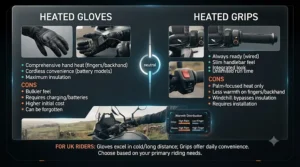
Working through those seven points honestly, most UK commuters on a single bike land on grips, while multi-bike owners, tourers, and anyone wanting certified protection tend to land on gloves — which is really the pattern reflected across this entire list.
Common Mistakes When Buying Heated Motorcycle Gear
The most common mistake, repeated across owner forums and review sites, is buying heated grips without checking handlebar diameter first — these are sized to fit 22mm (7/8″) bars in the vast majority of cases, and a mismatch means an awkward, loose fit or an install that simply won’t work. A close second is underestimating installation time for grips; budget an afternoon, not twenty minutes, especially if you’re running cabling back to the battery for the first time on that particular bike.
For gloves, the recurring error is buying on heat output alone and ignoring certification. As motorcycle safety commentators have pointed out, plenty of cheap “heated motorcycle gloves” sold online carry no genuine CE/PPE testing at all, meaning they may keep your hands warm but offer no meaningful crash protection — worth knowing if you’re choosing between a wearable heat product and a certified glove like the Keis G701. A final, smaller mistake: assuming glove sizing runs true across brands. Reviewers across multiple UK glove tests note that a “medium” in one brand can run noticeably tighter or looser than in another, so checking a specific brand’s size chart rather than assuming continuity is worth the extra two minutes.
What to Expect: Real-World Performance in British Weather
Manufacturer claims for both grips and gloves are typically measured under laboratory conditions, and real-world UK testing consistently finds performance running somewhere in the region of 15–20% lower once you account for wind chill, genuine ambient temperature swings, and battery age. Translated into practice: a grip rated for “extreme cold” performance will feel merely “good” on an actual Highland winter ride, and a glove battery advertised at two hours will more realistically deliver something closer to ninety minutes of genuinely warm output once you factor in a cold start and a few winters of battery wear.
This lines up with independent testing by BikeSocial of heated motorcycle kit, which found that grips alone rarely solve wind chill across the back of the hand — a limitation worth remembering before assuming grips alone will be enough for every rider. Regional testing also shows a clear pattern by ride type. Short city commutes under an hour see relatively little difference between budget and premium products, because neither battery capacity nor grip endurance is really stressed. Longer, colder rides — a proper multi-hour tour through genuinely low temperatures — are where the gap between budget and premium kit opens up dramatically, with only the higher-capacity, higher-spec options in this list (the Keis G701, the Oxford HotGrips Pro Adventure) maintaining real comfort throughout.
Long-Term Cost & Maintenance
Total cost of ownership tells a different story than the sticker price alone. Grips like the Oxford HotGrips Advanced Sport or Oxford HotGrips Premium Adventure have effectively zero running cost after installation — no batteries to replace, no charging routine — which makes their higher upfront price look better the longer you keep the bike. Gloves, by contrast, carry an ongoing cost: lithium battery packs for products like the Keis G701 typically lose meaningful capacity after two to three winters of regular use, and replacement packs are a genuine extra expense worth budgeting for rather than a hidden surprise.
Maintenance-wise, grips are largely “fit and forget,” with an occasional check of wiring connections for corrosion. Gloves need more active care: proper charging discipline, avoiding full battery drain, and drying thoroughly after wet rides to prevent the heating element wiring from corroding inside the glove lining. Over a five-year ownership window, a premium grip set like the Oxford HotGrips Pro Adventure may well work out cheaper per winter than a glove requiring two replacement battery packs over the same period — a genuinely useful number to run before assuming the cheaper upfront option is the better value.
Safety, Regulations and Compliance Guide
Since April 2018, motorcycle clothing sold in the UK and EU has been classed as Personal Protective Equipment, and gloves specifically must meet EN 13594 testing standards covering abrasion, cutting, tearing and impact resistance, with Level 1 or Level 2 pass ratings depending on the degree of protection. This matters directly for anyone choosing between grips and gloves: only certified gloves, such as the Keis G701 with its Level 1 knuckle protection, offer genuine crash protection alongside warmth. Heated grips, by their nature, offer none — they’re a comfort accessory, not PPE, and should never be relied upon for hand protection in a fall.
It’s also worth being wary of uncertified stock, particularly budget wearable options sourced from marketplace sellers with no verifiable brand history; motorcycle safety commentators have specifically flagged this as a growing issue, noting that some cheap heated gloves sold online carry no real certification behind their claims. Electrically, both grips and gloves should be fused appropriately and wired to a switched-live circuit — running either directly and permanently off the battery risks drain when the bike is parked, and in grips’ case, a fuse protects against wiring faults causing a genuine fire risk.
Features That Actually Matter (And Those That Don’t)
Cutting through the marketing noise, a handful of features genuinely affect real-world performance, and a few sound impressive but rarely matter in practice. Genuinely important: intelligent auto-off/battery protection (present on the Oxford HotGrips Premium Adventure), waterproof ratings like IP65/IP67 given how wet UK winters get, and — for gloves — genuine PPE certification rather than marketing claims of “motorcycle-grade” warmth. Also genuinely useful: adjustable or multiple heat settings, since a single fixed output rarely suits both a mild autumn evening and a January frost equally well.
Less important than the spec sheet suggests: extremely high maximum wattage or heat-setting counts beyond about five or six, since UK riders rarely need the very top setting for more than brief bursts, and most reviewers report settling on a mid-level output for the vast majority of rides. Similarly, flashy LED colour-cycling displays look good in product photography but add little practical value beyond confirming the current setting — a simple, reliable indicator does the same job. What most buyers overlook entirely is connector quality; a cheap, poorly sealed plug on an otherwise good product is a far more common failure point over several winters than the heating element itself.
✨ Ready to Beat the Cold This Winter?
🔍 Whichever route you choose — retrofit grips or wearable gloves — don’t leave it until the first frost to sort your kit. Check current prices and availability on any of the seven products above, and get your hands genuinely warm before the cold snap hits.
FAQ
❓ Are heated motorcycle gloves worth it for short commutes?
❓ Do heated grips drain my motorcycle battery?
❓ Can I fit heated grips myself?
❓ Are cheap heated motorcycle gloves safe?
❓ Which lasts longer, heated grips or heated gloves?
Conclusion
There’s no single winner in the heated motorcycle gloves vs heated grips debate, and honestly, anyone promising you one is oversimplifying. If you ride one bike regularly and want a fit-once solution, something like the Oxford HotGrips Advanced Sport or the budget-friendly KEMIMOTO Heated Grip Pads will serve you well through winter after winter with essentially no ongoing fuss. If you swap between bikes, ride pillion, or specifically suffer from cold fingertips rather than cold palms, a wearable option — the accessible Savior Heat 7.4V Rechargeable Heated Gloves, the simplified Keis G701S Shorty, or the certified, premium Keis G701 — will genuinely cover more of your hand where it counts.
For serious winter tourers, don’t rule out running both: grips for baseline palm warmth on the bike you use most, and a certified glove for the days when protection matters as much as comfort. Whatever you choose from this list, the difference between arriving somewhere with functioning fingers and arriving unable to feel the clutch lever is a real one — and for the price of a decent set of grips or gloves, it’s a problem worth solving properly rather than gritting your teeth through another British winter.
Recommended for You
- Heated Motorcycle Gloves for Raynaud’s: 7 Best Picks 2026
- Heated Motorcycle Gloves UK: 7 Best Picks for Winter 2026
- Heated Motorcycle Jacket vs Heated Vest 2026: 7 Picks Compared
Disclaimer: This article contains affiliate links. As an Amazon Associate, I earn from qualifying purchases. If you purchase products through these links, we may earn a small commission at no additional cost to you.
✨ Found this helpful? Share it with your friends! 💬🤗
