

In This Article
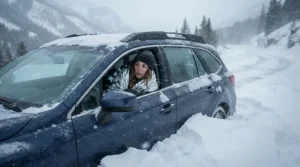
Picture it: 11pm, a back road glazed with black ice, and your car has just coughed, shuddered and gone silent. The heater, your loyal little furnace, dies with the engine. Within half an hour the cabin is drifting towards the temperature outside, and your phone is clinging on at 9%. This is exactly the moment an emergency car blanket for winter exists for. It’s small, it’s cheap, and it’s the one item most drivers swear they’ll buy “next week”.

What Is an Emergency Car Blanket for Winter?
An emergency car blanket for winter is a compact, lightweight cover kept in your vehicle to hold body heat if you break down or get stranded in cold weather. Most are foil thermal blankets that reflect radiated heat, while bulkier options use insulation or wool. Its job isn’t comfort. It slows heat loss until help arrives.
The idea descends from the space blanket, a thin plastic sheet coated with a reflective metal layer. Wikipedia notes that such sheets can reflect up to 97% of radiated heat, though retailers usually quote a more cautious 90%. That reflective trick is the heart of any foil thermal blanket, and, as you’ll see, also its limit.
Why bother at all? Breakdown firms such as the RAC report that callouts climb sharply every winter as temperatures drop, and a wait can stretch for hours when roads are icy and recovery is busy. Preparation isn’t paranoia. It’s winter breakdown preparedness, and the blanket is its cheapest layer.
Here’s how this guide works. I’ve compared seven real products sold on amazon.co.uk, from a foil sheet for under a tenner to full winter kits, using published specifications, listing details and the sentiment reviewers consistently report. I haven’t spent a night in a ditch with any of them, and I won’t pretend otherwise. What you get instead is honest analysis of what the specs mean when the heater packs in.
Quick Comparison: Emergency Car Blanket for Winter Options at a Glance
Here’s the short version before we go deep. Prices are ranges only and were checked at the time of research, so always check the current price before buying.
| Product | Type | Price range | Best For |
|---|---|---|---|
| Lifesystems Heatshield Emergency Thermal Blanket | Foil sheet | Under £10 | Cheap backup for every seat |
| Lifesystems Heatshield Emergency Thermal Bag | Foil bag | £10-£20 | Solo night drivers |
| Highlander Thermo Survival Blanket | Foil-coated foam | Mid-£10s | Longer rural waits |
| Snugpak Jungle Blanket | Insulated blanket | £25-£45 | Families and cold commutes |
| AA Winter Car Kit AA3386 | Starter kit | £15-£20 | New drivers, second cars |
| AA Emergency Winter Car Kit AA5281 | Extended kit | £25-£35 | Hilly, battery-prone routes |
| Xtremeauto Cold Weather Car Kit | Extended kit | Check current price | Hands-free work in the dark |
Reading across the table, the Lifesystems Heatshield Emergency Thermal Blanket is the obvious starting point if your car carries nothing at all. The Snugpak Jungle Blanket is the pick if you want something that feels like an actual blanket. The two winter kits, AA Winter Car Kit AA3386 and AA Emergency Winter Car Kit AA5281, win on convenience rather than warmth. Their foil sheets are basic, but the shovel, torch and hi-vis are what turn them into a rounded roadside safety kit. Budget buyers can mix and match, because a kit plus a spare foil sheet per passenger beats one premium item.
💬 Just one click — help others make better buying decisions too!😊
Top 7 Emergency Car Blanket for Winter Picks: Expert Analysis
Seven products, three tiers. The budget end is about wind protection and visibility. The middle adds insulation and bundled tools. The top end, such as it is, spends your money on warmth that lasts. The spec table below lines everything up, and the write-ups explain what the numbers mean when you’re actually cold.
| Product | Format and material | Size / weight | Review signal | Best For |
|---|---|---|---|---|
| Lifesystems Heatshield Emergency Thermal Blanket | Orange metallised foil | Single and Double sizes; Double listed around 98 g | 4.4-4.7 stars across size listings | Coat-pocket backup |
| Lifesystems Heatshield Emergency Thermal Bag | Foil bag | One-person bag | 4.4-4.6 stars, smaller review pools | Solo drivers |
| Highlander Thermo Survival Blanket | Foil-coated EVA foam | 195 × 140 cm, 230 g | Not verified on Amazon UK | Sit-on insulation |
| Snugpak Jungle Blanket | Synthetic-insulated polyester | XL about 90 × 72 in | 4.8 stars, 3,000+ ratings | Family cars |
| AA Winter Car Kit AA3386 | Shovel, torch, foil, hi-vis | About 1.3 kg boxed | 4.5 stars, thousands of ratings | First-time buyers |
| AA Emergency Winter Car Kit AA5281 | Adds jump leads, poncho, grips | Check listing | Limited verified reviews | Snowy, hilly routes |
| Xtremeauto Cold Weather Car Kit | Adds jump leads, tow rope, headlamp | Check listing | Review volume not verified | Dark rural lanes |
Two patterns jump out. Only the Snugpak Jungle Blanket and the Highlander Thermo Survival Blanket offer anything beyond reflection, and the bundles all rely on a basic foil sheet. If warmth is your priority, spend the extra on insulation. If preparedness is your priority, a kit gets more of the job done for the money.
1. Lifesystems Heatshield Emergency Thermal Blanket — the lightest, cheapest insurance policy
Think of this as the smoke alarm of the car boot: dull, ridiculously inexpensive, and enormously valuable on the one night you need it.
The blanket is bright orange metallised polyethylene that Lifesystems says reflects up to 90% of radiated body heat, while staying windproof, waterproof and tear-resistant. In practice, it won’t make you cosy, but it stops wind and damp stripping heat from your torso, which is where the real danger sits. The orange finish also makes you easier to spot in the dark if you have to wait outside. It packs to a little bigger than a deck of cards, so there’s no excuse to leave it at home.
Based on the spec sheet, this is a backup layer rather than a primary one. It suits drivers who already keep a coat and hat in the car, and it’s a sensible multi-buy for family cars, one per seat. Remember that foil does nothing about conduction, so tuck a coat between you and the cold seat as well.
Across the size variants on amazon.co.uk, ratings sat between roughly 4.4 and 4.7 stars at the time of research. The one prominent critical review I found came from a buyer who hadn’t realised the large “Double” was simply a bigger foil sheet. That’s an expectation mismatch rather than a defect.
Pros:
- ✅ Weighs next to nothing in a glovebox
- ✅ Wind- and waterproof film blocks draughts
- ✅ Bright orange aids visibility after dark
Cons:
- ❌ No protection from cold seats (conduction)
- ❌ Crinkly and easy to tear if rushed
Usually under £10 at the time of research (check current price), which is exceptional value as a single-item backup.
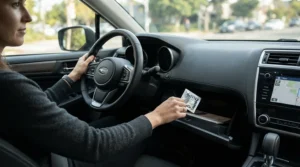
2. Lifesystems Heatshield Emergency Thermal Bag — a sleeve that stays put
Blankets slip, slide and flap. A bag simply stays wrapped around you, and that single design advantage is the whole pitch here.
The Lifesystems Heatshield Emergency Thermal Bag uses the same reflective, wind-blocking film as its blanket sibling, but in sleeping-bag form. Your legs and torso sit inside a sealed shell rather than under a loose sheet. Outdoor site Advnture named the Heatshield bivvy-style bag its favourite survival bag in a roundup of emergency shelters. For a stranded driver, that sealed shape matters because draughts around the ankles and neck are what turn a chilly wait into a miserable one.
On paper, it suits solo night-shift drivers and anyone covering long, lonely stretches where a wait could run for hours. The trade-off is condensation. Non-breathable film traps moisture, so open the top now and then rather than zipping yourself in tight. It’s also strictly a one-person item, so families would need one per head.
At the time of research, ratings sat around 4.4 to 4.6 stars across the listings I found. Those came from smaller review pools of roughly 30 to 60 ratings, which is encouraging but less robust than the bestsellers here.
Pros:
- ✅ Sealed shape stays put when you shift
- ✅ Blocks wind around legs and torso
- ✅ Reflective film suits very small boot spaces
Cons:
- ❌ One-person only, so families need several
- ❌ Non-breathable film can trap condensation
Around £10-£20 depending on listing and seller (check current price), which is fair for a wearable windbreak.
3. Highlander Thermo Survival Blanket — foam-padded foil that adds real insulation
Plain foil has a dirty secret. It’s brilliant against radiation and nearly useless against a freezing seat. This blanket is Highlander’s answer.
It measures about 195 × 140 cm, weighs 230 g and rolls to roughly 38 × 15 cm, built from EVA foam with a foil coating. That foam layer is the point. It adds a thin cushion of trapped air, so the sheet can double as a seat pad or a barrier between you and cold upholstery, which paper-thin sheets can’t do. You pay in weight, since it’s several times heavier than an ultralight foil sheet. In return you get a surface that doesn’t crackle like a crisp packet every time you move.
Based on the spec comparison, it suits drivers with a little door-pocket or boot space who expect longer waits, such as rural commuters. Advnture’s outdoor roundup rated it the best large emergency blanket in its list, which suggests the size-to-warmth balance has held up with gear testers. I’d treat it as the middle step between a foil sheet and a full insulated blanket.
I couldn’t verify a robust pool of recent amazon.co.uk reviews for it, and the listing I found showed as unavailable at the time of research. Stock can be patchy, so check availability before you plan around it.
Pros:
- ✅ Foam padding insulates against cold seats
- ✅ Large size wraps an adult comfortably
- ✅ Sturdier, quieter feel than thin foil
Cons:
- ❌ Bulkier and heavier than plain foil
- ❌ Amazon UK stock has looked inconsistent
Around the mid-£10s at the time of research (check current price), and decent value if your car sees long rural miles.
4. Snugpak Jungle Blanket — a proper insulated blanket, not a mirror
Where foil reflects, this one insulates, and that’s the difference between “survivable” and “bearable”.
The XL version measures roughly 90 × 72 inches (about 230 × 185 cm), with synthetic insulation inside a windproof, water-resistant shell and a compression sack for storage. Insulation traps air that your body warms, so it keeps working even when you’re sitting on a cold seat. That is the thing foil can’t do.
I’d choose this for a family car or a long rural commute, because it can cover one adult generously or two small passengers. Reviewers do split on the warmth ceiling, though. Some report using it as their only cover at around 5°C and staying toasty, while another found it underwhelming on a sofa with the heating off compared with a Sherpa fleece. An older independent test scored it 4.0 out of 5, with packability the standout and warmth a middling 6 out of 10. Treat it as a layer, not a substitute for a coat.
On amazon.co.uk, the Olive XL listing carried 4.8 stars from over 3,000 ratings at the time of research. That’s a hefty, reassuring sample.
Pros:
- ✅ True insulation that works against cold seats
- ✅ Compresses small into its stuff sack
- ✅ Windproof, water-resistant shell
Cons:
- ❌ Warmth ceiling is modest in a deep freeze
- ❌ Dearer than any foil option here
Roughly £25-£45 depending on size, colour and seller (check current price), and the best long-term value on this list if you need to keep more than one person warm.
5. AA Winter Car Kit AA3386 — the grab-and-go starter kit
Most people don’t build a roadside safety kit. They buy one and forget it lives under the spare wheel. That’s precisely why bundles like this earn their keep.
The kit packs a folding snow shovel, a foil blanket, an LED torch and a hi-vis vest (listed as EN471 approved) into a zipped canvas bag. In practice, you can dig out a wheel arch, be seen on a dark verge and wait under foil, all from one purchase. Parkers named it the best-value winter emergency kit in a UK roundup, while noting, a touch bemused, that it ships without gloves. Add your own.
Here’s what the spec sheet won’t tell you: the blanket is the weakest link. It’s a single thin foil sheet, so the kit’s genuine value is the shovel and the visibility gear. Buy it for a new driver or a second car, then upgrade the warmth with something like the Snugpak Jungle Blanket. Check whether the torch arrives with batteries before you rely on it.
The listing showed 4.5 stars from several thousand ratings at the time of research, about as strong a signal as budget kits get.
Pros:
- ✅ Shovel, torch, blanket and vest in one bag
- ✅ Compact enough for small boots
- ✅ Large, consistently positive review base
Cons:
- ❌ Foil blanket is basic and single-layer
- ❌ No gloves in the bag
Around £15-£20 at the time of research (check current price), and hard to beat as an all-in-one.
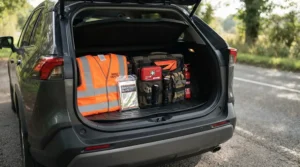
6. AA Emergency Winter Car Kit AA5281 — adds jump leads and snow grips
If the AA Winter Car Kit AA3386 is the starter kit, this is the one for people who’ve been caught out before.
It adds booster cables, a rain poncho and a pair of snow grips to the shovel, 9-LED torch, foil blanket and hi-vis vest. That poncho is an underrated extra. Worn over a foil sheet, it shields the delicate film from tears and adds a second wind layer. The booster cables tackle a classic cold-snap culprit, the flat battery, though they only help if another car can stop to assist, so think of them as a sociable accessory.
Parkers’ 2025 winter-driving roundup picked the AA emergency winter kit as its best product, praising value and an adequate amount of equipment. “Adequate” is the right word: functional rather than premium. It suits hilly rural routes where traction and dead batteries are realistic worries. As with the cheaper kit, the blanket inside is a basic foil sheet, so add insulation if your journeys are long.
I couldn’t verify a deep review pool for this exact model number, so I’m leaning on the editorial verdict rather than star ratings.
Pros:
- ✅ Jump leads, poncho and snow grips included
- ✅ Covers dark, wet and snowy scenarios
- ✅ Editorially rated good value for its contents
Cons:
- ❌ Booster cables need a second vehicle
- ❌ Foil blanket is the thinnest component
Around £25-£35 at the time of research (check current price), which is fair for the number of pieces.
7. Xtremeauto Cold Weather Car Kit — a headlamp that frees both hands
Try holding a phone torch in your teeth while wrestling with a jump lead. A headlamp ends that comedy.
The Xtremeauto Cold Weather Car Kit bundles jump leads, a hi-vis vest, a tow rope, a headlamp, a foil blanket and a snow shovel. Together they cover the four classic winter failures: flat battery, darkness, snow and the long wait. Parkers named it the best winter emergency car kit in an earlier UK roundup, a decent editorial endorsement even if that piece is a few years old.
Two practical notes. First, hands-free light is a real upgrade over a torch when changing a wheel or digging. Second, a tow rope is only as useful as its rating, and a Green Flag motoring blog advises checking that it can cope with your car’s weight. If you drive a heavy SUV, read the listing carefully.
I couldn’t verify a trustworthy volume of customer reviews for this listing, so there’s no sentiment summary here. Check the live reviews before buying.
Pros:
- ✅ Headlamp keeps both hands free
- ✅ Jump leads and tow rope included
- ✅ Covers dark, snow and flat-battery scenarios
Cons:
- ❌ Foil blanket is the thinnest part of the kit
- ❌ Review depth is hard to verify
Check current price. As the most heavily equipped bundle here, expect it to sit above the basic AA Winter Car Kit AA3386, and judge value by whether you’d otherwise buy those pieces separately.
Emergency Thermal Blanket for Car Breakdown: A Step-by-Step Usage Guide
Owning an emergency thermal blanket for car breakdown is step one. Deploying it with numb fingers is step two. Rehearse this sequence once at home and it becomes muscle memory.
- Store it in the cabin, not the boot. The Highway Code’s breakdown rules stress getting people clear of moving traffic and note that hard shoulders offer less protection than other places of relative safety. You may not be able to reach the boot safely, so a glovebox or door pocket is better.
- Unfold it once in advance. Foil is noisy and tears when pulled in a panic. Learn where the folds are.
- Wrap over your clothes. With foil sheets, the usual convention is the silver side towards your body, but follow the printed instructions.
- Seal the gaps. Tuck it round your neck and over your head, and hold it with a scarf or belt.
- Insulate from below. Slide a coat or the Highlander Thermo Survival Blanket under you, since cold seats drain heat by contact.
- Add fuel. A sugary snack and a warm drink help, as standard first-aid advice suggests.
Common mistakes in the first 30 days are leaving it in the boot, never opening the pack, and letting torch batteries die. Put a reminder in your phone for October.
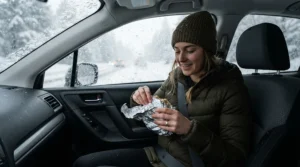
Winter Breakdown Preparedness: Three Real-World Scenarios
Gear only makes sense when it’s matched to a life. Here are three profiles with different budgets, environments and frequency of use.
The rural commuter. She drives 12 miles each way on single-track roads at 6am, five days a week, with patchy signal. Waits could be long, so a Snugpak Jungle Blanket on the passenger seat and a Lifesystems Heatshield Emergency Thermal Bag in the door pocket make sense. Budget: roughly £35-£65 combined.
The family motorway driver. Four people, one long Christmas drive. Foil won’t keep small children comfortable for long, so the AA Emergency Winter Car Kit AA5281 supplies the shovel, light and hi-vis, and a Lifesystems Heatshield Emergency Thermal Blanket per seat covers the rest. Add coats and snacks. Budget: roughly £40-£55.
The city student. Short hops, tiny boot, tight budget, an old hatchback. The AA Winter Car Kit AA3386 is the sensible one-purchase fix. Budget: under £20. Use is occasional, but frosty mornings do cause flat batteries, so keep it in the car all winter.
The pattern is simple. The longer your potential wait, the more insulation you need.
Roadside Safety Kit: Common Problems and Practical Solutions
A blanket is one layer. A decent roadside safety kit is a system. The RAC’s winter breakdown kit checklist lists essentials such as a torch with spare batteries, warm clothes and blankets, hi-vis, a first-aid kit, jump leads and a phone charger. Here’s how the common headaches map to solutions.
- “The only warm thing in my car is the blanket.” Layer a coat, hat and gloves under it. Foil amplifies what you’re wearing.
- “I can’t see in the dark.” A headlamp, as in the Xtremeauto Cold Weather Car Kit, frees your hands.
- “My battery’s flat on a frosty morning.” Jump leads, bundled with the AA Emergency Winter Car Kit AA5281, help if another driver stops. A portable jump starter is the solo alternative.
- “My phone is dying.” Keep a charged power bank in the glovebox and a cable that actually fits your handset.
- “I’m stuck in snow.” A folding shovel, as in the AA Winter Car Kit AA3386, plus a bag of grit or cat litter, gets you moving.
✨ Don’t Get Caught Out This Winter!
🔍 Take your winter breakdown preparedness to the next level with these carefully selected products. Click on any highlighted product to check current pricing and availability. A few minutes now could save you a very long, very cold night later!
How to Choose an Emergency Car Blanket for Winter
Choosing well takes five minutes. Work through these steps in order.
- Count the seats. Buy at least one blanket per regular passenger. Foil sheets are cheap enough that sharing is false economy.
- Match your routes. City commuters with fast recovery can lean on foil. Rural, hilly or motorway drivers should add insulation.
- Decide reflect or insulate. Foil reflects radiated heat, padded foil adds a cushion, and synthetic insulation traps warmth even against cold seats.
- Check the size. Around 210 × 140 cm is workable for one adult wrapped up. Anything smaller leaves gaps.
- Bundle or build. Kits save effort, but you can often assemble a better one by pairing a good blanket with separate tools.
- Read the contents list closely. Look for batteries, tow-rope ratings and glove omissions before you buy.
- Plan storage and checks. Choose a cabin spot and add a yearly October reminder.
Foil Thermal Blanket vs Wool, Fleece and 12V Heated Throws
Not every warm thing belongs in an emergency kit. Here’s how the main options compare.
| Option | How it keeps you warm | Main limit | Best For |
|---|---|---|---|
| Foil thermal blanket, such as the Lifesystems Heatshield Emergency Thermal Blanket | Reflects radiated heat, blocks wind | No help against cold seats | Cheap backup layer |
| Padded foil, such as the Highlander Thermo Survival Blanket | Foil plus foam cushion | Heavier and bulkier | Sit-on and wrap-over use |
| Insulated blanket, such as the Snugpak Jungle Blanket | Traps warmed air | Pricier; modest in deep freeze | Families, longer waits |
| Wool or fleece throw | Traps air, feels comfortable | Bulky, slow to dry | Extra boot-stored layer |
| 12V heated car blanket | Plug-in electric heat | Designed for use while driving | Journeys, not breakdowns |
On this evidence, a foil thermal blanket is the best first purchase for money and space, and an insulated blanket is the best second. Heated 12V throws are pleasant on the move, but Gocompare’s breakdown guide notes they’re designed to be used while the car is moving so they don’t flatten the battery. That makes them poor emergency tools. Wool and fleece are excellent if you have the room, but they take longer to dry once wet.
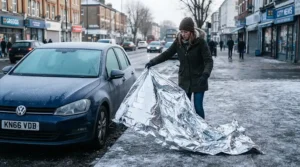
Features That Actually Matter (And Those That Don’t)
Marketing copy loves big numbers. Here’s how to filter it.
Features that matter:
- Size. A blanket that doesn’t wrap you is a decorative napkin.
- Wind and waterproofing. Draughts and damp do most of the damage in a stranded car.
- Bright colour. Orange helps rescuers and passing drivers see you at night.
- Tear resistance. Thin film rips in a panic.
- Packed size. If it doesn’t fit your door pocket, it won’t live there.
Features that don’t:
- “Space-age” branding. It’s decoration.
- Reflectivity percentages. Wikipedia says up to 97% and retailers say 90%, but real-world performance depends on fit and layers far more than on that figure.
- Giant multipacks. Thirty sheets is a first-aid-station purchase, not a car one.
- Piece counts in kits. Quality of the five key items beats a headline “29-piece” label.
Judge every blanket by one question: what happens when I’m sitting still in the cold for three hours?
Safety, Hypothermia and Regulations: What UK Drivers Should Know
Let’s keep this practical. The NHS describes hypothermia as a dangerous drop in body temperature below 35°C, a medical emergency. Symptoms include shivering, cold skin, slurred speech, slow breathing, tiredness and confusion. If you suspect it, call 999. Shivering by itself isn’t hypothermia, but it’s your body’s signal to warm up.
Several safety notes apply to winter breakdowns:
- Move out of the traffic’s way first. Blankets are for waiting safely, not waiting in danger.
- Keep wet clothing under control. Dry layers beat wet ones with foil on top.
- If you run the engine for heat, keep the exhaust clear of snow and ventilate. Blocked exhausts are a known risk.
- Watch children closely. Keep foil away from faces and wrap loosely over clothing.
On regulations, UK law doesn’t currently set a blanket requirement to carry a winter kit, though some European countries mandate items like hi-vis vests and warning triangles. Check the rules for your destination before you travel. Note too that the “EN471” on the AA Winter Car Kit AA3386 listing is the older designation of the hi-vis standard now published as EN ISO 20471.
Long-Term Cost and Maintenance
A winter kit isn’t a one-and-done purchase. It’s a small seasonal habit with a tiny running cost.
Over a typical winter, even a generous setup (a foil sheet per seat, an insulated blanket and a kit) costs less than a round of drinks for a large group. Compare that with the cost of a long recovery wait and the arithmetic is lopsided.
Maintenance is light:
- Each October, unpack and inspect the blanket for tears and creases.
- Replace foil after use or if it’s heavily creased, because the film weakens.
- Check torch and headlamp batteries, or swap in fresh ones.
- Air out insulated blankets like the Snugpak Jungle Blanket, and store them dry.
- Restock consumables such as snacks and water.
Consider cost per year, not cost per item. A Lifesystems Heatshield Emergency Thermal Blanket replaced annually costs pennies per day of winter. A Snugpak Jungle Blanket should last several seasons with care, making it the better long-term value. Kits like the AA Emergency Winter Car Kit AA5281 are best treated as a base you top up each year.
FAQ
❓ What size emergency car blanket for winter should I buy?
❓ Is it cheaper to build a roadside safety kit or buy one?
❓ Do foil thermal blankets stop working over time?
❓ Are foil blankets safe for children in the car?
❓ What should I do if my clothes are wet during a breakdown?
Conclusion
An emergency car blanket for winter is the smallest purchase in motoring with the largest gap between cost and consequence. Whichever you choose, the logic is the same: keep warmth within reach, prepare for a long wait rather than a short one, and treat foil as the backup it is rather than the whole plan.
If you want the cheapest sensible start, the Lifesystems Heatshield Emergency Thermal Blanket belongs in every glovebox. For solo night driving, the Lifesystems Heatshield Emergency Thermal Bag stays put better than any sheet. If you want padding against cold seats, the Highlander Thermo Survival Blanket adds it, while the Snugpak Jungle Blanket is the one to buy for real insulation. For all-in-one convenience, the AA Winter Car Kit AA3386 is the easy starter, the AA Emergency Winter Car Kit AA5281 adds jump leads and grips, and the Xtremeauto Cold Weather Car Kit brings the hands-free headlamp.
Whichever you pick, pair it with a coat, a hat, gloves and a charged phone. Winter breakdown preparedness is a layered habit, and the cheapest layer is the one you’ll be grateful for first.
Recommended for You
- Buy 12V Heated Travel Blanket: 7 Best Picks For UK (2026)
- 12V Heated Car Blanket: 7 Best Picks For UK Winters (2026)
- Heated Seat Covers UK: 7 Best 12V Picks For Winter 2026
Disclaimer: This article contains affiliate links. As an Amazon Associate, I earn from qualifying purchases. If you purchase products through these links, we may earn a small commission at no additional cost to you.
✨ Found this helpful? Share it with your friends! 💬🤗
