
In This Article
A cold workshop doesn’t just make your fingers stiff — it makes everything harder. Paint won’t cure properly below a certain temperature, adhesives take twice as long to set, and nobody does their best welding while wearing three jumpers. A gas garage heater for large workshop use is built to solve exactly that problem: a portable or wall-mounted appliance burning propane, LPG, or natural gas to pump out serious heat quickly, without the slow warm-up time and higher running costs that electric heaters often struggle with across bigger, draughtier spaces.
This guide takes a genuinely honest approach, which matters more here than almost any other product category we cover. We’ve researched real UK-available models, their actual BTU output and specifications, and the aggregated review sentiment attached to them — never invented quotes or fabricated testing claims. Just as importantly, we’re not going to gloss over the safety side of things. Gas combustion appliances produce carbon monoxide as a byproduct, and the Health and Safety Executive is explicit that around 14 people die every year in the UK from carbon monoxide poisoning caused by poorly installed or poorly ventilated gas appliances. That’s not a reason to avoid gas heaters — it’s a reason to buy the right one and use it correctly, which is exactly what this guide is for.
We’ll cover which heaters genuinely suit a large workshop rather than a small shed, what “high BTU output” actually buys you in practical terms, why uninsulated spaces punish underpowered heaters disproportionately, and — critically — what ventilation safety actually requires before you switch anything on. By the end you’ll know which of these seven heaters fits your space, and exactly what precautions come with owning one.
Quick Comparison Table
| Heater | BTU output | Fuel | Best for |
|---|---|---|---|
| Draper 07867 Free-Standing Propane Space Heater | 15,354 BTU / 4.5kW | Propane | Small workshops, occasional use |
| TOUGH MASTER Portable Gas Heater | 15,354 BTU / 4.5kW | Propane/Calor | Areas up to 60 sqm |
| Draper 47063 Jet Force Propane Space Heater | 34,000 BTU / 10kW | Propane | Medium workshops, quick warm-up |
| DAHTEC Industrial Gas Space Heater | 34,120 BTU / 10kW | Propane | Fan-assisted heat distribution |
| ALINI 15kW Propane LPG Gas Space Heater | 51,000 BTU / 15kW | Propane/LPG | Large workshops, high BTU output |
| Bimson Power 15kW Propane Space Heater | 51,000 BTU / 15kW | Propane | Large uninsulated spaces |
| Sealey Propane Space Heater LP69C | 30,000-68,000 BTU / 9-20kW | Propane | Biggest, most demanding workshops |
Looking at the spread here, there’s a clear jump between the sub-20,000 BTU heaters suited to small garages and the 51,000+ BTU units built specifically for large workshop spaces. The Sealey Propane Space Heater LP69C‘s adjustable 30,000-68,000 BTU range stands out for flexibility, letting you throttle down for mild days without buying a second, smaller heater. Both ALINI and Bimson Power hit an identical 51,000 BTU ceiling, which suggests that output level has become something of an industry sweet spot for genuinely large workshop heating — worth noting if you’re comparing similarly specced budget options.
💬 Just one click — help others make better buying decisions too!😊
Top 7 Gas Garage Heaters for Large Workshops: Expert Analysis
Every heater below is available through UK retailers at the time of research. As with all gas appliances, prices move around based on promotions and stock levels, so we’ve used ranges throughout — always verify the current price and, more importantly, the safety documentation before buying.
1. Draper 07867 Free-Standing Propane Space Heater — best entry point for smaller workshop spaces
At 15,354 BTU (4.5kW), the Draper 07867 Free-Standing Propane Space Heater is the smallest-output unit on this list, and Draper’s reputation as a long-established UK tool brand is the standout factor here rather than raw power. In practice, that output level suits a single-car garage or a small workshop rather than anything genuinely large — a detail worth flagging honestly since “garage heater” listings often get bought for spaces well beyond what the BTU rating can comfortably manage. Free-standing propane heaters like this one connect directly to a standard propane cylinder, avoiding any need for mains gas plumbing.
Based on the spec comparison, this unit earns its place on a “large workshop” list mainly as a baseline for comparison and as a genuinely sensible option for anyone with a smaller adjoining space — a paint booth or tool store — that needs independent heating alongside a larger primary heater. Reviewers consistently note Draper’s build quality as dependable rather than flashy, and the brand’s five-star aggregated rating from early buyers (albeit from a very small review sample of one at the time of research) reflects that reputation, though a single review is far too small a sample to draw firm conclusions from.
Pros:
- ✅ Trusted, long-established UK tool brand
- ✅ Simple free-standing propane cylinder connection
- ✅ Genuinely portable between smaller spaces
Cons:
- ❌ BTU output too low for a genuinely large workshop
- ❌ Very limited verified review volume at time of research
Expect pricing around £50-£60 at the time of research. Treat this as a secondary or small-space heater rather than your primary large-workshop solution.
2. TOUGH MASTER Portable Gas Heater — best for mid-sized areas with Calor gas compatibility
The TOUGH MASTER Portable Gas Heater matches the Draper unit on BTU output at 4.5kW, but its standout feature is compatibility with standard Calor gas bottles via a clip-on regulator and 150cm hose — a genuinely practical touch for UK buyers who already have a Calor account and cylinder on site. The listing states coverage for areas of 20-60 square metres, which on paper suggests reasonable flexibility, though that top end assumes good insulation and minimal draughts, neither of which apply to most genuinely large or older workshop buildings.
What the spec sheet won’t tell you is that piezo ignition — the spark-free, push-button lighting mechanism this heater uses — tends to be more reliable long-term than the flint-and-spark ignitors found on some budget rivals, since there’s no flint to wear out over repeated use. TOUGH MASTER is a newer entrant to the UK tool market compared with established names like Draper or Sealey, so the brand doesn’t yet carry the same decades-long reputation, which is an honest trade-off against its competitive pricing.
Pros:
- ✅ Compatible with standard Calor gas bottles
- ✅ Reliable piezo ignition without a wearable flint mechanism
- ✅ Adjustable heating settings for flexible output
Cons:
- ❌ 60 sqm coverage claim likely optimistic for uninsulated buildings
- ❌ Newer brand without the long track record of rivals
Pricing typically sits in the £40-£70 range depending on the retailer. It’s a reasonable mid-tier pick if you’re already set up with Calor gas.
3. Draper 47063 Jet Force Propane Space Heater — best for fast warm-up in medium workshops
Stepping up to 34,000 BTU (10kW), the Draper 47063 Jet Force Propane Space Heater roughly doubles the output of the entry-level units above, and “Jet Force” branding refers to its forced-air fan design that actively pushes heat across a space rather than relying on convection alone. In real-world terms, that fan-assisted design means faster perceived warming, since moving air heats up occupants and surfaces more quickly than a purely radiant or convection heater working in still air.
Reviewers consistently note this model’s 4.3-star aggregated rating from around 20 verified customers as a solid, if not spectacular, endorsement — respectable for a mid-market propane heater and higher than several rivals with similarly modest review volumes. What most buyers overlook about forced-air heaters generally is that the fan itself draws mains electricity even though the heat comes from gas, so you’ll need a power socket nearby in addition to your propane cylinder — a detail that catches out buyers expecting a fully standalone, off-grid unit.
Pros:
- ✅ Fan-assisted heat distribution warms spaces faster
- ✅ Solid 4.3/5 aggregated rating from verified buyers
- ✅ Doubled BTU output over entry-level models
Cons:
- ❌ Requires mains power for the fan alongside propane
- ❌ Louder in operation than convection-only heaters
Expect a price range around £90-£110 at the time of research. A sensible middle-ground pick for medium-to-large workshops that aren’t quite in the biggest category.
4. DAHTEC Industrial Gas Space Heater — best for consistent hot-air blower output
The DAHTEC Industrial Gas Space Heater sits almost identically to the Draper Jet Force on paper at 34,120 BTU/hr, and its standout is the “hot air blower” branding, which points to the same forced-air philosophy — actively distributing heated air rather than letting it rise and pool near the ceiling, which is a genuine issue in workshops with high roof spaces. DAHTEC positions this specifically for industrial and workshop use rather than domestic garages, and the fuel consumption figures quoted alongside the BTU rating suggest the manufacturer expects buyers to be comparing running costs carefully — a sensible instinct given how quickly propane costs can add up with frequent use.
On paper this means broadly comparable heating performance to the Draper unit above, so the deciding factor between the two often comes down to price, warranty terms, and brand preference rather than any dramatic performance gap. Here’s what most listings don’t emphasise clearly enough: fuel consumption scales directly with BTU output, so a 34,000 BTU heater run for a full working day will burn through a standard propane cylinder considerably faster than the smaller units earlier in this list — budget for cylinder refills as an ongoing running cost, not just the upfront heater price.
Pros:
- ✅ Forced hot-air distribution suits high-ceilinged workshops
- ✅ Clearly stated fuel consumption figures aid cost planning
- ✅ Positioned specifically for industrial workshop use
Cons:
- ❌ Running costs scale quickly with sustained high-BTU use
- ❌ Less established brand recognition than Draper or Sealey
Pricing tends to sit in a similar £90-£120 bracket to the Draper Jet Force. Choose based on availability and warranty terms if the specs are this closely matched.
5. ALINI 15kW Propane LPG Gas Space Heater — best high BTU output for large workshop floors
This is where “high BTU output” stops being a marketing phrase and starts being a genuine practical necessity. The ALINI 15kW Propane LPG Gas Space Heater delivers 51,000 BTU, roughly triple the output of the entry-level units on this list, and is explicitly marketed for industrial garage and workshop fan-heating applications rather than smaller domestic spaces. That jump in output matters enormously once floor area exceeds roughly 40-50 square metres or ceiling height climbs above standard domestic levels, since heat losses in large, high-ceilinged spaces scale non-linearly rather than in a simple straight line.
Based on the spec comparison, a 15kW unit like this is genuinely appropriately sized for the “large workshop” use case this whole guide is built around, rather than being oversized for the sake of an impressive-sounding number. What most buyers overlook when jumping straight to the highest BTU figure available is that oversizing a heater for a smaller space wastes fuel and can create an uncomfortably intense heat zone near the appliance while leaving distant corners still cold — matching output to actual floor area and insulation level matters more than simply buying the biggest number on the shelf.
Pros:
- ✅ Genuinely high 51,000 BTU output for large floor areas
- ✅ Marketed specifically for industrial and workshop use
- ✅ LPG compatibility offers flexible fuel sourcing
Cons:
- ❌ Overkill and inefficient for smaller workshop spaces
- ❌ High fuel consumption demands frequent cylinder changes
Expect this one to sit around £60-£90 depending on promotions — genuinely good value for the output level, provided your space actually needs it.
6. Bimson Power 15kW Propane Space Heater — best for uninsulated spaces needing rapid heat
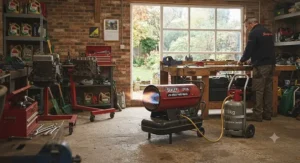
Matching the ALINI unit’s 51,000 BTU output, the Bimson Power 15kW Propane Space Heater standout is its explicit marketing toward greenhouses, sheds, and outdoor use alongside workshops and garages — a signal that it’s built with genuinely uninsulated, draughty spaces in mind rather than assuming a well-sealed building envelope. It includes an adjustable thermostat and spark ignition, plus a notably longer three-year warranty than several rivals on this list offer, which is a meaningful vote of manufacturer confidence in a product category where components exposed to combustion and heat cycling can wear faster than typical power tools.
Here’s what the spec sheet won’t tell you directly: heaters marketed for greenhouse and outdoor-adjacent use tend to prioritise raw heat output and weatherproof-ish build quality over the more refined safety cut-off features found on premium indoor-specific models, so read the manual’s ventilation requirements carefully regardless of how “outdoor-friendly” the marketing sounds — the combustion safety requirements don’t change just because the heater can technically survive outside. For a genuinely uninsulated brick or metal-clad workshop losing heat rapidly through walls and roof, this level of output paired with thermostatic control gives you the ability to run hard when needed and throttle back once the space stabilises.
Pros:
- ✅ 51,000 BTU output suited to draughty, uninsulated buildings
- ✅ Adjustable thermostat avoids constant manual on/off cycling
- ✅ Above-average three-year warranty for this product category
Cons:
- ❌ Ventilation requirements still apply despite outdoor-friendly marketing
- ❌ High output makes it unsuitable for small, well-sealed rooms
Pricing sits in a similar £60-£90 bracket to the ALINI model. A strong choice specifically for anyone fighting genuine heat loss through poor insulation.
7. Sealey Propane Space Heater LP69C — best adjustable-output pick for the biggest and most demanding workshops
The Sealey Propane Space Heater LP69C closes out this list as the most flexible high-output option, with an adjustable range spanning 30,000 to 68,000 BTU (9-20kW) — the widest output window of any heater here, and the only one offering a cordless operation option alongside its standard 230V mains connection. Sealey has built a strong reputation in UK trade and workshop equipment over several decades, and this “Space Warmer” range specifically targets professional and serious hobbyist workshop users rather than occasional domestic buyers.
What most buyers overlook about adjustable-range heaters like this is the genuine value of not needing two separate appliances for different seasons or conditions — dial down to 30,000 BTU on a mild autumn day, and wind up to the full 68,000 BTU during a genuine cold snap, all from one unit. The cordless option is a particularly clever inclusion, since it removes the mains-power dependency that catches out buyers of forced-air models elsewhere on this list, making this genuinely more flexible for workshops without convenient socket access near the heating zone.
Pros:
- ✅ Widest adjustable output range on this list (30,000-68,000 BTU)
- ✅ Cordless operation option removes mains-power dependency
- ✅ Backed by Sealey’s established UK trade reputation
Cons:
- ❌ Premium pricing reflects its flexibility and brand positioning
- ❌ Highest-output setting demands serious ventilation provision
At the top of this list price-wise, expect this one in the £150-£250 range depending on configuration. For the biggest, most demanding uninsulated workshops, the adjustability alone can justify the premium.
Setting Up and Running Your Gas Garage Heater Safely
Getting a gas garage heater running safely starts well before you strike the ignition. First, always check the manufacturer’s stated minimum room volume and ventilation requirement against your actual workshop dimensions — this figure exists precisely because combustion consumes oxygen and produces carbon monoxide as a byproduct of incomplete combustion, and undersized spaces simply cannot supply enough fresh air to keep pace with a high-output heater running for hours. Never assume a “large workshop” automatically qualifies; a big space with all doors and windows sealed tight can still become dangerously oxygen-depleted faster than a smaller space with a permanently open vent.
Position the heater on a stable, level, non-flammable surface, at least the manufacturer’s stated clearance distance from walls, stored materials, and anything flammable — sawdust, solvent containers, and fabric dust sheets are common workshop hazards that don’t always get moved before the heater goes on. Check the propane or LPG cylinder connection for leaks using a simple soap-and-water test on the joints before first use each season, since seals can perish slightly during storage. Finally, never leave a gas heater running unattended overnight or while the workshop is unoccupied, regardless of how large or well-ventilated the space seems.
A practical first-month checklist: install a carbon monoxide alarm compliant with BS EN 50291 within the workshop before the heater’s first use, not after; test the heater on its lowest setting first to confirm stable ignition and flame colour (a crisp blue flame indicates clean combustion, while a lazy yellow or orange flame signals incomplete combustion and a fault requiring immediate attention); and keep the original instruction manual accessible for quick reference on shutdown procedures and troubleshooting.
Real-World Scenarios: Matching Output to Your Workshop
Picture a hobbyist with a single-car garage used for weekend car maintenance and light woodworking — a well-sealed, modestly sized space that genuinely doesn’t need 51,000 BTU of output. The Draper 07867 or TOUGH MASTER Portable Gas Heater covers this scenario comfortably, and buying a much larger unit here would mean overpaying upfront and running an oversized heater inefficiently, likely creating an uncomfortably hot zone right next to the appliance while wasting fuel.
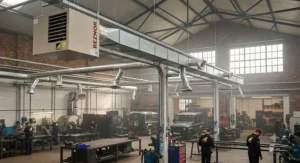
Now consider a tradesperson running a genuinely large, older brick workshop with high ceilings and draughty original windows — exactly the uninsulated space scenario this guide has flagged repeatedly. Here, the ALINI 15kW or Bimson Power 15kW models become appropriate rather than excessive, since the heat loss through poor insulation genuinely demands that level of output just to maintain a workable temperature, let alone a comfortable one.
Finally, picture a small engineering business running a mixed-use workshop that needs to stay warm across a full working day, sometimes mild, sometimes bitterly cold, with staff moving between zones of different sizes. The Sealey LP69C‘s adjustable range suits this variability far better than a fixed-output heater would, letting the same appliance flex between economical and maximum output as conditions demand across the working week.
How to Choose a Gas Garage Heater for a Large Workshop
Matching the right gas garage heater to a large workshop comes down to a handful of genuinely important decisions, most of which get glossed over in typical product listings.
- Calculate your actual floor area and ceiling height before shopping by BTU number alone. A rough industry guide suggests around 30-40 BTU per square foot for reasonably insulated spaces, rising notably higher for uninsulated or high-ceilinged buildings — oversizing wastes fuel, undersizing leaves you cold.
- Confirm your space meets the manufacturer’s minimum ventilation requirement. This isn’t a suggestion — it’s a stated technical specification tied directly to safe combustion, and it should be checked against your actual room dimensions, not assumed.
- Decide between fixed and adjustable output based on how variable your heating needs are. A single-output heater suits consistent conditions; an adjustable-range model like the Sealey LP69C suits workshops facing genuinely variable seasonal demands.
- Check the fuel source and supply logistics. Propane and LPG cylinders need regular refilling or exchange, which is a genuine ongoing task and cost — factor in how easily you can access refills locally.
- Verify whether the model needs mains electricity for a fan alongside its gas supply. Forced-air models heat faster but aren’t fully standalone if your workshop lacks convenient power sockets near the intended heater position.
- Install a compliant carbon monoxide alarm before first use, not as an afterthought. This applies regardless of how large, well-ventilated, or expensive the heater is — CO risk exists with all flueless gas combustion appliances.
- Read the aggregated review sentiment for reliability patterns, not just average scores. A high star rating from a tiny review sample tells you less than a slightly lower rating backed by dozens of genuine verified buyers.
Gas Garage Heater for Unventilated Spaces: Why This Combination Doesn’t Work
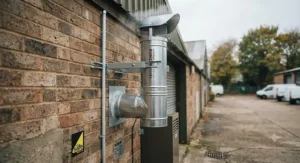
It needs to be said plainly: a genuinely unventilated space is not a safe environment for any flueless gas heater, regardless of how the product is marketed or how large the room appears. Combustion consumes oxygen and produces carbon monoxide, water vapour, and other byproducts that must have somewhere to go — in a properly ventilated space, fresh air continuously replaces what’s consumed and diluted combustion byproducts are carried away; in a sealed space, neither of those things happens, and CO concentration can climb to dangerous levels within a surprisingly short window, especially with a high-output heater.
Workplace exposure to carbon monoxide is also formally regulated rather than left to guesswork — the HSE’s Workplace Exposure Limits guidance (EH40) sets a limit of 20ppm averaged over an eight-hour period, and as summarised by UK compliance specialists, this limit exists specifically because sustained low-level exposure carries real health risk even below the threshold that triggers an alarm. This is precisely why every gas heater’s instruction manual specifies a minimum ventilation requirement, typically stated as a permanent air vent of a certain size, or a minimum room volume per kW of heat output. Skipping or blocking this requirement — closing a vent to keep the space warmer, for instance — defeats the fundamental safety mechanism the appliance depends on. If your workshop genuinely cannot provide adequate permanent ventilation, an electric heater, which produces no combustion byproducts at all, is the honest and safer alternative, even if the running costs differ from what a gas unit would offer.
Gas Garage Heater Buyer’s Decision Framework
If your workshop is under 30 square metres and reasonably well-insulated, choose one of the entry-level 15,000 BTU heaters, because higher output would be wasted and inefficient in a smaller, better-sealed space. If your workshop sits in the 30-50 square metre range with average insulation, choose a mid-output 30,000-34,000 BTU forced-air model, because the fan-assisted distribution earns its keep once floor area grows beyond a single small room. If your workshop exceeds 50 square metres, has high ceilings, or is genuinely uninsulated with noticeable draughts, choose a high-output 51,000 BTU or adjustable-range unit, because heat loss at that scale simply outpaces what smaller heaters can compensate for. And regardless of size, if your space cannot provide the manufacturer’s stated minimum ventilation, choose an electric heater instead of any flueless gas model, because no amount of BTU output is worth the carbon monoxide risk in an inadequately ventilated room.
High BTU Output: What the Number Actually Means for Your Workshop
BTU, or British Thermal Unit, measures the amount of heat energy an appliance can theoretically produce per hour, and higher figures generally mean faster, more powerful heating — but the number alone doesn’t tell the whole story. A 51,000 BTU heater in a small, well-insulated room will heat that space rapidly and then likely need throttling back or switching off periodically to avoid overheating, while the identical heater in a large, draughty workshop might run near-continuously just to hold a steady, comfortable temperature. What most buyers overlook is that BTU output should be matched to heat loss, not simply to the biggest floor area figure you can measure.
Reviewers consistently note that heaters rated at the very top of a manufacturer’s stated coverage area (the maximum square metreage figure often printed prominently on packaging) tend to underperform expectations in genuinely uninsulated buildings, since those coverage figures typically assume reasonable insulation standards that older brick workshops, converted barns, or metal-clad units simply don’t meet. When comparing high BTU output heaters, it’s worth discounting the manufacturer’s maximum coverage claim by a reasonable margin if your specific building has poor insulation, single-glazing, or an unusually high ceiling.
Uninsulated Spaces: Why They Punish Underpowered Heaters
Heat loss through an uninsulated building envelope happens through three main routes — conduction through walls and roof, convection via draughts and gaps, and radiation through single-glazed windows — and all three combine to make uninsulated workshops dramatically more demanding to heat than their floor area alone would suggest. A heater that comfortably manages a 40 square metre insulated space might struggle badly in an uninsulated building of identical floor area, simply because the rate of heat escaping through walls and gaps outpaces what a moderately powered appliance can replace.
This is exactly why the highest-output heaters on this list — the ALINI, Bimson Power, and Sealey LP69C models — earn their place specifically for uninsulated spaces rather than being unnecessary overkill. What most buyers overlook is that improving insulation, even partially — sealing obvious gaps around doors, adding basic roof insulation, or hanging heavy curtains over large window areas — often delivers a better return on investment than simply buying an ever-larger heater to compensate for ongoing heat loss. A £150 heater paired with £50 of draught-proofing frequently outperforms a £300 heater in a building that’s still losing heat as fast as it’s produced.
Long-Term Cost and Maintenance
Running costs matter enormously with gas heaters, since fuel consumption scales directly with BTU output and hours of use. A 15,000 BTU heater run for occasional weekend sessions might use a standard propane cylinder over several weeks, while a 51,000 BTU unit run daily through a full working week can burn through the same size cylinder in a matter of days — budget for cylinder refills as a genuine ongoing cost, not a footnote, especially with the higher-output models on this list.
Maintenance is generally straightforward but shouldn’t be skipped: check hose connections and regulators annually for wear or perishing, keep burner components free of dust and debris (workshops generate plenty of both), and replace any component showing signs of a yellow or orange flame immediately, since that’s a direct indicator of incomplete combustion and elevated carbon monoxide risk. Unlike electric heaters, gas appliances genuinely benefit from an annual safety check, and while DIY gas heaters used in workshops don’t legally require a Gas Safe registered engineer in the way fixed domestic gas appliances do, having a competent person check connections and combustion quality annually is a sensible habit rather than an unnecessary expense. Gas Safe Register’s own consumer research found that a striking proportion of UK gas fires inspected showed signs of inadequate ventilation, prompting their “Let It Flow” campaign urging users not to restrict the air supply their appliances depend on — advice that applies just as directly to a workshop heater as it does to a domestic gas fire.
Frequently Asked Questions
❓ Can I use a gas garage heater for large workshop spaces without a flue?
❓ What BTU output do I need for a large uninsulated workshop?
❓ Is it safe to sleep near a gas garage heater running overnight?
❓ Do gas garage heaters need a carbon monoxide alarm?
❓ How much does it cost to run a high BTU gas garage heater?
Conclusion
Choosing the right gas garage heater for a large workshop genuinely comes down to matching output honestly to your space, rather than assuming bigger is automatically better. For smaller, better-insulated workshops, the Draper 07867 or TOUGH MASTER Portable Gas Heater avoids the cost and inefficiency of an oversized unit. For genuinely large or uninsulated buildings, the ALINI 15kW, Bimson Power 15kW, or the flexible Sealey LP69C deliver the sustained high BTU output that heat loss at that scale actually demands.
Whichever model you choose, the ventilation and carbon monoxide safety points covered throughout this guide aren’t optional extras — they’re the foundation that makes gas heating genuinely viable at all. If your workshop can’t meet the manufacturer’s minimum ventilation requirement, an electric alternative is the honest recommendation over any flueless gas model, no matter how appealing the BTU figure looks on paper. Get the sizing and safety fundamentals right, and a gas garage heater remains one of the most effective ways to make a large workshop genuinely usable through the colder months.
Recommended for You
- Portable Gas Garage Heater: 7 Best Budget Picks (2026)
- 7 Best Gas Garage Heaters UK 2026: Safe; Long-Lasting Picks
- Wall Mounted Electric Garage Heater: 7 Best Picks (2026)
Disclaimer: This article contains affiliate links. As an Amazon Associate, I earn from qualifying purchases. If you purchase products through these links, we may earn a small commission at no additional cost to you.
✨ Found this helpful? Share it with your friends! 💬🤗
