
In This Article
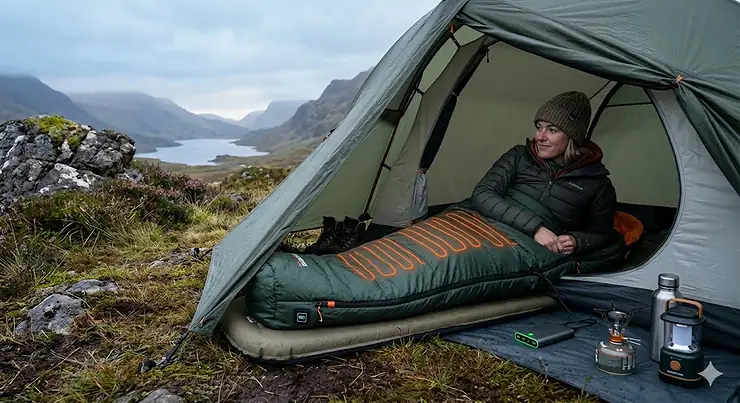
Picture this: you’ve driven two hours to the Lake District, pitched your tent as the sun sets, and crawled into your sleeping bag—only to spend the next six hours shivering through damp October air that feels far colder than the 8°C your weather app promised. If you’re nodding along, you’re not alone. British weather is notoriously deceptive, and what most UK campers overlook is that our mild-but-wet climate often feels colder than genuinely frigid but dry conditions elsewhere.
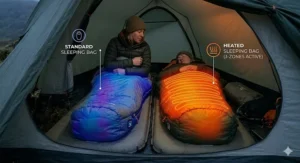
A heated sleeping bag transforms this experience entirely. Rather than layering on three jumpers and thick socks whilst still feeling the chill creep through your bones, you’re controlling your microclimate with the touch of a button. These aren’t your grandmother’s electric blankets adapted for outdoors—modern heated sleeping bags use graphene technology and USB power banks to deliver targeted warmth exactly where your body needs it most.
What sets 2026’s models apart from earlier versions? Better battery efficiency means you’re not running out of juice at 3am when temperatures drop lowest. Improved heating zone placement targets shoulders, lower back, and feet—the areas where British campers report feeling coldest. Most importantly, UK-available options now come with proper waterproofing for our persistently damp conditions, something American models often overlook.
Whether you’re a weekend warrior tackling the Brecon Beacons in November or a family introducing children to camping without the misery of cold nights, understanding which heated sleeping bag suits your specific needs makes the difference between a memorable adventure and a sleepless ordeal. Let’s examine what actually works for British conditions.
Quick Comparison: Top Heated Sleeping Bags at a Glance
| Model | Price Range (£) | Heating Zones | Battery Life | Best For | UK Compatible |
|---|---|---|---|---|---|
| Vango Radiate Single | £65-£75 | 1 (feet area) | 3-6.5 hours | Budget-conscious campers | ✅ Yes |
| KingCamp WHEATLAND 450 | £90-£120 | 4 (shoulders, back, feet) | 3-5 hours | Modular versatility | ✅ Yes |
| MANTUOLE 5-Zone Mummy | £70-£95 | 5 (full coverage) | 6-14 hours | Extended trips | ✅ Yes |
| ActionHeat 5V Battery | £110-£140 | 3 (tri-zone) | 2.5-6+ hours | Premium features | ⚠️ US model (230V adapter needed) |
| KingCamp FREESPACE 250 | £85-£110 | 4 (graphene) | 3-5 hours | Spacious comfort | ✅ Yes |
| Antarctica Gear Pro | £95-£130 | 5 (multi-zone) | 7.5-14.5 hours | Long battery life | ✅ Yes |
| Generic USB Heated Pad | £25-£50 | 3-4 zones | 4-8 hours | Budget option | ✅ Yes |
From this comparison, the sweet spot for most British campers sits between £70-£110. The Vango Radiate offers exceptional value if you primarily need foot warming, whilst the MANTUOLE 5-Zone justifies its mid-range price with genuinely useful battery longevity—particularly valuable when you’re wild camping in the Scottish Highlands without access to mains power for recharging. Worth noting: some American models like the ActionHeat require USB adapters for UK power banks, though they work fine with standard 5V/2A outputs once connected.
💬 Just one click—help others make better buying decisions too! 😊
Top 7 Heated Sleeping Bags: Expert Analysis
1. Vango Radiate Single Sleeping Bag
The Vango Radiate remains Britain’s bestselling heated sleeping bag for good reason—it’s designed specifically for UK camping conditions by a British outdoor brand that understands our weather. This isn’t just a standard sleeping bag with heating tacked on; it’s a proper 10-tog, three-season bag that performs admirably even with the heating switched off.
The graphene heating element sits at the foot area, which makes more physiological sense than you might initially think. When your extremities stay warm, your entire body maintains core temperature more effectively—something mountaineers have understood for decades. Vango’s four heat settings range from 36.6°C (white, lowest) through green and blue, up to 45°C (red, highest). The clever bit: higher settings auto-step down after 10 minutes to prevent overheating and conserve battery life.
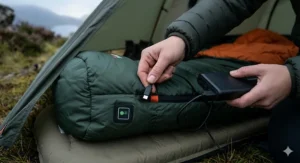
What British reviewers consistently praise is the machine-washable design (up to 30°C) and the integrated USB cable with dedicated power bank pocket. Most 20,000mAh power banks will run this through an entire night on the lower settings, though expect around 3-4 hours on maximum heat. The rectangular shape offers more room than mummy-style alternatives—appreciated by those who tend to fidget or feel claustrophobic.
The limitation? Only one heating zone. If you run cold in your torso or shoulders, you’ll need to pair this with additional layers. For perpetually cold feet and budget-conscious buyers, though, this represents outstanding value.
✅ Pros:
- British brand designed for UK climate
- Machine washable (uncommon in heated bags)
- Works brilliantly as standard 3-season bag without heating
❌ Cons:
- Single heating zone (feet only)
- Rectangular shape less thermally efficient than mummy style
Price: Around £65-£75 | Verdict: Best value for British campers who prioritise foot warmth.
2. KingCamp WHEATLAND 450 3-in-1 Heated Sleeping Bag
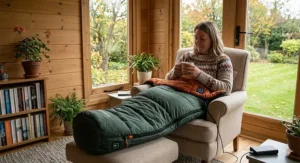
Here’s where things get interesting: the KingCamp WHEATLAND 450 functions as three separate pieces of kit. The main sleeping bag (250g/m² filling), an upper piece (200g/m²), and a lower graphene-heated mat (200g/m²) that detaches completely. This modular approach means you’re essentially carrying a sleeping bag, a heated camp mat, and a blanket in one package.
The four graphene heating sheets distributed across the lower layer deliver adjustable warmth: 50-55°C (high, red LED), 45-50°C (medium, green), and 40-45°C (low, blue). Runtime varies from roughly 3 hours on high through 5 hours on low using a standard 9V/2A power bank. What sets graphene apart from traditional heating wires is more uniform heat distribution and greater durability—these sheets flex with your body rather than creating uncomfortable pressure points.
For British campers, the real advantage emerges in transitional seasons. Early spring in the Cotswolds might start chilly but warm considerably by midday—you can strip down to just the inner bag. Late autumn in the Peak District often means damp ground that saps heat through your sleeping mat; the detachable heated layer addresses this brilliantly when secured to your camp bed.
The polyester-cotton blend strikes a sensible balance: tougher than pure polyester, more breathable than nylon, and it doesn’t develop that clammy feeling common with synthetic bags in humid British air. The envelope design with integrated hood provides decent head insulation, though the hood itself isn’t heated.
A word of caution: the modular system means more pieces to pack and potentially lose. The graphene heating element must be removed before washing, which requires a bit of faff. Still, if you value versatility over simplicity, this delivers.
✅ Pros:
- Genuine 3-in-1 versatility for different conditions
- Graphene technology distributes heat evenly
- Detachable components allow customised warmth levels
❌ Cons:
- More complex packing and setup
- Heating element not machine washable (must be removed first)
Price: £90-£120 range | Verdict: Best for experienced campers who appreciate modular gear systems.
3. MANTUOLE 5-Zone Mummy Style Heated Sleeping Bag
The MANTUOLE 5-Zone addresses the single biggest complaint about budget heated sleeping bags: inadequate battery life. Using a 20,000mAh power bank, you’ll genuinely get 6-14 hours of operation depending on heat setting—that’s enough to run through an entire British winter night with charge to spare.
Those five heating zones cover shoulders, back (two panels), hips, and feet. This comprehensive coverage matters more in British conditions than you might expect. American campers often worry about sub-zero temperatures; British campers face persistent damp cold that seeps into shoulders and lower back even when temperatures hover around 5-10°C. Having targeted heat exactly where cold spots develop makes an enormous difference to actual sleep quality.
The mummy-style design with drawstring hood provides better thermal efficiency than rectangular bags, though it does feel more restrictive. At 230cm x 90cm when fully opened, it accommodates users up to roughly 1.9 metres tall comfortably. The 210T waterproof polyester outer handles British drizzle admirably—not fully submersible, but resistant to the condensation and light rain that plague UK tents.
Temperature rating sits at -1°C/+30°F, though that’s with heating switched on. Without power, treat this as a standard three-season bag. The USB 5V/2A power requirement means most modern power banks work perfectly; just verify your bank delivers 2A output (some cheaper models only manage 1A, which won’t trigger the heating properly).
British buyers should note: this model ships from various suppliers on Amazon UK, and some listings confusingly show both Type-C and standard USB variants. Double-check specifications before ordering to ensure UK compatibility.
✅ Pros:
- Exceptional battery life (6-14 hours realistic runtime)
- Five heating zones cover all major cold spots
- Mummy design maximises thermal efficiency
❌ Cons:
- More restrictive than rectangular styles
- Some Amazon UK listings unclear about exact model variant
Price: £70-£95 | Verdict: Best battery life for multi-day trips without recharging access.
4. ActionHeat 5V Battery Heated Sleeping Bag
The ActionHeat represents premium territory with its tri-zone heating (top, mid, bottom panels) and included 9,300mAh power bank. This American brand uses FAR infrared heating technology combined with ActionWave heat-reflective materials—essentially, the heating panels emit infrared warmth whilst the bag’s lining reflects your body heat back toward you. The cumulative effect provides impressive warmth without draining batteries excessively.
Three heat settings offer good granular control: 140°F/60°C (high, red) for 2.5 hours, 130°F/54°C (medium, white) for 5 hours, or 110°F/43°C (low, blue) for 6+ hours. The included power bank simultaneously charges phones or tablets via a second USB port, which proves genuinely useful when camping remote Scottish bothies where you want to preserve your mobile’s emergency battery.
So why isn’t this ranked higher? Two reasons. First, it’s designed for the American market where extreme cold matters more than persistent damp. British testers report the bag performs brilliantly in dry, freezing conditions but doesn’t handle moisture particularly well—the ActionFlex material can feel clammy after a damp British night. Second, availability in the UK remains patchy. You’ll find it on Amazon.com with international shipping, but expect import duties post-Brexit and longer delivery times. Some UK camping retailers stock it, but at inflated prices (£110-£140 versus $90-$100 in the US).
If you’re planning genuinely cold-weather expeditions—winter mountaineering in the Cairngorms, for instance—this bag’s superior insulation and heating technology justifies the premium. For typical three-season British camping, you’re paying for features you won’t fully utilise.
✅ Pros:
- Excellent build quality and heating technology
- Included power bank with dual USB outputs
- Machine washable (rare for premium heated bags)
❌ Cons:
- US-focused design doesn’t handle British damp well
- Limited UK availability, potential import duties
- Premium pricing for features most UK campers don’t need
Price: £110-£140 (depending on source and import costs) | Verdict: Best for extreme cold-weather specialists, overspecified for casual UK camping.
5. KingCamp FREESPACE HEATING 250
If you’ve ever felt trapped in a standard mummy bag, the FREESPACE 250 addresses that frustration with its extra-wide rectangular design. At roughly 85cm wide (versus 75-80cm for standard bags), this provides genuine room to shift position without fighting restrictive fabric. The 250g/m² hollow cotton filling offers decent insulation independent of the heating, whilst the soft flannel lining proves notably more comfortable against skin than synthetic alternatives.
Four heating zones powered via USB (9V/2A recommended) deliver three-speed temperature control. The heating panels integrate into the bag’s base layer, targeting the areas where you’ll actually lie rather than trying to heat your entire body surface. This focused approach conserves battery life whilst maintaining practical warmth.
Where this excels for British family camping is comfort over raw performance. Children particularly appreciate the roomier design and soft lining, and the envelope shape with integrated hood makes it easier for younger campers to get in and out independently. Parents camping with kids in places like the New Forest or Yorkshire Dales during spring and autumn half-term will find this strikes the right balance between warmth and usability.
The trade-off? Thermal efficiency suffers compared to mummy-style bags. That extra internal volume means more air to heat, which translates to higher battery consumption and less effective insulation when the heating’s switched off. The waterproof rating is decent but not exceptional—fine for inside a tent, less suitable for bivvy camping in typical British drizzle.
One quirk: KingCamp’s sizing can be generous. The “standard” version comfortably fits users up to 1.85m tall, which exceeds some brands’ “long” designations. Check dimensions carefully if you’re particularly tall or short.
✅ Pros:
- Extra-wide design eliminates confined feeling
- Flannel lining far more comfortable than synthetic
- Family-friendly with easier child access
❌ Cons:
- Lower thermal efficiency than mummy bags
- Higher battery consumption due to larger internal volume
Price: £85-£110 | Verdict: Best for families and campers who prioritise comfort over maximum efficiency.
6. Antarctica Gear Pro 5-Zone Heated Sleeping Bag
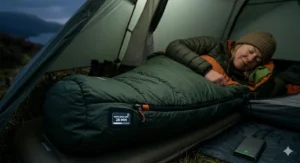
The Antarctica Gear Pro makes bold battery life claims—up to 14.5 hours on low settings with the included 16,000mAh 12V battery pack. British field testing suggests those numbers are achievable, though you’ll want to manage expectations: that’s in moderate conditions (around 10°C) with minimal wind. Drop to near-freezing with a breeze, and expect 8-10 hours, which remains impressive.
Five heating zones (shoulders, back, hip, feet) provide thorough coverage. The 12V system delivers noticeably warmer peak temperatures than 5V alternatives—the high setting genuinely approaches uncomfortable warmth, which matters when you’re trying to recover from a long, cold day hiking the Pennine Way. Three adjustable levels (red-high, blue-medium, green-low) with LED indicators make operation straightforward even inside a dark tent.
The 210T waterproof polyester outer with hollow cotton filling creates a decent cold-weather package independent of heating. Temperature rating claims suggest down to -20°C comfort, though that seems optimistic for most users without the heating active. More realistically, treat this as a solid winter bag that becomes exceptional with heating engaged.
Two concerns for UK buyers. First, the included 12V battery pack charges via a proprietary adapter, not standard USB. If you lose that adapter or it fails, replacement becomes complicated—you can’t simply borrow a mate’s USB cable. Second, the mummy-style fit runs slightly narrow through the shoulders for larger builds. If you’re broad-shouldered, consider sizing up or looking at the FREESPACE instead.
Despite those niggles, the combination of genuine all-night battery life and comprehensive heating coverage makes this a strong contender for serious UK winter campers tackling the Highlands or winter wild camping in Wales.
✅ Pros:
- Genuinely long battery life (8-14.5 hours realistic)
- Included 16,000mAh battery (most competitors require separate purchase)
- Comprehensive five-zone coverage
❌ Cons:
- Proprietary charging adapter (loses it, you’re stuck)
- Narrow shoulder fit for larger builds
Price: £95-£130 | Verdict: Best all-round performance for committed winter campers.
7. Generic USB Heated Sleeping Bag Pad/Liner
Not every camper needs a complete heated sleeping bag system. If you already own a quality sleeping bag suited to British conditions, a heated pad or liner represents an economical upgrade path. These inserts slide inside your existing bag, adding 3-4 heating zones powered by any 5V/2A USB power bank you already own.
The budget appeal is obvious: £25-£50 versus £70-£140 for integrated systems. You’re also not locked into a single sleeping bag—the same heated liner works with different bags for different seasons. Come summer, pack your lightweight bag with the liner for occasional chilly nights. Winter arrives, pair it with your heavy-duty four-season bag for genuine cold-weather capability.
Performance varies wildly depending on which budget brand you select on Amazon UK. Some deliver decent 4-6 hour runtime with even heating; others develop hot spots or fail after a handful of uses. Check reviews carefully and look for listings with substantial UK buyer feedback rather than generic international reviews.
The most significant limitation: these liners add bulk and weight. You’re essentially carrying two separate items instead of one integrated system, and packing becomes more fiddly. The heating elements can shift inside your sleeping bag, sometimes ending up bunched in awkward positions. Some users report the separate liner feeling like an extra layer to fight with rather than a seamless warmth solution.
For car campers with limited budgets or anyone wanting to test heated sleeping solutions before committing to an expensive integrated system, these liners represent sensible entry points. For backpackers or serious outdoor enthusiasts, the compromises probably aren’t worth the savings.
✅ Pros:
- Budget-friendly entry to heated sleeping
- Works with multiple sleeping bags you already own
- Easy to upgrade or replace
❌ Cons:
- Quality highly variable between brands
- Adds bulk and packing complexity
- Heating elements can shift awkwardly inside bag
Price: £25-£50 | Verdict: Best budget option for car campers testing heated sleeping technology.
Real-World Application: Matching Heated Sleeping Bags to British Camping Scenarios
Understanding which heated sleeping bag suits your specific camping style matters more than chasing specifications. Here’s how three typical British outdoor enthusiasts should approach their selection:
Profile 1: Weekend Wild Camper (Lake District, Snowdonia) Meet Sarah, who drives up from Manchester every other weekend to wild camp in the Lakes. She’s hiking 8-12 km to reach pitches, so weight and pack size matter. Temperatures range from 5-15°C depending on season and elevation.
Optimal choice: MANTUOLE 5-Zone Mummy (£70-£95). The mummy design packs smaller than rectangular alternatives, the comprehensive five-zone heating addresses variable mountain temperatures, and the exceptional battery life means she’s not lugging multiple power banks or worrying about recharging. The -1°C rating handles those unexpectedly cold September nights at altitude.
Profile 2: Family Car Campers (Cotswolds, New Forest, Norfolk) The Robinsons introduce their two children (ages 7 and 10) to camping during school holidays. They’re driving to established campsites with facilities, so weight isn’t critical. Comfort and ease of use matter most, particularly for keeping children warm enough to actually sleep.
Optimal choice: KingCamp FREESPACE 250 (£85-£110). The extra-wide design and soft flannel lining make this approachable for children. Parents can help kids adjust the simple three-level heating, and the spacious interior prevents that trapped feeling that makes some children resist sleeping bags entirely. The envelope shape also works as a blanket for reading stories before bed.
Profile 3: Budget-Conscious Festival Goer (Glastonbury, Reading, Download) Tom attends multiple festivals yearly, often sleeping in less-than-ideal conditions. Budget matters, weight doesn’t (he’s carrying minimal gear short distances from car parks), and he needs something that handles varied weather and doesn’t matter if it gets muddy.
Optimal choice: Vango Radiate Single (£65-£75). British-made durability handles festival abuse, the machine-washable design means post-festival cleanup is straightforward, and the foot-zone heating solves the specific problem of cold feet in damp festival fields. The rectangular shape allows lounging in the tent during daytime, and it doubles as decent kit for occasional casual camping trips between festivals.
Each scenario demonstrates why “best” depends entirely on context. Sarah prioritises weight and battery life for remote locations. The Robinsons need comfort and child-friendly features. Tom wants affordable durability that handles abuse. Buying the “wrong” heated sleeping bag for your use case means either paying for features you won’t use or lacking capabilities you genuinely need.
How Graphene Heating Technology Actually Works (And Why It Matters for UK Conditions)
Walk into any outdoor shop and sales staff will enthusiastically mention “graphene heating”—but what does that actually mean, and why should British campers care?
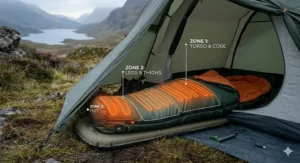
Graphene consists of carbon atoms arranged in a honeycomb lattice just one atom thick. Despite being essentially a sheet of carbon, it conducts electricity and heat extraordinarily efficiently. When you apply voltage across graphene, it converts electrical energy to infrared heat rapidly and uniformly—typically reaching operating temperature within 3-5 seconds compared to 15-30 seconds for traditional heating wires.
For camping, three advantages emerge. First, uniform heat distribution eliminates those uncomfortable hot spots you get with wire-based systems where the wire touches your back directly. Graphene sheets flex naturally with your body movement without creating pressure points. Second, the material is remarkably durable—properly constructed graphene heating elements withstand thousands of flexing cycles, addressing the historical problem of heating wires breaking at stress points after limited use.
Third, and most relevant to British conditions: graphene heating operates efficiently at lower voltages. Traditional heated clothing often requires 7.4V or 12V systems with proprietary batteries. Graphene-based sleeping bags work with standard 5V/2A USB power banks—the same ones you already carry for charging phones. This means you can charge your power bank from any USB source (car adapter, solar panel, portable generator, campsite facilities) without needing specialised equipment.
The infrared heat that graphene produces differs from simple conductive warmth. Infrared penetrates slightly into muscle tissue, which feels more deeply warming and comfortable than surface heating. This explains why users report graphene-heated bags feeling warmer at lower actual temperatures compared to wire-heated alternatives at higher settings.
According to research from the UK Health Security Agency, maintaining core body temperature during cold exposure matters more than heating extremities alone. Graphene’s ability to provide even heating across larger body areas—shoulders, back, hips—aligns better with physiological needs than traditional single-zone foot warmers.
Does all this technical superiority justify premium pricing? For serious outdoor enthusiasts camping in genuinely challenging British conditions—winter Munro-bagging in Scotland, extended bikepacking trips through Welsh mountains in April—probably yes. For casual weekend campers in established campsites? The benefits exist but matter less. A well-designed traditional USB heating system at £50 might serve you better than a mediocre graphene system at £100.
Common Mistakes When Buying Heated Sleeping Bags (And How to Avoid Them)
Mistake 1: Ignoring Temperature Rating vs. Actual UK Conditions
Many heated sleeping bags advertise impressive temperature ratings: “-20°C comfort!” sounds brilliant until you realise that’s with heating activated. British weather rarely drops that cold, but our damp conditions create perceived cold that temperature ratings don’t capture.
Solution: Assess the bag’s passive insulation separately. Could you sleep reasonably comfortably in this bag at 5°C without heating? If yes, the heating becomes a useful supplement. If the bag’s a thin shell relying entirely on electrical warmth, you’re vulnerable if batteries die unexpectedly.
Mistake 2: Overlooking Power Bank Compatibility and Availability
Not all USB outputs are equal. Some heated bags require 5V/2A, others need 9V/2A, and premium models want 12V systems. Your existing 5V/1A phone charging bank won’t trigger many heating elements at all.
Solution: Verify exact voltage and amperage requirements before purchasing. Calculate whether your existing power banks work or if you need to buy specific models. Factor that additional cost into your budget—a “£70 sleeping bag” might actually cost £100 once you’ve bought the required 20,000mAh 2A power bank.
Mistake 3: Choosing Based on Heat Zones Without Considering Your Actual Cold Spots
Five heating zones sounds objectively better than one, but where are those zones placed? If you run cold in your shoulders and lower back but the bag heats your chest and hips instead, you’ve wasted money on irrelevant features.
Solution: Honestly assess where you personally feel cold when camping. Perpetually cold feet? A single foot-zone bag like the Vango Radiate might outperform a scattered five-zone system. Cold torso and shoulders? Prioritise bags with upper-body heating regardless of total zone count.
Mistake 4: Underestimating the Importance of Waterproofing for UK Camping
American and European camping often means dry conditions. British camping means condensation, light rain seeping through tent fabric, and general dampness. Heated sleeping bags marketed elsewhere sometimes use materials that become clammy and unpleasant in humid conditions.
Solution: Look specifically for “210T polyester” or similar waterproof/water-resistant outer shells. Check UK buyer reviews for comments about condensation handling. Brands like Vango that design specifically for British conditions typically address this better than imports.
Mistake 5: Forgetting About Long-Term Running Costs
The sleeping bag purchase is one-time. The power banks, replacement batteries, and electrical charging represent ongoing costs that accumulate over years.
Solution: Calculate cost-per-night including electricity for recharging. Premium bags with efficient heating and long-lasting batteries actually cost less over 50+ camping nights than cheap models requiring frequent battery replacements. The Energy Saving Trust provides useful calculators for small appliance running costs that help contextualise these expenses.
Mistake 6: Buying Based on Brand Recognition Rather Than Actual UK Performance
ActionHeat and Antarctica Gear dominate American reviews, but that doesn’t mean they suit British conditions better than lesser-known brands designed for European weather.
Solution: Prioritise reviews from UK buyers camping in British locations. Someone testing a sleeping bag in Arizona’s dry cold provides limited insight for Lakes District camping. Search specifically for “tested in Scotland,” “used in Wales,” or similar geographical markers in reviews.
Understanding Battery Life and Power Management in British Winter Conditions
The battery life claims on heated sleeping bags represent ideal laboratory conditions—usually around 20°C ambient temperature with no wind and a fresh, fully-charged power bank. British reality differs considerably.
Temperature Impact: Lithium batteries lose capacity in cold. At 0°C, expect roughly 20% reduction in actual available power compared to room temperature. At -5°C (achievable during Scottish winter camping), you might see 30-40% reduction. Your “12-hour” rated bag might deliver only 7-8 hours when you actually need it most.
Practical Management Strategies:
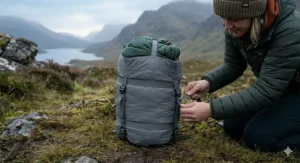
Keep your power bank inside your sleeping bag (in an inside pocket or loose in the foot box) rather than outside in the cold tent air. Your body heat maintains the battery at operational temperature, preserving capacity. This alone can extend runtime by 15-25% in winter conditions.
Don’t run heating continuously at maximum. Start on high for 20-30 minutes to warm the bag whilst you’re getting ready for bed. Once you’re inside and comfortable, step down to medium or low. Most cold discomfort comes from initially climbing into a frigid bag; maintaining warmth requires less power than generating it initially.
Calculate your actual overnight needs. If you sleep 8 hours and your bag delivers 6 hours on medium, you don’t need a bigger battery—you need to run heating for the first 3-4 hours (the coldest part of the night, typically 11pm-3am), then let passive insulation handle the remaining hours. Your body generates enough heat whilst sleeping to maintain comfort once you’re warm initially.
Pack a backup smaller power bank specifically for emergencies. A 5,000mAh unit adds minimal weight but provides that crucial 2-3 hours of heating if your main bank dies unexpectedly. According to UK Scouts’ winter camping guidance, always having emergency warmth options represents essential safety practice.
Charging Realities: Car camping? Run your vehicle for 15 minutes daily to top up power banks via USB. Wild camping multiple nights? A portable solar panel (20-30W) provides enough charge in 4-6 hours of British winter sunlight to run one night’s heating. Factor in that British December daylight runs roughly 8am-4pm, giving you limited solar charging windows.
Premium power banks with LED charge indicators prove worth the investment. Knowing precisely how much capacity remains lets you manage heating strategically rather than guessing whether you’ll make it through the night.
Legal Considerations and Safety Standards for Heated Camping Gear in the UK
British regulations around heated products differ from American and EU standards, though post-Brexit UKCA marking increasingly aligns with practical requirements.
UKCA Marking: Electrical heated products sold in Great Britain (England, Scotland, Wales) should carry UKCA marking indicating conformity with UK safety regulations. Many heated sleeping bags sold through Amazon UK ship from Chinese manufacturers and may lack proper certification. This doesn’t necessarily mean they’re unsafe, but it does mean they haven’t undergone independent UK safety testing.
Practical Implications: If a heated sleeping bag causes a fire or electrical injury and it lacks UKCA marking, your insurance claim becomes significantly more complicated. Some outdoor accident policies specifically exclude injuries from non-certified electrical equipment. Check your camping insurance policy’s fine print.
Carbon Monoxide Risk: Never attempt to modify heated sleeping bags or use external heating sources inside your bag. Some campers have tried combining heated bags with chemical hand warmers or portable propane heaters—this creates serious carbon monoxide poisoning risk. According to UK Government cold weather safety guidance, carbon monoxide is colourless and odourless, making it impossible to detect without sensors. Stick to the manufacturer’s intended electrical heating only.
Water and Electrical Safety: USB heating systems operate at low voltage (5-12V), which poses minimal electrocution risk even if they get wet. However, wet heating elements can short-circuit, killing the battery or permanently damaging the heating function. Most quality sleeping bags use waterproof encapsulation around heating elements specifically to prevent this.
If your heated sleeping bag gets genuinely soaked (fell in a stream, tent flooded), disconnect power immediately, remove heating elements if detachable, and dry everything thoroughly before attempting to use electrical functions again. The sleeping bag itself can typically be used without heating while wet; just don’t power up the heating until completely dry.
Battery Safety: Lithium battery fires, whilst rare, are catastrophic when they occur in confined spaces like tents. Only use power banks from reputable manufacturers with overcharge protection and thermal cutoff. Never leave power banks charging unattended in tents, and never charge them whilst actively using them to power heated bags. The dual electrical load can overheat cheaper batteries.
Store power banks in hard cases rather than loose in packs where they might get crushed or punctured. A damaged lithium battery can ignite hours after the initial damage occurs.
Heated Sleeping Bags vs Traditional Cold-Weather Alternatives: The Honest Comparison
| Factor | Heated Sleeping Bag | Traditional Down Bag | Synthetic Extreme Cold Bag | Multiple Sleeping Bags |
|---|---|---|---|---|
| Weight | 1.8-2.4 kg + power bank (0.4-0.6 kg) | 1.2-1.8 kg | 2.0-3.5 kg | 2.0-4.0 kg total |
| Pack Size | Medium-large | Small-medium | Large-very large | Very large |
| Cost (GBP) | £65-£140 | £200-£500 | £150-£300 | £150-£400 |
| Wet Weather Performance | Variable (most handle British damp acceptably) | Poor (down loses insulation when wet) | Excellent | Depends on specific bags |
| Temperature Flexibility | Excellent (adjust heating instantly) | Fixed rating | Fixed rating | Good (swap bags) |
| Dependency Risk | Battery dies = reduced performance | None | None | None |
| Maintenance | Moderate (battery care + bag care) | High (specialist cleaning) | Low | Moderate |
| Lifespan | 3-5 years (batteries degrade) | 10-15 years | 7-12 years | Varies |
The comparison reveals heated sleeping bags occupy a specific niche rather than replacing traditional solutions entirely. For British spring and autumn camping where temperatures hover around 5-12°C and conventional bags leave you slightly cold, heated bags genuinely improve comfort without massive weight penalties.
For genuine winter mountaineering in Scotland where temperatures drop to -10°C or below, traditional four-season down bags still outperform heated alternatives. Batteries simply can’t maintain heating through 12-hour winter nights at those temperatures, and relying on electrical systems when weather turns severe represents poor safety practice.
The hybrid approach makes most sense for many British campers: own a decent three-season conventional bag as your foundation, then add a budget heated liner (£25-£50) for shoulder-season trips. This provides flexibility without single-point-of-failure risk.
Maintenance and Care: Making Your Heated Sleeping Bag Last
British conditions—damp, muddy, occasionally frosty—test sleeping bag durability harder than dry continental climates. Proper care extends lifespan significantly.
After Every Trip: Air your sleeping bag completely before storing. Hang it outdoors on a dry, breezy day or indoors over a clothes horse for 24-48 hours. British condensation means “dry-feeling” bags often retain moisture that promotes mildew. If you smell any mustiness, wash before storing.
Washing Protocols: Remove all electrical components before washing (detachable heating pads, integrated USB cables disconnected from their ports). Most heated bags machine wash at 30°C on delicate cycle, but check your specific model’s tags.
Use technical fabric cleaner rather than standard detergent—regular detergents leave residues that reduce insulation and water resistance. Nikwax Tech Wash or similar products work well and are widely available in UK outdoor shops.
Never tumble dry unless explicitly stated as safe by the manufacturer. Line dry in shade—direct sunlight degrades synthetic materials over time. Expect 2-3 days to fully dry in typical British humidity.
Battery Care: Lithium batteries last longest when stored at 40-60% charge, not fully charged or depleted. Before putting your camping gear away for winter, discharge power banks to roughly half, then store in a cool (not cold) dry place. Fully charge 24-48 hours before your next trip.
Don’t leave power banks in cold garages or sheds through winter—temperatures below 0°C can permanently reduce capacity. Keep them indoors.
Long-Term Storage: Store sleeping bags loosed in a large cotton storage sack, never compressed in their stuff sacks. Compression damages insulation over time. If space is limited, hang them in a wardrobe.
Keep heating elements flat rather than folded tightly—repeated tight creasing can damage graphene sheets or wire elements at fold points.
Lifespan Expectations: Quality heated sleeping bags should provide 5-8 years of regular use with proper care. Power banks typically need replacing after 3-4 years as lithium capacity naturally degrades. Budget this cost: a replacement 20,000mAh power bank costs £25-£40.
FAQ: Your Heated Sleeping Bag Questions Answered
❓ Are heated sleeping bags safe to use in tents?
❓ How long do heated sleeping bags stay warm on a single charge?
❓ Can you wash heated sleeping bags in a washing machine?
❓ Are heated sleeping bags worth it for UK camping?
❓ Do heated sleeping bags work with portable solar panels for recharging?
Conclusion: Finding Your Perfect Heated Sleeping Bag for British Conditions
The heated sleeping bag market has matured considerably since early USB-heated offerings that barely warmed your feet. Modern graphene technology, improved battery efficiency, and designs specifically addressing British camping challenges mean you’re no longer choosing between comfort and practicality.
For most UK campers, the Vango Radiate at £65-£75 represents the sensible starting point—British-designed, machine-washable, and genuinely effective at solving the specific problem of cold feet in damp conditions. If you camp regularly enough to justify premium investment, the MANTUOLE 5-Zone (£70-£95) or Antarctica Gear Pro (£95-£130) deliver comprehensive heating and exceptional battery life that transforms multi-day trips.
Families should seriously consider the KingCamp FREESPACE 250 for its child-friendly design and comfort-focused features, whilst experienced wild campers tackling Scottish Highlands or Welsh mountains benefit from the MANTUOLE‘s proven overnight battery performance and comprehensive heating coverage.
The technology isn’t perfect—batteries degrade, electrical systems can fail, and nothing replaces proper layering and conventional cold-weather camping knowledge. But as a practical tool for extending your comfortable camping season and actually enjoying those crisp autumn evenings rather than merely enduring them, heated sleeping bags have earned their place in British outdoor gear collections.
Your purchase decision should ultimately match your specific camping patterns, budget constraints, and honest assessment of where you personally feel cold. The “best” heated sleeping bag is whichever one addresses your particular discomfort points whilst fitting your practical requirements for weight, pack size, and maintenance. With the options now available on Amazon UK, finding that match has never been more achievable.
Recommended for You
- Electric Blanket vs Heated Throw: 7 Best UK Options 2026
- Infrared vs Ceramic Heater UK 2026: 7 Best Picks to Slash Bills
- Electric Heating vs Gas: 7 Best Options UK 2026
Disclaimer: This article contains affiliate links. As an Amazon Associate, I earn from qualifying purchases. If you purchase products through these links, we may earn a small commission at no additional cost to you.
✨ Found this helpful? Share it with your mates! 💬🤗
