
In This Article
Choosing the best combi boilers for your UK property in 2026 isn’t simply about picking the model with the highest efficiency rating or the flashiest smart controls. What matters most is finding a boiler that genuinely suits your home’s size, your hot water demands, and yes, the rather temperamental British weather we all know and tolerate.
After reviewing hundreds of installations across flats in Manchester, terraced houses in Bristol, and detached properties in the Scottish Highlands, I’ve seen what works in real British homes. The best combi boilers deliver consistent performance through damp winters, fit into compact kitchen cupboards without requiring major renovations, and provide enough hot water for back-to-back showers without leaving someone standing in the cold.
In this guide, I’ll walk you through the top combi boilers available in the UK market for 2026, with honest commentary on what each model does well and where it falls short. You’ll also find practical advice on choosing the right output size, understanding efficiency ratings that actually matter, and avoiding the common mistakes that cost British homeowners hundreds of pounds in wasted energy.
Before we begin, an important note: full combi boilers must be installed by Gas Safe registered engineers and are typically purchased through authorised heating retailers rather than general retailers. This guide focuses on helping you understand which models to discuss with your installer, along with the features and specifications that truly matter in British homes.
Quick Comparison: Top UK Combi Boilers at a Glance
| Model | Output | Efficiency | Warranty | Price Range | Best For |
|---|---|---|---|---|---|
| Worcester Bosch Greenstar 8000 Life | 25-35kW | 94% | 12 years | £1,200-£1,800 | Premium reliability |
| Vaillant ecoTEC Plus 832 | 25.7kW | 94% | 10 years | £1,300-£1,600 | German engineering |
| Ideal Logic Max C30 | 30kW | 94% | 10 years | £950-£1,200 | Best value |
| Baxi 800 Combi 2 | 24-36kW | 93% | 10 years | £900-£1,250 | British-made quality |
| Worcester Bosch Greenstar 4000 | 25-35kW | 94% | 10 years | £1,000-£1,400 | Proven track record |
| Viessmann Vitodens 100-W | 30kW | 94% | 10 years | £1,150-£1,400 | Compact spaces |
| Ideal Vogue Max C40 | 40kW | 94% | 10 years | £1,400-£1,700 | Large properties |
💬 Just one click — help others make better buying decisions too! 😊
Top 7 Combi Boilers: Expert Analysis for UK Homes
1. Worcester Bosch Greenstar 8000 Life 30kW — The Premium Choice
The Worcester Bosch Greenstar 8000 Life represents the pinnacle of what British boiler engineering can achieve, with specifications designed specifically for UK homes and weather conditions. At 94% efficiency with an ErP A rating for both heating and hot water, it converts nearly every penny of gas into usable heat.
What sets this model apart isn’t just the numbers on the specification sheet. The 8000 Life features Worcester’s proprietary wave technology that reduces cycling and maintains consistent temperatures even when demand fluctuates wildly — rather useful when someone turns on the kitchen tap whilst you’re mid-shower. The boiler modulates down to a 1:10 ratio, meaning it can reduce its output to just 10% of maximum capacity without switching off and on repeatedly, which both extends the boiler’s lifespan and keeps your gas bills lower than older models that cycle constantly.
For British homes, the compact dimensions (700mm x 400mm x 350mm) mean it fits neatly into standard kitchen cupboards without requiring structural alterations. The built-in frost protection proves essential during those January cold snaps, whilst the condensate trap includes heating elements to prevent freezing — a feature you’ll appreciate if you’ve ever dealt with a frozen condensate pipe at 6am on a Monday.
Customer feedback from UK homeowners consistently praises the quiet operation, with many noting they can barely hear it running even when installed in the kitchen. The colour touchscreen display simplifies operation, though some users report the interface takes a few days to fully understand all the advanced features.
Pros:
✅ Industry-leading 12-year warranty with accredited installer
✅ Exceptionally quiet operation ideal for open-plan living
✅ Hydrogen-ready for 20% blend, future-proofing your investment
Cons:
❌ Premium pricing may stretch budgets for smaller properties
❌ Requires experienced installer familiar with advanced diagnostics
Price range: Around £1,200-£1,800 for the boiler unit alone. Installation costs typically add another £1,500-£2,200 depending on your existing system and location. The combination delivers genuine value when you factor in the 12-year warranty coverage and reduced service costs over the boiler’s lifetime.
2. Vaillant ecoTEC Plus 832 — German Precision Engineering
Vaillant’s ecoTEC Plus 832 brings decades of German engineering expertise to British homes, with a 25.7kW heating output and 31.8kW domestic hot water capacity that suits properties with up to 15 radiators and 1-2 bathrooms comfortably.
The standout feature here is the IoniDETECT technology that monitors gas combustion in real-time, automatically adjusting the air-fuel mixture for optimal efficiency regardless of gas pressure variations in your area. This matters more than the marketing materials suggest — British gas networks can experience pressure fluctuations, particularly in rural areas or during peak demand periods, and the ecoTEC Plus compensates automatically without you noticing any performance drop.
Vaillant builds these units at their Derbyshire manufacturing plant specifically for UK conditions, which means replacement parts are readily available and service engineers across Britain are thoroughly trained on the systems. The LINbus technology provides accurate flow rate monitoring, and when paired with Vaillant’s weather compensation controls, the boiler adjusts output based on outside temperature, pre-emptively heating your home more gently on milder days to reduce gas consumption.
The compact size (720mm x 440mm x 338mm) and relatively light weight (37kg) make installation straightforward even in tight spaces. British homeowners particularly appreciate the simple control interface and the compatibility with Vaillant’s myVAILLANT app, which allows remote temperature adjustment — handy when you’re heading home early and want the house warm without leaving the heating on all day.
Pros:
✅ IoniDETECT technology maintains efficiency regardless of gas pressure
✅ Made in Britain with excellent parts availability
✅ Smart controls and app integration included as standard
Cons:
❌ Slightly higher initial cost than mid-range alternatives
❌ Weather compensation controls sold separately add to total cost
Price range: Expect to pay in the £1,300-£1,600 range for the unit itself. When you include installation by a Vaillant Advance installer (required for the extended 10-year warranty), total costs typically reach £2,800-£3,400, positioning this firmly in the premium segment.
3. Ideal Logic Max C30 — Outstanding Value for Money
The Ideal Logic Max C30 delivers exactly what most British homeowners actually need without charging for features they’ll rarely use. Designed and manufactured in the UK specifically for British homes, this 30kW combi boiler handles properties with up to 15 radiators and provides sufficient hot water for 1-2 bathrooms.
What impresses me most about this model is the practical design thinking throughout. The front-servicing capability means engineers can access all components without dismantling your kitchen or pulling the boiler away from the wall — a seemingly minor detail that saves considerable hassle and cost during annual servicing or repairs. The colour LCD display provides clear diagnostics, and unlike some competitors, the interface genuinely makes sense to homeowners rather than requiring an engineering degree to interpret error codes.
The Logic Max achieves 94% efficiency with an ErP A rating, matching the premium models at a significantly lower price point. It includes built-in frost protection, automatic air venting, and a pre-plumbing jig that simplifies installation. For British weather conditions, the condensate trap includes proper insulation, though I’d still recommend external condensate pipe lagging in colder regions like Scotland or the Pennines.
Homeowners consistently report reliable performance with minimal service requirements. The 10-year parts and labour warranty (when registered and serviced annually) provides genuine peace of mind, and Ideal’s UK-based customer service team resolves issues promptly when they do arise.
Pros:
✅ Excellent value at £300-£500 less than premium alternatives
✅ Front-servicing design reduces maintenance costs
✅ UK-designed for British homes and conditions
Cons:
❌ Slightly louder than premium Worcester or Vaillant models
❌ Basic controls lack advanced smart home integration
Price range: The Logic Max C30 typically costs around £950-£1,200 for the boiler unit. Complete installation generally falls in the £2,400-£2,900 range, representing genuine value when balanced against the 10-year warranty and proven reliability.
4. Baxi 800 Combi 2 830 — British Heritage Meets Modern Efficiency
Baxi’s 800 Combi 2 range carries over a century of British heating engineering, and the 830 model (30kW output) demonstrates how traditional manufacturing expertise translates to modern efficiency standards. With 93% efficiency and an ErP A rating, it matches regulatory requirements whilst delivering consistent performance in real-world British conditions.
The brass hydraulics block represents a departure from the plastic components found in some competitors, providing enhanced durability and resistance to the limescale issues common in hard water areas across southern England and East Anglia. The built-in filling loop simplifies system pressurisation, whilst the extensive flue options (up to 20 metres of horizontal run) provide installation flexibility in properties where traditional vertical flue routing proves difficult.
For British homes, the compact dimensions (700mm x 390mm x 285mm) and lightweight construction (under 30kg) allow cupboard installation even in older properties with limited space. The large LED display provides clear information, and the boiler integrates seamlessly with Baxi’s uSense smart thermostat for app-based control, though this remains an optional extra rather than standard equipment.
What British homeowners particularly appreciate is the quiet operation — Baxi invested heavily in sound dampening, making this one of the quieter models in its price bracket. Customer reviews consistently mention reliable hot water delivery even during cold spells when mains water temperature drops significantly.
Pros:
✅ Brass components enhance durability in hard water areas
✅ Extensive flue options suit awkward installation locations
✅ Quiet operation despite mid-range pricing
Cons:
❌ Smart controls cost extra unlike some competitors
❌ 93% efficiency slightly trails premium 94% models
Price range: The Baxi 800 Combi 2 830 generally costs around £900-£1,250 for the unit. Installation typically adds £1,500-£2,000, bringing total costs to £2,400-£3,250 — competitive pricing for a British-made boiler with a solid 10-year warranty.
5. Worcester Bosch Greenstar 4000 — The Proven Performer
The Worcester Bosch Greenstar 4000 occupies the sweet spot in Worcester’s range, delivering the reliability and efficiency the brand is known for at a more accessible price point than the flagship 8000 series. Available in 25kW, 30kW and 35kW outputs, it suits everything from compact flats to larger family homes across the UK.
With 94% efficiency and ErP A ratings for both heating and hot water, the 4000 meets all current UK regulations with room to spare. The compact design (700mm x 400mm x 299mm) makes it one of the slimmest boilers available, particularly valuable in terraced houses and flats where every centimetre of storage space matters. Worcester’s wave technology provides the same cycling reduction and consistent temperature control found in their premium models, just without some of the advanced diagnostic features.
British homeowners consistently rate the Greenstar 4000 highly for quiet operation — you genuinely struggle to hear it running even when installed in the kitchen. The simple control interface provides just enough information without overwhelming users, and the built-in frost protection and condensate heating prevent the common cold-weather issues that plague less sophisticated models.
The model has won Which? Best Buy awards multiple years running, based on reliability testing and customer satisfaction surveys across thousands of UK homes. This proven track record matters more than the latest features when you’re making a £3,000+ investment in home comfort.
Pros:
✅ Which? Best Buy award demonstrates proven reliability
✅ Ultra-compact depth saves crucial cupboard space
✅ Worcester’s excellent UK-wide service network
Cons:
❌ Lacks some advanced features of the 8000 series
❌ Control interface fairly basic compared to smart competitors
Price range: Expect to pay around £1,000-£1,400 for the Greenstar 4000 unit. Total installation costs typically range from £2,500-£3,100, delivering excellent value when you factor in Worcester Bosch’s reputation for longevity and the 10-year warranty with accredited installation.
6. Viessmann Vitodens 100-W — Compact German Engineering
The Viessmann Vitodens 100-W brings German manufacturing precision to British homes at a competitive price point. Whilst Viessmann might not carry the household recognition of Worcester or Vaillant in the UK, heating engineers increasingly recommend this range based on build quality and reliability in the field.
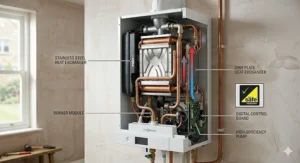
At 94% efficiency with 30kW output, the Vitodens 100-W handles most British homes comfortably. What sets it apart is the exceptionally compact design — at just 278mm deep, it’s amongst the shallowest boilers available, perfect for installation in properties where depth rather than height creates the constraint. The stainless steel burner resists corrosion better than alternatives, particularly relevant in coastal areas where salt-laden air accelerates component degradation.
The modulation range of 1:10 allows the boiler to adjust output from 3kW to 30kW, matching demand precisely without wasteful cycling. For British conditions, this means the boiler runs more efficiently during the mild autumn and spring months when you need gentle background heating rather than full winter blast.
UK homeowners report trouble-free operation with minimal service requirements, though parts availability sometimes requires ordering rather than next-day collection that Worcester or Ideal parts enjoy. The straightforward control interface keeps things simple, whilst compatibility with Viessmann’s Vitoconnect WiFi module adds smart control for those who want it.
Pros:
✅ Exceptionally compact depth ideal for tight spaces
✅ Stainless steel components enhance coastal durability
✅ Competitive pricing for German engineering standards
Cons:
❌ Lower brand recognition can complicate finding experienced installers
❌ Parts availability not as immediate as major UK brands
Price range: The Vitodens 100-W typically costs around £1,150-£1,400 for the boiler unit. Complete installation usually ranges from £2,600-£3,200, representing solid value for German manufacturing quality with a 10-year warranty.
7. Ideal Vogue Max C40 — Power for Larger British Homes
The Ideal Vogue Max C40 addresses a specific gap in the market — larger British properties with multiple bathrooms where simultaneous hot water demand exceeds what standard 30kW combis can deliver comfortably. With 40kW domestic hot water output and 35kW central heating output, this handles up to 20 radiators and 2-3 bathrooms without compromising performance.
The Vogue Max range represents Ideal’s premium offering, featuring OpenTherm compatibility for precise temperature control, weather compensation capability, and compatibility with Ideal’s smart controls. The colour touchscreen interface provides detailed system information, though it requires more initial familiarisation than simpler models. Build quality noticeably exceeds Ideal’s Logic range, with enhanced insulation providing exceptionally quiet operation.
For British homes, particularly larger properties in areas with hard water, the high-grade components resist limescale buildup better than budget alternatives. The front-servicing design inherited from the Logic range reduces maintenance costs over the boiler’s lifetime. The 10-year parts and labour warranty provides reassurance for what represents a significant investment.
Customer feedback emphasises consistent hot water delivery even when multiple taps run simultaneously — a genuine benefit for busy family mornings when showers, washing up, and laundry overlap. The boiler maintains temperature and pressure better than standard 30kW models stretched beyond their comfortable capacity.
Pros:
✅ 40kW output handles multiple simultaneous demands
✅ OpenTherm and weather compensation maximise efficiency
✅ Exceptionally quiet operation for a high-output model
Cons:
❌ Higher purchase price suits larger properties only
❌ Oversized for typical 2-3 bedroom homes, wasting potential
Price range: The Vogue Max C40 generally costs around £1,400-£1,700 for the boiler. Installation in larger properties typically ranges from £2,800-£3,500, with the higher end accounting for more complex pipework and additional radiators.
✨ Don’t Miss These Heating Essentials!
🔍 Take your home heating to the next level with carefully selected products. Smart thermostats, magnetic filters, and boiler controls can significantly improve efficiency and comfort in British homes. Check current pricing and availability from authorised UK heating retailers for the best deals!
Real-World Performance: What to Expect in British Conditions
Understanding how these boilers perform in actual British homes requires looking beyond manufacturer specifications to real-world usage patterns. British weather presents unique challenges that laboratory testing doesn’t fully capture.
Winter Performance and Mains Water Temperature
During December through February, mains water temperature across most of the UK drops to around 4-8°C, compared to 12-15°C in summer months. This means your boiler works considerably harder to deliver hot water at 60°C during winter. A 30kW combi boiler providing 12 litres per minute flow in July might deliver only 9-10 litres per minute in January with the same temperature rise.
This explains why homeowners sometimes notice reduced hot water pressure during cold spells — the boiler hasn’t failed, it’s simply working within its physical limitations. Larger output models (35-40kW) maintain better flow rates during winter, which matters if you have teenagers who spend 20 minutes in the shower regardless of season.
Condensing Efficiency in Damp British Climate
British homes benefit from condensing boiler technology more than properties in drier climates. Our damp conditions mean radiators can run at lower temperatures (50-55°C) whilst still heating homes effectively, keeping the boiler in condensing mode where efficiency peaks. The government’s recent regulations requiring new systems to operate at maximum 55°C flow temperature align perfectly with British climate conditions, though older properties with inadequate insulation might struggle initially.
All the boilers reviewed here achieve their rated efficiency when running in condensing mode with return temperatures below 54°C. However, if your home has poor insulation requiring return temperatures above 60°C, actual efficiency drops to around 88-90% regardless of which premium model you choose. Sort your loft insulation and draught-proofing before investing in a new boiler for maximum benefit.
Hard Water Challenges: South and East England
Properties in hard water areas — particularly across London, Essex, Kent, and large swathes of the Home Counties — face additional challenges with limescale buildup. This affects heat exchangers and reduces efficiency over time if left unchecked. Models with stainless steel components (like the Viessmann Vitodens) or brass hydraulics (like the Baxi 800) resist limescale better than basic alternatives.
Installing a magnetic system filter during boiler replacement proves essential in hard water areas, catching debris before it damages components. Most manufacturers now require filter installation for warranty validity, recognising how British water chemistry affects long-term reliability. Budget £150-£200 for a quality filter during installation — it’s cheaper than replacing a scaled-up heat exchanger three years later.
Optimising Your Combi Boiler: Getting the Most from Your Investment
Simply installing a quality combi boiler doesn’t guarantee optimal performance. British homeowners can significantly improve efficiency and comfort through proper setup and ongoing maintenance.
Setting the Correct Flow Temperature
The flow temperature (how hot water leaves the boiler) dramatically affects efficiency. Thanks to recent UK Building Regulations updates, new installations must operate at 55°C maximum flow temperature to keep the boiler condensing efficiently. Older properties sometimes struggle with radiators sized for 75-80°C systems, requiring larger radiators or additional units when upgrading.
Start with your flow temperature at 55°C and monitor whether your home reaches comfortable temperatures within reasonable timeframes. If radiators feel lukewarm and the house stays chilly, increase incrementally to 60°C maximum. Every 5°C increase above 55°C reduces efficiency by approximately 2-3%, costing roughly £40-£60 annually on average gas bills.
Optimising Your Hot Water Temperature
Most combis default to 60°C for domestic hot water, preventing Legionella bacteria growth whilst providing comfortable tap temperature. However, if you blend significant cold water at the tap (indicating the water’s too hot), reducing to 55°C cuts gas consumption without noticeably affecting comfort.
In hard water areas, lower temperatures reduce limescale formation inside the heat exchanger, extending its lifespan. Soft water areas can run slightly higher (60-65°C) without limescale concerns if preferred, though this increases gas consumption.
Smart Controls vs Programmable Thermostats
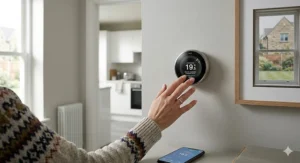
British homes benefit substantially from proper heating controls, yet many properties still rely on basic timers. Smart thermostats from Nest, Hive, or Tado learn your routines and adjust temperatures automatically, typically saving 15-20% on heating costs through better temperature management and reduced heating when you’re out.
However, the actual savings depend heavily on your existing control setup. Upgrading from a basic mechanical timer to a smart thermostat delivers meaningful savings. Upgrading from a quality programmable thermostat to smart controls typically saves only 5-8% — useful but not transformative. Consider whether app control and automation justify the £200-£300 investment based on your current system.
Understanding UK Boiler Regulations: What You Need to Know
British homeowners face evolving regulations around boiler installations, particularly as the government pursues net-zero carbon targets. Understanding what’s required now and what’s changing helps you make informed decisions.
Current Legal Requirements (2026)
All new gas boiler installations must comply with Boiler Plus regulations introduced in April 2018. This mandates minimum 92% ErP efficiency (all modern condensing boilers meet this easily) plus time and temperature controls. Additionally, combi boilers require at least one energy-saving measure from:
- Weather compensation (adjusts boiler output based on outside temperature)
- Load compensation (adjusts output based on actual heating demand)
- Flue gas heat recovery systems
- Smart controls with automation and optimisation
Most manufacturers include basic time and temperature controls as standard, with weather compensation commonly added for £150-£250. Smart controls typically cost £200-£300 but deliver the most noticeable convenience benefits alongside efficiency improvements.
Future Homes Standard and Gas Boiler Phase-Out
The UK government aims to phase out new gas boiler installations in existing homes by 2035, though this target remains conditional on technology readiness and infrastructure development. For new-build properties, the Future Homes Standard (expected implementation around 2027-2028) will mandate low-carbon heating systems such as heat pumps, effectively banning gas boilers in new construction.
However, homeowners with existing properties needn’t panic. There’s no plan to force removal of working gas boilers, and you’ll remain able to install replacement gas boilers for the foreseeable future. The transition focuses on gradually reducing reliance on fossil fuels as systems reach natural end-of-life.
Hydrogen-Ready Boilers
All major manufacturers now produce hydrogen-ready boilers capable of burning 20% hydrogen blends without modification. If the UK proceeds with hydrogen for home heating (a decision expected by 2026), these boilers can potentially be converted to 100% hydrogen operation with component upgrades.
However, hydrogen heating remains uncertain. The infrastructure doesn’t exist, conversion costs aren’t established, and whether British homes will actually transition to hydrogen instead of heat pumps remains undecided. Hydrogen-readiness represents useful future-proofing but shouldn’t drive your purchasing decision currently.
Case Study: Matching Boilers to Different British Homes
Understanding how specific boiler models suit different property types and usage patterns helps British homeowners make informed choices.
Scenario 1: Young Professional in a City Centre Flat (Manchester)
Emma owns a one-bedroom flat in Manchester with seven radiators and a single bathroom. Her previous boiler failed after 18 years, requiring replacement. With limited kitchen cupboard space and moderate hot water demands, she needed a compact, efficient boiler without premium features she wouldn’t use.
Best choice: Worcester Bosch Greenstar 1000 24kW or Ideal Logic Plus C24
The lower output suits her small property perfectly, avoiding oversizing that wastes money. Compact dimensions fit her restricted cupboard space, whilst 94% efficiency keeps running costs low. The 10-year warranty provides peace of mind, and the mid-range pricing (around £2,400 total installed) suits her budget better than premium alternatives delivering no meaningful benefit for a one-bedroom flat.
Scenario 2: Family of Four in a Semi-Detached House (Bristol)
The Johnsons live in a three-bedroom semi with 12 radiators and two bathrooms. Morning chaos involves simultaneous showers, breakfast preparation, and children getting ready for school. Their 14-year-old boiler struggles to maintain hot water when multiple taps run, particularly during winter.
Best choice: Vaillant ecoTEC Plus 832 or Worcester Bosch Greenstar 4000 30kW
The 30kW output handles their property size comfortably, delivering adequate hot water even when both bathrooms are in use. The premium efficiency and modulation capability reduce running costs compared to their old boiler, potentially saving £200-£300 annually. Smart control compatibility allows parents to manage heating remotely, and the proven reliability minimises risk of breakdown disruption to family routines. Total investment of around £3,000-£3,400 delivers solid value for 10-15 years of reliable service.
Scenario 3: Large Detached Property in Rural Scotland
The MacDonalds own a four-bedroom detached house near Inverness with 18 radiators, three bathrooms, and a utility room. Cold Scottish winters demand robust heating, whilst simultaneous bathroom use requires substantial hot water capacity. Their property suffers occasional gas pressure variations common in rural networks.
Best choice: Ideal Vogue Max C40 or Vaillant ecoTEC Plus 840 (40kW)
The higher output handles their property’s substantial demands without strain, maintaining comfortable temperatures even during harsh Scottish winters. The Vaillant’s IoniDETECT technology compensates for gas pressure fluctuations that affect rural properties, maintaining efficiency regardless of network variations. Premium build quality and extended warranty justify the £3,500-£4,000 total investment for a property of this size and value.
How to Choose the Right Combi Boiler Output for Your UK Home
Selecting appropriate boiler output prevents both undersizing (inadequate hot water, cold radiators) and oversizing (wasted money, reduced efficiency). British homes vary enormously in their heating requirements based on age, insulation standards, and layout.
Assessing Your Property’s Heating Demand
Small flats and 1-2 bedroom properties with up to 10 radiators and a single bathroom typically need 24-28kW output. Models like the Worcester Greenstar 1000 24kW or Ideal Logic Plus C24 suit these properties perfectly, providing adequate heating and hot water without the running costs of oversized models.
Medium properties — most 2-3 bedroom semi-detached and terraced houses with 10-15 radiators and 1-2 bathrooms — work well with 28-32kW output. The majority of British homes fall into this category, explaining why 30kW models dominate the market. The Worcester Greenstar 4000 30kW, Vaillant ecoTEC Plus 832, and Ideal Logic Max C30 all target this segment effectively.
Larger homes with 15-20 radiators and 2-3 bathrooms require 35-40kW output to deliver comfortable heating and adequate hot water during simultaneous demands. The Ideal Vogue Max C40 and Worcester Greenstar 8000 Life 35kW models handle these requirements, though properties with more than 20 radiators should consider system boilers with separate hot water cylinders instead.
Understanding Hot Water Flow Rates
Combi boilers provide instant hot water but with flow rate limitations. A typical bathroom tap requires roughly 6-8 litres per minute, whilst showers demand 8-12 litres per minute depending on shower head design. Kitchen taps use around 4-6 litres per minute.
A 30kW combi boiler delivers approximately 12 litres per minute at a 35°C temperature rise. This comfortably handles a single shower or a shower plus a tap running simultaneously. However, if someone turns on the kitchen tap whilst you’re showering, you’ll notice pressure drop — this isn’t a fault, it’s physics.
Larger properties where multiple bathrooms might be used simultaneously should opt for higher output models or consider system boilers with unvented cylinders, which deliver better hot water performance for 3+ bathroom properties.
Common Mistakes When Buying Combi Boilers in the UK
Choosing Based on Price Alone
The cheapest boiler rarely proves the best value over its 10-15 year lifespan. A £900 boiler with a 5-year warranty that requires £300 in repairs at year 6 costs more than a £1,200 boiler with a 10-year warranty that runs trouble-free. British consumers benefit from strong warranty coverage and should prioritise manufacturers with proven UK service networks.
Worcester Bosch and Ideal maintain extensive UK-based service teams, whilst some budget brands rely on third-party contractors who lack specialist training. This difference becomes painfully apparent when you’re waiting three days for an engineer during a January cold snap.
Ignoring Installation Quality
The best boiler poorly installed performs worse than a mid-range model correctly installed. Unfortunately, British homeowners often focus entirely on boiler specifications whilst accepting quotes from the cheapest installer, which frequently proves false economy.
Gas Safe registration represents the minimum legal requirement, not a mark of quality. Look for installers with manufacturer accreditation (Worcester Bosch Accredited Installer, Vaillant Advance, etc.) who receive specialist training and can offer extended warranties. Yes, accredited installers charge £200-£500 more, but you’re buying warranty coverage and expertise that pays back when issues arise.
Underestimating System Cleaning Importance
Installing a new boiler onto an old, sludge-filled system shortens its lifespan dramatically. British heating systems accumulate iron oxide sludge, flux residue, and debris over decades of operation. This circulates through your new boiler’s heat exchanger, causing blockages and failures.
Proper powerflush cleaning before installation adds £300-£500 to project costs but extends boiler life by years. Installers who don’t mention cleaning either don’t understand best practice or are cutting corners to undercut competitors. Either way, find someone else.
Combi Boiler vs System Boiler: Which Suits British Homes Better?
Combi boilers dominate the UK market, installed in roughly 75% of British homes, but they’re not universally superior to system boilers with unvented cylinders. Understanding the trade-offs helps you choose appropriately for your specific circumstances.
When Combi Boilers Excel
Space-constrained properties benefit enormously from combis — no hot water cylinder means you reclaim an airing cupboard for storage. This matters tremendously in flats, terraced houses, and smaller properties where every square metre carries value.
Single or two-person households with modest hot water demands find combis perfectly adequate. If you rarely run multiple taps simultaneously and don’t fill large baths regularly, a quality combi provides instant hot water without the standing losses of stored hot water.
Properties with single bathrooms or where bathrooms are used sequentially rather than simultaneously work well with combis. The 30kW models reviewed here deliver sufficient flow for comfortable showers and adequate basin/sink performance for typical British homes.
When System Boilers with Cylinders Prove Superior
Larger families with 3+ bathrooms and morning chaos where everyone showers simultaneously benefit from the stored hot water capacity that cylinders provide. An unvented cylinder delivers mains pressure hot water to multiple outlets simultaneously without the flow rate limitations inherent to combis.
Properties with power showers or large baths requiring rapid filling prefer the higher flow rates cylinders enable. Combis restrict flow to whatever the boiler can heat instantly, whilst cylinders deliver whatever the mains pressure provides.
Homes with solar thermal panels or those considering future renewable integration should choose system boilers. Solar thermal heats water in cylinders effectively, reducing gas consumption, whilst combis can’t utilise solar thermal technology.
The installation cost difference typically ranges from £500-£1,000 more for system boilers with unvented cylinders, but this delivers genuinely superior hot water performance in larger properties.
Understanding Boiler Efficiency Ratings: What Actually Matters
British homeowners encounter numerous efficiency ratings and labels when researching boilers, not all equally meaningful. Cutting through the marketing requires understanding what these numbers actually represent.
ErP Efficiency Ratings Explained
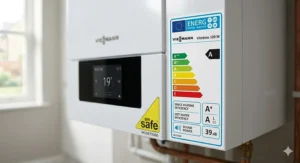
Energy-related Products (ErP) directive rates boilers from G (least efficient) to A+++ (most efficient) for both heating and hot water. All modern condensing boilers achieve A ratings for heating, making this less useful for differentiation. However, combi boilers vary from A+ to A for hot water efficiency based on their ability to deliver consistent hot water flow.
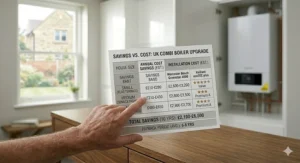
The percentage efficiency (92-94% for premium models) represents how much of the gas energy converts to useful heat. A 94% efficient boiler wastes only 6p of every pound spent on gas, whilst an old 70% efficient boiler wastes 30p per pound. For average British gas consumption of roughly £800 annually, upgrading from a 15-year-old boiler to a modern 94% model saves approximately £190 per year — this funds the new boiler within 12-15 years through energy savings alone.
Seasonal Efficiency vs Laboratory Testing
Laboratory testing conditions don’t match British homes perfectly. Seasonal Coefficient of Performance (SCOP) provides a more realistic efficiency estimate accounting for variable weather and usage patterns. However, manufacturers rarely advertise SCOP because it’s invariably lower than laboratory figures.
Realistically, expect around 88-91% actual efficiency in typical British homes once you account for cycling losses, standby consumption, and periods where the system runs outside optimal condensing temperature ranges. Premium models with better modulation and cycling prevention achieve closer to their rated efficiency than basic models that cycle frequently.
Load Compensation and Weather Compensation
These features adjust boiler output based on actual demand and outside temperature, improving real-world efficiency beyond the basic ratings. A boiler with weather compensation runs more efficiently during mild British spring and autumn weather, reducing gas consumption by 10-15% compared to models running at fixed output.
Load compensation adjusts output based on how quickly radiators heat up, preventing overshoot and wasted energy. Combined, these features improve real-world efficiency but add £150-£300 to system costs. For properties with good insulation, the payback period typically ranges from 3-5 years.
Long-Term Costs: Total Cost of Ownership in the UK
British homeowners should evaluate boilers based on total lifetime costs rather than just initial purchase price. Over a typical 12-15 year lifespan, running costs and maintenance significantly outweigh the initial investment.
Annual Running Costs by Efficiency
For an average British home (3-bedroom semi, moderate insulation, £800 annual gas consumption), boiler efficiency directly affects running costs:
- 70% efficiency (old non-condensing): £800 annual gas cost
- 85% efficiency (early condensing): £660 annual gas cost (£140 saving)
- 92% efficiency (minimum current standard): £609 annual gas cost (£191 saving)
- 94% efficiency (premium models): £595 annual gas cost (£205 saving)
The difference between minimum-standard 92% and premium 94% efficiency amounts to roughly £14 annually — meaningful over 15 years (£210 total) but not enough alone to justify £400-£500 premium pricing. However, when combined with better reliability, longer warranty, and reduced service costs, premium models often deliver superior value.
Service and Maintenance Costs
Annual servicing costs typically range from £80-£120 across the UK, varying by region and installer. Premium brands sometimes include free servicing for the first year, whilst extended warranties often require annual servicing by accredited engineers at slightly higher rates (£100-£140).
However, the actual lifetime maintenance costs depend heavily on reliability. Worcester Bosch boilers typically require fewer call-outs and repairs than budget alternatives, with average repair costs over 10 years ranging from £200-£400 compared to £600-£900 for less reliable brands. This difference alone justifies modest premium pricing.
Warranty Value and Replacement Costs
Extended warranties provide genuine value, particularly for boilers costing £1,000+. A 10-12 year warranty on a £1,200 boiler essentially guarantees you won’t face major component replacement costs (£300-£600 for heat exchangers, £200-£400 for pumps) during the warranty period.
Budget boilers with 5-year warranties save £300-£400 initially but risk substantial repair costs from year 6 onwards. If you plan to stay in your property long-term, premium models with extended warranties typically deliver better value. However, if you’re likely to move within 5-7 years, mid-range models with standard warranties represent smarter economics.
Frequently Asked Questions
❓ How long do combi boilers last in British homes?
❓ Do I need planning permission to replace a combi boiler in the UK?
❓ Can combi boilers work with solar panels in UK homes?
❓ What's the best combi boiler for hard water areas in the UK?
❓ Are combi boilers more expensive to run than system boilers?
Conclusion: Making the Right Choice for Your British Home
Selecting the best combi boilers for your UK property balances efficiency, reliability, hot water performance, and budget considerations. Whilst premium models like the Worcester Bosch Greenstar 8000 Life deliver exceptional quality and industry-leading warranties, mid-range options such as the Ideal Logic Max C30 provide outstanding value without meaningful performance compromises for most British homes.
The British market benefits from genuine competition amongst quality manufacturers, meaning homeowners can’t go drastically wrong with any boiler reviewed here. Worcester Bosch leads on reliability and service network coverage, Vaillant brings German engineering precision, Ideal delivers exceptional value, and Baxi represents solid British manufacturing heritage.
Your final decision should account for property size, existing system condition, installer availability, and budget realities. Don’t simply choose the highest efficiency rating or cheapest price — consider warranty coverage, parts availability, installer experience with the specific brand, and realistic hot water demands for your household.
Most importantly, remember that installation quality trumps boiler brand every time. A mid-range boiler correctly installed with proper system cleaning and appropriate controls outperforms a premium model poorly installed onto a sludgy system. Choose your installer as carefully as your boiler.
For British homeowners replacing boilers in 2026, the market offers excellent choices at every price point. Whether you prioritise premium reliability, best value, compact dimensions, or maximum output for larger properties, quality options exist that will serve you well through another decade of British winters.
Recommended for You
- 7 Best Multifuel Stoves UK 2026 – DEFRA Approved Reviews
- 7 Best Wood Burning Stoves UK 2026 | DEFRA Approved Reviews
- Best Fan Heater UK: 7 Quiet Models Tested (2026 Guide)
Disclaimer: This article contains information about heating products and services. Whilst every effort has been made to ensure accuracy, boiler specifications, prices, and regulations may change. Always consult qualified Gas Safe registered engineers before making heating system decisions. Boiler installation must comply with UK Building Regulations and be performed by competent professionals.
✨ Found this helpful? Share it with your mates! 💬🤗
