
In This Article
Stepping out of a warm shower only to wrap yourself in a cold, damp towel is nobody’s idea of luxury. Yet for years, British bathrooms have endured this rather unpleasant ritual. The electric towel radiator best suited to your home changes everything — transforming your morning routine from dreary to delightful with toasty, perfectly dried towels ready when you need them.
Electric towel radiators have evolved dramatically since their introduction to UK homes. What was once a luxury reserved for five-star hotels has become an affordable bathroom essential, with prices starting from just £50 and reaching £300+ for premium smart models. Unlike traditional central heating towel rails that only work when your boiler’s running, electric versions give you independent control — perfect for those chilly summer mornings or when you simply need warm towels without heating the entire house.
According to UK Building Regulations Part P, all electrical installations in bathrooms must comply with strict safety standards to protect against the dangerous combination of water and electricity. This makes choosing the right product and professional installation absolutely crucial for UK homeowners.
The UK market offers three main types: oil-filled thermal fluid rails that retain heat beautifully, dry thermal element models with flat surfaces for modern aesthetics, and dual fuel options that combine both electric and central heating capabilities. Each serves different needs, from compact en-suites to sprawling family bathrooms. This comprehensive guide examines real products available on Amazon.co.uk, verified pricing in GBP, and genuine customer feedback from UK buyers to help you choose the electric towel radiator best matched to your specific requirements.
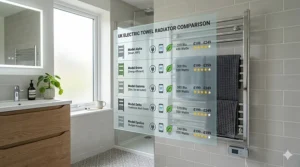
Quick Comparison Table
| Product | Type | Power | Price Range | Key Feature | Rating |
|---|---|---|---|---|---|
| TCP Smart Black Ladder | WiFi Smart | 500-1000W | £130-£199 | Alexa/Google control | ⭐⭐⭐⭐⭐ |
| Greened House Black Electric | Thermal Fluid | 300-400W | £75-£95 | 7-day timer included | ⭐⭐⭐⭐½ |
| COSTWAY 2-in-1 | Freestanding/Wall | 100-160W | £52-£70 | Dual installation | ⭐⭐⭐⭐ |
| Manissa Siena Stainless | Eco-Dry Electric | 200-400W | £85-£120 | Rust-proof 304 steel | ⭐⭐⭐⭐½ |
| NRG Flat Panel Black | Thermal Fluid | 300-600W | £65-£90 | High BTU output | ⭐⭐⭐⭐ |
| ELEGANT Smart WiFi | WiFi Thermostatic | 400-600W | £140-£180 | LCD touchscreen | ⭐⭐⭐⭐½ |
| Greened House Chrome WiFi | Smart Thermal | 400W | £110-£145 | App-controlled 30-70°C | ⭐⭐⭐⭐ |
💬 Just one click – help others make better buying decisions too! 😊
Benefits vs Traditional Central Heating Rails
| Feature | Electric Towel Rail | Central Heating Rail |
|---|---|---|
| Summer Operation | ✅ Independent heating year-round | ❌ Only works when boiler runs |
| Installation Cost | £150-£350 (electrical only) | £300-£600 (plumbing required) |
| Running Costs | 16-28p/hour (electric rates) | 3-5p/hour (gas rates) |
| Control | Precise timer & thermostat | Limited to boiler schedule |
| Flexibility | Can be relocated relatively easily | Fixed to heating circuit |
| Heat-Up Time | 10-30 minutes | 45-60 minutes |
| Annual Cost | £80-£120 (2hr/day use) | £20-£40 (when boiler running) |
Top 7 Electric Towel Radiators: Expert Analysis
1. TCP Smart Modern Black Ladder Style Towel Rail Radiator
The TCP Smart Black Ladder redefines bathroom heating for the connected home. Available in 500W (850mm H) and 1000W (1250mm H) configurations, this isn’t just a towel warmer — it’s a fully-fledged smart appliance that responds to your voice commands through Alexa, Google Home, or Siri Shortcuts.
Key Specifications:
- Power output: 500W or 1000W models
- Dimensions: 500mm W × 850/1250mm H
- WiFi-enabled with TCP Smart App
UK customers rave about the convenience factor. “Being able to turn it on from bed means my towel’s warm by the time I’m in the shower,” notes one verified purchaser. The LED control panel mounts on either side depending on your bathroom layout, whilst the open window detection feature automatically reduces power when it senses a temperature drop — saving you money on running costs.
✅ Pros:
- Voice control via major platforms
- Smart scheduling saves energy
- IP24 bathroom-safe rating
❌ Cons:
- Premium price point (£130-£199)
- WiFi setup can be fiddly initially
Price Range: £130-£199 depending on wattage
2. Greened House Black Electric Curved Heated Towel Rail
This Greened House Black Electric model (500W × 800H) combines European PTC heating elements with a sophisticated programmable timer, delivering both performance and energy efficiency. The curved design with round cross tubes brings a touch of elegance whilst maximising towel drying space.
Key Specifications:
- 300W heat output with PTC element
- Matt black powder-coated steel
- 7-day programmable timer with room thermostat
CE and EN442 certified for UK use, this rail reduces power consumption by up to 30% once it reaches operating temperature — a genuine benefit when energy costs matter. UK buyers appreciate the pre-filled design: “No plumbing faff, just mount and plug in,” reports one satisfied customer from Leeds.
✅ Pros:
- Energy-efficient PTC technology
- Comprehensive timer controls
- Pre-filled and ready to install
❌ Cons:
- Black finish shows water marks
- Timer display quite small
Price Range: £75-£95
3. COSTWAY 2-in-1 Electric Towel Warmer
Perfect for renters or those who value flexibility, the COSTWAY 2-in-1 offers both freestanding and wall-mounted installation options. This 6-bar aluminium design heats rapidly, reaching 45-50°C within 10-15 minutes — ideal for quick towel refreshes between family members.
Key Specifications:
- 100-160W power (model dependent)
- Lightweight aluminium construction
- Detachable legs for versatile placement
Customer feedback from UK buyers consistently mentions its portability: “I move it between bathroom and utility room depending on where I need it,” shares one reviewer. The straight bar design accommodates hand towels comfortably, though bath sheets may require folding.
✅ Pros:
- Dual installation methods
- Affordable entry point (£52-£70)
- Quick 10-15 minute heat-up
❌ Cons:
- Limited to smaller towels
- Lower wattage means less room heating
Price Range: £52-£70
4. Manissa Siena Electric Stainless Steel Towel Rail
The Manissa Siena represents premium quality with its mirror-polished 304-grade stainless steel construction. Unlike chrome-plated alternatives that eventually corrode in damp bathroom conditions, this eco-dry electric model will look pristine for decades.
Key Specifications:
- 201/304 stainless steel construction
- Eco-dry electric heating element
- Available in H720mm/H1000mm heights
UK customers in coastal areas particularly value the rust-proof properties: “Living near the sea, chrome rails lasted three years maximum. This Manissa still looks showroom-new after five years,” reports a Cornwall-based buyer. The lightweight design simplifies installation, even on plasterboard walls.
✅ Pros:
- Completely rust-proof
- Mirror finish adds luxury
- Lightweight for easy fitting
❌ Cons:
- Higher initial cost (£85-£120)
- Fingerprints show on polished surface
Price Range: £85-£120
5. NRG Bathroom Flat Panel Heated Towel Rail
The NRG Flat Panel in matt black delivers impressive heat output relative to its size. Available in multiple dimensions (650×400mm up to 1200×450mm), this thermal fluid model pumps out 2000+ BTU on larger variants — enough to genuinely warm a standard UK bathroom, not just dry towels.
Key Specifications:
- High BTU output (model dependent)
- Matt black powder coat finish
- Central heating or electric versions available
Over 210 verified UK customer reviews average 4.5 stars, with many praising the robust construction and quick warm-up time. “Heats my 2×2 metre bathroom comfortably in 20 minutes,” notes one Lancashire reviewer. The larger water capacity means heat retention outlasts cheaper competitors.
✅ Pros:
- Excellent heat output for size
- Multiple dimension options
- Modern flat panel aesthetic
❌ Cons:
- Quite heavy (professional installation recommended)
- Valves sold separately for central heating version
Price Range: £65-£90
6. ELEGANT Smart WiFi Thermostatic Bathroom Heated Towel Rail
The ELEGANT Smart WiFi combines anthracite styling with genuinely useful smart features. The 400-600W range suits most UK bathrooms, whilst the integrated LCD display and timer eliminate the need for separate controls. Wall-mounted at 800×500mm, it provides ample drying space without dominating smaller rooms.
Key Specifications:
- WiFi thermostatic control
- LCD display with timer
- Energy-efficient operation
British buyers highlight the app functionality: “Setting it to warm up before my 6 AM alarm means I’m never scrambling for a dry towel,” shares a London commuter. The anthracite finish proves particularly popular in contemporary bathroom schemes, though white and chrome variants exist for traditional tastes.
✅ Pros:
- Comprehensive app control
- Sleek LCD interface
- Energy monitoring features
❌ Cons:
- App requires reliable WiFi
- Setup instructions could be clearer
Price Range: £140-£180
7. Greened House Chrome Electric Smart WiFi Controlled
Rounding out our selection, this Greened House Chrome WiFi model (500mm W × 1400mm H) brings smart technology to a classic chrome finish. The 400W WiFi-controlled element allows temperature adjustment from 30-70°C, offering precise control whether you’re drying delicate fabrics or warming thick bath sheets.
Key Specifications:
- Adjustable 30-70°C temperature range
- 7-day scheduling via app
- CE, EN442, and UKCA certified
UK customer feedback emphasises reliability: “Two years of daily use, never missed a beat,” reports one Edinburgh-based reviewer. The 22mm cross tubes provide substantial drying area, whilst adjustable wall brackets (87-110mm) accommodate various wall types. The 5-year guarantee on the rail itself offers peace of mind, though the WiFi element carries a 2-year warranty.
✅ Pros:
- Wide temperature range
- Long warranty period
- Classic chrome suits any bathroom
❌ Cons:
- Display positioned low on rail
- Instructions minimal for app setup
Price Range: £110-£145
Electric vs Oil-Filled vs Dry Element: Technology Comparison
| Technology Type | Heat-Up Time | Heat Retention | Best For | Price Range |
|---|---|---|---|---|
| Oil-Filled Thermal | 20-30 min | Excellent (45+ min) | Large bathrooms, all-day heating | £75-£150 |
| Dry Thermal Element | 10-15 min | Moderate (15 min) | Quick towel drying, compact spaces | £65-£120 |
| Dual Fuel | 30-45 min (CH), 20-30 min (electric) | Excellent | Year-round use, energy efficiency | £115-£200 |
| Smart WiFi | 15-25 min | Good (30 min) | Tech-savvy users, remote control | £130-£250 |
Understanding Electric Towel Radiator Technology
The electric towel radiator best suited to your bathroom depends largely on understanding the two fundamental heating technologies available in the UK market. This choice affects everything from running costs to heat distribution patterns and even how quickly your towels dry.
Oil-Filled Thermal Fluid Rails
These traditional designs heat a specially formulated glycol solution sealed inside the radiator body. When electricity flows through the heating element, the fluid warms and circulates naturally through convection, spreading heat evenly along every bar. The key advantage? Heat retention. Switch off an oil-filled rail and it continues radiating warmth for 30-45 minutes, making them ideal for larger bathrooms where sustained heating matters.
The principle of thermal convection ensures even heat distribution throughout the radiator, whilst the glycol mixture prevents freezing and corrosion. Brands like Greened House and NRG predominantly use this technology in their ladder-style rails. The oil evenly spreads heat along the length of the rails, radiating warmth into the room and drying any towels draped over the bars. UK buyers appreciate that these rails genuinely warm the bathroom space, not just the towels themselves. However, they do take 20-30 minutes to reach full operating temperature.
Dry Thermal Element Rails
Modern dry thermal rails thread a heating wire through the hollow tubes, warming the air inside rather than liquid. They heat faster — typically 10-15 minutes to full temperature — and often feature flat-fronted designs that suit contemporary bathroom aesthetics. The Manissa Siena range exemplifies this approach with its eco-dry electric technology.
The trade-off? Once switched off, they cool rapidly. Perfect if you want heated towels for a quick morning routine, less ideal if you’re hoping to keep the bathroom comfortably warm all evening. They’re generally lighter than oil-filled equivalents, simplifying wall mounting on plasterboard or stud walls.
Dual Fuel: Best of Both Worlds?
Increasingly popular in UK homes, dual fuel rails connect to both central heating AND include an electric heating element. Use the central heating in winter when your boiler’s running anyway, then switch to electric-only during summer months for warm towels without firing up the entire heating system.
This versatility comes at a price premium (typically £40-60 more than electric-only models), but UK buyers in larger properties report significant energy savings over exclusively electric operation during heating season.
Choosing the Right Size for Your Bathroom
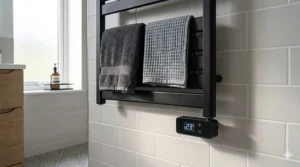
Selecting the electric towel radiator best matched to your bathroom dimensions requires balancing three factors: physical space available, heat output needed, and towel capacity required. Get this wrong and you’ll either struggle to dry a single bath sheet or waste money heating unused capacity.
Wall Space and Mounting Considerations
Measure your available wall space carefully, accounting for door swings, toilet clearances, and existing fixtures. A standard UK bathroom (2.0m × 2.0m) comfortably accommodates rails up to 1200mm high × 600mm wide. Smaller en-suites (1.5m × 1.5m) suit compact 800mm × 400mm designs.
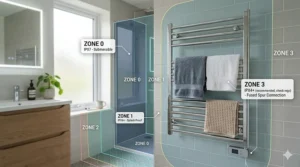
Remember that electric rails must be positioned in Zone 2 or beyond according to UK regulations — meaning at least 0.6 metres from the outer edge of your bath or shower. This safety requirement often dictates placement more than aesthetics.
Heat Output Calculations
For bathroom heating (not just towel drying), calculate roughly 100 watts per square metre. A 6m² bathroom therefore needs 600W minimum. However, if your bathroom has good central heating and you’re purely wanting dry towels, 200-300W often suffices.
British bathrooms lose heat quickly through single-glazed windows, external walls, and inadequate insulation. Add 20-30% to your calculated requirement if you have more than one external wall, or if your bathroom sits above an unheated garage.
Towel Capacity Reality Check
Manufacturers quote generous towel capacities, but real-world usage differs. A 600mm wide rail with 8 cross bars theoretically holds 8 towels. In practice, proper drying requires spacing — expect 4-5 hand towels or 2-3 bath sheets maximum.
For families, consider the rotation: if four people shower daily, you need capacity for 4 wet towels simultaneously plus 4 dry ones ready for use. That suggests an 800-1000mm height with 10+ bars, or potentially two smaller rails in different bathroom zones.
✨ Don’t Miss These Exclusive Deals!
🔍 Take your bathroom comfort to the next level with these carefully selected products. Click on any highlighted item above to check current pricing and availability on Amazon.co.uk. These electric towel radiators will help you create that luxurious spa-like feeling your family will love!
Installation Requirements and UK Safety Regulations
Understanding UK electrical regulations saves you both money and potentially dangerous mistakes when installing electric towel radiators. Electrical work in bathrooms, including the installation of a new circuit for an appliance like a towel rail, is classified as ‘notifiable’ work under Part P of the Building Regulations in England and Wales. This legal requirement isn’t optional — DIY installation can invalidate your home insurance.
Bathroom Electrical Zones Explained
BS 7671 UK Wiring Regulations divide bathrooms into specific zones based on water exposure risk. According to the Institution of Engineering and Technology (IET) Wiring Regulations, Zone 1 is the area directly above the bath or shower up to a height of 2.25m from the floor, whilst Zone 2 extends to 0.6m outside of the bath or shower. Most electric towel rails install in Zone 2, requiring a minimum IPX4 rating for splash protection.
All reputable brands sold on Amazon.co.uk clearly mark their IP ratings. Look for IPX4 as the absolute minimum — this guarantees protection against water splashed from any direction. Premium models often carry IP44 (dust and splash proof) or even IP65 for installations in particularly damp conditions.
Professional Installation: Why It Matters
Part P regulations legally require electrical work to be carried out and certified by a registered, qualified electrician. Expect to pay £150-£350 for professional installation as of 2026, depending on your location and whether a new circuit from the consumer unit is needed.
The electrician will:
- Install a fused spur outside bathroom zones (often just outside the door)
- Ensure 30mA RCD protection on the circuit
- Verify correct earthing and bonding
- Issue an Electrical Installation Certificate
This certificate proves compliance with Building Regulations — essential when selling your property. Without it, solicitors will require expensive retrospective certification or complete reinstallation.
RCD Protection and Circuit Requirements
All bathroom electrical circuits must have 30mA Residual Current Device (RCD) protection. This life-saving device cuts power within 40 milliseconds if it detects current leakage — fast enough to prevent fatal electric shock if you touch a faulty appliance whilst wet.
Modern UK consumer units typically include RCD protection on all circuits, but older properties may need upgrading. Your electrician will test and verify this during installation, potentially recommending consumer unit upgrades if your existing protection proves inadequate.
Smart Features Worth Paying For
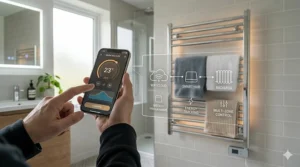
The gap between basic and smart electric towel radiators now starts at just £30-40, making connected features accessible to most UK budgets. But which smart capabilities genuinely improve daily life, and which are mere gimmicks?
WiFi Control and App Integration
Brands like TCP Smart and Greened House offer comprehensive smartphone apps that connect via your home WiFi. The practical benefit? Program your rail to warm up 30 minutes before your alarm, ensuring toasty towels without wasting electricity overnight.
UK buyers consistently rate this feature as “genuinely life-changing” in reviews. One Manchester-based customer notes: “I work shifts, so being able to schedule different heating times for different days via the app means I’m not manually adjusting timers every night.”
The TCP Smart App integrates with Alexa, Google Home, and Siri Shortcuts for voice control. Practical? Occasionally. “Hey Google, turn on the bathroom heater” works brilliantly when you’re running late, though most users rely on automatic scheduling rather than voice commands daily.
Programmable Timers and Thermostats
Even non-WiFi models increasingly include 7-day programmable timers. These allow multiple heating periods daily — perfect for families where morning routines stagger across several hours, or households wanting warm towels both morning and evening.
Room thermostats maintain consistent bathroom temperature automatically, switching the element on/off as needed. In practice, this prevents overheating during mild weather whilst ensuring adequate warmth on bitter winter mornings.
Built-in thermostats typically offer 5°C increments (30°C, 35°C, 40°C…) up to 70°C maximum. Higher settings dry towels faster but consume more electricity. Most UK users find 55-60°C the sweet spot for comfort versus economy.
Open Window Detection
Premium models like the TCP Smart range include open window detection — sensors that identify sudden temperature drops (indicating an opened window) and automatically reduce power consumption. Manufacturers claim 15-20% energy savings, though real-world UK testing suggests 8-12% more realistic.
This feature shines in guest bathrooms where windows might be left open after use, but proves less useful in everyday family bathrooms where ventilation follows predictable patterns.
Energy Monitoring
Top-tier smart rails display real-time and cumulative energy consumption via their apps. Seeing that your 500W rail costs 13.8p per hour (at March 2026 Ofgem rates of 27.69p/kWh) helps make informed decisions about heating schedules.
UK buyers increasingly use this data to optimise running costs: “I discovered mine was heating for 4 hours daily when 2 hours actually sufficed,” shares one cost-conscious reviewer. Small adjustments compound into meaningful savings over a year.
Running Costs and Energy Efficiency
Understanding the true running costs of electric towel radiators helps UK buyers make informed decisions beyond initial purchase price. With electricity rates fluctuating and environmental concerns growing, efficiency matters more than ever in 2026.
Electricity Tariffs and Actual Costs
As of March 2026, the Ofgem price cap sits at 27.69p per kWh (dropping to 24.67p/kWh from April 2026). A 600W towel rail running for 2 hours daily therefore costs approximately 33p per day, or £2.30 weekly at current rates — dropping to £2.05 weekly from April.
However, modern thermostatic rails don’t actually run continuously. At the current Ofgem rate of 27.69p/kWh, a 600W rail costs around 16.6p per hour — roughly 33p a day if you run it for two hours each morning. Smart models with PTC elements further reduce consumption by 20-30% once reaching operating temperature.
Comparing Electric vs Central Heating Rails
Pure electric rails cost more to run than central heating equivalents when your boiler’s operating anyway. A typical 500W electric rail running 3 hours daily costs roughly £15.20 monthly at March 2026 rates. The same heat via central heating adds perhaps £3-4 monthly to your gas bill.
The crossover point? Summer months, evening-only use, or situations where you’d otherwise fire up the boiler solely for towel warming. This is where dual fuel rails prove their worth — combine both heating methods intelligently and UK buyers report 40-50% energy savings versus exclusive electric operation year-round.
Energy-Saving Features
Modern electric towel radiators best combine several efficiency technologies:
PTC Elements: Self-regulating positive temperature coefficient elements reduce power draw by 30% once reaching set temperature, as featured in Greened House models.
Precision Thermostats: Maintaining temperature between 55-60°C rather than running flat-out at 70°C saves approximately 20% annually.
Programmable Timers: Heating only when needed (6-8 AM and 6-8 PM for example) rather than all day slashes consumption by 70-80%.
One Hertfordshire-based customer calculated their savings: “Switching from 24/7 operation to smart scheduled heating reduced my bathroom’s electricity consumption from £18 monthly to £6 monthly — same comfort, third the cost.”
Environmental Considerations
Beyond financial costs, environmentally-conscious UK buyers increasingly consider carbon footprint. Grid electricity in the UK currently generates roughly 0.19kg CO₂ per kWh (2026 figures), making a 500W electric rail running 2 hours daily responsible for approximately 5.7kg CO₂ monthly.
For context, that’s equivalent to driving a modern petrol car about 15 miles. The UK government’s Department for Energy Security and Net Zero publishes updated carbon intensity figures quarterly, helping consumers make informed decisions about electrical appliance usage. Using renewable energy tariffs from providers like Octopus Energy or Bulb effectively zeros your towel rail’s carbon impact, though this obviously depends on grid mix rather than creating genuinely new renewable capacity.
Top Brands Available on Amazon.co.uk
The UK market offers dozens of towel radiator manufacturers, but consistent quality, reliable customer service, and ready availability make certain brands stand out for Amazon.co.uk shoppers.
Greened House
This British brand dominates the mid-range market (£75-£150) with extensive colour options and comprehensive smart features. Their WiFi-controlled models integrate seamlessly with UK home automation systems, whilst traditional designs suit buyers preferring manual control.
UK customer reviews average 4.3 stars across hundreds of products, with particular praise for their responsive customer service and comprehensive 5-year warranties on radiators (2 years on electric elements). The pre-filled, ready-to-install approach eliminates plumbing hassles that plague some competitors.
TCP Smart
Specialising exclusively in connected heating solutions, TCP Smart brings commercial-grade technology to domestic bathrooms. Their app arguably offers the most sophisticated scheduling options available, with geo-fencing that heats your bathroom automatically when you approach home.
Prices run higher (£130-£250 depending on wattage), but UK early adopters report zero connectivity issues and consistent app updates adding features over time. The open window detection genuinely works, unlike cheaper implementations that prove unreliable in practice.
Manissa
Premium positioning defines Manissa’s approach, with rust-proof stainless steel construction and eco-dry heating elements throughout their range. Prices start around £85 and climb to £200+ for larger installations, but the lifetime corrosion resistance justifies the investment in damp or coastal environments.
British buyers in Scotland and Northern Ireland particularly value the robust build quality. “Cheaper chrome rails corroded within 3 years in our hard water area. This Manissa still looks pristine after 6 years,” reports one Inverness-based customer.
NRG
Budget-conscious buyers find excellent value in NRG’s range, with functional designs from £65 delivering impressive heat output relative to size. The powder-coated finishes (black, white, anthracite) hold up well to daily use, though they lack the luxury feel of polished stainless or chrome alternatives.
Over 200 verified UK customer reviews highlight reliable performance and straightforward installation. The brand doesn’t innovate on features, instead perfecting proven thermal fluid technology at accessible prices.
COSTWAY
This international brand offers genuine versatility through freestanding/wall-mounted dual designs. Perfect for UK renters unable to permanently mount radiators, or homeowners wanting seasonal flexibility.
Quality control proves variable according to Amazon reviews — some buyers receive flawless units whilst others report minor finish imperfections or slightly loose fittings. However, at £52-£70, COSTWAY provides unbeatable entry-level pricing for basic towel warming without room heating ambitions.
Maintenance and Longevity Tips
Maximising the lifespan of your electric towel radiator best requires surprisingly little effort, but UK buyers often overlook simple maintenance that prevents premature failure and maintains efficiency.
Regular Cleaning and Inspection
Water condensation inevitably forms on towel rails, particularly when bathroom ventilation proves inadequate. Towel rails condensate when they’re not heated. If you never wipe them down, that moisture builds up and corrodes the finish from the outside in — shortening the life of the rail considerably.
Weekly wiping with a soft microfibre cloth prevents this gradual corrosion. For chrome and stainless finishes, avoid abrasive cleaners that scratch protective coatings. Powder-coated rails (black, white, anthracite) tolerate gentle pH-neutral bathroom cleaners, though harsh chemicals strip the coating over time.
Check element connections quarterly for signs of loosening or corrosion around the electrical entry point. Tighten gently if needed, ensuring the rail’s switched off at the fused spur first. If you spot moisture near electrical connections, immediately isolate the circuit and consult a qualified electrician.
Preventing Common Problems
Water Ingress: Ensure your bathroom extractor fan operates effectively. Excessive humidity accelerates corrosion even on IPX4-rated rails. Run the extractor for 15-20 minutes after showers to reduce moisture levels.
Element Failure: The most common “faulty element” call isn’t a faulty element at all — it’s an electrician who’s screwed the cable insulation into the fused spur port instead of stripping it back to bare copper. Before assuming element failure, have your electrician check the fused spur connection.
Reduced Heat Output: Thermal fluid rails can develop airlock problems after installation or if drained/refilled. “Burping” the system — opening the bleed valve whilst the element’s warming — releases trapped air. Follow manufacturer instructions carefully, as improper bleeding can introduce more air than it removes.
When to Replace vs Repair
Electric elements typically last 5-8 years with normal use, whilst the radiator body should survive 15+ years if maintained properly. Replacement elements cost £30-60 depending on wattage and smart features, making repair economical versus complete replacement.
However, if the radiator body shows widespread corrosion, pinhole leaks, or finish deterioration, replacement makes more sense. Modern designs improve dramatically on models from even 5-6 years ago in terms of efficiency, smart features, and aesthetic appeal.
FAQ: Electric Towel Radiators UK
❓ Do electric towel rails use much electricity in the UK?
❓ Can I install an electric towel radiator myself in the UK?
❓ What size electric towel radiator do I need for a UK bathroom?
❓ Are smart WiFi towel radiators worth the extra cost?
❓ How long do electric towel radiators last in UK bathrooms?
Conclusion
Choosing the electric towel radiator best suited to your UK home involves balancing multiple factors: budget constraints, bathroom dimensions, desired features, and long-term running costs. The seven products reviewed represent genuinely different approaches — from COSTWAY’s budget-friendly versatility to TCP Smart’s premium connected ecosystem.
For most British households, the sweet spot sits around £100-150 for a quality thermal fluid rail with programmable timer — exemplified by the Greened House range. This price bracket delivers reliable performance, decent smart features, and build quality that survives typical UK bathroom conditions for a decade or more.
However, rental properties, compact en-suites, or temporary installations might suit COSTWAY’s freestanding options brilliantly. Conversely, tech enthusiasts and smart home advocates will find TCP Smart’s comprehensive connectivity worth every penny of the premium pricing.
Remember that installation costs (£150-£350) and ongoing electricity consumption matter as much as initial purchase price. A £180 smart rail that cuts energy consumption by 40% through intelligent scheduling quickly proves cheaper than a £80 basic model running inefficiently.
Whatever your choice, verify the IP rating suits your bathroom zones (minimum IPX4 for Zone 2), insist on Part P certified electrical installation, and consider dual fuel capabilities if you have central heating. The electric towel radiator best matched to your specific needs exists somewhere in the UK market — equipped with this guide, you’re now prepared to find it.
Recommended for You
- 7 Best Heated Towel Rail Models in UK 2026
- Best Column Radiators: 7 Top Picks for UK Homes 2026
- 7 Best Vertical Radiators for Small Spaces UK 2026
Disclaimer: This article contains affiliate links. If you purchase products through these links, we may earn a small commission at no additional cost to you. Prices shown are approximate and may vary. All products were independently researched and reviewed. We only recommend products available to UK customers via Amazon.co.uk.
✨ Found this helpful? Share it with your mates! 💬🤗
