
In This Article
Picture stepping out of bed on a frosty January morning, your feet meeting a gently warmed floor instead of icy tiles. That’s the simple luxury electric underfloor heating brings to British homes in 2026. No bulky radiators hogging wall space, no cold spots, just consistent, even warmth rising from below.
Electric underfloor heating has evolved from a premium luxury to a practical solution for UK homeowners. With the Future Homes Standard and Building Regulations Part L pushing energy efficiency forward, understanding your heating options is crucial. Unlike water-based systems requiring extensive pipework, electric systems slip beneath your tiles, laminate, or vinyl with minimal fuss.
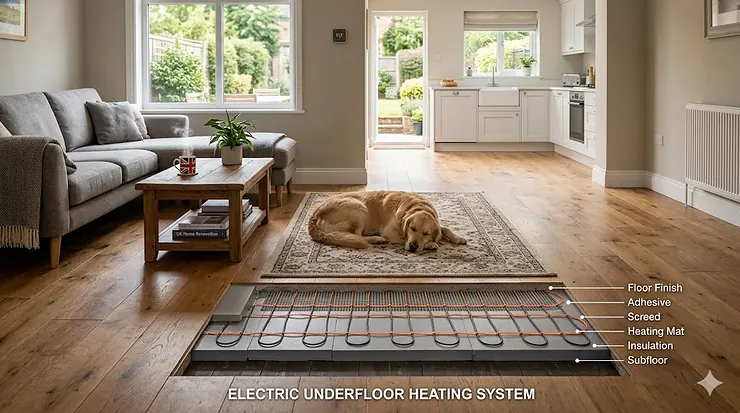
The technology is brilliantly straightforward: thin heating cables or pre-spaced mats convert electricity into radiant heat. Modern thermostats—many WiFi-enabled—give precise control from your smartphone. For a typical 4m² bathroom in Birmingham, running costs are around £0.55 to £0.75 per day, making it surprisingly affordable for targeted comfort.
Quick Comparison Table
| Feature | Electric UFH | Traditional Radiators | Wet UFH |
|---|---|---|---|
| Installation Cost (per m²) | £60–£120 | £40–£80 | £90–£190 |
| Heat-Up Time | 30–60 minutes | 15–30 minutes | 2–4 hours |
| Running Cost (6m² room/day) | £0.55–£0.75 | £0.80–£1.20 | £0.35–£0.55 |
| Ideal Room Size | Under 15m² | Any size | Over 20m² |
| Floor Height Impact | 3–10mm | None | 50–150mm |
💬 Just one click – help others make better buying decisions too!😊
Top 7 Electric Underfloor Heating Systems: Expert Analysis
After extensive research across Amazon.co.uk, we’ve identified seven standout systems delivering genuine value in 2026.
1. Nassboards Professional Electric Underfloor Heating Kit 150W
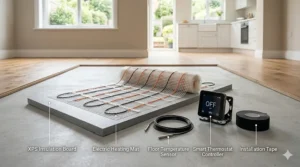
The Nassboards kit dominates UK sales with its complete package designed for hassle-free DIY installation. Features a professional dual-core mat with ultra-thin 3mm cable wire, making it one of the slimmest options available. The kit includes self-adhesive heating mat (1.5m² to 24m²), choice of thermostat (including smart WiFi options compatible with Alexa/Google), thermal tape, primer, floor probe, and conduit.
Key specs: 150W/m² output, CE certified, 100% armoured earth coverage, fluoropolymer insulation, no harmful EMF emissions.
Price: £89.99–£241.97
UK customers praise the sticky backing that keeps mats firmly in place. A Leeds reviewer noted: “Easy to lay under travertine tiles. Performs really well.”
✅ Pros: Complete kit, multiple thermostat options, minimal 3mm cable, suitable for all floor types
❌ Cons: Orders over 12m² use 2 separate mats, requires qualified electrician
2. ProWarm Electric Underfloor Heating Mat Kit 150W
ProWarm stands out with their unique CableSafe Guarantee—accidentally cut the cable during installation, they’ll replace it free. The system uses ETFE insulation (no PVC) with multi-strand wires for durability.
Key specs: 2mm thickness, 150W/m² output, sizes 1m² to 20m².
Price: £65–£195
The ultra-thin cable can be tiled straight over. Free technical support from qualified electricians available throughout installation. Glasgow customers report systems performing flawlessly after 5+ years.
✅ Pros: CableSafe Guarantee, thinnest cable (2mm), eco-friendly ETFE, UK technical team
❌ Cons: Thermostat sold separately on some kits
3. Warmup StickyMat Electric Underfloor Heating 150W/200W
Warmup represents premium quality with ultra-thin 1.8mm heating wire on glass-fibre mesh with pressure-sensitive adhesive. Available through Topps Tiles and specialist retailers.
Key specs: 150W/m² or 200W/m² variants, 1.8mm wire, 0.5m width, areas 1m² to 15m², Limited Lifetime Warranty.
Price: From £54.02/m² (ex. VAT)
The 200W/m² excels in conservatories and high heat-loss rooms. A London homeowner reported: “Heats my bathroom in under 45 minutes.”
✅ Pros: Premium brand, ultra-thin 1.8mm wire, two power variants, lifetime warranty
❌ Cons: Premium pricing, thermostat separate
4. Ezewarm Electric Underfloor Heating 200W
For budget-conscious UK homeowners, Ezewarm offers impressive value. Manufactured in Ireland with L.G.A. safety accreditation.
Key specs: 200W/m² output, adhesive mesh, lifetime guarantee, meets U.L. & L.G.A. standards.
Price: £45–£85/m² (when available)
Irish manufacturing ensures UK/Irish building code familiarity. Birmingham customers praise the “thin cable and sticky tape for fixing.”
✅ Pros: Competitive pricing, lifetime guarantee, fast delivery
❌ Cons: Intermittent Amazon availability, smaller dealer network
5. BEOK WiFi Thermostat TDR89B-WIFI-EP
The UK’s bestselling smart control for electric underfloor heating. This 16A digital thermostat offers Tuya app connectivity, Alexa/Google voice control, and touchscreen operation.
Key specs: 16A capacity (3,680W), WiFi via Tuya app, 6 daily time periods, external NTC floor sensor.
Price: £41.99
Over 2,200 UK reviews average 4.3 stars. Remote control capabilities let you pre-adjust temperature before arriving home.
✅ Pros: Exceptional value under £42, smart home integration, remote control
❌ Cons: Some connectivity issues during setup
6. BEOK Digital Programmable Thermostat TOL47-WP
For simplicity without smart features, TOL47-WP offers reliable temperature control at an accessible price.
Key specs: 230V 3A, 5+1+1 programmable periods, 5-35°C range, 0.5°C precision, open window detection.
Price: £36.99
The open window detection automatically reduces heating when sudden temperature drops are detected—brilliant for British weather.
✅ Pros: Budget-friendly under £37, 7-day programming, no connectivity issues
❌ Cons: No remote control
7. KETOTEK Smart Thermostat WiFi 16A
The KETOTEK competes with BEOK whilst offering alternative ecosystems. Compatible with Tuya Smart Life and Alexa/Google.
Key specs: 16A capacity, weekly scheduling, touchscreen LCD, 3m floor probe, voice control.
Price: £42–£48
108 UK reviews averaging 4.3 stars. Extended 3m sensor probe provides installation flexibility. Edinburgh customer: “Pairs perfectly with my 6m² heating mat.”
✅ Pros: Multiple platform compatibility, accurate sensing, extended probe
❌ Cons: Slightly pricier than BEOK
✨ Don’t Miss These Exclusive Deals!
🔍 Take your electric underfloor heating to the next level with these carefully selected products. Click on any highlighted item to check current pricing and availability on Amazon.co.uk!
Understanding How Electric Underfloor Heating Works
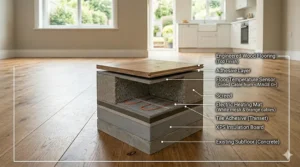
Electric underfloor heating operates through resistance heating: thin cables beneath your floor convert electrical energy into heat. The system comprises heating elements (cables or mats), digital thermostats with floor sensors, and insulation directing heat upward.
Unlike radiators heating air through convection (creating temperature stratification), underfloor heating provides radiant warmth heating objects directly. According to Building Regulations Part L, all floor heating systems must have controls to adjust operating temperature, with room thermostats requiring manual override capability.
Modern systems offer programmable schedules and smart connectivity. Floor sensors prevent overheating whilst maintaining comfort. The beauty lies in even heat distribution—no cold spots, just consistent warmth throughout the room.
Installation Process: DIY-Friendly Approach
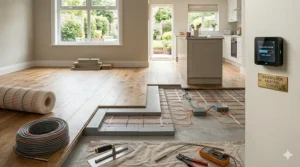
Electric systems offer DIY accessibility—though you’ll need a Part P-registered electrician for final electrical connections to comply with UK Building Regulations.
Typical process:
- Subfloor prep: Clean, level surface, repair any damage
- Insulation: Lay 6–10mm boards to prevent downward heat loss
- Mat installation: Unroll adhesive-backed mats, maintain even spacing
- Floor probe: Embed sensor in conduit between cable loops
- Resistance testing: Verify no cable damage occurred
- Screed/adhesive: Apply carefully over mats, allow proper curing
- Electrical connection: Qualified electrician connects and certifies
- Floor covering: Install tiles, vinyl, or laminate
For a typical bathroom, expect 3–5 hours for mat laying, plus 2–3 hours for electrical work. Total project time including curing: 5–7 days.
Running Costs: Real-World Numbers for 2026
Based on January–March 2026 energy prices, UK electricity costs 27.69p per kWh. Let’s examine realistic scenarios:
4m² bathroom (150W/m², 2 hours daily): 0.6 kW × 27.69p × 2 hours = 33.23p daily (£121 annually)
15m² kitchen (150W/m², 6 hours daily): 2.25 kW × 27.69p × 6 hours = £3.74 daily (£1,364 annually)
However, modern thermostats cycle heating, typically reducing actual consumption by 30–40% once rooms reach target temperature. Well-insulated rooms retain heat better, further reducing energy usage.
Cost comparison: Whilst gas costs 6.93p/kWh versus electricity’s 27.69p/kWh, electric UFH’s zonal control and efficient distribution partially offset this difference. For small rooms like bathrooms, the difference is modest; for whole-house installations, gas or wet systems remain significantly cheaper long-term.
Strategic scheduling dramatically impacts costs: timers ensure heating operates only when needed. Smart thermostats with geofencing detect when you’re away and automatically adjust, restoring comfort before you arrive home.
Key Benefits Over Traditional Heating
Space liberation: Radiators occupy 0.5–1.5m² per room. For an 8-radiator house, that’s 4–12m² of reclaimed wall space for furniture, artwork, or cleaner aesthetics.
Even heat distribution: Radiant floor heating maintains uniform temperatures (1–2°C floor-to-ceiling variation) versus radiators’ 4–6°C variation. Heat where you experience it—at floor level.
Energy efficiency: Operating at lower temperatures (25–28°C floor surface) requires less energy for comfort. The Building Research Establishment reports properly designed UFH can reduce consumption by 10–20% in well-insulated homes.
Health benefits: No airborne dust circulation benefits allergy sufferers. Reduced humidity helps prevent mould—common in British homes.
Silent operation: Zero noise—no clicks, gurgles, or creaks from expanding pipes.
UK Building Regulations and Compliance
Part L (Conservation of Fuel and Power): All floor heating must have adjustable temperature controls. Electric systems require manual override thermostats. Ground floors must limit heat loss to 10 W/m². Installers must provide operation information within five days.
Part P (Electrical Safety): Final connections require Part P-registered electricians who’ll issue Electrical Installation Certificates—essential for Building Control and property sales. Systems need dedicated circuit breakers (16–32A) with RCD protection.
BS EN 1264: British Standard covering design, installation, and operation specifications. Compliance ensures quality and reliable performance.
The Future Homes Standard (mandatory from 2025) doesn’t explicitly require UFH but sets carbon targets that often favour low-temperature heating systems. Electric UFH aligns with efficient, controllable zonal heating requirements.
Benefits vs Traditional Radiators
| Factor | Electric UFH | Traditional Radiators |
|---|---|---|
| Wall Space | None | 0.5–1.5m² per radiator |
| Temperature Distribution | Even (1–2°C variance) | Uneven (4–6°C variance) |
| Warm-Up | 30–60 minutes | 15–30 minutes |
| Noise | Silent | Can click/gurgle |
| Visual Impact | Invisible | Visible fixtures |
| Zonal Control | Excellent | Good (with TRVs) |
Choosing the Right System for Your Home
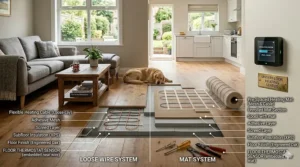
Room size: Under 10m² (bathrooms, utilities)—use pre-formed mats. Larger or irregular spaces—consider loose-lay cables for custom layouts.
Floor construction: Concrete subfloors need insulation boards (6–10mm). Timber floors require joist spacing assessment. Critical question: can you afford 15–20mm floor height increase?
Power requirements: 150W/m² suits well-insulated modern homes. For conservatories or poorly insulated spaces, use 200W/m² variants. Simple calculation: room area × 80W/m² (modern) or 120W/m² (older properties) = target wattage.
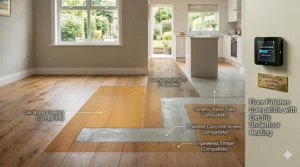
Floor coverings: Ceramic/porcelain tiles ideal. Natural stone excellent. Vinyl/laminate suitable if UFH-rated. Carpets work if combined tog ≤2.5.
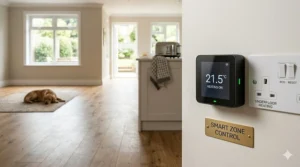
Thermostat selection: Basic programmable (£30–£40) provides 7-day scheduling. WiFi smart thermostats (£40–£80) add remote control, energy monitoring, learning features. Smart controls typically pay for themselves within 18–24 months through reduced consumption.
Installation Costs Breakdown
| System | Area | Supply | Installation | Total |
|---|---|---|---|---|
| Budget | 4m² bathroom | £90–£140 | £150–£250 | £240–£390 |
| Mid-Range | 10m² kitchen | £350–£550 | £300–£450 | £650–£1,000 |
| Premium | 20m² open plan | £800–£1,200 | £500–£750 | £1,300–£1,950 |
| Whole House | 60m² ground floor | £2,400–£3,600 | £1,200–£1,800 | £3,600–£5,400 |
Includes mats, thermostat, insulation, labour. Floor covering priced separately.
Common Installation Mistakes to Avoid
Insufficient insulation: Without proper insulation beneath mats, 30–40% of heat disappears downward. Always use 6–10mm boards with thermal resistance ≥1.25 m²K/W.
Incorrect sizing: Measure accurately, exclude permanent fixtures. Drawing scaled plans helps visualise placement.
Cable damage: Never use sharp tools directly on mats. Always test resistance before and after installation.
Rushing curing: Follow manufacturer curing times—typically 21–28 days for screeds, 7–14 days for adhesive. Early activation risks expensive damage.
Poor thermostat placement: Position at 1.5m height on internal walls away from draughts, sunlight, or heat sources.
DIY electrical work: Violates Part P regulations. Always engage registered electricians for connections and certification.
Smart Controls for Maximum Efficiency
Programmable scheduling: 7-day programming with multiple daily periods cuts consumption by 30–40%. Set bathrooms to warm before morning showers, reduce during work hours.
WiFi connectivity: £40–£80 smart thermostats deliver exceptional value through remote access. Unexpected early return? Activate heating via smartphone 2 hours before arrival.
Voice control: “Alexa, set bathroom to 24 degrees” provides genuine convenience when juggling tasks.
Learning algorithms: Premium thermostats observe patterns and automatically optimise schedules. £20–£40 additional cost typically recovers within 18–24 months.
Open window detection: Automatically cuts heating when rapid temperature drops detected—brilliant for British homes where “airing out” is common.
Energy monitoring: Real-time consumption data helps identify wasteful patterns, encouraging efficient usage.
Room-Specific Recommendations
Bathrooms: Perfect application for electric UFH. Small size (3–6m²) means manageable costs. Quick 30–45 minute warm-up suits morning routines. For 4m², expect £90–£120 annually. Consider 200W/m² in larger bathrooms with external walls.
Kitchens: Open-plan kitchen/diners benefit from invisible heating leaving walls free for cabinetry. Larger area (12–20m²) requires careful scheduling. Heat during breakfast/dinner preparation; reduce midday. For 15m² operating 6 hours daily, budget £1,200–£1,400 annually.
Conservatories: High-heat-loss spaces challenge any system, but 200W/m² performs admirably. Enhanced power compensates for glazed walls/roof. Pair with substantial insulation and modern double/triple glazing. For 20m² using 4 hours daily, expect £1,600–£1,800 annually.
Living rooms: For main spaces over 20m², wet UFH usually makes more financial sense due to lower running costs. Electric remains viable if wet systems aren’t feasible. For 25m² operating 8 hours daily, costs approximately £2,000–£2,200 annually.
✨ Don’t Miss These Exclusive Deals!
🔍 Take your electric underfloor heating to the next level with these carefully selected products. Click on any highlighted item to check current pricing and availability on Amazon.co.uk. These tools will help you create authentic warmth your family will love!
Maintenance and Troubleshooting
Electric UFH requires virtually no maintenance—no pumps to service, no valves to bleed, no corrosion. Simply verify thermostat batteries remain fresh and occasionally clean dust from vents.
Common issues:
Floor not heating: Check circuit breaker, thermostat wiring, floor probe, and thermostat settings (heat mode active, schedule running, target exceeds current temperature).
Uneven heating: Suggests cable damage or inadequate insulation. Thermal imaging identifies break locations. Additional insulation may be necessary.
High costs: Investigate insulation deficiency (most common), programming errors, probe faults, or unrealistic expectations (electricity costs more per unit than gas).
When to call professionals: Electrical faults, cable breaks, unusual smells, visible damage, complex networking issues. Most UK suppliers maintain excellent telephone support.
Frequently Asked Questions
❓ What is the typical lifespan of electric underfloor heating systems in UK homes?
❓ Can electric underfloor heating be retrofitted into existing UK homes?
❓ How do running costs compare with traditional gas radiators?
❓ Does electric underfloor heating increase UK property values?
❓ What floor coverings work best with electric underfloor heating?
Conclusion: Is Electric UFH Right for Your UK Home?
Electric underfloor heating excels in specific applications: bathrooms, en-suites, kitchens, utility rooms, and spaces under 15m² where quick installation, low upfront costs, and rapid heat-up compensate for higher running costs. The invisible heating, freed wall space, and luxurious warm floors justify investment for many UK homeowners.
With quality kits from Nassboards, ProWarm, or Warmup available from £90–£250 for typical bathrooms, and smart WiFi thermostats from BEOK or KETOTEK adding sophisticated control for under £50, the technology has never been more accessible.
For larger whole-house installations, carefully weigh running costs against wet alternatives. At 2026 UK energy prices, annual electric system costs can exceed wet systems by 50–100% in larger spaces. However, if you’re renovating single rooms, undertaking phased improvements, or facing constraints making wet systems impractical, electric UFH delivers genuine value.
The 2026 regulatory landscape favours underfloor heating. Building Regulations Part L emphasis on energy efficiency, zonal control, and lower operating temperatures aligns with UFH’s strengths. Start with rooms where electric UFH shines—that cold bathroom, the kitchen disrupting cabinetry layouts, the unused winter conservatory. Experience the transformation, then evaluate extending to additional rooms.
Recommended for You
- 7 Best Smart Radiator Valves UK 2026 | Save £150+ Yearly
- 7 Best Tado Smart Thermostat Options UK 2026
- Hive vs Nest Comparison: 7 Best Smart Thermostats UK 2026
Disclaimer: This article contains affiliate links. If you purchase products through these links, we may earn a small commission at no additional cost to you. Prices shown are approximate and may vary.
✨ Found this helpful? Share it with your mates! 💬🤗
